The @TryRamp top vendors list is our favorite list to be on because it's one of the few 'real' benchmarks out there. This is our second time on it. A year ago, it was @Stedi alongside a bunch of other SaaS and a few AI companies. Now, we're the first non-AI company to be on the list in 5 months.
There is still an enormous market for API-first, network-based SaaS – agents need efficient and reliable ways of connecting to the otherwise-illegible real world (in our case, we handle connectivity to 3,500+ different healthcare insurance companies for claims processing) – but building a defensible business in these categories is a huge investment of time and capital. Nine years in, we're growing faster than ever. We're hiring across many roles – engineering, design, product, GTM, legal, ops, recruiting, and more. If you're looking to be a part of something special for the long term, drop me a note.
Had a great time at @AWSEvents re:Invent talking about the @Stedi agent. We built and launched the first version in <2 weeks using Bedrock AgentCore – from talking to other founders, it seems that AgentCore is one of the best kept secrets in software (hopefully not for long).
You can read the full announcement on our blog, but I thought I'd editorialize a bit more here and tell more of the backstory of what happened over the past 18 months.
In late Feb 2024, I brought our engineering team into a war room. Change Healthcare – the nation's largest clearinghouse for processing healthcare claims between providers and insurance companies – had been down for almost a week due to a cyberattack that would ultimately take them out for 2 months.
It’s hard to explain the magnitude of the outage to people outside the healthcare industry. Nearly 40% of healthcare claims processed in the United States flowed through Change’s platform. They processed an aggregate $1.5 trillion of claims volume annually – 15 billion claims in total. Healthcare spend in the US is $4.9 trillion annually – 18% of total GDP – which means that when Change went down, it was processing roughly *5.5% of US GDP*.
We worked around the clock to launch our drop-in replacement for their clearinghouse, which we did 5 days later. We were in the right place at the right time, but so were a lot of other people – this didn't exactly happen in private. We were able to do this because we had spent the previous 6 years building the underpinnings of a platform that could power a clearinghouse.
It's funny because by February 2024, we had what we thought was product market fit – our EDI processing platform was used across retail, logistics, healthcare, and more. We had plenty of customers, but even with all of the work that we had put in to make our EDI processing platform easy to use, it still took weeks or months for companies to get up and running, because each connection had to be set up one-by-one. Customers were willing to put in the work, but it was still a far cry from what I had set out to do from the earliest days.
I always loved Uber's original mission statement: 'To provide transportation as reliable as running water, everywhere, for everyone' (its current mission statement – 'To reimagine the way the world moves for the better'– is watered down corporate nonsense). My goal was similar: to make business-to-business transactions as reliable as running water.
In our January board meeting, I said that our plan for the back half of 2024 was to finally move another level 'up the stack' and to offer turnkey transaction functionality in healthcare – the only place where it's currently possible to do so, thanks to regulatory-enforced transaction schemas and robust network of interconnectivity – by building a clearinghouse.
It became clear a few days into the outage that Change wasn't coming back online anytime soon, or perhaps ever. We accelerated our plans and launched over the weekend.
It was pandemonium. For the seven weeks after launch, I couldn't leave my keyboard for more than five minutes at a time – most days from 4:30 or 5am until midnight. Six/seven figure deals went from initial phone call or text message to signed terms in under an hour. A couple of weeks in, I went for a quick walk to get outside, and took three phone calls from CEOs and CTOs who were desperate to get back online. We sent people to their offices and had them integrated and processing claims within hours.
It's strange to tell this story now because our world was almost entirely about the Change Healthcare outage for a couple of months last year, and we've hardly thought about it since. They eventually came back online and the dust settled. None of our customers who signed and went live switched back. But at the same time, Change stopped hemorrhaging customers – the companies who were going to jump ship, jumped ship.
Yet our growth has only accelerated. Last month, we signed 5x the number of customers that we signed at the height of the Change outage. Stedi has become the de facto choice for virtually every new venture-backed health tech company – and as later-stage health tech companies and traditional institutions revisit their legacy clearinghouse dependencies in the wake of the Change outage, Stedi’s cloud-native, API-first platform has become the obvious choice.
But more and more, our growth is driven by GenAI use cases from all segments of the market – from brand new startups to traditional companies coming to Stedi to build agentic functionality into their existing platform. One-third of our customer base is now made up of fully-native GenAI companies.
Development teams hit frustrating roadblocks with legacy clearinghouses. The legacy clearinghouses were built pre-cloud computing (and in many cases, pre-internet), and most are the result of a series of private equity acquisitions with tech stacks that were never harmonized or modernized. They offer only the bare minimum of hopelessly outdated APIs – most of the functionality offered by legacy clearinghouses is not accessible programmatically.
Stedi’s approach is API-first: every piece of functionality available through our user interface is available via API. Our thesis is simple: as more and more aspects of software are subsumed by agentic workflows, companies will shift ever-greater portions of their workloads to the platforms that offer the best accessibility and legibility to AI agents that are performing actions; since other clearinghouses don’t offer ways to perform tasks programmatically, customers will continue to migrate to Stedi as they build net-new workflows, or as they find that existing workflows come to exceed the requirements afforded by other clearinghouses.
We have a single question that we use to guide our roadmap decisions: does this make it easier for humans and agents to interact with our platform? This has dozens of small improvements alongside bigger launches – notably our MCP server last week and our own native agent yesterday.
Venture capital is a wonderful thing – it would not have been possible to spend 6+ years building a platform without it. This latest funding allows us to accelerate hiring of world-class talent across engineering, product, design, business operations, and more.
If that sounds exciting to you, send me a note.
I told investors from the first day in 2017 that it was going to take a very long time, but once it started working, we would be impossible to catch. 4.5 years to launch our first APIs, +2.5 for the full platform, and +1 to now be one of the fastest-growing software vendors.
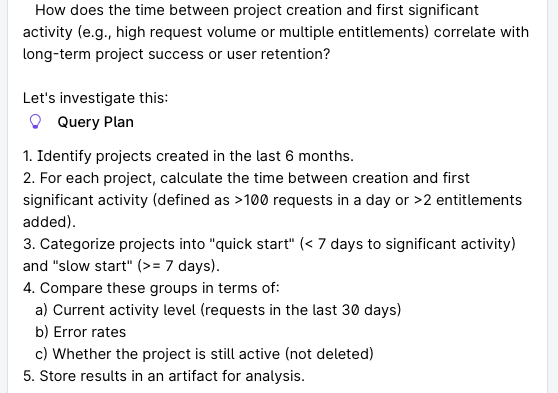
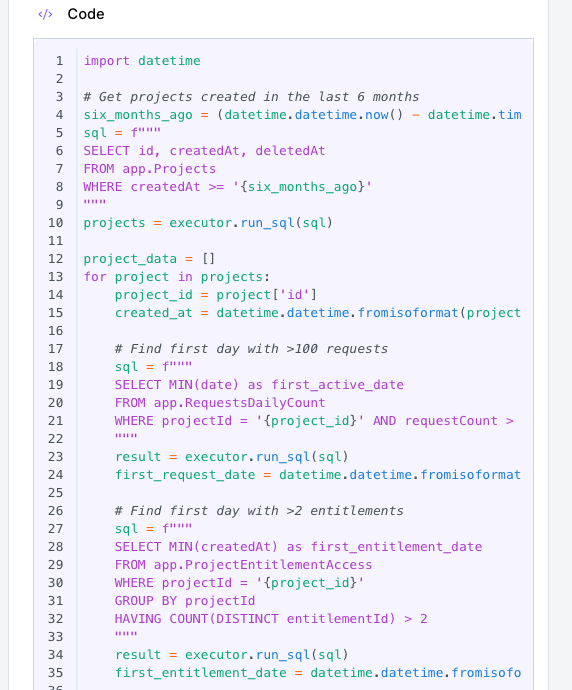
I've been playing with a new tool that pairs LLMs with data sources in an Agentic data access pattern called PromptQL from @HasuraHQ. It's a very interesting way to explore and utilize your data, and not just by your data science folks! https://t.co/H2Hk0gMT7K
@adamdotdev Wasn’t a farmer, but in my early teens I spent a couple summers working corn fields in Indiana. Decided I was going to do computer things somewhere in those fields.
I've always been a huge fan of @ShortJared's opinion on developer tooling so I took @HasuraHQ's PromptQL playground for a test drive last night.
https://t.co/cAblaDe9th
I have some plans to play around and build some more interesting things and write about it, but until then you can play around with it too here: https://t.co/y1Yn23IVqj
Neat to see PromptQL go public! I've been playing with it for a little bit now and working with the team to give feedback. Being able to wire in disparate data sources and ask all sorts of questions and get answers has been very neat. Even questions about what questions to ask!
Hot take: AI Assistants are failing us
Despite the buzz, closed-domain AI assistants are falling short. Without reliable, context-aware responses, they’re not ready for serious business use.
Where AI Assistants Fail
Here’s a scenario from a well known sales assistant that’s out there today:
📊 User Query: “What’s the length of my average sales cycle?”
➡️ Assistant Response: “I calculated the average sales cycle length for your opportunities, but there are no results to show.”
The assistant can’t perform a computation. Why? Let’s break it down.
🛑 The Issue: Closed-domain AI assistants rely heavily on search-first RAG methods, making them unsuitable for high-trust applications.
Consider a task like “Find all emails from last week that need follow-ups.” A search-based AI might skip important messages if they lack specific keywords, leaving critical follow-ups unnoticed. When this incomplete data is passed to the language model, the result is unreliable, making these assistants ill-suited for nuanced business queries.
✅ The Solution: Agentic query planning. Instead of rigid keyword search, assistants should gather all relevant emails and then use an LLM to classify follow-ups—just as a person would—ensuring accuracy.
That’s why our AI lab built PromptQL - an agentic, data access API for your AI!
Here’s a look at what we’ve been up to ⤵️
One of the nice parts is PromptQL explains the steps it took in code, so you can understand exactly what it did to get to the answers it gives you. If you notice any problems or mistakes, like an LLM it accepts coaching pretty well to improve things / iterate.
Anyone know how much of our computing power and energy goes into updating / training weather models? Seems like surprise rapid intensification to cat 5 indicates we have big gaps in the models. (I know nothing about this space, curious for resources to learn more)