Cisco Officially Validated my transition into Cybersecurity.
Find my proof attached🥳
Intro to Cybersecurity ✅
Networking Basics ✅
Endpoint Security ✅
Networking Device and Initial Configuration ✅
Network Defense ✅
Cyber Threat Mgt ✅
See you at the top
Ahead Ahead💻🛡️🔐
Day 4️⃣ of 10 Days of Cybersecurity (4th round)
I have finally completed the Endpoint Security course on the Cisco Junior Cybersecurity Analyst Pathway 🎉🎉
The future of cybersecurity isn't preventing every attack. It's assuming attackers will eventually get in.
That's why concepts like "Zero Trust" matter.
no user, device, or application is trusted by default. Every access request must be verified.
Never trust. Always verify.🔐
Milestone Unlocked! 🎯
I’m excited to share that I have successfully completed the Ethical Hacker course with Makatob IT Securities and received my Certificate of Completion
This training strengthened my practical understanding of penetration testing methodologies, including reconnaissance, scanning, enumeration, exploitation, and post-exploitation activities in lab-based environments.
Beyond the technical skills, this phase helped me better understand how vulnerabilities are discovered, analyzed, and mitigated from both an attacker and defender perspective.
Grateful to my instructors, and the entire Makatob team for their guidance, and to my fellow learners for the shared experience.
Next up: CyberOps and deeper focus on security operations.
#Cybersecurity #EthicalHacking #Infosec #SOC #ContinuousLearning
Testing my knowledge is one of my favorite parts of learning. Every quiz is a chance to see how much I’ve understood and where I can improve. Learning,Testing,Improving.
Finally done with Nmap module
Learnt how to maintain stealth while evading a firewall/IDS
Understood the difference between the diff types of Scans (-sS -sA -sT) when and when not to use them
Most importantly my documentation was solid so I can always come back
Been quiet on here, but never stopped learning. Recently completed Unit 1 of the Certified Ethical Hacker (CEH) course on @coursera by Pearson. Covered the Cyber Kill Chain, ethical hacking, security controls, laws, standards, and pentest planning. 7 units to go. Let's get it.
Day 27/182 of Ethical Hacking Internship at ICDFA
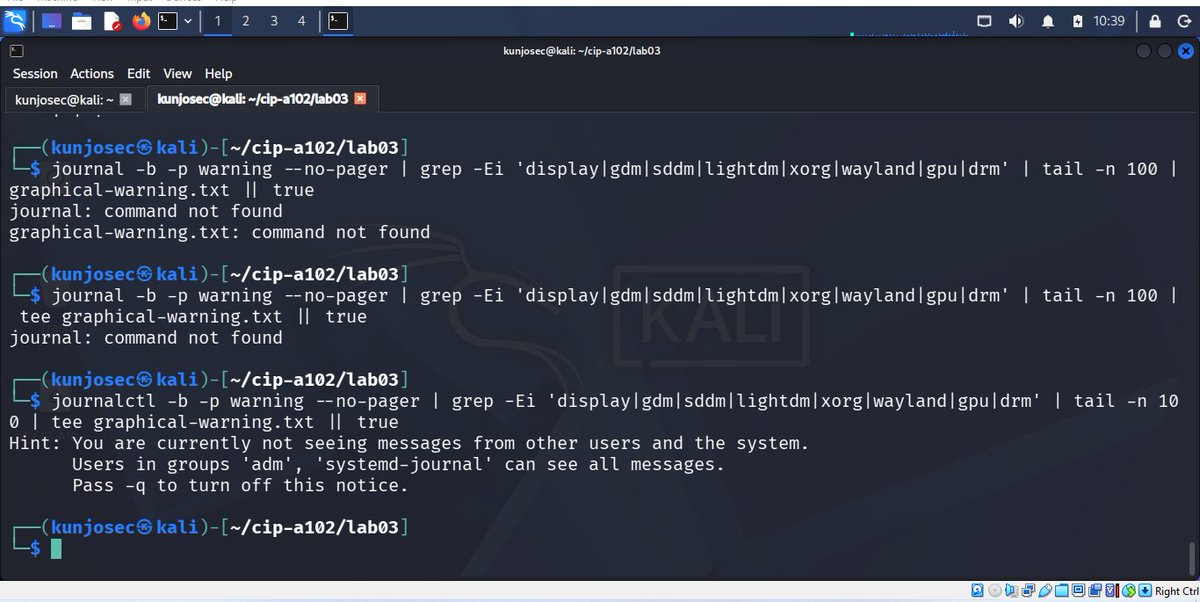
Today, I completed Lab 3, successfully solving 5 hands-on tasks focused on Linux system inspection and troubleshooting.
The lab covered:
✅ Creating a script to inventory active sessions – Gathering information about users currently logged into the system.
✅ Inspecting the display manager – Examining the service responsible for managing graphical logins.
✅ Inspecting the boot target – Identifying the system's current boot target and understanding how Linux determines its startup mode.
✅ Reviewing graphical logs – Analyzing system logs to identify warnings and issues related to the graphical environment.
✅ Developing a non-destructive recovery plan – Planning safe troubleshooting steps that preserve system integrity and avoid unnecessary changes.
@_DeejustDee@ireteeh@segoslavia@sudosheggs@Cyberhijabitech
🚀 Excited to share that I’ve been selected for the ShadowFox Virtual Internship Program!
This 1-month experience (Aug 1 - Aug 31) will give me the opportunity to work on real-world cybersecurity projects, strengthen my hands-on skills, and continue building toward a career in security.
Looking forward to:
- Gaining practical experience
- Solving real-world challenges
- Connecting with other learners in the field
No better way to keep the momentum going.
#Cybersecurity #Internship #LearningByDoing #ShadowFox #InfosecJourney
So :
✅Ubuntu Server installed ✅ SSH from Kali working ✅ Host-only network discovered and configured ✅ Ubuntu got a stable 192.168.56.x address ✅ Splunk Enterprise installed ✅ Fixed the root ownership mess ✅ Splunk Web running on port 8000 ✅ Kali can reach Splunk
Back to learning.
My Cybersecurity Journey: from Interest to Impact.
I continued from where I stopped, and I learned about subnetting.
Subnetting is the process of taking one large network and dividing it into several smaller, organized groups called subnets.
Gn mutuals🥰
Day 2/100
Today I realized 644 and 755 aren't just random Linux numbers, they're Linux file permissions. Ran my first SUID audit, which showed me how permission mistakes can lead to privilege escalation. Also started OverTheWire Bandit (Level 0- 1).
#100DaysOfCybersecurity#Linux