Science published our letter proposing that China’s government should better report the collection and use of its restoration fees to ensure the money is used as intended and the offset ecosystems are suitable substitutes for those that have been degraded.
https://t.co/r1joEjhFZo
Important new paper from Hannah Thomas & Fei Chung with a critique of Australia’s attempt at nature positive reforms: Achieving “nature positive” requires net gain legislation https://t.co/p2d7WNx5Bz @UQ_CBCS @UQscience @j_r_rhodes@J_Simmonds_AUS@BrookeWEcology @manammichelle
Sharks are older than the dinosaurs and yet their populations – and those of their close relatives, rays – are in rapid decline.
Marine conservationist and Oxford DPhil student Trisha Gupta (@Trisha_0405) is taking action to protect them.
Read her story on #WorldAnimalDay ⬇️🦈
Conservation is as much about working with people as it is about nature and wildlife...
"I think social justice is deeply intertwined with conservation."
Prof. of Biodiversity @EJMilnerGulland explains....
@ConservOptimism#Conservation#Biodiversity
https://t.co/5luuxjSSS4
Super primer on the #ecological, #financial and #institutional risks and uncertainties around #NaturePositive, and how they might be addressed. Very wide-ranging but with a lot of depth to the analysis too, I really enjoyed reading it! @CSIRO https://t.co/nera9KdIEI
Really proud to be associated with this paper led by @hollieboothie on how businesses can think about transformative change in the context of #NaturePositive, lots of helpful tips and examples https://t.co/0UMOPji6bf
🚨Cultural attributes such as values, meanings, and norms shape our interactions with land 👩🌾💚🌻. Our latest #paper on #Culture's influence in #LandSystems, co-authored by @rach_garr and @Yann_le_Polain, is published in @NatureSustainab. Check it out: https://t.co/2GlS7WuLit 👈
We is excited to announce the #ConservationOptimism Youth Blog series launching in July!
Want to be featured?
Simply fill out our questionnaire by May 31st & share your insights on youth engagement and conservation efforts here:
https://t.co/cbR6UVwtjP
Highly recommend this program! Fully funded for Global South countries applicants. I am the alumni, can keep in touch if you want to know more abt this amazing course!
What can you expect from a role with ICCS?
✅Varied, interesting work
✅Lovely community
✅LOTS of learning opps including seminars, group discussions + research group coffee mornings
✅Supportive colleagues
✅Picnics, pizza + lots of cake
Apply now: https://t.co/UTd91PZNMF
New paper! Sharkey et al. present a framework for understanding participatory approaches to protected area law enforcement that can be used for framing discussions and facilitating clear communication between people living in and around protected areas: https://t.co/F86OJ27ELJ
I'm so excited about this! Previous #ConservationOptimism summits have been inspiring, enlightening and heartwarming. See this short video to get a flavour https://t.co/4V3zQdK4ss. We're actively searching for funding to bring people from around the world. Hope you can join us!
Today, we have lost one of the greatest contemporary thinkers.
Daniel Kahneman shattered the glass palace of science and became famous worldwide in 2011 with the publication of "Thinking, Fast and Slow”, in which he popularized the dual-process theory. This theory suggests that human decisions arise from a complex interplay between two cognitive systems: one more intuitive and the other more deliberative. Despite many critiques and refinements, this theory remains one of the main reference points for scholars studying human decisions.
But this was not Kahneman's only contribution. His 1979 paper in Econometrica, introducing prospect theory, is one of the most cited articles in economics and is one of the main reasons he, a psychologist, was able to win the Nobel Prize in Economics. In this paper, Kahneman and Tversky introduce a utility function aimed at explaining how people make decisions under risk. Personally, I found this article to be one of the most inspiring I have ever read. The day I read it, I understood that human behavior could be captured through a mathematical formula. I was a pure mathematician at the time, now I study human decisions.
In another article from 1986, Kahneman, Knetsch, and Thaler introduced an economic game that later became known as the “dictator game”, which has become the official measure of human altruism. The game is very simple: you have 10 dollars and the recipient has nothing. You can give any amount to the receiver, ranging from 0 to 10. The recipient is passive and only gets what you decide to give. How much would you give?
But this is not even the tip of the iceberg. Any summary of his work would inevitably be incomplete. I have just gone on his Google Scholar page. His work has more than half a million citations! He reshaped psychology and economics by inventing entirely new fields of research.
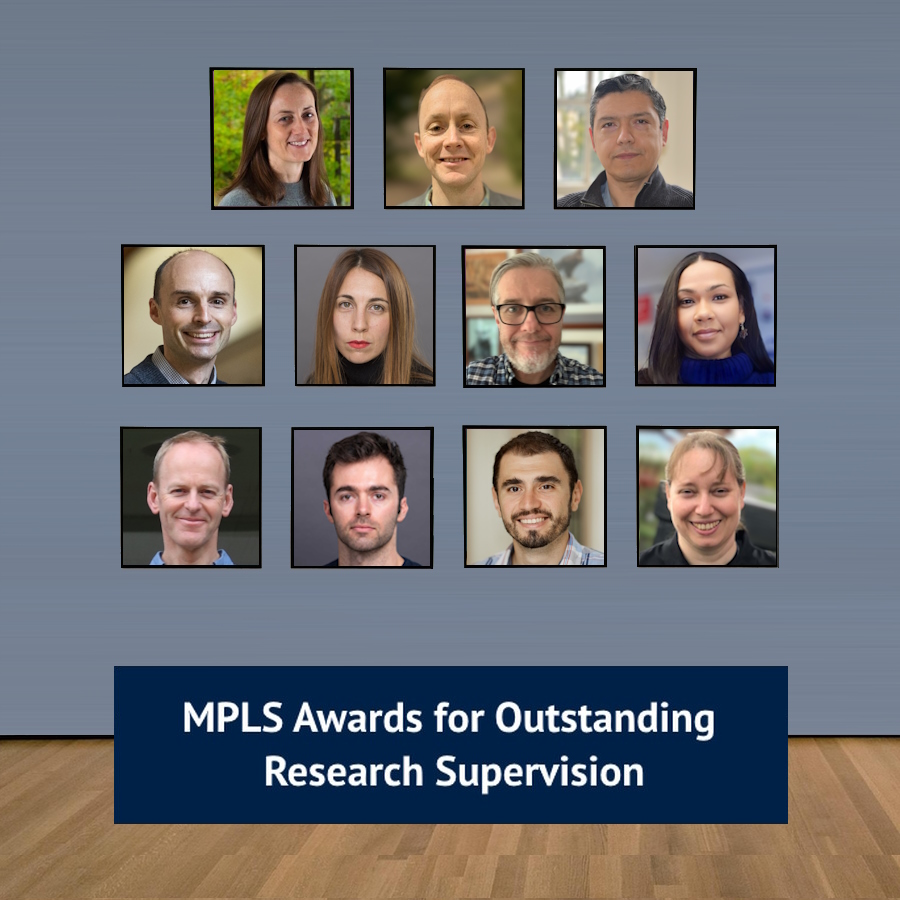
👏 Congratulations to the winners of the MPLS Awards for Outstanding Research Supervision!
Eleven of our brilliant divisional academics are recognised today for their inspirational leadership and unwavering support of their colleagues.
Read more at: https://t.co/syob0RT3yS