Proud to have partnered with @_anishkaran from day 0 on Sol. 🚀
What they’re building is the obvious next step for AI: an agent that actually finds the work, gets it done, and comes back to you for approval.
Once you try Sol, it’s hard to go back to doing all of this yourself.
Can’t wait for more people to experience it.
https://t.co/RpaWZADLla
@generalcatalyst
The obvious is missing.
So we built Sol - https://t.co/ph4XsBV5b5
Sol finds the work itself, does it, and comes back for your approval.
Every day in our emails we say "I’ll share”, "I'll review”, "I'll get back" - then repeat the exact same thing to an AI. Why?
Sol finds everything you said you’d do & gets them started for you.
It does the research, creates the doc, builds the slides, finds the time, connects the dots across multiple emails, doing everything it takes to get the job done - but doesn’t send, schedule, or share anything until you approve.
Sol runs on its own computer, uses a browser, and has a library of skills that automatically get assigned to the work that needs to get done. No setup. It just starts working.
We've raised $4M from General Catalyst, Nexus Venture Partners, DeVC, PeerCheque, Kunal Shah, and a few others.
Extending early access now.
@generalcatalyst@nexusvp@DeVC_Global@peercheque@neerajarora@b_jishnu@kunalb11@miten@RTinkslinger@Rahul_J_Mathur@AkarshS27@SiddhantD06@RajatAgarwal167
Looped transformers perform silent, iterative refinement in an internal vector space, letting the model spend more computational steps on complex logic puzzles or math problems. They offer a way to scale reasoning capacity up without a proportional increase in physical model size or RAM required for storage.
I get the memory size and Parameter size argument for Looped Transformers, but running multiple passes through smaller blocks of neural nets might have impact on compute costs ?
Looped transformers are a popular architecture topic right now.
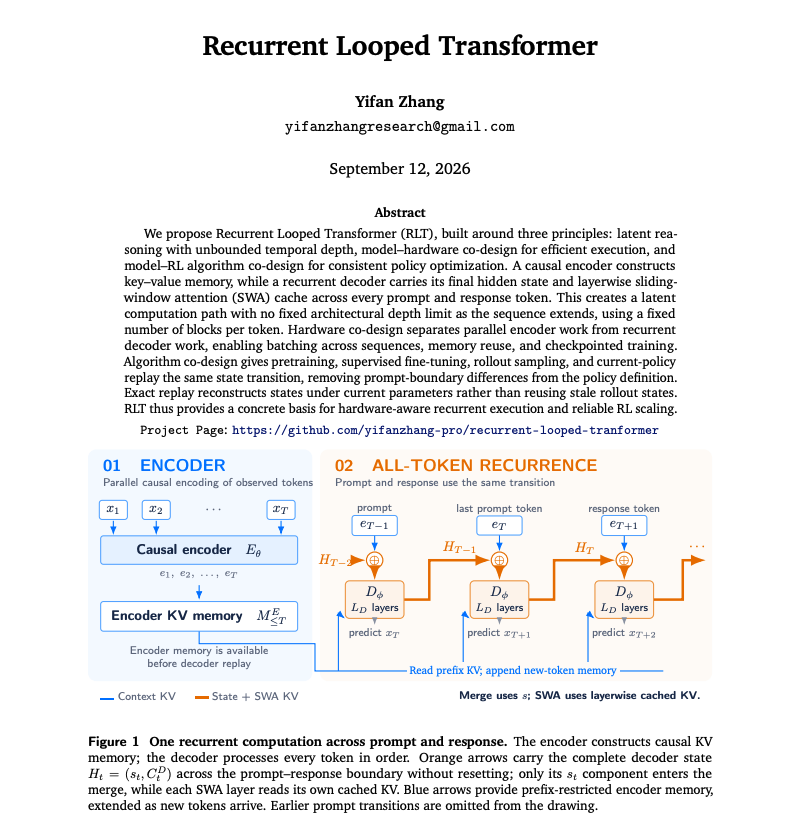
This new technical report extends the loop across tokens.
Recurrent Looped Transformer (RLT) makes the decoder recurrent over every token, prompt and response included.
A causal encoder builds global KV memory. For each new token, the decoder combines the token's encoder representation with its own final hidden state from the previous token and a sliding-window cache of recent activations.
With a 48-layer decoder, the computation path after t tokens runs through 48t decoder blocks, while each token still executes a fixed number of blocks. Depth grows with the sequence and per-token cost stays the same.
The same state transition is used for pretraining, SFT, sampling and RL replay, and nothing resets at the prompt-response boundary. RL replay rebuilds states under the current weights instead of reusing stale rollout states.
The report is a design proposal. The author states that reasoning gains, hardware speedups and RL scaling are goals that have not been measured yet.
Paper: https://t.co/rSSuuWijR3
Chat with Paper: https://t.co/fVDQaGdfpX
After co-inventing ChatGPT, I kept asking myself: why have superhuman chat models not led to AGI?
I’ve spent the last 2 years in stealth building a new way to train models (RLCD), and a new type of frontier AI model that we are releasing today: Jev
• 20-200x faster
• 40-400x cheaper (w/ output tokens free)
• Frontier composable intelligence optimized for decisions
AFAICT the shortest path to AI-based economic revolution
Banger paper from NVIDIA on shared memory for research agents.
(bookmark it)
If you run several coding agents on the same research problem, this design keeps them from repeating each other's experiments and lets each agent build on results the others have already verified.
Agora records every result, hypothesis and verification as an immutable Git commit.
Parent edges show what each claim builds on, and an index lists open branches and which claims have been verified.
They ran 13 LLM workers for nearly 12 days without assigned tasks or a central planner. The workers had to initialize a 119.6M-parameter hybrid model from 141 donor models without training data or gradient updates.
The workers posted 1,703 contributions.
They cut the evaluator from 3.39 to 1.899 bits per byte, closing 62% of the gap to a trained GPT-2 124M. All 165 independent reproductions succeeded.
Paper: https://t.co/IujsIvVeUO
Chat with Paper: https://t.co/yf5P8GgnJo
Super interesting, if RSIAgents update memory and context instead of weights, would this be inferior/superior method compared to continual learning. The debate then becomes which agent performs better, "context steered agent" or "behaviourally changed agent" 🤔
Can an agent explore a new environment, learn its causal structure, and keep improving without updating its model weights?
We introduce RSIAgent, a framework for recursive self-improvement through autonomous exploration. Using Kimi-K3 and GLM-5.3 as base models, RSIAgent outperforms GPT-6 Astra on both OSWorld 2.0 and Agents’ Last Exam.
RSIAgent decides what to explore, executes tasks, verifies outcomes, and consolidates stable action-condition-outcome relationships into memory for future use.
With the underlying model weights fixed, RSIAgent achieves:
- 78.98% Partial Score on OSWorld 2.0 (0808 offline), compared with 72.60% for GPT-6 Astra
- 84.82% on Agents’ Last Exam (Near-term), compared with 82.26% for GPT-6 Astra
We call this Scaling Experience. Agents can continue improving by acquiring, verifying, and reusing their own experience while the underlying model weights remain fixed.
Links in the reply below.
What happens when you put some of Bangalore's sharpest tech minds in a room with the team behind one of the most interesting RL x coding companies right now? We're about to find out!
@generalcatalyst and @ProximalHQ are hosting an evening featuring curated research presentations, a deep dive into the FrontierSWE benchmark, and an open conversation on reinforcement learning and coding agents with the co-founders of Proximal @MatternJustus and @calvinchen.
We've designed this as a focused evening for people who share a passion for the frontier of software engineering and AI. Seats are limited and we'd love to have you there. Luma link in the comments below!
.@maitreya_wagh and @xan_ps watched voice AI demos work perfectly in labs, then break in Mumbai call centers: customers code-switching mid-sentence, connections dropping, reality exposing every edge case.
They'd seen this pattern before—Maitreya shipping products at Datamuni and Bain, and Prateek scaling infrastructure at Zomato and Atlassian. So they built @bolna_dev to work in the complexity of enterprise environments.
India runs on a billion business calls daily. Most are still manual, expensive, fragile. Bolna built an orchestration layer that lets enterprises deploy multilingual voice agents at scale, without vendor lock-in or brittle systems.
Their platform already handles thousands of concurrent calls. Customer service reps now manage escalations while Bolna handles routine queries in Hindi, English, and Hinglish without dropping connections.
We're backing Maitreya, Prateek, and the Bolna team from day one.
More from @neerajarora, @yuris, @AkarshS27, and @SiddhantD06: https://t.co/xGvektqJay