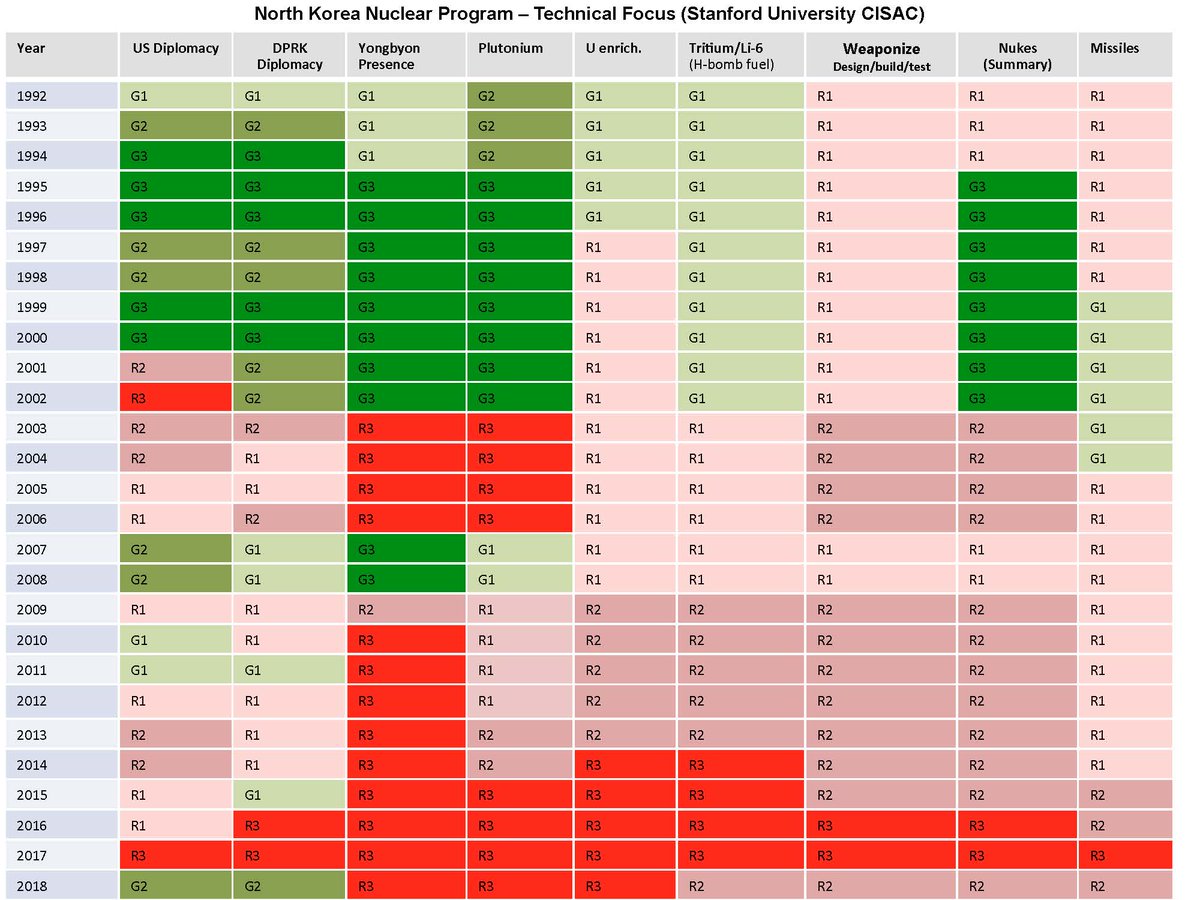
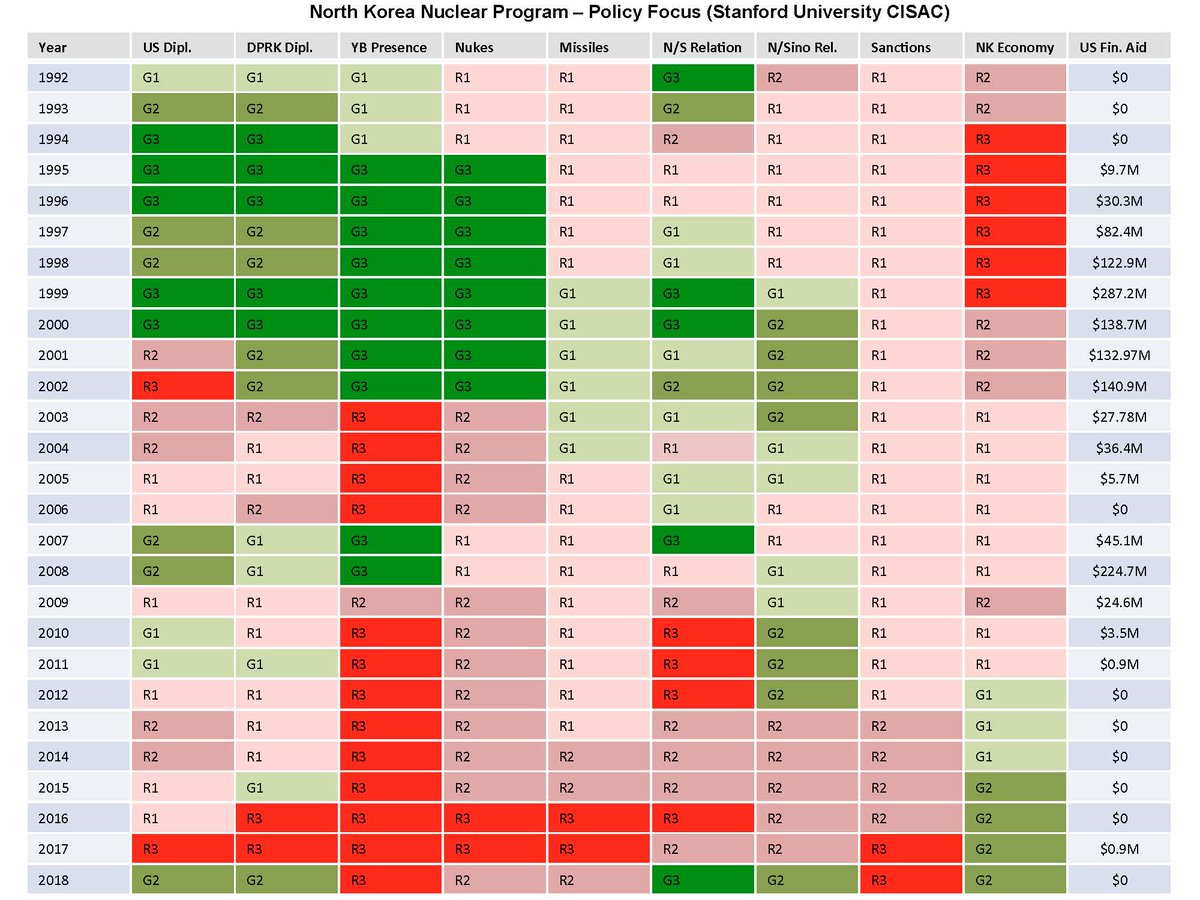
My @StanfordCISAC colleagues Robert Carlin, @easerbin, and I have completed the 2018 update to our color chart study of #NorthKorea's #nuclear history.
2018 Update: https://t.co/V53wirt2MF.
Original report: https://t.co/QNHUK5owur
My latest with Bob Carlin in the @TheWorldPost on the danger that Washington and Pyongyang may let the current window of opportunity pass them by: https://t.co/LH8jcfoJc2
The role that #nuclear power could play globally to mitigate the effects of #ClimateChange continues to be debated. In this @BulletinAtomic series, we present perspectives on the future of nuclear power from Russian and American young professionals.
https://t.co/4YSO98OBGd
Start with the introduction by @SiegfriedHecker and Alla Kassianova: "The future of global #nuclear power through the eyes of young Russian and American professionals" cc: @FSIStanford Read it here: https://t.co/5IPG1xvxD0
New interview: @SiegfriedHecker is an American nuclear scientist & was director of @LosAlamosNatLab from 1986 to 1997. He discusses his time at Los Alamos, the importance of US-Russia collaboration during the 1990s and 2000s, & his trips to North Korea. https://t.co/lNAgAftRXW
While it is important to examine what went wrong in Hanoi, a myopic focus on President Trump’s inability to strike a deal overlooks the larger picture: Both sides are still at the beginning of a fundamentally long-term process. https://t.co/tdFzUg8l86
Regarding #HanoiSummit, I'm disappointed but still optimistic. Disappointed because opportunity to take concrete steps toward denuclearization/ normalization was missed. Optimistic because Trump and Kim did not return to ‘fire and fury’ days of 2017. They left Hanoi on good terms
So…what happens now?
@draylien, @SiegfriedHecker, and Gi-Wook Shin share their thoughts following the sudden end of the #HanoiSummit:
https://t.co/vSfg2FnqBw
Robert Carlin, my @StanfordCISAC colleague and a co-author of the report, assessed recent developments yesterday with @camanpour @pbs: https://t.co/1ObnL1UMcZ
U.S. experts conclude that North Korea may have produced material for 6 more nukes in 2018, on top of the 30 it already had. But they say the threat of its program decreased overall. https://t.co/ycSvrJ0aDP
The article builds on our recent update to the denuclearization framework and comprehensive study of #NorthKorea's nuclear history that we published last year:
https://t.co/V53wirt2MF
.@SiegfriedHecker, Robert Carlin, and Elliot Serbin review where we stand ahead of the upcoming Trump-Kim summit on #NorthKorea in this op-ed @washingtonpost : https://t.co/CXvowmXu1F…
My latest in @TheWorldPost, with Bob Carlin and @easerbin, assesses the status of #NorthKorea's nuclear arsenal and the state of affairs on the Korean Peninsula heading into the #TrumpKimSummit https://t.co/UsjmIaCxyp
Ahead of Kim-Trump II, interviews with leading U.S. experts and an analysis of statements by top officials have identified a common refrain: The focus of that meeting has shifted. https://t.co/Weu1Ktb5x0
“Ahead of the Trump-Kim summit next week, the prevailing view in the U.S. is that North Korea expanded its nuclear program in 2018 despite pledging to do the opposite. But our findings paint a different picture.”
—@SiegfriedHecker in @TheWorldPost https://t.co/Yngh4yWkMU
My @StanfordCISAC colleagues Robert Carlin, @easerbin, and I have completed the 2018 update to our color chart study of #NorthKorea's #nuclear history.
2018 Update: https://t.co/V53wirt2MF.
Original report: https://t.co/QNHUK5owur
Cooperative conversion, where North Korea, South Korea, and the US explore cooperative efforts to demilitarize the North Korea's nuclear/missile programs and convert them to civilian uses, can improve verification and possibly accelerate the timeline: https://t.co/HJHOfLcg4Y