If Ebola becomes a pandemic, it will be in no small part because millions of people now view public health measures as oppression rather than the most basic infrastructure of a functioning and sustainable civilization.
Pete Buttigieg gets asked how a left-leaning person in a deep red county can convince their neighbors that they love America just as much as they do.
His answer: 💯
Incredible. Came for the celebration of Anderson Cooper’s career at 60 Minutes but watched through the end blown away seeing not just reminders of his outstanding work telling stories but the entire history of the show and its legendary journalism.
@IamHerMonster Totally agree. Those speakers from the ceiling blocked a lot of views of the screens, unless you were on the floor, it was hard to see her on the screen. Perfect Celebrity is my least favorite song on the album so honestly, it was more about that just not being my jam
I don’t really understand the maths it takes to send humans behind the Moon and bring them back safely. And the more I sit with that, the more it genuinely messes with my head even tho my love for physics and my knowledge of physics is astounding to a point
Somebody had to work out a path where the Moon’s gravity is pulling you in, the Earth is pulling you back, and you’re moving just fast enough and not slow enough not to get trapped by either. They had to figure out the exact angle to come back into Earth’s atmosphere too. Too steep, you burn up. Too shallow, you bounce off and drift into space. And they had to get all of that right at the same time, for real people sitting in a small metal capsule about 400k kilometres away from home.
Nothing in that system is standing still.
The Moon is moving.
The Earth is moving.
Even the Sun is pulling on everything. And still, some people looked at all of that motion, all of that chaos, and turned it into numbers you can follow. Go here.
Adjust here.
Come back here.
And unlike nepa light, it infact works.
There’s also that moment in the journey where the crew passes behind the Moon. No contact with Earth. No signal. Just silence, with a massive rock blocking everything they’ve ever known. The only reason they can stay calm in that moment is because someone, somewhere, did the maths and proved they’ll come out the other side.
I don’t know what it feels like to trust something that much. To put your life in an equation when you’re that far away from everything.
But I do know this for sure, whatever that level of thinking is, whatever it takes to reach it, it might be one of the most extraordinary things human beings have ever done...
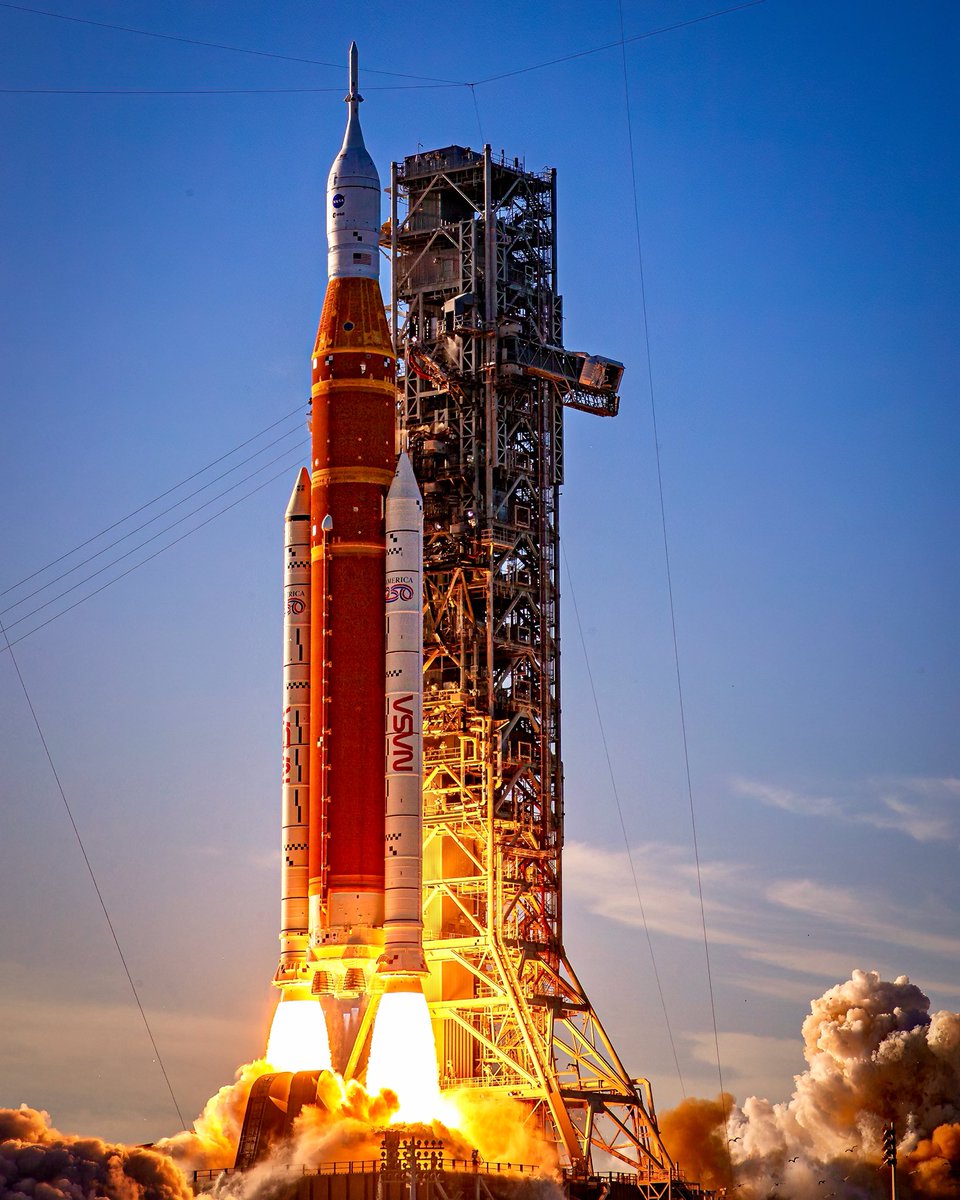
Just 1,500 feet (457 m) from the Artemis II launch, we deployed our special high-resolution, slow-motion camera to record the blast-off in jaw-dropping detail at 2,000 frames per second. Find out how we did it: https://t.co/MxKSqR5zes
The sound alone made a space geek out of me! 🚀
Here’s one unedited minute of the Artemis II launch from our setup on the press mound.
My first time covering a launch from Kennedy Space Center… and I’m not sure I could’ve picked a better one. Thanks to everyone who watched!
This is the shot you can’t get from the press site. This camera was sitting a few football fields from the SLS rocket at Pad 39B for days before launch, baking in the Florida sun, surviving rain, humidity, and whatever else the Cape threw at it. No photographer behind the viewfinder. Just a camera, a sound trigger, and a bet.
The way pad remotes work: you set your camera up days in advance, dial in your composition, lock everything down, and walk away. You don’t touch it again until after the launch. The shutter fires on sound activation
with a @MiopsTrigger smart+ trigger. With SLS, the four RS-25 engines ignite six seconds before the solid rocket boosters, so the camera is already firing before the vehicle even leaves the pad. You get home, pull the card, and find out if you nailed it or if a bird landed on your lens two days ago and left your a present and you got 400 photos of soemthing crappy.
There’s no formula for protecting your gear this close. Some photographers build wooden boxes with doors that pop open. Some use plastic bags and tape. Some do plastic or metal barn door rigs on hinges. I tend to leave mine open just in plastic rain covers because boxes limit my composition and setup time, but that means your cameras are more exposed to the elements and whatever energy and debris comes off the pad. You’re basically gambling a camera body every time you set one.
That’s what I love about this genre. There’s no playbook. You make it up as you go. Every time is an adventure.
📸 credit: me for @SuperclusterHQ - Artemis II pad remote | ~1,000 ft from Pad 39B | Kennedy Space Center
Nancy Pelosi: “I think Hillary Clinton was the most qualified person of that generation. More qualified than her husband, more qualified than George W. Bush, more qualified than Barack Obama. Certainly more qualified than the creature that is there now”
#Iran War Update No. 12 (focus on Iranian strategic narrative):
🔹Iranian sources expect that the war is entering a new and more volatile phase that could, on the one hand, involve internal unrest, and on the other hand, expanded regional fronts and greater pressure on global energy markets.
🔹Iranian security circles are warning that a phase involving foreign-instigated domestic instability or civil strife may be approaching. In response, authorities appear to be tightening internal security, adjusting Basij and security forces procedures, and mobilizing pro-government supporters to maintain control of public spaces.
🔹Pro-government gatherings were reported in several cities during the night. Iranian officials have openly encouraged supporters to occupy the streets in order to prevent opposition groups from shaping the domestic narrative during wartime.
🔹At the same time, state media claim new volunteers have come forward to join Basij operations after reports that some Basij members had been targeted and killed by Israeli drones in Tehran. The state media are in fact signaling that attacks on these forces are unlikely to intimidate the government’s core ideological support base.
🔹Iranian strategic discussions also suggest that the conflict is entering a more complex regional phase. Hezbollah’s escalation is seen in Tehran as a way to reduce pressure on Iran by forcing the United States and Israel to divide their military focus across multiple fronts.
🔹In response to Hezbollah’s large rocket attacks, Israel reportedly conducted a major wave of strikes against Hezbollah infrastructure in Lebanon. Iranian analysts believe this could force Israel either to shift resources toward Lebanon or risk widening the war further.
🔹Some Iranian analysts also argue that the Yemen front could soon become active, potentially adding another layer of pressure on the United States and Israel and further stretching their military resources across the region.
🔹At the same time, reports indicate that Israel may be considering establishing a base in Somaliland to counter the Houthis in Yemen. If implemented, such a move could expand the conflict toward the Horn of Africa and create new targets for Houthi operations.
🔹At the same time, there is growing concern in Iranian discussions about Syria potentially becoming another arena of escalation. Some analysts warn that Syrian government forces could become involved in the conflict against Hezbollah in coordination with Israel, which in turn could trigger retaliation by Iran or by Iraqi Shia militias against Syrian targets.
🔹The maritime dimension of the conflict continues to dominate global attention. G7 leaders have discussed the possibility of organizing a coordinated naval escort mission for commercial shipping in the Strait of Hormuz in order to restore maritime traffic and stabilize energy markets.
🔹The economic impact of the war is also becoming more pronounced. The International Energy Agency announced the release of around 400 million barrels of oil from strategic reserves in an effort to stabilize global markets.
🔹Despite these measures, energy markets remain under pressure due to the near halt of shipping traffic through the Strait of Hormuz and the broader disruptions caused by the conflict.
🔹Donald Trump stated that oil prices are already beginning to fall but indicated that the United States is unlikely to end the war before achieving its objectives, suggesting that Washington may still lack a clear endgame for the war.
🔹Meanwhile, GCC political dynamics appear more complicated behind the scenes than public statements suggest. According to reports cited by Reuters, some Gulf leaders privately believe the United States entered the war hastily and dragged regional partners into the conflict without a clear long-term plan.
🔹Iranian analysts interpret these reports as evidence that Gulf states may be increasingly frustrated with Washington’s ability to guarantee their security despite massive investments in defense systems.
🔹From the Iranian perspective, geography will ultimately force Gulf states to maintain relations with Iran regardless of current tensions. Iranian observers argue that once the war ends, regional states may reassess aspects of their strategic alignment with the United States.
🔹Diplomatically, Iranian analysts appear to view the recent UN Security Council abstentions by Russia and China pragmatically. They note that both countries attempted mediation efforts but could not guarantee that Gulf states would deny their territory to U.S. operations, making abstention the expected outcome.
🔹At the same time, Iranian observers emphasize that Russia and China continue to support Iran through diplomatic backing and other forms of cooperation, even if they avoid openly confronting the United States in international institutions.
🔹Iranian strategic thinking increasingly assumes that the United States may escalate the war further. Scenarios discussed include attacks on Iran’s economic and energy infrastructure, limited ground deployments, and expanded targeting of security forces such as the Basij.
🔹Overall, day 12 suggests that the war is moving toward a broader contest over regional positioning, domestic resilience inside Iran, and the ability of each side to impose economic and political costs over time. At the same time, the geography of the conflict may be widening, with growing indications that additional theaters such as Syria and even the Horn of Africa could become involved as the war evolves.
#Iran War Update No. 11 (focus on Iranian strategic narrative):
🔹There are mounting signs that the war may be moving toward a more dangerous maritime phase. Reports that Iran may have begun mining the Strait of Hormuz have fueled growing concern that Tehran is preparing to impose longer-term costs on global energy flows and maritime trade.
🔹At the same time, some Iranian analysts are speculating that the next phase could involve the Houthis more directly in order to increase pressure on a second strategic chokepoint, Bab el-Mandab. The logic is that simultaneous disruption in both Hormuz and the Red Sea corridor would have a much greater impact on global trade and energy markets than pressure on either route alone.
🔹Political signaling from Tehran appears consistent with that possibility. Ali Larijani said the Strait of Hormuz will either remain a route of peace and prosperity for all or become a place of defeat and suffering for those who wage war in the region, reinforcing the sense that Iran is prepared to escalate further at sea.
🔹Donald Trump warned that any Iranian move to fully stop oil flows through the Strait of Hormuz would trigger a decisive American response. Yet later reports suggested that Iran had begun at least limited mining activity, indicating that Tehran may now believe the costs imposed so far have not been sufficient to alter Washington’s calculations.
🔹Iranian calculations appear to be shaped by several factors at once. One is the belief that the United States is unlikely to end the war soon. Another is concern that continued strikes on Iranian missile and naval assets could eventually make Tehran’s strategy of selective disruption of the strait unsustainable, pushing it toward a more direct closure option.
🔹The maritime front is becoming more serious in military terms as well. According to CENTCOM video footage, the United States targeted a Shahid Soleimani class vessel along with several IRGC Navy missile and torpedo boats. The Fateh submarine, Iran’s only operational domestically built semi-heavy submarine, was also reportedly hit.
🔹This comes as Iranian attacks on Gulf neighbors continued, particularly against Qatar and the UAE, while diplomatic channels with some Gulf states remain open. Qatar said communication with Iran is continuing and emphasized that Doha is still focused on de-escalation and diplomacy.
🔹The economic effects of the maritime escalation are becoming more visible. Reports indicate that major oil producers in the region, including Saudi Arabia, the UAE, Iraq, Kuwait, and Bahrain, have already begun reducing production because of the situation in the Strait of Hormuz, with an estimated 6.2 to 6.9 million barrels per day effectively offline.
🔹Iranian officials continue to signal that they do not want a ceasefire under current conditions. Kazem Gharibabadi said a halt in hostilities now would make little sense if Iran could simply be attacked again a few months later, while the government spokesperson said any mediation would only be meaningful after a complete halt to the war and firm guarantees against renewed attacks.
🔹Mohammad Bagher Ghalibaf made Tehran’s position even clearer. He said Iran is certainly not pursuing a ceasefire and instead believes it must deliver a decisive blow that becomes a lasting lesson to the aggressor. In this view, Iran is trying to break what it sees as Israel’s preferred cycle of war, negotiation, ceasefire, and then renewed war.
🔹At the operational level, Iranian officials continue to emphasize the effects of earlier strikes on enemy radar and early warning systems. The Army spokesperson said that after degrading a significant portion of those capabilities, Iranian forces have been able to strike with greater accuracy and effectiveness in recent operations.
🔹Iranian missile strikes on Israel continued during the day, with growing use of cluster-type warheads. According to Iranian analysts, the goal at this stage is not only to hit strategic targets but also to keep Israeli civilians under continuous pressure by forcing them into shelters and sustaining a climate of disruption and anxiety.
🔹Ghalibaf also warned that Iran is now operating under the logic of “an eye for an eye,” saying that if Iranian infrastructure is targeted, Iran will certainly respond by striking enemy infrastructure in return. That suggests the infrastructure war may deepen further in the coming phase.
🔹Israeli and American strikes inside Iran continued to hit infrastructure as well. One of the latest strikes reportedly hit an area along a major highway in Tehran, halting traffic as smoke rose from the strike site. Some Iranian analysts interpret the increasing intensity of such attacks as a sign of impatience in Washington and Tel Aviv over the difficulty of achieving their strategic objectives.
🔹At the same time, the regime is tightening its internal security posture. Additional checkpoints have reportedly been established across Tehran, and the police chief warned that if people take to the streets they will be treated as enemies and security forces will not hesitate to open fire. This suggests that fear of domestic unrest remains high.
🔹The Lebanon front remains highly consequential. Lebanese President Joseph Aoun sharply criticized Hezbollah and called for direct talks with Israel as part of a plan to end the conflict, citing the massive displacement and casualties caused by the war.
🔹The Iraq front may also be heating up again. There were reports of airstrikes targeting several PMF positions in Iraq.
🔹Diplomatically, maneuvering is intensifying on several levels. Gulf countries are reportedly preparing a UN Security Council draft resolution condemning Iranian attacks and calling for an end to Iranian retaliatory strikes, while Russia has circulated its own draft calling on all parties to halt military activities and condemning attacks on civilians and civilian infrastructure.
🔹Russia and China are both continuing de-escalation efforts, though in different ways. Moscow says Putin has put forward several mediation options, while China’s special envoy is traveling to the Middle East and Chinese officials continue to stress the importance of preserving the security and stability of the Strait of Hormuz.
🔹European concern is also becoming more explicit. German Chancellor Friedrich Merz said Germany and Europe have no interest in an endless war or in the dissolution of Iran’s territorial integrity, warning that collapse of the Iranian state could create serious economic and migration consequences for Europe.
🔹Overall, Day 11 suggests that the war is moving toward a sharper confrontation over chokepoints, infrastructure, and endurance. Tehran appears increasingly determined to reject a quick ceasefire, widen the costs of the conflict, and force a new strategic equation.
Day 5 of #Iran vs. U.S./Israel conflict (focus on Iranian strategic narrative):
🔹There is growing concern in Iran that decapitation has become a continuing war strategy rather than a one-off strike. Iranian sources believe Washington and Tel Aviv may attempt to target the heads of Iran’s government branches or members of the interim leadership council.
🔹This fear extends to whoever becomes the next Supreme Leader, with Iranian commentators referencing the precedent of Hezbollah, where Nasrallah’s successor was reportedly targeted shortly after assuming leadership.
🔹Israeli and U.S. strikes have continued across western and central Iran, including in cities such as Shiraz, Khorramabad, Kermanshah, Qom, Ahvaz, and Tabriz, with western regions and the capital remaining the primary focus.
🔹At the same time, Iranian sources acknowledges that several missile bases have been hit, including installations near Kermanshah. Damage to access points and infrastructure may be affecting the tempo of missile launches.
🔹The decline in Iranian missile strikes on Israel therefore appears linked both to operational constraints caused by Israeli air dominance and to Iran’s possible effort to conserve its remaining arsenal.
🔹Instead, Iran appears to be still prioritizing strikes on U.S. interests and regional energy infrastructure, aiming to raise the cost of the war for Washington and its regional partners.
🔹Iranian missiles have reportedly targeted additional THAAD early warning radars, including systems in Jordan following earlier strikes in Qatar and the UAE.
🔹If accurate, these attacks suggest a strategy aimed at degrading the regional missile-defense architecture that helps protect both U.S. bases and Israel.
🔹Iranian sources also claim that communications and radar infrastructure at several U.S. bases – including facilities in Bahrain, Qatar, Kuwait, Saudi Arabia, and the UAE – have been damaged.
🔹The objective appears to be disrupting command-and-control systems and weakening coordination between U.S. and Israeli air-defense networks.
🔹At the same time, Iranian air defenses appear to have had greater success targeting Israeli reconnaissance drones, including additional Hermes 900 systems.
🔹Some analysts suggest that improvements in Iran’s short-range air-defense network may be responsible for these successes, even though long-range systems remain degraded.
🔹On the proxy front, Iraqi armed groups have continued attacks on U.S. bases, even after heavy U.S.-Israeli strikes on PMF positions in Anbar, Diyala, and Samawah.
🔹Hezbollah has also continued its operations, including missile and drone attacks against Israeli targets in northern Israel and the Golan Heights.
🔹The Houthis, meanwhile, remain largely outside the conflict. Some Iranian sources claim they are being deliberately held in reserve as a deterrent against Saudi Arabia or the UAE joining the war.
🔹Energy warfare remains central to Iran’s strategy. QatarEnergy has declared force majeure and halted LNG production following attacks on energy infrastructure.
🔹These disruptions are reinforcing Iran’s effort to sustain pressure on global energy markets, particularly given uncertainty about how long the Strait of Hormuz can remain closed.
🔹At the same time, the war has begun to generate secondary instability across the region, including protests in Pakistan and Bahrain in response to the killing of Khamenei and the ongoing conflict.
🔹Within Iran itself, supporters of the Islamic Republic have continued to organize demonstrations calling for retaliation and resistance.
🔹Authorities are also warning against internal dissent. The chief justice has stated that any actions aligning with U.S. or Israeli objectives will be treated as wartime collaboration.
🔹Iran’s leadership is simultaneously attempting to reassure Gulf countries. President Pezeshkian and parliamentary speaker Qalibaf have emphasized that Iranian strikes are directed at U.S. forces rather than host states.
🔹Iranian officials have also reaffirmed commitment to the China-brokered 2023 Beijing agreement with Saudi Arabia, signaling an effort to prevent Gulf states from joining the conflict.
🔹China has reportedly dispatched a special envoy to the region to explore mediation options, reflecting Beijing’s concern over disruptions to energy flows through the Strait of Hormuz.
🔹Meanwhile, the Kurdish issue is emerging as a major security concern for Tehran. Kurdish insurgent groups have recently formed a broader coalition, raising fears that they could be used as ground forces against the Islamic Republic.
🔹Tehran has reportedly warned KRG officials that if Kurdish groups launch attacks from Iraqi Kurdistan, Tehran could directly target the Kurdistan Regional Government itself.
🔹The war has also produced a potentially dangerous incident involving Turkey. A missile launched from Iran was intercepted by a NATO air-defense system over Hatay while reportedly heading toward the U.S. base at Incirlik.
🔹Although the intention remains unclear, one interpretation is that Iran’s decentralized missile-launch structure may increase the risk of accidental escalation or uncoordinated moves.
🔹International monitoring agencies have also assessed damage near Iranian nuclear facilities. Satellite imagery shows limited damage near the Isfahan site, but the IAEA reports that no nuclear material has been affected.
🔹Concerns remain particularly high around the Bushehr nuclear power plant, where Russian personnel operate the facility and where nearby explosions have been reported.
🔹Inside Iran, discussions have also begun about the country’s future nuclear policy after Khamenei. Some argue that the war demonstrates the need for a nuclear deterrent and that the next Supreme Leader my move toward that direction.
🔹The Assembly of Experts continues deliberations on selecting a new Supreme Leader.
🔹Overall, the fifth day of the war suggests a continuation of existing patterns rather than a dramatic shift: sustained Israeli air operations inside Iran, Iranian efforts to impose costs on U.S. interests and regional energy markets, and a widening regional and proxy dimension to the conflict.
🔹The trajectory of the conflict increasingly resembles a prolonged regional confrontation in which both sides are attempting to reshape the strategic balance over time rather than achieve rapid military victory.