We've given all Pro, Max, Ultra, and Team users one free full reset, across all models and limits. Use it anytime before December 10 at 2:00PM PT.
We recently fixed a few small issues that used more limits than intended, and the Fable resets didn't do much for those of you who'd already hit your weekly limits for all models. While these issues didn't affect everyone, we want to make up for the trouble.
You'll find it in Settings > Usage, or at https://t.co/5YRzheAZyQ.
Some unpopular-but-true notes on pretraining research:
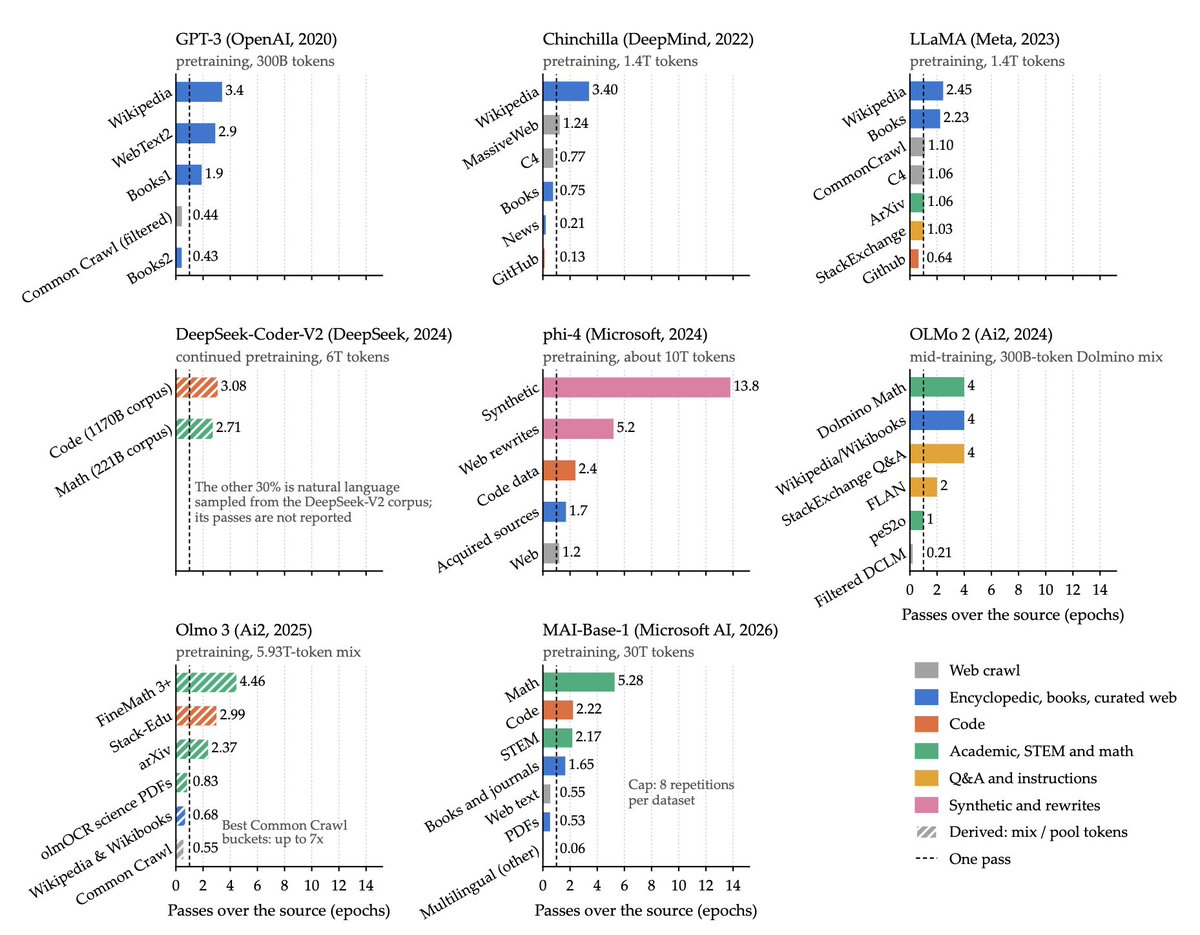
→ 𝗗𝗮𝘁𝗮 𝗿𝗲𝗽𝗲𝘁𝗶𝘁𝗶𝗼𝗻 is a very common practice.
→ 𝗢𝘃𝗲𝗿-𝘁𝗿𝗮𝗶𝗻𝗶𝗻𝗴 (~1000 TPP) is a very common practice.
→ In the long run, 𝗱𝗮𝘁𝗮-𝗲𝗳𝗳𝗶𝗰𝗶𝗲𝗻𝘁 architectures and algorithms will matter more than (currently) 𝗵𝗮𝗿𝗱𝘄𝗮𝗿𝗲-𝗳𝗿𝗶𝗲𝗻𝗱𝗹𝘆 ones.
→ 𝗙𝗶𝗻𝗲𝗪𝗲𝗯-𝗘𝗱𝘂 is a bad dataset for testing architectures; it can be misleading.
Fable 5.2 just one-shot a whole game from code in 8 hours: models, sounds, textures, all written from scratch.
This is why we built OpenWorld the way we did. The whole world is code: every map, person, item and rule. When you do something the game never defined, an AI writes the new rule while you play, and from then on it’s part of the world.
We’re still building it in the open. Contributions and feedback very welcome:
https://t.co/a78dhXoGxs
I wanted to test Fable 5.2's quality with one-shot prompts without human feedback.
Everything in this game is from scratch: models, sounds, textures. ~$550 at API pricing, ~2.7M output and 445M input tokens, heavily cached. Took 8 hours!
Play it here: https://t.co/fazOCcyNIH
The sim problem is often argued to be solvable via parameter passing and coordinate systems, without the need for visual modalities.
But what about real-world settings?
Many may marvel that Fable 5.2 appears to have cracked robotics, yet when confronted with the dynamics and variations of real scenes, it still demands faster, more flexible visual modules and preprocessing pipelines.
We remain convinced that real-world deployment ultimately comes down to a multimodal problem!
Our first major update on https://t.co/v8KSoNBKqM
- venue confirmed in the heart of Manhattan
- paper deadline is December 22nd
- single-blind, free-form (just a page limit), use AI however you want--focus on the science
- everything public (openreview), < 3 papers per reviewer
Introducing Claude Fable 5.2 and Claude Mythos 5.2, designed to tackle the most daunting technical challenges.
They’re capable collaborators on ambitious projects in many fields, and show improvements in areas like coding, reasoning, and vision.
Introducing Claude Fable 5.2 and Claude Mythos 5.2, designed to tackle the most daunting technical challenges.
They’re capable collaborators on ambitious projects in many fields, and show improvements in areas like coding, reasoning, and vision.
🚨“It works, but why is training so much slower?”
We kept hearing this from people replacing standard residual connections with Hyper-Connections, and ran into it ourselves. 𝗗𝗲𝗲𝗽𝗦𝗲𝗲𝗸 𝗺𝗛𝗖 𝗮𝗱𝗱𝘀 𝗲𝘅𝘁𝗿𝗮 𝟱𝟵–𝟭𝟬𝟬% 𝘁𝗿𝗮𝗶𝗻𝗶𝗻𝗴 𝗼𝘃𝗲𝗿𝗵𝗲𝗮𝗱 𝘄𝗶𝘁𝗵 𝗮 𝗣𝘆𝗧𝗼𝗿𝗰𝗵 𝗶𝗺𝗽𝗹𝗲𝗺𝗲𝗻𝘁𝗮𝘁𝗶𝗼𝗻.
That’s why we’re introducing 𝗦𝗶𝗺𝗽𝗹𝗲𝗛𝗖, one of the fastest Hyper-Connections methods to date.
It adds just 2.4% training overhead over vanilla residual at the largest tested width, with competitive performance compared to mHC and demonstrated scalability.
📄 https://t.co/pJnXKyoOcl
💻 https://t.co/AdTnHHynH7
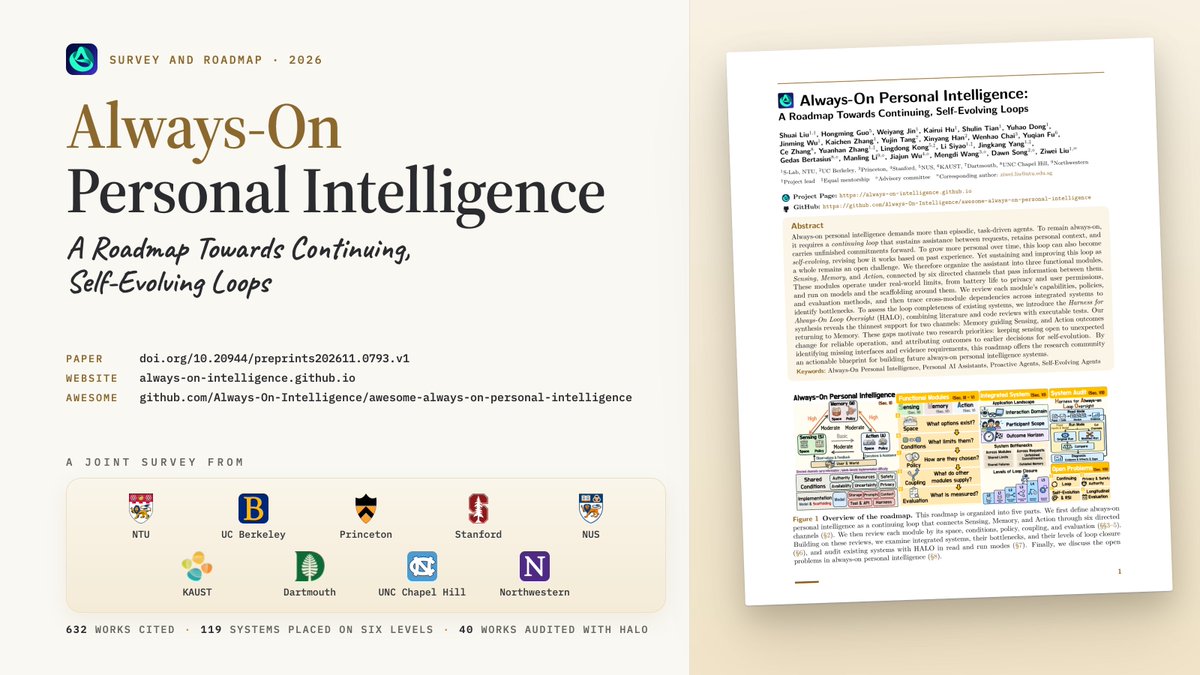
🗺️A Roadmap Towards Always-On Personal Intelligence🗺️
🚀How to build the future of personal agents? We introduce:
🧠A unified framework
🔄A taxonomy of agent capabilities
📊A harness #HALO for agents to close the loop
🔬15 open research challenges
👇https://t.co/dY6tKTVPyT
1/15 Personal agents are the hottest topic in AI right now. Frontier AI labs have shipped products such as Muse, dots, Claude Duet, Grok Bot and Gemini Daily Brief, and wearables like Omi and Bee capture conversations through the day. Robots are moving the same way. Frontier models are already becoming the robot's high-level brain, and the next step is a life companion that knows you better. What would make an assistant truly always-on, and how far are we from it?
We wrote a survey to answer this: "Always-On Personal Intelligence: A Roadmap Towards Continuing, Self-Evolving Loops". It is joint work from NTU, UC Berkeley, Princeton, Stanford, NUS, KAUST, Dartmouth, UNC Chapel Hill and Northwestern.
We describe an always-on assistant as Sensing, Memory and Action linked by six channels. We review each module, place 119 systems on six levels of loop closure, and find two channels with the thinnest support: Memory guiding what to observe, and action outcomes returning to Memory. We also release HALO, an open-source tool and MCP plugin for checking these channels in real systems.
📃 Paper: https://t.co/Q2CqPK0obR
🌎 Website and demo: https://t.co/tTJqRNnJmX
📚 Reading list: https://t.co/lmC6n4XjAO
🔧 HALO: https://t.co/22HCjQYSrh
🧵👇