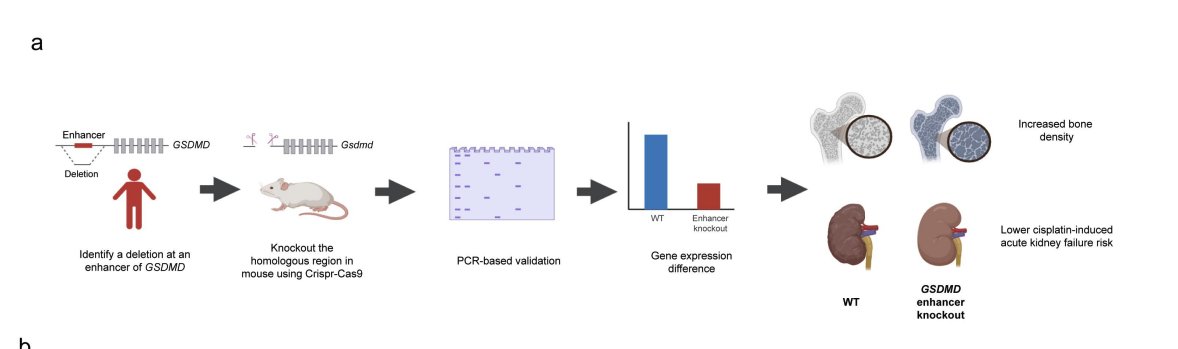
945 Han Chinese @nanopore sequenced & analyzed! Identified SV with functional impact (e.g WWP2 & GSDMD) & validated them on mouse models + HELA !
Spoiler non coding SV impact enhancers :) Amazing collaboration with Shaohua Fan @FudanUni
Link: https://t.co/F6Dxa3EDnz
@BCM_HGSC
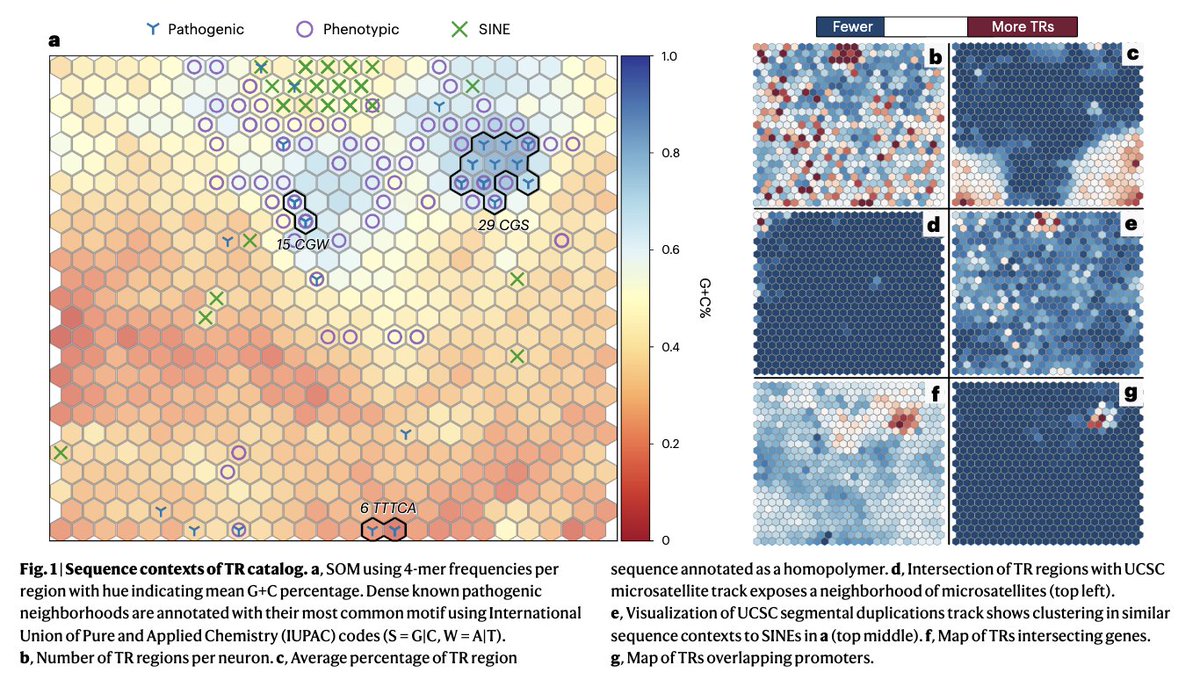
Tandem repeat @GenomeInABottle benchmark @NatureBiotech out today: https://t.co/7vAt2MRgzC . Characterization of 1.7 million TR + benchmark variants + new method to overcome var. representation issues! Great work lead by Adam E. @BCM_HGSC & great collab. from so many! (1/4)
If you’re interested in rapid in-situ metagenomics with Oxford @nanopore MinION, here’s a great example of how a lab-in-a-suitcase approach can achieve same-day on-site results, allowing “real-time functional and taxonomic monitoring of microbial communities in remote areas”.
The article, by Tamames et al. (2024), features two case studies:
⭐Investigating the microbial communities associated with volcanic rocks on La Palma island, Canary Islands, Spain.
Here the authors investigated bacterial and eukaryotic communities on lava rocks of different ages, producing results within a 24-hour window. To validate the results, the data produced with ONT MinION were later compared with those produced with Illumina NextSeq2000. The taxa and functional genes detected with both sequencing technologies were very similar, confirming the results were accurate.
⭐ Investigating the sulphur metabolism genes in planktonic microbial communities in Ria de Vigo, an estuary in Galicia, Spain.
In this study the aim was to test a results-driven sampling approach over two days. On the first day surface waters were sampled and analysed from three sites, with the results indicating the most interesting site for sulphur metabolism genes to be sampled and analysed in greater detail during the second day.
The authors suggest several advantages of their in-situ approach, such as:
🧬 Rapid monitoring of microbial communities: where rapid results can guide rapid appropriate responses, for example pathogen and antimicrobial resistance gene detection, rapidly evolving microbial blooms, fermentations, and bioreactors.
🧬 Rapid surveys of remote sites: where rapid results can allow researchers to determine whether a site is of interest or not, and whether to sample in more depth or sample elsewhere.
🧬 Rapid discussion of results: the authors' software pipeline allows immediate publishing of the results on a web interface (provided there is an internet connection) allowing collaborators elsewhere in the world to access and interrogate the results as if they were present.
Very cool stuff!
You can read the article here:
Tamames et al. (2024). In situ metagenomics: A platform for rapid sequencing and analysis of metagenomes in less than one day. Molecular Ecology Resources, 24(2), e13909.
https://t.co/KOgpQNPbuM
You can also find a complete experimental protocol to accompany the article here:
https://t.co/cqWRHu1iBY
☃️David's paper about mutational coldspots in the human genome is now out in @NAR_Open!
Read the latest and greatest version here:
https://t.co/4xLjh0S312
Considering building a human pangenome? Dive into our latest preprint for insights on the sequencing technologies and the minimal coverages needed for accurate assemblies https://t.co/RNjKreOeov Joint work with Prof JJ Liu lab w/@msprasad693, @JosipaLipovac and Filip Tomas!!
Gapless assembly of complete human and plant chromosomes using only nanopore sequencing | bioRxivc Happy @keygene could contribute to this work. @nanopore #T2T#duolex https://t.co/4j8XV9oaTr
Interested in chromosome number or centromere structure evolution?
Giant chromosomes and mini-chromosomes?
Pathogenicity-specific horizontal gene transfer?
Find all these and more in this massive piece of work led by @MarcoACoelho1 and @MrciaDavidPalm1.
https://t.co/8kxYOO4U0A
New in @ScienceMagazine with @jaegc. A combinatorially complete fitness landscape with >260.000 E.coli genotypes shows unexpected 🤯 properties. Despite ~500 fitness peaks in this landscape, adaptive evolution can easily navigate to highest fitness peaks https://t.co/tpgvVrGDd1
📢CALLING ALL MICROBIOLOGISTS📢
Do you use CFU assays?
Here is a new high-throughput, low-waste viability assay for microbes
All you need is agar media, pipette tips and a standard camera 🧫📸
https://t.co/faTjjeTE3x
@meyerct6@danastamo
Happy to see this paper out! With @AmLarracuente, we review the implications of intragenomic conflicts mediating the co-amplification of gene families on sex chromosomes, and how this process might be fueled by sex-biased mutation. https://t.co/sxIF9BmBpe
Another paper in our @RSocPublishing special issue on the resolution of evolutionary conflicts:
‘Genetic conflict and the origin of multigene families: implications for sex chromosome evolution’
Great work from @emilianomarti7 + @AmLarracuente!
https://t.co/EYGcMpfR2s
I always assumed that the P-element was the latest invader in D.mel. -> I was wrong, there is Spoink; many thanks to @signor_molevol @r_pianezza@Almoro_Scarpa for super fun collaboration :) https://t.co/AVJpCYo8ln