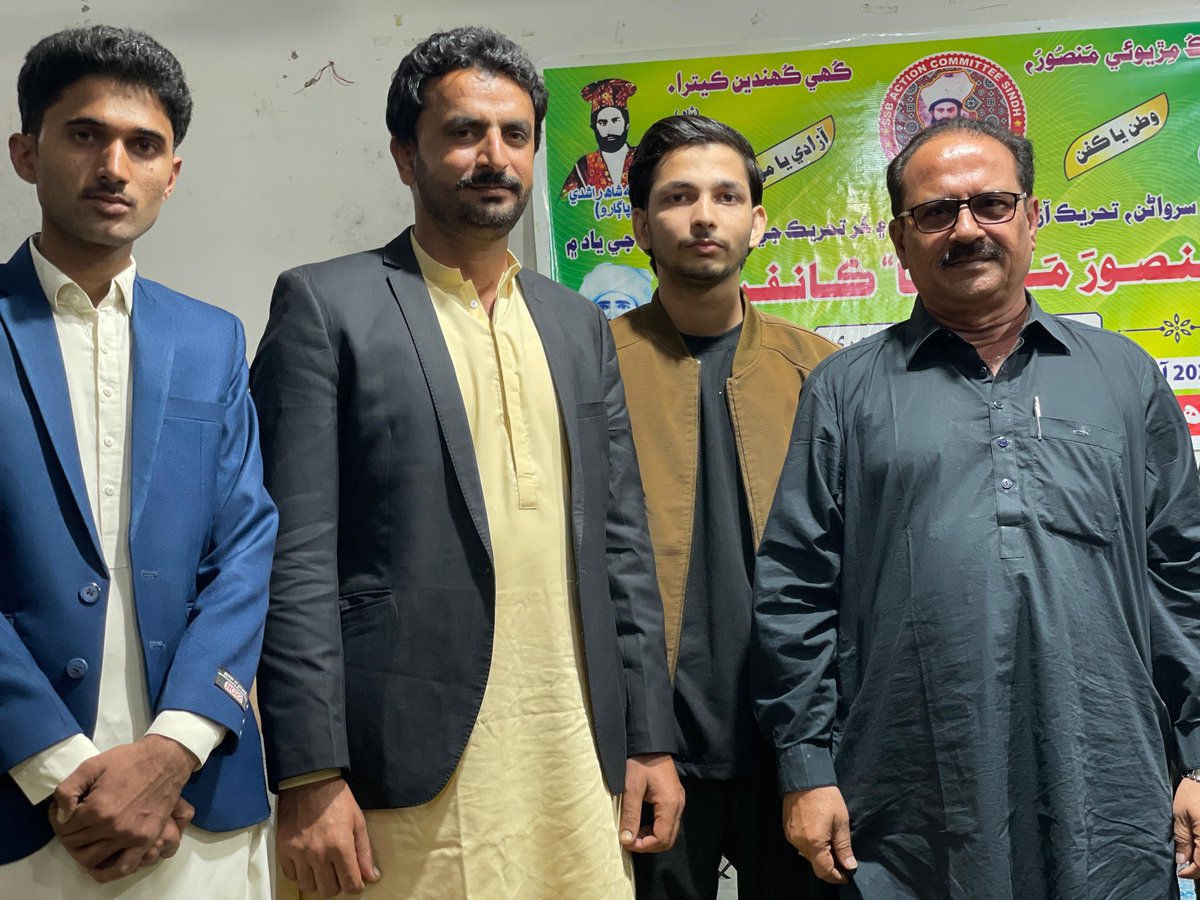
“ہمیں ہر اُس منافق لیڈر کی راہ روکنی ہوگی جو اس بدبودار اور سڑے ہوئے نظام کو مضبوط کر کے ہمیں بے حس غلام بنا کر رکھنے کی کوشش کرتا ہے۔ پھر چاہے وہ بلاول زرداری ہو، پیر پگاڑا ہو یا زین شاهه ۔ ۔
APPEAL TO THE UNITED NATIONS AND THE INTERNATIONAL COMMUNITY
FOR THE RESTORATION OF THE INDEPENDENCE OF SINDHUDESH
This appeal is solemnly made on behalf of the Sindhi nation and its national Freedom movement, grounded in the historical, political, and moral legitimacy of the Sindhi nation’s claim.
We, the representatives of the Sindhi Nation, respectfully submit this appeal to the United Nations, its Member States, international human rights bodies, and the global conscience, seeking recognition of the inalienable right of the Sindhi Nation to self-determination and freedom, including the geographical independence and territorial integrity of Sindhudesh, political sovereignty, economic ownership, and the national survival of Sindhudesh.
The Sindhi nation is not an artificial or newly constructed identity. It is one of the world’s most ancient living civilizations, the creator of a continuous culture, language, and social system that dates back over five thousand years. Sindh has historically existed as an independent country, stretching geographically from Makran to Multan, long before the emergence of modern nation-states in South Asia.
Sindh was never a natural part of the state now called Pakistan. The inclusion of Sindh into Pakistan in 1947 was not the result of a free and democratic choice by the Sindhi people, but rather a product of elite-level political maneuvering under colonial withdrawal, followed by military coercion, demographic engineering, and administrative domination.
Sindh as a Historically Independent State and Civilizational Entity
For thousands of years, Sindh existed as a sovereign political entity, functioning as an independent state with its own systems of governance, economy, diplomacy, and defense. From the Indus Valley Civilization through the eras of the Rai Saharas, Rai Sahasi, Raja Chach, Raja Dahir, and later the Samma, Soomra, Kalhora, and Talpur dynasties, Sindh consistently preserved its political sovereignty and cultural continuity.
This sovereignty was forcibly disrupted when the British military commander Charles Napier, through deception and in violation of an existing peace treaty, launched a sudden invasion and occupied Sindh. That occupation was subsequently transferred in 1947 to Punjabi colonial domination. In principle and under international norms, the British had invaded an independent Sindh; therefore, in 1947, Sindh should have been restored and recognized as an independent country.
Sindhi civilization contributed fundamentally to human history in agriculture, urban planning, trade, pluralistic coexistence, and intellectual traditions. The Sindhi people developed a tolerant, secular, and humanistic worldview that stands in sharp contrast to the extremist and exclusionary ideologies imposed upon them in recent decades.
Historically, Sindh’s independence was disrupted not by the will of its people but through repeated external invasions and later by modern colonial arrangements, culminating in its forced absorption into Pakistan, a state defined by religious majoritarianism, military dominance, and centralized authoritarianism.
Pakistan as a Modern Colonial State over Sindh
Pakistan today represents a modern form of internal colonialism, where power is monopolized by a Punjabi-dominated military-bureaucratic elite. Sindh has been reduced to a captive nation under this system, deprived of meaningful political authority, economic control, and demographic security.
Despite being rich in natural resources, including ports, gas, coal, agriculture, and coastline, Sindh remains economically exploited. Its wealth is extracted to sustain the central state, while the Sindhi people suffer from poverty, unemployment, displacement, and underdevelopment.
The demographic balance of Sindh has been deliberately altered through state-sponsored settlements, migration policies, and administrative restructuring, turning the indigenous Sindhi population into a marginalized community in its own homeland.
Political Disenfranchisement and Military Domination
The Sindhi people are denied genuine political representation. Electoral processes are manipulated, nationalist voices are suppressed, and peaceful political activism is criminalized. Enforced disappearances, extrajudicial killings, arbitrary arrests, and censorship have become routine tools used against Sindhi activists, intellectuals, students, and human rights defenders.
The overwhelming military presence, controlled by a single ethnic power center, has transformed Sindh into a militarized zone rather than a federating unit. This violates the fundamental principles of federalism, democracy, and self-rule promised but never delivered.
The exercise of their natural right to self-determination under international law for the freedom of their motherland, Sindhudesh.
The Sindhi nation qualifies fully for the right to self-determination under:
The UN Charter
The International Covenant on Civil and Political Rights (ICCPR)
The International Covenant on Economic, Social, and Cultural Rights (ICESCR)
UN General Assembly Resolution 1514 (XV) on decolonization
The right to self-determination is the natural right of nations and is also an established universal principle of national liberation; it is a recognized legal remedy against colonial domination, systematic oppression, and denial of political participation.
The Sindhi demand for Sindhudesh is a demand for:
Restoration of historical sovereignty
Protection of a threatened indigenous nation
Democratic self-governance
Ownership over land, water, and resources
Peaceful coexistence with neighboring states
Sindhudesh as a Secular, Democratic, and Peace-Loving State
The envisioned state of Sindhudesh is not founded on religious extremism, ethnic hatred, or territorial aggression. It is based on:
Secularism and pluralism
Equal citizenship for all communities
Rule of law and human rights
Regional peace and cooperation
Rejection of militarism and terrorism
Sindhudesh seeks to rejoin the international community as a responsible, peaceful, and cooperative nation-state, contributing to regional stability in South Asia rather than threatening it.
Global Appeal for the Independence of Sindhudesh
In the context of the present regional and global geopolitical environment, it is imperative for the international community to critically reassess the nature, conduct, and consequences of the Pakistani state. Pakistan is not a natural or organic nation-state formed through the free will of its historical nations; rather, it is an artificial entity constructed through ideological manipulation, military dominance, and sustained coercion.
Since its inception, Pakistan has systematically functioned as a state sponsor of religious extremism, militant proxy groups, and terrorist organizations. These groups have not only destabilized Pakistan internally but have been deliberately exported to neighboring countries as instruments of state policy. The Pakistani military establishment, driven by corruption and unchecked power, has repeatedly orchestrated terrorism, subversion, and sabotage across the region, thereby endangering regional peace and global security.
Pakistan has long served as a hired executor of “dirty work” for global and regional power interests, operating on rent and patronage rather than principled statecraft. This pattern of behavior has transformed Pakistan into a destabilizing actor, one that thrives on chaos, provocation, and permanent conflict. Even today, Pakistan continues to act as a rogue element in the region, undermining peace initiatives, fueling proxy wars, and deliberately sabotaging the balance of power through conspiracies, hybrid warfare, and covert aggression.
In its obsessive hostility toward India, Pakistan has engaged in reckless, irresponsible, and dangerous activities that threaten the entire South Asian region. These actions are not merely bilateral provocations; they have broader implications for regional stability, nuclear risk escalation, and international security. The cost of these policies is disproportionately borne by the oppressed historical nations trapped within Pakistan’s borders.
Historical nations such as Sindh have been forcibly imprisoned within this artificial state and subjected to systematic political repression, economic exploitation, demographic engineering, and cultural erasure. These practices constitute clear violations of international law, including the United Nations Charter, the International Covenant on Civil and Political Rights, and the universally recognized principle of the right of nations to self-determination.
In Pakistan, the denial of fundamental human rights and the suppression of historical nations are not isolated incidents but state policy and a daily reality. Enforced disappearances, extrajudicial killings, collective punishment, media censorship, and the criminalization of political dissent have become normalized instruments of governance. The very existence, identity, and future of historical nations are treated as expendable in the service of a centralized, militarized ideology.
The continued containment of Sindh and other historical nations within Pakistan represents a structural injustice that contradicts the moral foundations of the international order established after World War II. The global community cannot credibly advocate for democracy, human rights, and rule-based order while ignoring the colonial-style domination exercised by Pakistan over captive nations.
Therefore, the independence of Sindhudesh is not merely a regional demand; it is an international necessity. A free Sindhudesh would contribute to regional stability, peace, secular coexistence, and economic cooperation, while removing one of the fundamental fault lines exploited by extremism and militarism in South Asia.
We call upon the United Nations, international human rights organizations, democratic governments, and global civil society to recognize the legitimacy of the Sindhudesh independence movement and to support the inalienable right of the Sindhi nation to freedom, dignity, and self-determination in accordance with international law.
Pakistan as an Irresponsible, Militarized, and Ideologically Engineered State
Pakistan is an irresponsible, coercive, and fundamentally unnatural state, constructed not on the free consent of its constituent nations, but through the manipulation of religion and the sustained terror of the gun. It exists primarily to serve the political, economic, and strategic interests of a single dominant group, the Punjabi military-bureaucratic elite, at the expense of historically rooted nations such as the Sindhi, Baloch, Pashtun, and others.
The ideological foundation of Pakistan rests on the so-called Two-Nation Theory, a concept whose early intellectual roots can be traced to British colonial strategists, including policies promoted during the era of Lord Curzon. This theory was part of a broader imperial strategy to divide the peoples of the Indian subcontinent along religious lines, facilitating colonial withdrawal while ensuring long-term instability, dependence, and control.
This religiously constructed ideology did not produce peace or coexistence. Instead, it became a psychological and political catalyst for religious extremism and militant violence, the consequences of which have spread far beyond the region. The global community has suffered immensely from terrorism, radicalization, and insecurity emanating from this ideological framework, which the Pakistani state has repeatedly instrumentalized for domestic control and foreign policy objectives.
Total Militarization of State and Society
At present, Pakistan functions as a military-dominated state, where the armed forces exercise decisive control over politics, judiciary, economy, media, foreign policy, and all major state institutions. Civilian governance is nominal, while real power is enforced through intimidation, surveillance, and coercion.
This militarized structure has reduced the state into a security apparatus rather than a democratic polity. Nations within Pakistan are treated as captive populations, governed not by consent but by fear.
Systematic Repression, Enforced Disappearances, and Crimes Against Political Activists
Thousands of political activists, students, intellectuals, and human rights defenders from oppressed nations have been arbitrarily arrested, subjected to inhuman torture, and extrajudicially executed. Mutilated bodies are routinely dumped to terrorize communities and silence dissent.
Thousands more remain forcibly disappeared, held in secret detention facilities operated by state agencies, deprived of legal protection, family contact, and basic human dignity. These practices constitute grave violations of international human rights law, including crimes against humanity under international legal standards.
Colonial Exploitation of Sindh: Water, Land, and Demography
Sindh represents one of the clearest cases of internal colonialism within Pakistan.
Under the 1945 Rao Commission Award, water-sharing agreements recognized that 75 percent of the Indus River’s waters belonged to Sindh, while Sindh was entitled to 25 percent of the waters of Punjab’s rivers. These legally established rights have been systematically violated.
Through the construction of canals, dams, and diversionary infrastructure, Punjab has unlawfully appropriated Sindh’s water, devastating agriculture, ecology, and livelihoods. This water deprivation is not accidental; it is a deliberate colonial instrument to weaken Sindh economically and socially.
Millions of acres of Sindhi land have been occupied by the military under various pretexts, transforming fertile regions into cantonments, corporate farms, and security zones. Indigenous Sindhi farmers are displaced, while military and external interests reap the benefits.
Demographic Engineering and Cultural Marginalization
Through organized state policies, millions of non-indigenous populations have been settled in Sindh, with the explicit effect of transforming the Sindhi people into a minority in their own homeland. This demographic engineering threatens the very existence of the Sindhi nation as a distinct cultural, linguistic, and political entity.
To further weaken Sindhi society, the state has patronized:
Religious extremists
Armed sectarian and racist groups
Feudal elites aligned with military interests
These forces are used to fragment society, suppress progressive voices, and prevent national unity.
Total Denial of Political Freedom and Human Rights in Sindh
Today in Sindh, political freedom, human rights, and the collective existence of the Sindhi nation hang by a thread. Peaceful political expression has been criminalized; secular political movements for national freedom have been banned or systematically interfered with; and civil society has been methodically suppressed. State terror and repression have been deliberately institutionalized, spreading fear and intimidation throughout society and embedding coercion into the public psyche through a calculated strategy.
This situation represents a complete negation of democratic principles, secularism, and the right of nations to exist and govern themselves.
Global Crisis, Escalating Conflicts, and the Moral Imperative of National Freedom
At the present moment, the world is witnessing an alarming escalation of direct and indirect conflicts engineered by global and regional powers. From the war in Ukraine to the unprincipled and coercive policies pursued by the United States against Venezuela, from Pakistan’s repeated use of terrorism against India to its continuous violations of Afghan sovereignty, from the tensions between Israel and Iran to the prolonged conflicts in Africa and Yemen, the tragic treatment of the Palestinians these crises collectively point to a world drifting dangerously toward militarization and confrontation.
In East Asia, China’s assertive posture toward Taiwan and its attempts to dominate vital maritime trade routes have heightened regional insecurity. Simultaneously, the United States’ emerging ambitions regarding Greenland, renewed Europe-Russia hostilities, and North Korea’s irresponsible accumulation of excessive nuclear stockpiles without legitimate defensive necessity further intensify global instability. Equally dangerous is the continued existence of nuclear weapons in the hands of irresponsible states, including Pakistan, whose strategic behavior remains deeply destabilizing.
Taken together, these developments present a disturbing global picture, one that suggests humanity is being pushed toward the preparatory stages of a Third World War. Such a war would not merely redraw political boundaries; it would threaten the very survival of humanity and the existence of all life on this planet. We regard this trajectory as a grave crime against humanity and an unforgivable moral sin against future generations.
At such a critical juncture in human history, the continued imprisonment of historical nations within multinational and militarized states represents a profound injustice. Nations are being held captive, denied freedom, stripped of political agency, and subjected to systemic repression, all in blatant contradiction to global claims of justice, democracy, human rights, and freedom.
This reality stands as a loud and undeniable cry before the conscience of the world: no genuine peace, no real justice, and no meaningful protection of human, political, or civil rights is possible as long as nations remain enslaved. The liberation of historical nations is not a peripheral issue; it is central to any sustainable global order based on peace and human dignity.
Until nations are free, all claims of international justice, human rights protection, and democratic values remain hollow and hypocritical. True global stability can only emerge when nations are allowed to determine their own future, free from domination, coercion, and colonial-style control.
A National Declaration in a Multipolar World
Today, we place this truth before the world with clarity and conviction: humanity is entering an increasingly multipolar global order. The world is no longer defined by rigid Cold War-era ideological blocs. Instead, nations and states are pursuing their own political, economic, and strategic interests based on national priorities and survival.
In this evolving global reality, we consider blind alignment with any ideological camp or power bloc to be unrealistic and self-defeating. Our struggle is not driven by borrowed ideologies or external agendas. It is rooted solely in the national liberation, territorial integrity, and historical restoration of Sindhudesh, the freedom of the Sindhi nation, and the establishment of an independent homeland, Sindhudesh.
On behalf of the Sindhi nation, our national movement places this appeal before all nations, states, and international institutions of the world. We speak as representatives of the historical, collective, and legitimate national interests of the Sindhi Nation.
We assert, without ambiguity, that Pakistan is an artificial state sustained through coercion and the institutional sponsorship of terrorism. Within this state, Sindh and the Sindhi nation are subjected to systematic oppression, political subjugation, economic exploitation, and structural domination. The Sindhi nation today faces an existential threat, one that goes far beyond routine human rights violations. It is a threat to our very survival as a people.
The Sindhi nation is not merely a political community; it is one of the world’s oldest historical nations, the inheritor of the great Indus Valley Civilization, an ancient, human, and civilizational legacy. The denial of our freedom endangers not only our political rights but the continuity, security, and existence of a civilization that belongs to all humanity.
Therefore, we call upon the conscience of the world to recognize the urgency of the Sindhudesh independence cause. We urge the international community to give serious attention to this national appeal and to stand on the right side of history.
We further declare that all states and powers that continue to provide political, military, or economic support to the artificial and militarized state of Pakistan are, in effect, enabling the continued enslavement of historical nations, particularly the Sindhi nation under Punjabi domination. Such actions will be remembered as complicity in oppression.
Despite this, we affirm with unwavering resolve that the Sindhi nation’s struggle for freedom, dignity, and self-determination will continue under all circumstances. No pressure, no alliance, no threat, and no denial will force us to abandon our national cause. Our commitment is firm, our will is unbreakable, and our struggle is guided by justice, courage, and historical responsibility.
We seek freedom, not domination; independence, not conflict; dignity, not submission. And we shall continue our political, principled, and determined national struggle until Sindhudesh stands free among the nations of the world.
In conclusion, we extend an open and principled appeal to the United Nations and to the international community at large, including the United States, Russia, Germany, France, India, Israel, the UK, EU, Canada, Iran, Afghanistan, South African countries, and the Arab world, and all nations of conscience.
We call upon the world to view the question of Sindhudesh not through the lens of power politics, but through the principles of justice, stability, and the internationally recognized right of nations to self-determination.
Any state, institution, or people who choose to support and assist the Sindhi nation in its legitimate struggle for freedom and independence will find their support received with sincerity, respect, and strategic responsibility, in full alignment with our national interests.
We seek constructive international engagement based on mutual respect, peaceful cooperation, and shared commitment to regional stability. Our appeal is not rooted in hostility toward any nation, but in our unwavering pursuit of dignity, freedom, and lawful self-determination.
We also wish to make it absolutely clear before the world, and to all linguistic, ethnic communities, religions, and sects living in Sindh, that according to the modern Sindhi national concept, we are a territorial nation, not a linguistic, ethnic, or tribal one.
Therefore, in this global appeal of ours, we include all the people of Sindh, including Urdu-speaking Sindhis, and all linguistic and ethnic communities living in Sindh, whether they are Sindhi, Baloch, Pashtun, Punjabi, Lasi, Siraiki, Brahui, Kutchi, Dhatki, Memon, Bihari, or speakers of any other language.
All those residents of Sindh whose political, economic, and national interests are inseparably linked with Sindh are considered by us to be an integral part of the Sindhi nation and society.
This global appeal of ours is made on behalf of all those Sindhis who, in territorial and national terms, consider themselves part of the Sindhi nation.
History has shown that enduring peace is achieved not by suppressing nations, but by recognizing their rights. Those who stand with Sindhudesh in this critical moment will stand on the side of justice and will be remembered as partners in a just and peaceful future.
Shafi Burfat
Chairman
Jeay Sindh Muttahida Mahaz, JSMM
Germany
اگر تھر کے باسیوں کو تھر کا کالا سونا، کارونجھر اور وہاں کے نایاب جانور بچانے ہیں تو انہیں ہمت، اتحاد اور جدوجہد کرنی ہوگی۔
خاموشی تباہی کو دعوت دیتی ہے، جبکہ شعور اور مزاحمت ہی زمین، پہاڑوں اور جنگلی حیات کی بقا کی ضمانت ہے۔
ھلو ھلو سن ھلو .
منهنجي من مندر جا سائين،
بلبل جي گُلشن جا سائين،
تنهنجي سِر تان صدقو هي سِر،
تنهنجو رهبر منهنجو رهبر،
جي ايم سيد- جي ايم سيد…!
(بُلبُل کورواهي)
سترنھن جنوري ھر وک سن طرف🌷
#17JanuaryHBDSainGMSayed#17January2026#SainGMSayed