Our team is expanding, we are looking for a new collaborator - Computational Scientist (IR) - to join us at @institut_curie@CNRSbiologie @Unit3244_ICurie . Exciting single cell cancer datasets to analyse and a great opportunity for a permanent position. Postdoc, PhD or IR apply
Gene expression involves thousands of proteins that bind DNA, yet comprehensively mapping these is challenging. We developed ChIP-DIP – a method for simultaneous, genome-wide mapping of hundreds of DNA-protein interactions in a single experiment. https://t.co/NEH92mQTGs
📢 The @institut_curie Single Cell Initiative platform is looking for a motivated bioinformatics engineer to contribute to the development of single cell multi-omics technologies as part of the Curie SiRIC program ⤵️
https://t.co/mnPaL1anGZ
Great talk at the #SCG2023 in Engelberg! We have been amazed by all the work and advances done in #SingleCell#Genomics this past few years. Waiting for more in 2024!
🚨We are hiring!
The Custom Single Cell Omics (CSCO) core facility @institut_curie is looking for an engineer. If you like single cell molecular biology, platform work and technological development, come and join us! #singlecell#corefacility
https://t.co/tor6RnsBsz
We are excited to introduce Phospho-seq, our approach for profiling intracellular protein and cell signaling dynamics alongside additional molecular modalities in single cells!
Check out @JBlairSci's preprint at https://t.co/LANumW2Ko4
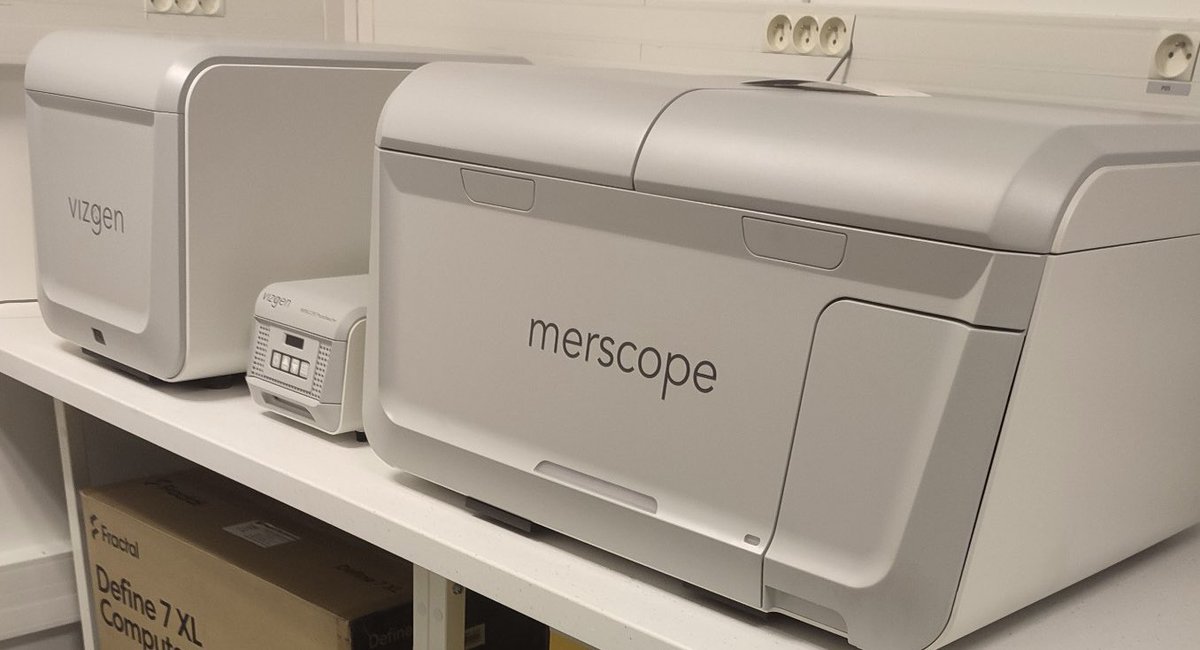
Thanks to @wamoyal & Sebastien Bellow from @vizgen_inc for this training on the #MERSCOPE! The PATHEX , NGS & Single cell facilities of @institut_curie got together with Kyra Borgman for some #spatialtranscriptomics . We can't wait to try it out on real projects!
Today was the final day of the training on the the Vizgen #MERSCOPE#spatialtranscriptomics platform at Institut Curie single cell facility (Initiative Single Cell).
Thanks a lot to Mylène Bohec, Eve Moutaux , Melanie Miranda, Renaud Olivier and Kyra Bo…https://t.co/nW5YNHNp9f
In detail, they identified the best tissue fixation for pA-Tn5 tagmentation: 1% PFA +HCl treatment. After tagmentation, they embedded sample in polyacrylamide gel and digested it with prot K to ensure efficient transcription. Then,MERFISH allow visualization of transcribed RNAs.
They are able to reveal key epigenetic marks (H3K4me3, H3K27ac,H3K27me3) of loci of interest by combining: enhanced tissue fixation, pA-Tn5 tagmentation with Mosaic End containing T7 promoter, production of RNA (amplified signal) which can then be imaged using MERFISH technology.
After nanoCut&Tag @GoCasteloBranco and MultiCut&Tag @ ThomasFazzio for multimodal profiling, here is the scMulTI-Tag from @mpmeers. Now it's possible to visualize up to 3 histone marks in a single experiment by coupling 2 tagmentation events followed by PCR using microfludic.
Happy to report that MulTI-Tag is officially published in a special spooky 🎃 online edition of @NatureBiotech--shareable link here: https://t.co/m6VGXRI6da 1/5
Congrats to Louisa (@Perielab1, @SingleCell18 ) for developing CellDestiny, an app to analyse single cell lineage tracing datasets. Hopefully useful for those who want to analyse their own or published data but don't code or don't know where to start. https://t.co/OoZnd4F5Ev.