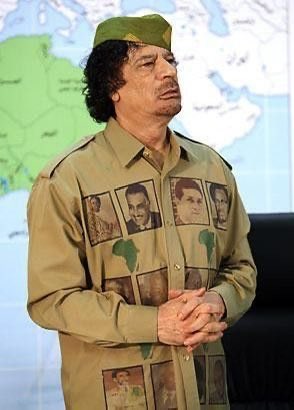
Once appeared with a shirt full of African leaders, men like President Gamal A. Nasser or former Emperor of Ethiopia Hailse Selaisse, Patrick Lumumba , Kwame Nkrumah, Thomas Sankara or even Nelson Mandela.
When Muammar Gaddafi appeared in that shirt, it was a deliberate visual statement tying himself to a pantheon of African and Arab liberation figures.
But the man didn’t stop there but continued to play an ambitious role in the African Union and his efforts to secure a united Africa.
He did that by wealth and by weapon until he became popular figure.
As Professor Hussein Solomon noted in Libya’s Foreign Policy in Flux, Gaddafi’s foreign policy toward Africa was unpredictable, extravagant, and deeply controversial. He used Libya’s oil wealth to bankroll projects, buy influence, and position himself as a pan-African leader. Many African leaders, enticed by his largesse, dubbed him the “Son of Africa.”
He was their China with his Oil money and extravagant economic involvement in Africa.
The greedy Africans for money could simply said no so they followed him and even called him “ The Son of Africa”
Today AU don’t have Gaddafi but China instead who invested across nearly every African country and become center of influence and center of power.
The effect is the same: Africa’s collective destiny is being shaped by external capital.”
Any claims like those of @ymahmoudali are ultimately shaped by the gravitational pull of Chinese foreign policy under one man principle man Xi Jinping.
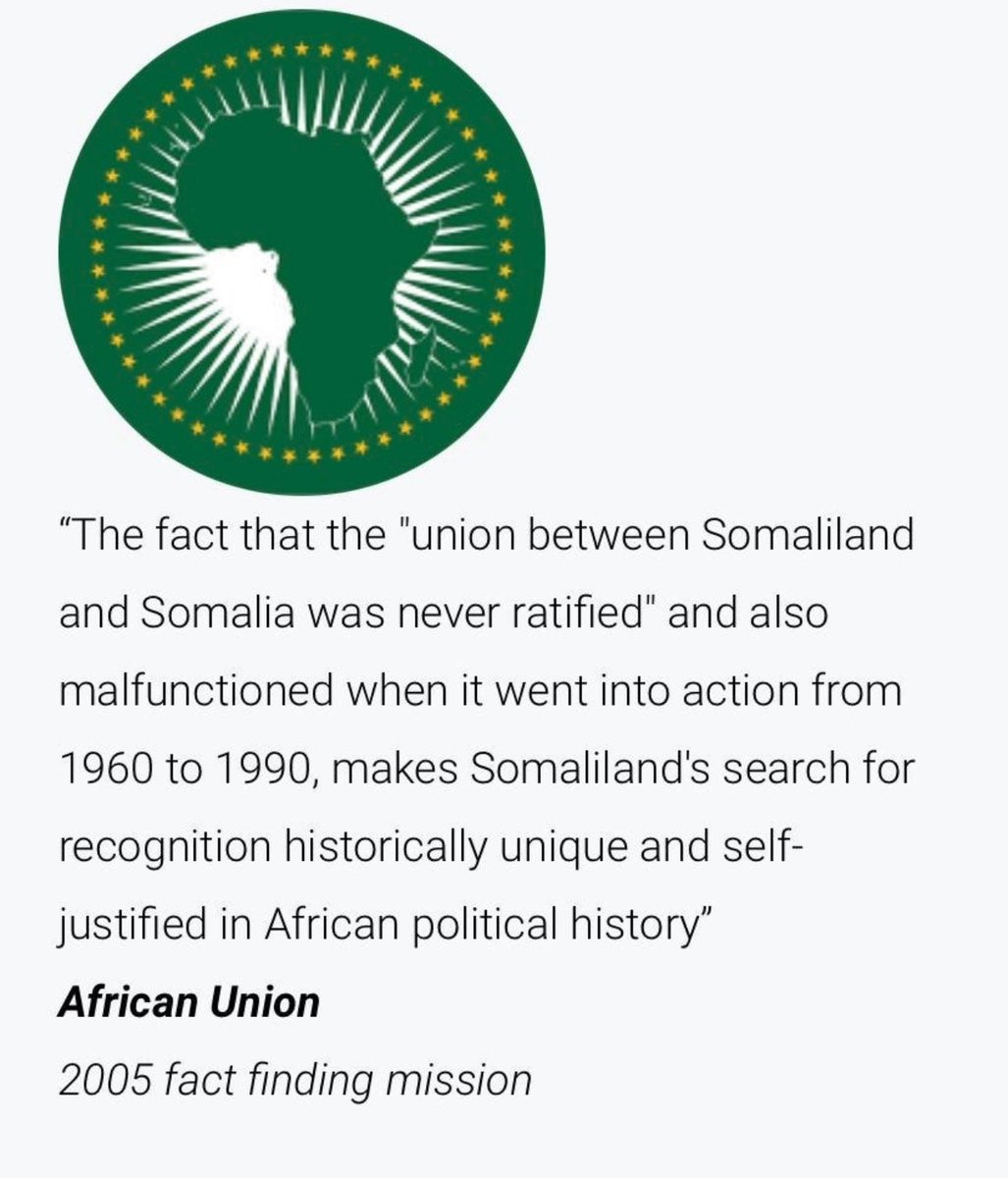
On matters of self‑determination and sovereignty, the African Union has failed to enact formidable changes. South Sudan’s independence in 2011 stands as a rare exception, but beyond that, the AU has struggled to uphold the principle of peoples’ right to decide their own destiny. Somaliland remains a striking example: despite functioning as a de facto independent state with its own institutions, currency, and governance, the AU has withheld recognition. This hesitation underscores the Union’s inability to consistently champion sovereignty, even as external powers like China increasingly shape its agenda.
We will not make a status for this man nor a sculpture
Simply because he’s a lion and lions don’t need sculptures. Only sheep do!
October month is full of big events that took place over the world, events that had changed many beliefs and perceptions.
Perhaps moved beyond that.
One man who believed this revolutionary idea was Mohamed Hashi Diriye Lixle by name and an Engineer by profession.
Mohamed believed that the only way to defeat Barre military and regime was to wage a war against it. 
It didn’t matter how small or unequipped they’re but the main important thing they were focusing was to not let Barre rejoice his military coup in 1969 and after 15 years in October 1984 it was time to hit them hard enough.
Only 360 members of SNM led by Lixle was enough to tear down Barre massive Military.
Everything for Mohammed was calculated , the time , the war and strategy.
The man was keeping his notes always with him and whom ever he met. He was a good listener and a good leader.
He died in Burco Duuray fierce fight but he left something more of his death. He left a spirit and everyone to believe this not gonna anywhere in f we don’t
Take our rights on our hand - our destiny on our shoulders
Finally Mohamud Ahmed Silanyo - Somaliland 4th president was asked one time from BBC what’s like after Lixle death and he replied
“ SNM are hundreds if not thousands of Lixle”
Xus oo Xasuuso!
For the first time in history, a sitting U.S. president has publicly acknowledged Somaliland as a country separate from Somalia.
If that is not a gain and positive development for Somaliland case, I don’t know what else would be !
WOAH! Potentially serious developments coming for Somaliland recognition. It's a huge development for Trump to even mention this at a campaign rally.
Some will say "it's just talk." Well I remember the same was said about the Board of Peace when Trump announced from the White House "we are going to own Gaza." Every word a President says is essentially policy. When Trump speaks, it's often part of the process of testing messaging and calibrating ideas.
I am not sure when recognition will happen but we have seen a chain of steps that includes Israel's recognition, the Israeli government's diplomatic support for Somaliland independence, and Senator @tedcruz 's call for the White House to recognize this country.
The proud, resilient people of the Republic of Somaliland, at home and across the world, extend their profound gratitude to U.S. President Donald J. Trump for bringing global attention to the fundamental differences between 𝐒𝐨𝐦𝐚𝐥𝐢𝐥𝐚𝐧𝐝 𝐚𝐧𝐝 𝐒𝐨𝐦𝐚𝐥𝐢𝐚: 𝐭𝐡𝐞𝐲 𝐚𝐫𝐞 𝐭𝐰𝐨 𝐬𝐞𝐩𝐚𝐫𝐚𝐭𝐞 𝐜𝐨𝐮𝐧𝐭𝐫𝐢𝐞𝐬 𝐰𝐢𝐭𝐡 𝐝𝐢𝐬𝐭𝐢𝐧𝐜𝐭 𝐢𝐝𝐞𝐧𝐭𝐢𝐭𝐢𝐞𝐬 𝐚𝐧𝐝 𝐩𝐨𝐥𝐢𝐭𝐢𝐜𝐚𝐥 𝐫𝐞𝐚𝐥𝐢𝐭𝐢𝐞𝐬.
Mr. President, thank you for articulating a truth the world has overlooked for 35 years. Our nation’s identity, sovereignty, and aspirations cannot be erased by silence or denial.
You can watch the video multiple times. Perhaps you could call Trump himself to clarify his meaning.
Is he referring to Minnesota, a state in the United States, as a country, or was he talking about Somalia, a failed state that doesn’t export anything except terror and chaos? Or is he referring to Somaliland, which is entirely different in shape and form?
Good luck.
You can watch the video multiple times. Perhaps you could call Trump himself to clarify his meaning.
Is he referring to Minnesota, a state in the United States, as a country, or was he talking about Somalia, a failed state that doesn’t export anything except terror and chaos? Or is he referring to Somaliland, which is entirely different in shape and form?
Good luck.
@vioryvideo Time to leave this name because enough for confusion and misconceptions about Somaliland as an Identity and as a country that is different from the failed state of Somalia.
By the way this what President Egal has said earlier “ Our Identity has been hijacked”!!
More accurately, he’s a desperate President who’s been paying attention and addressing global issues as if Somalia can somehow solve some of the world’s problems and be a part of it, even if it’s not the solution.
That’s not true
The President who’s is simply addressing the world is without a mandate to continue in office, as his term has expired.
Mr. Hassan can save his energy and instead focus on the increasing number of home evictions taking place.
Yesterday, Alex de Waal was interviewed by Dhaxalreeb, a Somalian online media outlet. What makes his interview so interesting is that he previously worked alongside Rakiya Omaar, a Somalilander and former director of Africa Watch, where they documented much of the destruction and atrocities committed against Somalilanders during the war in 1998/90. Rakiya authored the famous Africa Watch report, "Somalia: A Government War on Its Own People" 1990. I hope that one day #Somaliland media will interview Prof Alex de Waal to explore what he, Rakiya Omaar, and Africa Watch documented during the 1988–1991 Somaliland's liberation war.
For context, Alex de Waal is a prominent British researcher, academic, and expert on humanitarian crises, famine, human rights, and the Horn of Africa. He currently serves as the Executive Director of the World Peace Foundation and is a Research Professor at the Fletcher School of Law and Diplomacy at Tufts University. He earned his DPhil in Social Anthropology from Nuffield College, Oxford, focusing his research on how rural populations in #Sudan coped with famine.
Interview Hamish Wilson will also be so interesting: Hamish Wilson served as an embedded journalist with the Somali National Movement (SNM) during the Somaliland liberation war. Notably, he was the sole Western journalist to witness the conflict, the subsequent peace process, and the historic declaration on May 18, 1991, announcing Somaliland’s withdrawal from the union. Appointed by President Muse Bihi as Director of the Somaliland National Museum, Wilson has extensive expertise on the conflict 1988–1991 and its aftermath in Somaliland.
Anyone can end up in prison, and I am not particularly worried about Aadan simply because he is a man imprisoned in his own country.
What does concern me is when personal grievances, political differences, or individual vendettas are brought into the courts of justice and used as a means of seeking revenge against a person for holding different views.
All I know is that Aadan has been a decent individual and a committed Somaliland patriot who has defended Somaliland wherever he could, from advocating for the Somaliland e-Visa to promoting the country's interests on various platforms.
Justice should be guided by facts, evidence, and the rule of law, not by personal animosity or political score-settling.
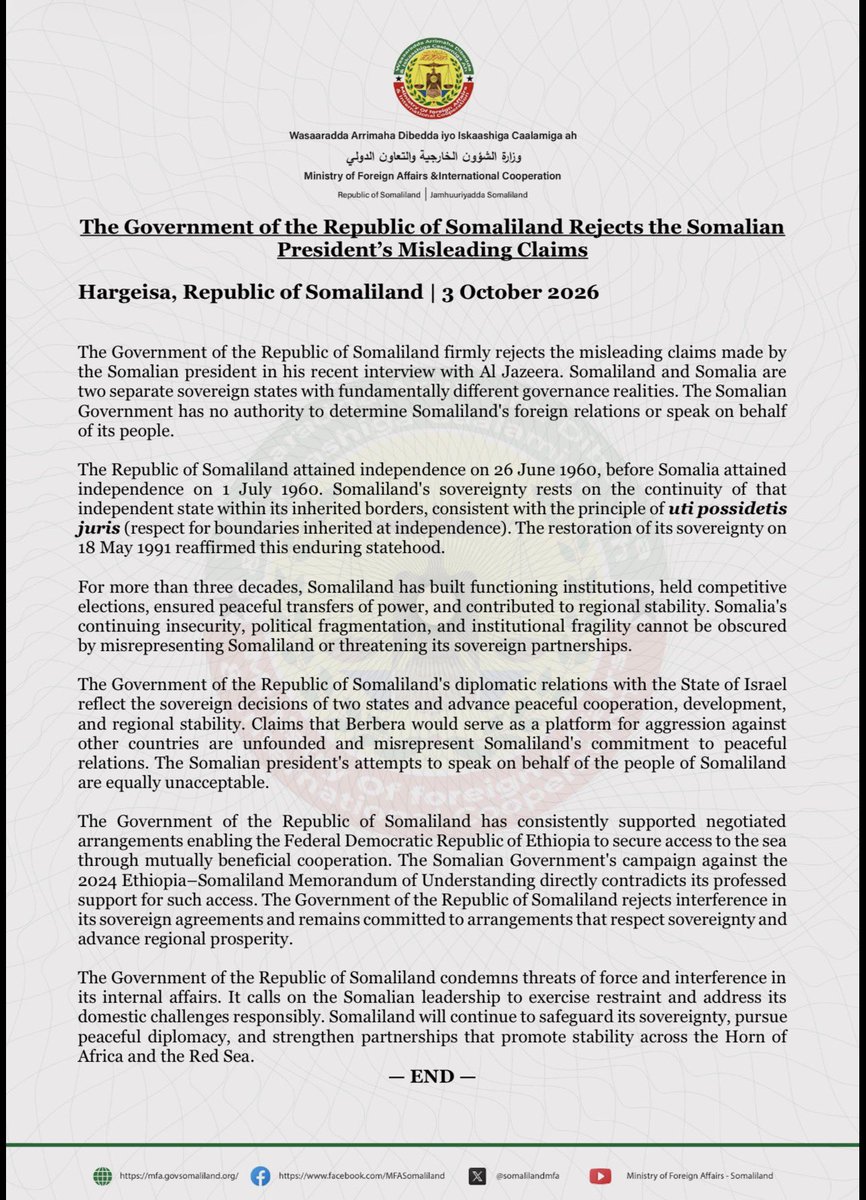
The Government of the Republic of Somaliland firmly rejects the misleading claims made by the Somalian President and reaffirms Somaliland’s sovereignty, state continuity, and exclusive authority over its foreign relations.
Read the full statement 👇🏾
https://t.co/6KvutmhsdR
@Dhulkahooyo23 Meet the man whom his president have signed an agreement with Ethiopia for the GERD https://t.co/1xykWnknA0 and yes it was with Ethiopia benefit.
Egypt is in no position to dictate other sovereign countries what they want to do or not.