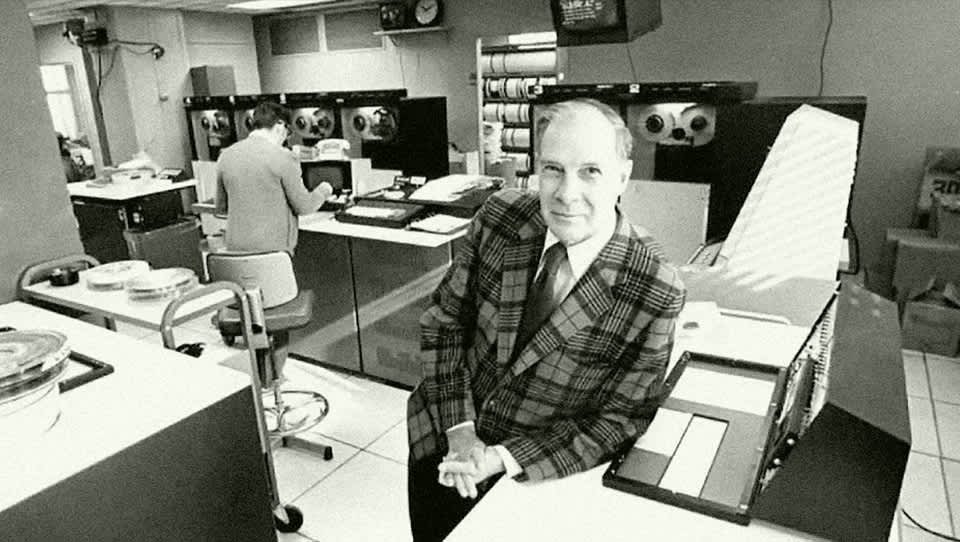
A mathematician who shared an office with Claude Shannon at Bell Labs gave one lecture in 1986 that explains why some people win Nobel Prizes and other equally smart people spend their whole lives doing forgettable work.
His name was Richard Hamming. He won the Turing Award. He invented error-correcting codes that made modern computing possible. And he spent 30 years at Bell Labs sitting in a cafeteria at lunch watching which scientists became legendary and which ones faded into nothing.
In March 1986, he walked into a Bellcore auditorium in front of 200 researchers and told them exactly what he had seen.
Here's the framework that has been quoted by every serious scientist for the last 40 years.
His opening line landed like a punch. He said most scientists he worked with at Bell Labs were just as smart as the Nobel Prize winners. Just as hardworking. Just as credentialed. And yet at the end of a 40-year career, one group had changed entire fields and the other group was forgotten by the time they retired.
He wanted to know what the difference actually was. And he said it wasn't luck. It wasn't IQ. It was a specific set of habits that almost nobody is willing to follow.
The first habit was the one that hurts the most to hear. He said most scientists deliberately avoid the most important problem in their field because the odds of failure are too high. They pick a safe adjacent problem, solve it cleanly, publish it, and move on. And because they never swing at the hard problem, they never hit it. He said if you do not work on an important problem, it is unlikely you will do important work. That is not a motivational line. That is a logical one.
The second habit was about doors. Literal doors. He noticed that the scientists at Bell Labs who kept their office doors closed got more done in the short term because they had no interruptions. But the scientists who kept their doors open got more done over a career. The open-door scientists were interrupted constantly. They also absorbed every new idea passing through the hallway. Ten years in, they were working on problems the closed-door scientists did not even know existed.
The third habit was inversion. When Bell Labs refused to give him the team of programmers he wanted, Hamming sat with the rejection for weeks. Then he flipped the question. Instead of asking for programmers to write the programs, he asked why machines could not write the programs themselves. That single inversion pushed him into the frontier of computer science. He said the pattern repeats everywhere. What looks like a defect, if you flip it correctly, becomes the exact thing that pushes you ahead of everyone else.
The fourth habit was the one that hit me the hardest. He said knowledge and productivity compound like interest. Someone who works 10 percent harder than you does not produce 10 percent more over a career. They produce twice as much. The gap doesn't add. It multiplies. And it compounds silently for years before anyone notices.
He finished the lecture with a line I have never been able to shake.
He said Pasteur's famous quote is right. Luck favors the prepared mind. But he meant it literally. You don't hope for luck. You engineer the conditions where luck can land on you. Open doors. Important problems. Inverted questions. Compounded hours. Those are not traits. Those are choices you make every single day.
The transcript has been sitting on the University of Virginia's computer science website for almost 30 years. The video is free on YouTube. Stripe Press reprinted the full lectures as a book in 2020 and Bret Victor wrote the foreword.
Hamming died in 1998. He gave his final lecture a few weeks before. He was 82.
The lecture that explains why some careers become legendary and others disappear is still free. Most people who could benefit from it will never open it.
I am not what I am, I am what you mistake me for.
“Nothing gives you a clearer look into someone than how they misinterpret things; every misinterpretation is a confession.” — @DylanoA4
My deepest claim about free will is that determinists are using an outdated & incorrect theory of physics.
The universe is determined (after the fact) but not pre-determined.
You cannot step into the same river twice, for it is not the same river and you are not the same person.
Kindness is peak human performance and high status.
Kindness requires metabolic abundance: the capacity to override primal impulses, regulate emotions, and extend empathy.
Meanness is dirty energy: high cortisol, inflammation and an exhausted executive function.
WHY MUSCLE STRENGTH PREDICTS LONGEVITY BETTER THAN CARDIO FITNESS
Your grip strength matters more than how fast you can run a mile. Studies tracking mortality between ages 40 and 60 show people in the strongest third of the population are half as likely to die as those in the weakest third.
The relationship between muscle strength and lifespan extends beyond cardiovascular disease.
Thirty percent of cancer deaths actually result from muscle weakness associated with the disease, not the cancer itself.
Patients in the strongest third face one quarter the cancer mortality risk compared to the weakest third. They don't avoid cancer. They survive the brutal treatments that weaker patients can't endure.
Grip strength inversely correlates with dementia risk. Stronger bodies predict better brain function. The connection runs deeper than simple correlation.
When you trip while walking, your brain must fire signals fast enough to get your foot forward and prevent a fall. A stronger, fitter brain responds faster.
Better proprioception (your body's spatial awareness sensors) comes from regular resistance training. These factors combine to prevent falls that lead to broken hips. Break your hip after age 60 and your life expectancy drops below one year.
Cardiovascular fitness matters too, obviously. Early research comparing London bus drivers to ticket takers on double decker buses found the ticket takers (who climbed stairs all day) had less heart disease.
A follow up study compared letter carriers to machinists doing heavy labor. The heavy workers, combining rhythmic movement with strength work, showed even better cardiovascular outcomes than pure endurance workers.
Two types of exercise create different adaptations. Rhythmic exercises (walking, running, cycling, swimming) cause volume overload on the heart. Each muscle contraction pushes blood back toward the heart, making it bigger during exercise.
Over time this improves heart function. These exercises also build mitochondria in muscles, literally increasing your capacity to produce energy. That's why exercise eventually gives you more energy despite making you tired in the moment.
Resistance exercise creates pressure overload. When you lift heavy weight, muscles contract so hard they shut down blood vessels running through them. Your heart now pushes against higher pressure, making the heart muscle bigger and stronger. The same principle that grows your biceps grows your heart.
The protein mTOR acts as a central regulator of muscle growth. Research using animal models showed direct correlation between mTOR activation after a single exercise bout and muscle growth over six weeks.
Muscles loaded closer to failure activated mTOR more and grew larger. This protein also senses nutrient availability by detecting the amino acid leucine. High leucine signals abundant food, triggering growth responses. Animal proteins and dairy provide the best leucine sources.
Timing matters. Exercise acts like an address on an email, directing nutrients where you want them to go. After exercising specific muscles, blood flow to those muscles stays elevated for at least two hours.
Eat during this window and more nutrients reach the worked muscles. Swimmers develop massive backs because they pull constantly, then eat while blood flow to pulling muscles remains high. Cyclists get huge legs through the same mechanism.
For young healthy people, the timing window extends wider. Exercise today and tomorrow's meals still preferentially feed yesterday's worked muscles. Older individuals lose insulin sensitivity, making the post exercise window more important. They benefit from eating within two hours of training.
Alcohol blocks mTOR. Australian rules football players who lifted weights on Friday then hit the pub that night built less muscle than players who moved their lifting sessions to Wednesday. The mechanism is clear. The Friday lifters suppressed their growth signal with alcohol before their muscles could fully respond to training.
PGC1 alpha coordinates endurance adaptations. This protein increases mitochondria, fat burning enzymes, and blood vessels in muscles. Exercise activates it two ways.
Long duration at low intensity works. Short bursts at high intensity work better because they recruit larger motor units. Scandinavian research on bicycle commuters found speed mattered more than duration for lifespan benefits. Going fast beat going long.
You recruit muscle fibers based on intensity. Light steady exercise uses maybe 40 to 60 percent of available fibers.
Sprint intervals force recruitment of larger motor units, spreading the training stimulus across more tissue. A 30 second all out effort followed by rest, repeated three times, activates PGC1 alpha in more muscle fibers than an hour of easy jogging.
Most exercise complication serves financial interests. Professors make terrible salespeople. The truth costs nothing. To build muscle, pick a movement and do it until you can't anymore.
Building muscle resembles squeezing water from a towel. The first squeeze releases most water. The second squeeze produces drops while requiring much more effort. One hard set to failure extracts most benefit. Additional sets provide diminishing returns.
You need minimal equipment. Fill shopping bags with water bottles or cans for weighted lunges. Push against your desk until your arms give out.
Loop a resistance band around a door and pull down until you can't pull anymore. Your muscles don't know whether you used a ten thousand dollar machine or a grocery bag. They only know tension and fatigue.
Five movement patterns cover everything. Push horizontally (like a pushup). Pull horizontally (like a row). Push overhead. Pull from overhead. Hinge your hips. Hit these patterns twice weekly, one set to failure each. That's your strength training sorted.
Between strength sessions, do isometric holds. Put your back against a wall, slide down until your knees and hips form 90 degree angles, and hold. Your legs will burn.
This signals tendon adaptation without the injury risk of dynamic movements. Hold positions for 10 to 30 seconds. Your connective tissue listens for five to 10 minutes, then tunes out. Like a teenage daughter.
Exercise snacks work. Walk up three flights of stairs four times throughout your day. You've completed your high intensity interval training without changing clothes or going to a gym.
Two minutes weekly of sprint intervals produces measurable cardiovascular improvements. That's six 20 second bike sprints spread across three days with recovery between efforts.
Protein requirements increase with age. Stomach acid decreases, reducing protein digestion and absorption. A steak at 55 provides less usable protein than the same steak at 20. Ground meat (mince) builds more muscle than steak because it's pre broken down.
Older people need more protein but often eat less because meat costs more on fixed incomes.
Vegetarians and vegans face additional challenges. Plant proteins are harder to digest and absorb than animal proteins. A study comparing omnivore meals (meat, potatoes, applesauce) to vegan meals (beans, soy) with matched calories and protein found only the omnivore group increased muscle protein synthesis five hours later.
Vegetarians benefit from hydrolyzed pea protein supplements. The pre broken down protein compensates for reduced digestibility of whole plant foods.
Dairy provides easy protein supplementation. Prefer A2 dairy. Low protein dinner? Add a glass of milk or Greek yogurt. Problem solved without powders or shakes.
Warming up means starting slower. Walk for three to five minutes before running. Swim easy lengths before going hard. This raises core temperature and primes fat burning enzymes. You can skip formal warmups by treating the start of your session as the warmup. You'll just need to go easier at first.
Cooling down matters more. Those isometric holds that build tendon strength also help recovery. After running, hold a lunge position for 30 seconds per leg.
This stretches quad tendons, patellar tendons, and Achilles tendons under load. The static tension helps tissues recover from the repetitive impact forces (called jerk in biomechanics) that cause injury over time.
Musculoskeletal injuries cost the US healthcare system more than heart disease and diabetes combined. Back pain, knee pain, ankle pain, heel pain.
Ten minutes of isometric holds several times weekly prevents most of this. The minimal effective dose for tendon health requires less time than most people spend checking social media.
Europeans live longer than Americans partly because of universal healthcare, but also because cities built for walking create natural exercise snacks.
Continental Europe's pedestrian streets and walkable neighborhoods mean people accumulate movement throughout the day. When you drive everywhere, you must consciously exercise. When you walk to the local shop carrying your groceries home, your arms get resistance training whether you planned it or not.
You don't need the Hollywood version of exercise. You need movements that challenge you, performed until they become difficult, done consistently over time.
Twice weekly strength sessions of 20 minutes each. Daily isometric holds of five to 10 minutes. Some fast walking or stair climbing throughout the week.
This keeps your heart strong through both volume and pressure adaptations. It preserves muscle mass, the single best predictor of longevity. It maintains brain function and balance, preventing falls that kill older adults. It builds resilient tendons and ligaments that let you keep moving without pain.
Strong people survive longer. The mechanism isn't mysterious. They handle physical stress better. They recover from illness and injury faster. Their brains work better. They fall less often. When they do fall, they catch themselves. When they get sick, they endure harsh treatments. When they age, they keep moving.
Ignore the noise telling you to maximise your VO2max!
Grip strength predicts your future better than almost any other single metric. So does your ability to stand up from a chair without using your hands. These simple measures reveal whether you've built the physical capacity to handle what life throws at you.
The difference between the strongest third and weakest third of the population is a 50 percent mortality difference between ages 40 and 60.
“A bird with a 10-gram brain is doing pretty much the same as a chimp with a 400-gram brain,” said Onur Güntürkün, who studies brain structures at Ruhr University Bochum in Germany. “How is it possible?” https://t.co/714Lo8Hzug
The era of the narrow specialist is over.
Marc Andreessen predicts the future belongs to the generalist.
In the AI age, founders can’t excel in just one domain. They need competence across 6 to 8 different fields.
Deep expertise still has its place. But broad knowledge combined with AI leverage is the new superpower.
@LeilaHormozi People love the Alchemist quote, “If you want something badly enough, the universe will conspire to help you get it.”
That hasn’t been my experience. The universe puts obstacles in your way to see how badly you want it. It’s not rigged against us. That’s the game.
In chess?! Prodigy, early specialization, and near-total dedication have been the only way to the top since Fischer! Athletic development may benefit some from practicing multiple sports early on, but Caissa is a more jealous goddess.