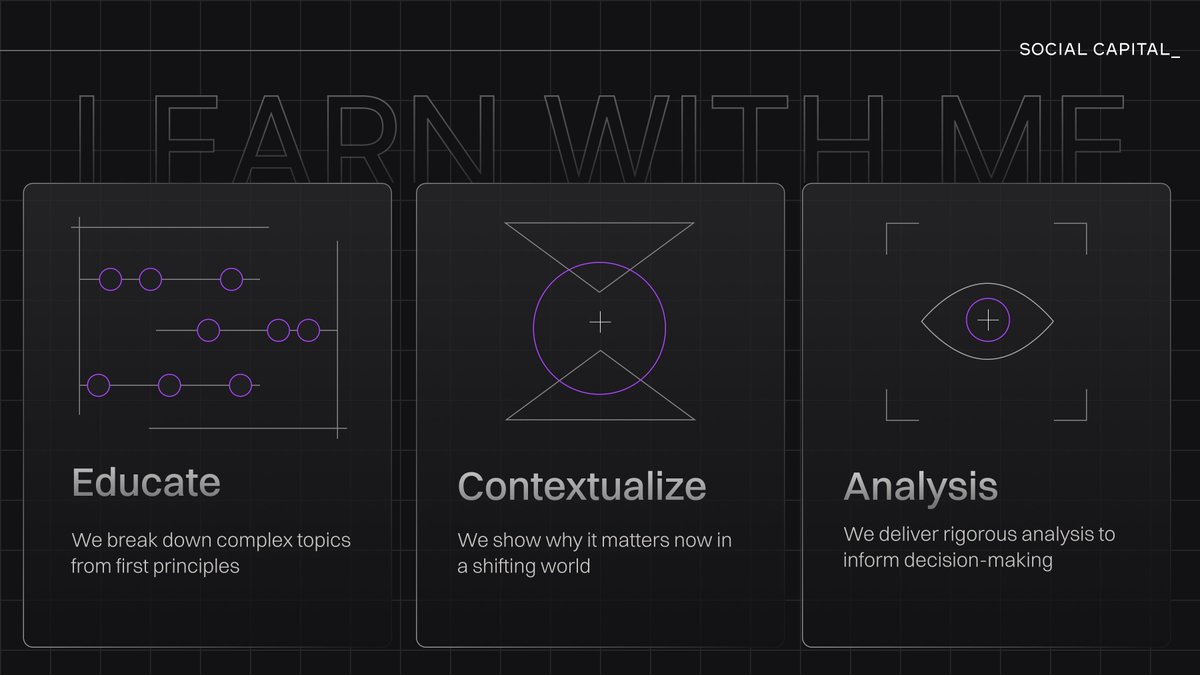
4 first-principled deep dives every month to help educate, contextualize, and analyze what's happening in the world today.
Learn with us: https://t.co/KFy2fJW9pl
In 2020, I hired McKinsey to teach me about the global energy transition. I learned a lot, but it cost me more than $2M.
After that experience, I decided to build my own internal research project at Social Capital called Learn With Me.
Over the last two years, my @socialcapital team and I systematized our process into a product that allows anyone to learn with me continuously, for a fraction of the cost of a single McKinsey report.
Each Learn With Me Deep Dive represents 300+ hours of first-principles research, expert interviews, and truth-seeking analysis of what's happening in the world today.
We have 3 main goals:
1) Educate: Break down complex topics from first principles
2) Contextualize: Show why it matters now in a shifting world
3) Analysis: Help individuals, founders, investors, and policymakers make informed decisions on their own
Over the last 2 years, we’ve released 30+ Deep Dive reports across five primary themes I believe are essential to understanding the world today: Technology, Energy, Life Sciences, Economic Analysis, and Socio-Political Trends.
Some of our most popular Deep Dives:
- Stablecoins: Early last year, I predicted that the biggest business winner in 2025 will be dollar-denominated stablecoins and shared the research behind this thesis.
- Magnificent 7: They are the undisputed winners of the internet era, with over $21T in combined market cap. We took a deeper look at each company’s products, key competitive edge, and revenue pillars.
- China: We created a 3-part, 450-slide report to explore the history, governance, and both the domestic and foreign policies of one of the world’s most powerful and longest-lasting civilizations.
Historically, we averaged ~1 comprehensive Deep Dive per month, delivered as a slide deck. After expanding our team, we’re looking to scale our output significantly in 2026:
- 4X Deep Dives per month: You'll start to see them drop weekly instead of monthly, and we aim to raise the quality bar with each release.
- Explainer Videos: We’ll be experimenting with cinematic explainer videos for our Deep Dive topics, presented by me with high-quality animations to make the research more accessible and shareable.
- Community: We aim to deepen our community of curious individuals who are invested in the topics we cover with our group chat that I’m involved in, and we plan to do even more next year to cultivate digital and physical connections between our members.
Price: While we’re increasing output by 4-5x, we will be keeping the price at $99/m or $999/y.
Essentially, we aim to curate a community of individuals who are curious and invested in the topics we cover. Those who want to learn alongside other like-minded members and me can self-select.
Deep Dives we have planned for Q1 2026: Humanoid Robotics, Autonomous Investing, Tokenization of Equities, Critical Minerals and Rare Earths, Prediction Markets, American AI Stack, Batteries, Population Collapse, Longevity and Aging, AI in Healthcare, GLP-1s, Affordable Housing, Neuralink, Autonomous Driving, California Fiscal Review, Agentic AI.
We will also look to our subscribers to influence what we research in our private group chat.
I invite you to come and Learn With Me here:
https://t.co/PSBNs9US6o
Congrats @JonathanRoss321@sundeep - we’ve been working on this for some time and it’s already started producing results. Looking forward to seeing even more accelerated #GroqSpeed for #GroqCloud
I will be hosting a Q+A live on Spaces today at 2:30pm PST.
If you are interested in joining in and asking questions, you can set a reminder below:
https://t.co/SfRYY1hO1K
Saildrone’s celebrating a major #milestone! Our fleet of #USVs surpassed an incredible 1M nm over 32,000 days.💪
“Evolving the Saildrone design, capabilities, and team has been an incredible journey,” said Saildrone founder and CEO Richard Jenkins.
https://t.co/IMmgWRNyQc
SD 1045 set the #GuinnessWorldRecord for highest wind speed recorded by a #USV during its 24 hours in Hurricane Sam. Measuring a maximum of 109.83 knots (126.4 mph), the uncrewed surface vehicle will be in the @GWR 2024 issue. 🏆💪#hurricanedata@NOAA
https://t.co/QIDheYqggD
Ever wonder what it is like to be in the center of a hurricane?
Video from @saildrone (uncrewed ocean robot) captured the inside of Hurricane Idalia last month in the Gulf.
More: https://t.co/tWBrswkraH
In the arena with super amazing @chamath 😇 big supporter of work @HarvestingFN is doing with small scale farmers in India
🚀🚀🚀
Leave No Farmer Behind #HFN
If you, or an adult you care about, may have ADHD, there is an FDA authorized technology (ie non drug option) for treating ADHD that is now in a product you can get without a prescription.
And unlike stimulants, there are very low side effects and the effects appear to last when you’re not using the product.
Please read below if curious why it’s grown to a Top 20 Medical app since launch in June.
@EndeavorOTC helps you with cognitive strengthening through a game using an algorithm that acts as a personal trainer, tailoring attention challenges to individual users.
A multi-site, 200+ participant trial yielded very strong results in treating ADHD - 83% experienced a clinically meaningful change in attention function as measured by the TOVA ACS.
73% of participants also reported quality of life improvements as measured on a validated quality of life scale. See below for the trial summary slide. Separately, no serious side effects have been reported. For full use and safety information see Instructions for Use: https://t.co/daw69lAQQz.
You can start a free trial or subscribe here if interested: https://t.co/ncYTeSVcmU.
Disclaimer: Akili, the maker of this product, is a company we invested in to develop digital therapeutics to target these and other issues in the brain.
“Both companies will field very interesting offerings available in early 2024...upstarts like @GroqInc have shown advantages on certain models and workflows for LLM inference, today,” Moorhead added.
#Groq outperforms NVDA in most #AI
https://t.co/rMSxyvCRTX via @YahooFinance
The AI compute market will all boil down to T/s (tokens per second).
So if you’re trying to figure out whether to buy $NVDA or not, consider the below…
When Web2.0 exploded in the late 2000s, AWS was principally responsible for arming the rebels - they offered startups compute (EC2) and storage (S3) in bite sized pieces we could pay for with a credit card. As a result a thousand flowers bloomed.
This will happen for AI compute clusters. And as it does a few things should happen:
1) startups won’t care what chips are used - a100, h100, Groq etc.
2) CUDA lockin will be broken
3) foundational model diversity will emerge
As all of this gets figured out, it’s generally good for incumbent revenues but generally bad for incumbent enterprise values (see Cisco c2000s). It’s also very good for emerging disrupters like @GroqInc (disclaimer: I helped get this company off the ground 8 years ago and am one of their largest external shareholders).
I expect startups like @GroqInc to push the market aggressively towards super cheap T/s: they should show that they can drive massive throughout at the lowest relative cost.
The cloud providers will then do the rest…
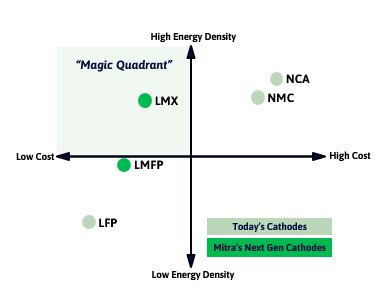
TL;DR: If you’re too lazy to read this, then just look at the graph! We need to be in the upper left quadrant for US energy independence, national security and mass electrification.
The problem with mass electrification in the West today is it relies on complicated materials like Nickel and Cobalt. These are not broadly available; a lot of it comes from high conflict areas, some of it is mined using child labor, the climate implications can be terrible, and China has stockpiled and will rate limit its use. And these are just a few of the problems…
All of this means that batteries are expensive and/or don’t deliver the energy density we want. Part of the reason we are here is that experimentation in battery metals is poor and most of the market is based on technology that is decades old.
At the beginning of the pandemic in 2020, I started a conversation over @X with @VivasVK7.
That back and forth led to us starting a company:
Can we build something that can better predict how different chemical elements may work together to make better battery materials? By building such a system, experiments could run much faster than the counterfactual, and learnings would grow quickly.
In current state-of-the-art battery materials, it takes 12-18mo to evaluate a hypothesis about a new chemical composition for metrics like energy density. The company we started, @Mitra_Chem, has shrunk the testing cycle by 90%, which should become even faster and smarter over time.
It has allowed us to land on a commercial formulation for an improved version of LFP - called LMFP - that will be scaled into OEM supply chains. IOW, slowly creeping towards the magic quadrant.
We have also found a new experimental formulation, LMX, that can deliver the energy density of NMC and NCA at the pack level but at the cost and reliability of LFP. There is still a lot of work to do to make LMX work, but we are hopeful. Aka, sweet foreplay with the magic quadrant is at hand.
Anyways, we just raised our first round of external capital, led by @GM. Hopefully they become customers tomorrow as well as investors today.
If you are a machine learning/AI engineer, a materials scientist or a chemist, please consider working with us:
https://t.co/WglPo0UJ6Q
https://t.co/W1URtlTCWH
Onwards.
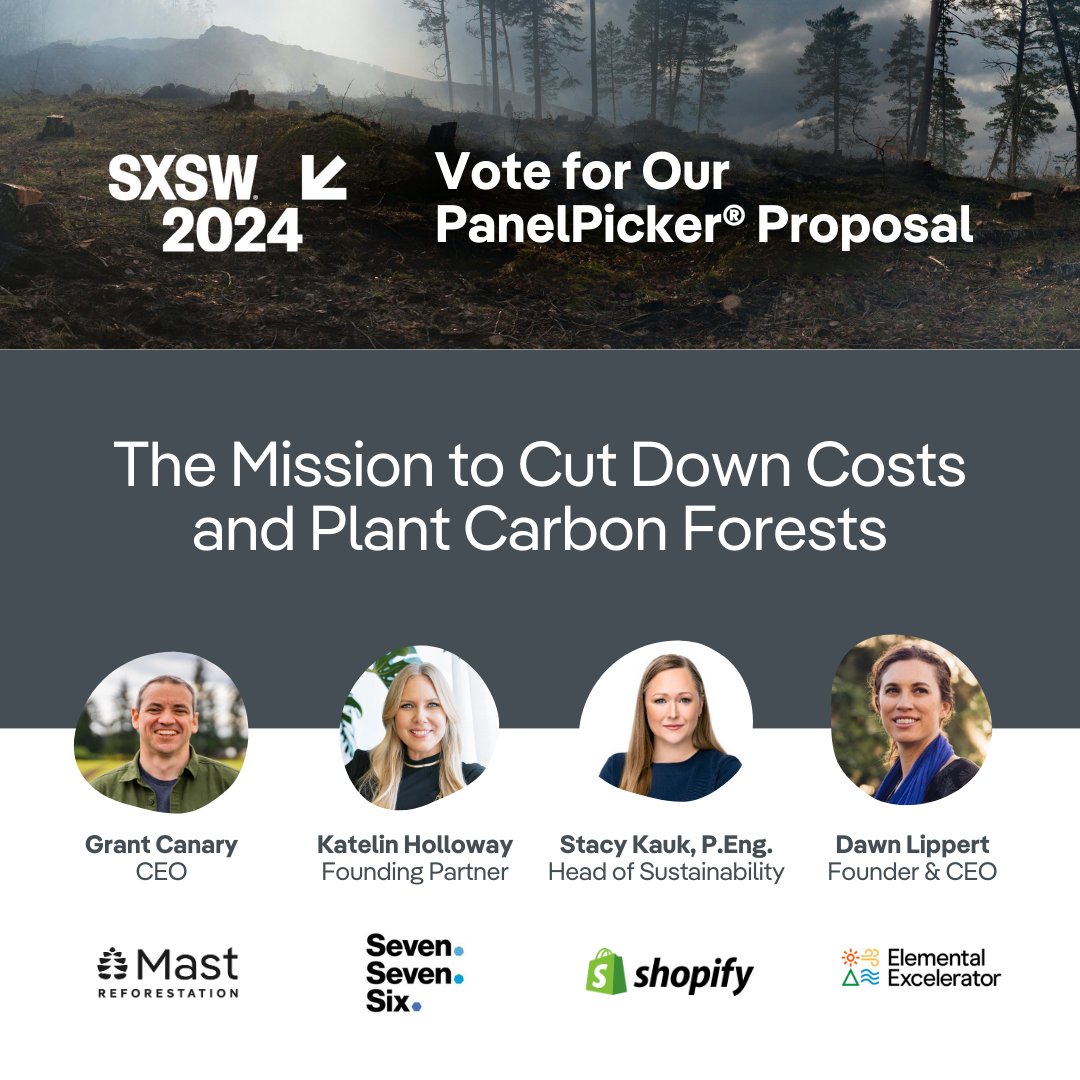
Mast friends and family, help us secure a panel at next year’s @SXSW
Cast your vote to hear from our CEO @GrantCanary and other climate leaders at SXSW on how to restore resilient forests.
👇Click to vote
https://t.co/woflkXNC63
Thanks for your support.