Do animals get jealous like people? New @BerkeleyPsych research looks at years of studies into whether non-human animals have a similar sense of fairness. The answer is more nuanced than it may seem. https://t.co/eCsGaaGeOO
Interested in developmental or comparative psychology? Join us! The Social Origins Lab will be hosting an 8-week summer internship filled with hands-on research experience, expert panels, and more. For more information, go to https://t.co/wUrRBLw0tJ.
Very excited to have this published! No evidence for inequity aversion in nonhuman animals: a meta-analysis of accept/reject paradigms, w/ Christoph Völter, @nicholaraihani , & @JanEngelmann5 : https://t.co/CHLyRO4RwP
Had a lot of fun speaking with the @mindsmatterpod all about great apes, their curious social behaviors and attentional patterns, and their amazing long-term social memory! Thank you for having me and for such a great convo 🧡🙏🏽
As I wrote this story, it made me wonder what else chimps and bonobos know.
Chimps remember the faces of old friends and family for decades | Science | AAAS https://t.co/lAdvMdMesf
Join us! The Social Origins Lab, will be hosting an 8-week (funded) internship for summer 2024. Go to https://t.co/BXXzIbdnfK and click 'Get Involved' tab for more information & a link to the application. Applications will be due February 5th at 9:00AM PST.
I am thrilled to finally share these results with the world! We found that chimps and bonobos likely remember familiar conspecifics whom they haven't seen in years -- possibly as long as 26 years. It's the longest memory ever recorded in nonhuman animals. https://t.co/2HGk62McnF
Wonderful video summary of our work showing that bonobos and chimpanzees likely remember previous friends and other groupmates for decades!
https://t.co/BO6xiJoPGS
A computer showed chimpanzees and bonobos pairs of ape faces for three seconds at a time: one of a stranger and the other an old companion they had not seen for years. The apes always spent more time looking at their former companion, research found. https://t.co/9e7taG0Nei
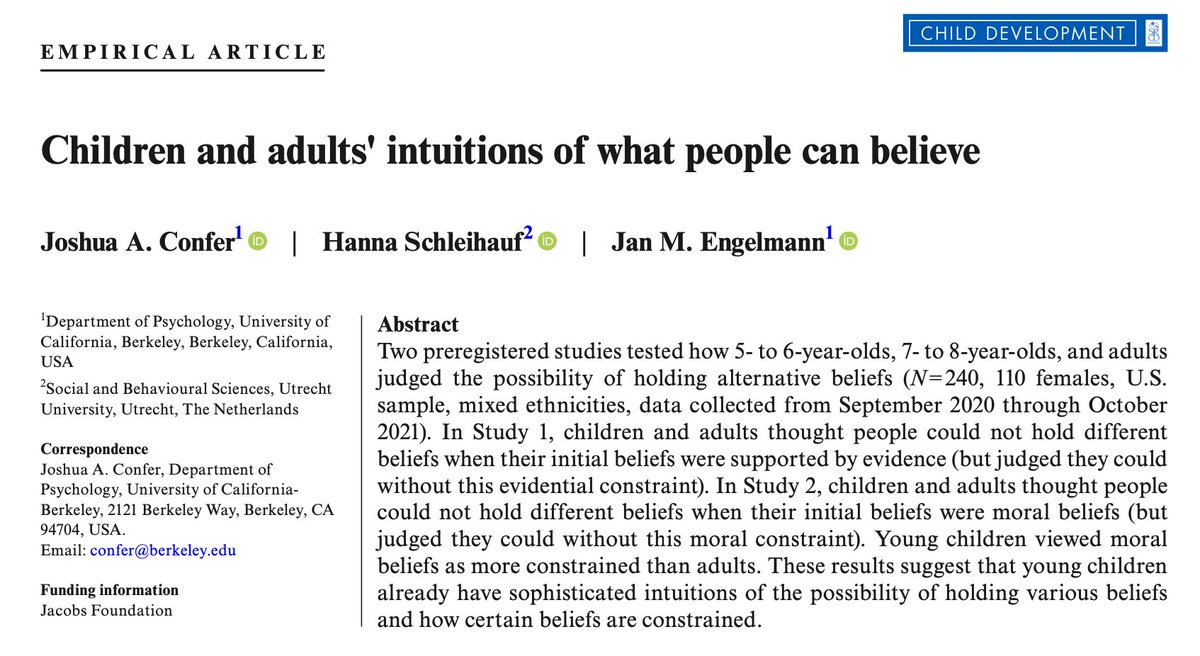
We often blame people for the beliefs they hold.
Does this mean we think people can choose their beliefs, like they can choose their actions?
We find children and adults generally think we can select our beliefs, but think we are restricted by evidence and morality.
Out now!
To be ready for any weather, you might grab sunscreen, a coat and an umbrella before you leave home. Now chimpanzees have demonstrated a similar ability to consider alternative futures. https://t.co/D2HJRxn6WT
More evidence that chimpanzees reason about different possibilities!
Using a new paradigm, we found that chimpanzees prepare for alternative possible outcomes. Paper out @royalsociety https://t.co/RoiZoVLlHk
Here is Okech protecting two possible targets from a competitor
1/5
We have a new paper out on the development of multimodal communication in chimpanzees!
Out #openaccess in #AnimalBehaviour, led by the v talented @emma_doherty27@DurhamPsych
Here's the link https://t.co/QG3Prwa4m9
& thread of the key findings 🐵🧵⤵️ 0/10
Pic by @jakebrooker
In our new paper with @Alex_Primate on #Curiosity, we compare how children and apes deal with uncertain options. Kids are more likely to explore alternatives and more willing to take risks, but apes can become more exploratory through analogical reasoning
https://t.co/0ixlYvX6YU
New evidence that nonhuman primates' response to receiving less than a partner might not be about fairness but instead about disappointment in the experimenter! In line with the social disappointment hypothesis: https://t.co/75AOuShBJ8
What does it mean to reason well?
In our new paper, out in Cognition today, we find a developmental shift: young children weigh outcome more heavily than process when evaluating someone's reasoning; older children and adults show the reverse preference
https://t.co/cf1hhpRNtm
Does good reasoning refer to reaching the right OUTCOME or to following the right epistemic PROCESS? https://t.co/nyMfmkPr46
We found that children initially value WHAT someone believes, but with development, increasingly value HOW beliefs are formed. Look at this 8-year-old💫: