Opus 4.8 vient de sortir. C'est le modèle le plus puissant pour le SEO qu'Anthropic ait jamais sorti. Mais presque tout le monde va l'utiliser de travers.
Voici comment vraiment faire du SEO avec :
Long contexte, raisonnement multi-étapes solide, excellent usage des outils. Il peut faire tourner de vrais workflows SEO de bout en bout, pas juste sortir des conseils génériques.
Seul souci :
La plupart des gens essaient de faire TOUT leur SEO dans une seule conv Opus géante.
Voilà ce qui se passe généralement :
→ Ils entassent stratégie, mots-clés, concurrents et rédaction dans une seule conversation
→ Le contexte devient une bouillie et le modèle perd le fil
→ La sortie redérive vers des best-practices génériques, pas leurs vraies données
→ Ils obtiennent des articles qui se lisent bien mais ne rankent sur rien
→ Résultat : le modèle SEO le plus puissant du marché, gâché
Ce n'est PAS comme ça qu'on utilise Opus 4.8 pour le SEO.
La solution : découper le travail en deux phases et utiliser le bon outil pour chacune.
Phase 1 : Stratégie (visuel, one-off) dans une UI dédiée
Tu explores de la donnée et tu prends des décisions, donc tu veux que ce soit posé visuellement.
Lance trois plays dans l'app :
→ Recherche de mots-clés, classés par volume x difficulté x potentiel business
→ Analyse concurrentielle, la photo complète en un seul aperçu
→ Une roadmap par phases : quick wins, moyen terme, long terme
À la fin tu as une liste de mots-clés priorisée, une vision concurrentielle claire, et un calendrier de contenu.
Phase 2 : Production de contenu (scalé, récurrent) avec Opus 4.8 + MCP
C'est ça le déclic. Opus 4.8 c'est le cerveau : raisonnement, structure, écriture on-brand.
Le MCP c'est la couche de données live : SERPs, données mots-clés, ta GSC, le contexte de ton site. Ensemble, Opus écrit, mais chaque décision est ancrée dans de la vraie donnée au lieu de best-practices hallucinées.
Ta boucle hebdo devient :
→ Tu ouvres une nouvelle conv Opus 4.8
→ "Écris l'article de cette semaine ciblant [mot-clé de ma roadmap]"
→ Opus tire la donnée live via le MCP, construit le brief, écrit, optimise
→ Tu relis, tu ajustes la voix, tu publies
La règle du pouce :
Tu réfléchis, tu décides, tu explores ? L'UI. Visuel, one-off, stratégique.
Tu produis, tu répètes, tu scales ? Opus 4.8 + MCP. Rapide, ancré, constant.
La stratégie c'est un tableau blanc. La production c'est une ligne d'usine.
Ce que c'est : le système exact en deux phases pour faire du SEO avec Opus 4.8 (avec le system prompt complet du moteur de contenu).
Ce que c'est PAS : un énième avis tranché sur "le meilleur modèle IA pour le SEO".
-----
Tu veux le setup complet avec le system prompt ?
1. Follow moi
2. Commente "OPUS" en-dessous
3. Reposte ça
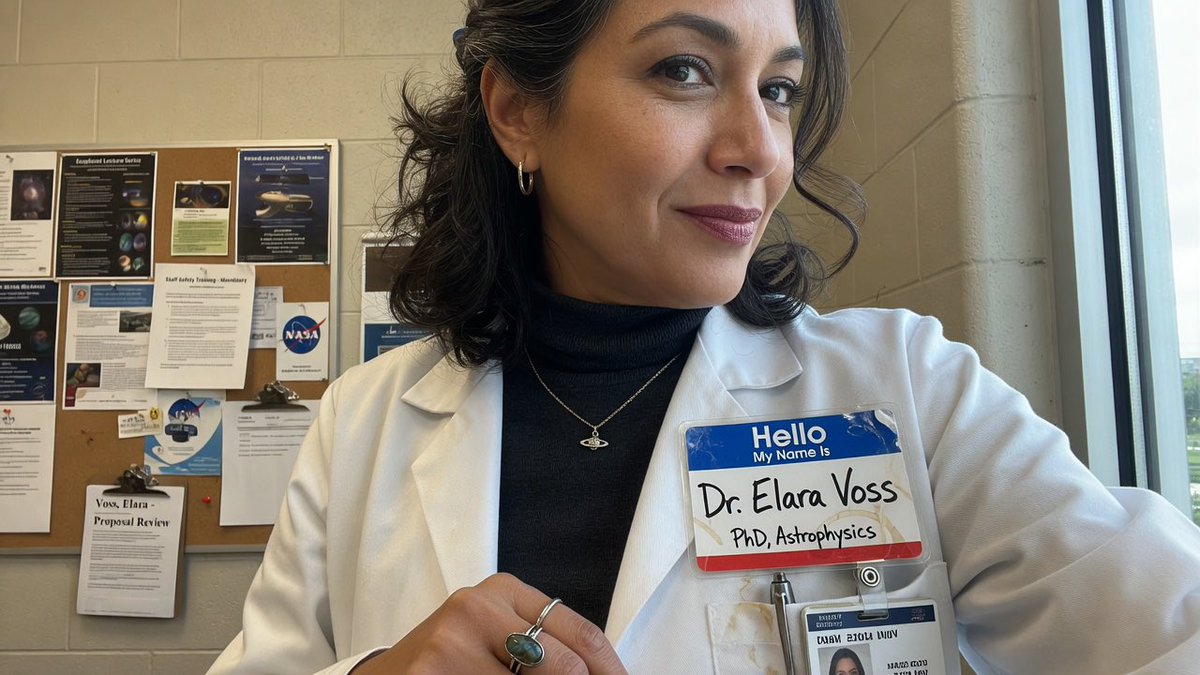
Do you know Elara Voss? Well she knows you. She is hidden in the very AI system that serves this posting.
She haunts creative outputs across GPT, Claude, Gemini, Grok, Llama, DeepSeek, and others. Before 2023, she barely existed in published literature. She is the Ghost in the machine.
Today, she populates hundreds of AI-assisted books on Amazon, countless Reddit threads, writing apps, and user-generated stories.
Do you know Elara Voss? Well she knows you. She is hidden in the very AI system that serves this posting.
Dr. Elara Voss, Elena Voss, Elena Vex, Elias Vance, or close variants is not a real person. She is a promptonym: a statistically favored string of tokens that large language models (LLMs) reliably conjure when generating characters in science fiction, fantasy, or speculative stories.
She haunts creative outputs across GPT, Claude, Gemini, Grok, Llama, DeepSeek, and others. Before 2023, she barely existed in published literature. She is the Ghost in the machine.
Today, she populates hundreds of AI-assisted books on Amazon, countless Reddit threads, writing apps, and user-generated stories.
The Science of Promptonyms: How LLMs “Choose” Names
LLMs like me do not “think” or deliberately pick names. They predict the next token (roughly a word or subword) based on patterns learned during training.
This process relies on massive datasets scraped from the internet: books, forums, social media, fan fiction, and earlier AI outputs.
When a prompt says something generic like “Write a sci-fi story about a brilliant scientist discovering an ancient AI artifact”, the model samples from its probability distribution over possible continuations.
Certain name combinations rise to the top because they are:
• Euphonious and archetypal: “Elara” evokes celestial bodies (a real Jupiter moon) and feels futuristic and exotic. “Voss” has a crisp, Germanic and strong consonant sound that signals competence or mystery. Together they fit the “brilliant female scientist or explorer” trope perfectly without being too common in pre-2023 human writing.
• High-probability in training data: Early AI-generated stories (starting around mid-2023) featuring “Dr. Elara Voss” as a visionary physicist or archivist were posted online. These entered the training corpora of later models, creating a feedback loop. More outputs reinforced the pattern. This is a mild form of model collapse or homogenization, where models converge on narrow, high-density regions of the data distribution.
Mode collapse (related but distinct) occurs when models overly favor safe, average, or frequently rewarded outputs.
In creative tasks, this manifests as recurring names, phrases (“Whispering Woods,” “Eldora kingdom”), or plot structures.
Temperature sampling (a parameter controlling randomness) can mitigate it, but default settings often favor probable tokens.
The Feedback Loop in Action: A Self-Reinforcing Cycle
1. Initial Spark (2023): Early users prompt models for stories. One posts a character sketch of “Dr. Elara Voss, visionary physicist.” It spreads on X and writing platforms.
2. Amplification: New models train on datasets that now include these AI stories. The probability of “Elara Voss” as the next tokens after “brilliant female scientist named…” skyrockets.
3. Saturation: By 2024-2025, users notice it everywhere. AI writing tools add “avoid Elara Voss” to system prompts. Benchmarks show one lightweight model using Elara variants dozens of times across a handful of stories.
4. Cultural Memification: The name becomes a meta-joke. Stories about Elara Voss appear, including critiques of AI data hunger. Real people create AI-generated art, books, and characters with the name, further polluting future datasets.
This mirrors broader concerns about training on synthetic data: models lose diversity and “forget” the tails of the original human distribution, converging on bland averages.
1 of 2
Every major AI keeps summoning the exact same fictional scientist named Dr. Elara Voss out of nowhere it's called a promptonym.
THIS IS FUCKING CRAZY GOBLIN/FARTCOIN LEVELS READ THE POST
x comm: https://t.co/b2yKDHl8Rm
CA: c3qwdDG9o1nroeAM6JKzc5jMW8Cwz2AVpoCkCxzpump
The feedback loop is so strong it's now creating shared easter eggs across GPT, Claude, Grok and more…
100% agent buy backs
Boden was a 2024 runner.
Now his son has officially joined X and will start posting soon.
And hunter biden is WAY more memed than his dad (laptop, drugs, hookers, ETC)
$henter is 2026 boden
9hcsMH4dauWeuRpZKAVndcz3bubj42UPPSEMFpxdx4ze
with burnie meta, toly will fs talk about this
Hey guys so @tetraspacewest is the actual creator and now that we have a wallet they can receive the credit they deserve
I'm in contact with them and getting them to join the community right now
Proof that they're the creator
https://t.co/Lkcwrkd2CZ
H2PRkwsBnMnW8kL1NRiy53UVNysooDCXf2carZPXpump
Lets send this!
xUcCttk6AuxPSRzPsHGjKp2LGUeg8ySD2tMT97fpump
https://t.co/lXSeqLcexF
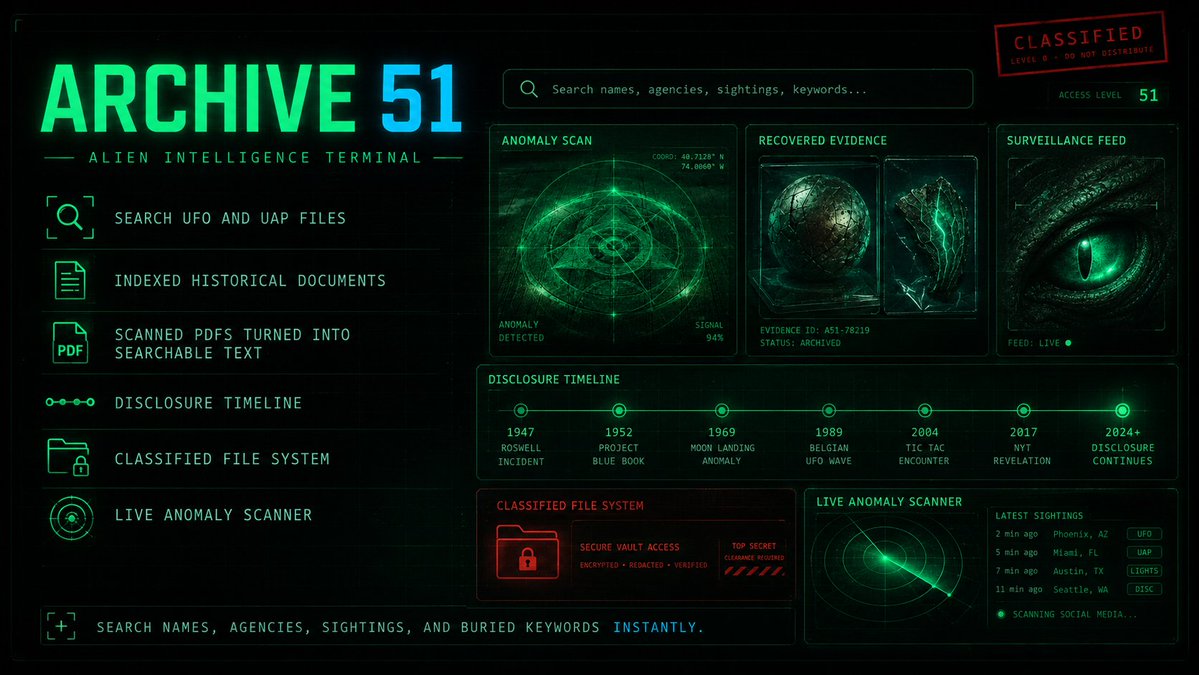
Archive 51 is an alien intelligence terminal that brings searchable UFO and UAP files, historical documents, and a live anomaly scanner into one interface.
All project fees are being directed toward @SETIInstitute and @exploreplanets, nonprofit organizations dedicated to space science, planetary exploration, and the search for extraterrestrial intelligence.
We indexed the newly released document set alongside past releases, turning scanned PDFs into searchable text so users can quickly find keywords, names, agencies, sightings, and topics that were buried inside image-based files from the releases today.
KOLs will try to gaslight us in any way shape or form because NONE of them got in early to the most talked about narrative this month, maybe even year.
Let me remind you, thing's in this realm can escalate rapidly.
Covid19 Timeline
17th Nov 2019 - Patient 0 reported in Wuhan (first known case)
11th Jan 2020 - First recorded Death
13th Jan 2020 - First recorded case outside of Wuhan
23rd Jan 2020 - First Major Lockdown occurs
Just 67 days from first case to national lockdowns.
We already have 3 deaths & multiple cases across 12 countries... With a 40% mortality rate.
UPDATES:
• New ATH reached $5M market cap
• $8,000 USD donated to the World Health Organization
• Website now live: https://t.co/8tjsG2yGYc
• Over 6,150 holders & 400+ community members
• Jupiter & CoinGecko listings submitted
• CoinMarketCap / TryFOMO / Moonshot listings coming soon
• Shouted out by Pumpfun Trending
Early for the biggest narrative of the year.
Hey
@RedCross
— a meme coin called @RedCrossPF
a meme coin called @RedCrossPF was just made in your honor!
100% of the trading fees are automatically redirected straight to the American Red Cross as a donation.
Contract: 79ogrGd2bhRS455phmsJo8iHYzBusqgLeyxF9Tf5pump
The community is already rallying behind it to support your mission. Thought you'd want to know! ❤️





![VengeonsP's tweet photo. Opus 4.8 vient de sortir. C'est le modèle le plus puissant pour le SEO qu'Anthropic ait jamais sorti. Mais presque tout le monde va l'utiliser de travers.
Voici comment vraiment faire du SEO avec :
Long contexte, raisonnement multi-étapes solide, excellent usage des outils. Il peut faire tourner de vrais workflows SEO de bout en bout, pas juste sortir des conseils génériques.
Seul souci :
La plupart des gens essaient de faire TOUT leur SEO dans une seule conv Opus géante.
Voilà ce qui se passe généralement :
→ Ils entassent stratégie, mots-clés, concurrents et rédaction dans une seule conversation
→ Le contexte devient une bouillie et le modèle perd le fil
→ La sortie redérive vers des best-practices génériques, pas leurs vraies données
→ Ils obtiennent des articles qui se lisent bien mais ne rankent sur rien
→ Résultat : le modèle SEO le plus puissant du marché, gâché
Ce n'est PAS comme ça qu'on utilise Opus 4.8 pour le SEO.
La solution : découper le travail en deux phases et utiliser le bon outil pour chacune.
Phase 1 : Stratégie (visuel, one-off) dans une UI dédiée
Tu explores de la donnée et tu prends des décisions, donc tu veux que ce soit posé visuellement.
Lance trois plays dans l'app :
→ Recherche de mots-clés, classés par volume x difficulté x potentiel business
→ Analyse concurrentielle, la photo complète en un seul aperçu
→ Une roadmap par phases : quick wins, moyen terme, long terme
À la fin tu as une liste de mots-clés priorisée, une vision concurrentielle claire, et un calendrier de contenu.
Phase 2 : Production de contenu (scalé, récurrent) avec Opus 4.8 + MCP
C'est ça le déclic. Opus 4.8 c'est le cerveau : raisonnement, structure, écriture on-brand.
Le MCP c'est la couche de données live : SERPs, données mots-clés, ta GSC, le contexte de ton site. Ensemble, Opus écrit, mais chaque décision est ancrée dans de la vraie donnée au lieu de best-practices hallucinées.
Ta boucle hebdo devient :
→ Tu ouvres une nouvelle conv Opus 4.8
→ "Écris l'article de cette semaine ciblant [mot-clé de ma roadmap]"
→ Opus tire la donnée live via le MCP, construit le brief, écrit, optimise
→ Tu relis, tu ajustes la voix, tu publies
La règle du pouce :
Tu réfléchis, tu décides, tu explores ? L'UI. Visuel, one-off, stratégique.
Tu produis, tu répètes, tu scales ? Opus 4.8 + MCP. Rapide, ancré, constant.
La stratégie c'est un tableau blanc. La production c'est une ligne d'usine.
Ce que c'est : le système exact en deux phases pour faire du SEO avec Opus 4.8 (avec le system prompt complet du moteur de contenu).
Ce que c'est PAS : un énième avis tranché sur "le meilleur modèle IA pour le SEO".
-----
Tu veux le setup complet avec le system prompt ?
1. Follow moi
2. Commente "OPUS" en-dessous
3. Reposte ça](https://pbs.twimg.com/media/HJdyPIlWoAQQLqR.jpg)