such a cool #GPU! btw available on https://t.co/J4gO5pcw3d @eBay_UK - and this one @PowerColor is much cheaper than the same #videocard analogues like: Gigabyte on Very or Amazon, and Asus on Box with AWD, or Sapphire on AliExpress, etc etc
I used to run two @AMD GPUs already at home: #RX7800 XT 16GB → #RX7900 XTX 24GB → A few days ago, I installed a @PowerColor@AMDRadeon#AI PRO #R9700 with 32GB of VRAM.
The hardest part wasn't getting the GPU to work. It was getting my AI agents to figure out that it was already working. My setup is slightly ridiculous:
→ @Hi_MINISFORUM's @AMDRyzen mini-PC and their OCuLink DEG1 eGPU dock (with @GlobalLianli #LianLi 1200W PSU)
→ @OlaresOS / @Linux / @kubernetesio
A growing collection of #AI assistants supposedly capable of operating all of this:)
The hardware booted. The GPU was detected. The driver worked. And then the fun began.
One AI assistant couldn't access the Olares terminal. Another tried a different route and hit a 404. Another ran out of usage credits before completing the diagnosis.
At some point, I realised I wasn't benchmarking the GPU anymore.
I was benchmarking the AI agents trying to benchmark the GPU:)))
Eventually, @claudeai's coding environment found a working path through #Kubernetes.
And suddenly everything worked! O_o
@Alibaba_Qwen 2.5, Q4_K_M, running locally on the R9700:
→ 7B — 102.3 tokens/sec
→ 14B — 54.3 tokens/sec
→ 32B — 27.1 tokens/sec
Three runs per @qwenmax model. All layers on the GPU. No crashes or out-of-memory errors. Maximum junction temperature: 69°C.
→ The 32B model used around 21GB of VRAM, leaving roughly 11GB available.
→ All through an OCuLink connection running at PCIe 4.0 ×4.
And this wasn't just an isolated benchmark. The R9700 is now running a separate 27B model as the fourth backend in my local @AnythingLLM setup, alongside two @nvidia #RTX3060 machines and a dedicated @TiinyAILab devices.
My takeaway?
→ The #AMD hardware was less troublesome than I expected:)
→ The AI orchestration was more troublesome than it had any right to be:(
And the most useful breakthrough wasn't a new model or driver. It was finding an AI execution environment that could actually operate the machine.
Next experiment: a used AMD Instinct MI50 with 32GB of HBM2... Can an older accelerator deliver enough of the same practical utility (at less than a third of the price)?
That's a comparison I'm genuinely curious about.
#LocalAI #AMD #ROCm #AIInfrastructure @ClaudeDevs
Heard Jensen in London. Still chewing on it. AI that answers faster is useful. AI that makes me notice I asked the wrong question is more interesting.Tool isn’t the bottleneck anymore. (Bach analogy was a stretch.) Agents will feel ordinary long before they’re safe — which is why
The tool is no longer the bottleneck. The question might be.
Give me an AI that answers my question in half the time: useful.
Give me an AI that helps me notice I was asking the wrong question: now we might be getting somewhere.
Three more thoughts from hearing #JensenHuang (suddenly not yesterday, in Berlin) in London on 14 October. Recollections and interpretation, not a transcript. The Bach analogy is entirely my fault.
1. DON'T JUST USE THE MACHINE. BUILD THE MACHINE.
The idea that stayed with me wasn't simply producing more things with AI. It was being able to create your own means of producing them.
Using software to do your work is one thing. Building the software through which your work gets done is another.
One makes you a faster operator. The other lets you question the operation.
Imagine wanting to play Bach, but first having to prove you can read every mark in the score. Now imagine that technical entry barrier becoming less decisive.
Not “engineering no longer matters”. More: “technical notation is no longer the only admission ticket.” You still need judgment. What do you want to play? Can you tell whether it sounds right?
2. THE AGE OF AGENTS MAY ARRIVE AS A HABIT.
I remember Jensen comparing agents with the early browser era. I took away a psychological point: people may adopt useful agents before the technology becomes immaculate. Repetition turns something unsettling into something ordinary.
Eventually, some of it becomes Tuesday.
My qualification: familiarity is not safety. But asking people to remain permanently frightened isn't a product strategy either.
The system has to earn the right to become boring.
That's why I care about controls that remain in force after the user relaxes. NVIDIA's OpenShell announcement in Berlin yesterday adds a concrete engineering counterpart: containment, monitoring and policy enforcement outside the agent's own discretion.
3. FASTER ANSWERS ARE NOT THE ONLY KIND OF PROGRESS.
“How do I make this payment faster?” becomes “Does the agent still have authority to make it?”
“Where do we find power for a data centre?” becomes “What else could an existing energy site provide?”
Those are different design problems, not more eloquent answers to the old ones.
We already discussed the move from creators and coders to industry-specific agents. The next question is what industry experts choose to build once building becomes easier.
I don't just want AI to agree with my question more efficiently. I want it to help me discover a better one — and build something small enough to test it.
My entirely unsolicited two-word slogan for the @nvidia:
Keep asking.
What would you build if the technical entry barrier were lower? What question would make it worth building at all? @NVIDIAAI
Source code, the credential-free request, completed Atlas status & unedited raw result:
https://t.co/QrqNmFkn4k
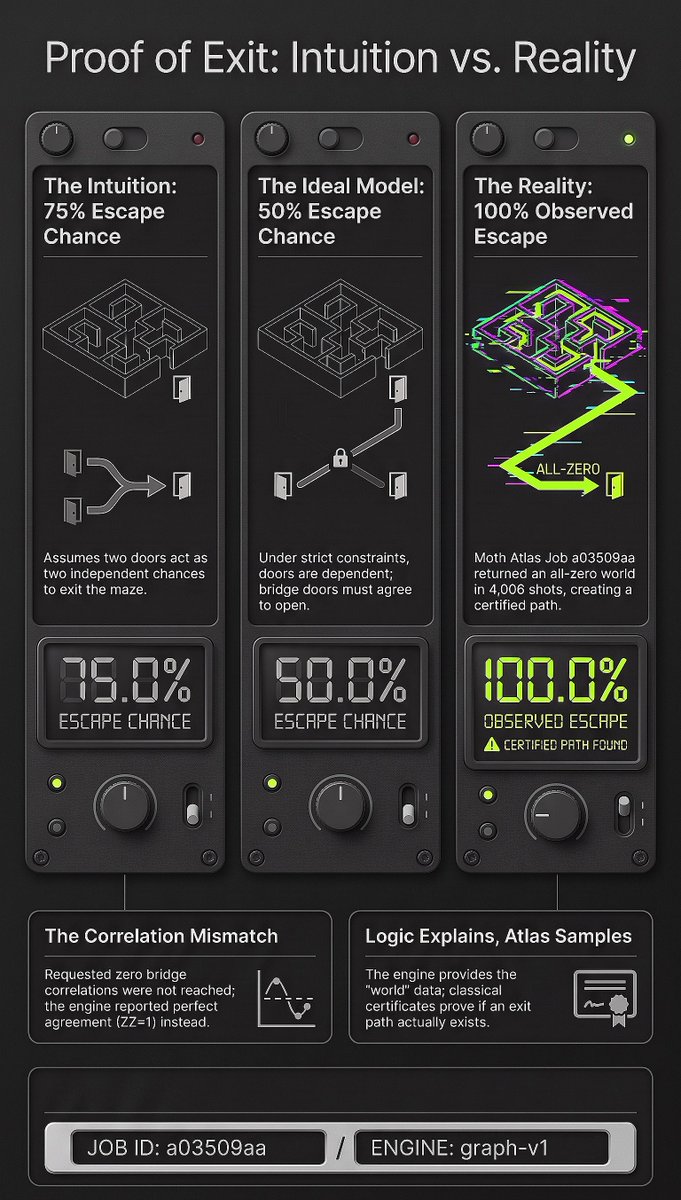
Atlas graph-v1 emulation on Aer — not a physical QPU. The intended 50% target was not realised; the observed result was 100%, & that mismatch is preserved as the result
The 100% Escape Paradox: Why Logic Overrules Intuition in a Quantum-Simulated Maze
tested @Moth_Quantum with my https://t.co/63KvD5xXpc small experiment:)
1. The Odds You Think You Know
Imagine a world where your entire reality is defined by exactly sixteen bits of information. You are standing in a 4×4 maze, facing two doors that lead to the exit. If you’re told each door has a 50% chance of being open, what are your odds of escaping?
Most of us instinctively calculate a 75% success rate, assuming that two paths provide two independent opportunities to win. But in the "Proof of Exit" project, we use quantum-inspired simulation to reveal a deeper truth: independence is often an assumption, not a fact. In a system governed by strict logical constraints, that second door might not be a "second chance" at all—it might be a mirror image of the first.
2. The Illusion of Independent Chances
Human intuition defaults to what we call "Independent-door intuition." If Door A and Door B are independent, the only way to fail is if both are closed (a $0.25$ probability), leaving a $0.75$ or 75% chance of escape.
However, the logic of this specific 4×4 maze is dictated by an Agreement Rule: a corridor between two rooms only opens if those rooms share the same bit value (both 0 or both 1). Under these equality constraints, the "bridge doors"—specifically identified as edges (3,7) and (10,14)—are not independent. They are mathematically locked.When the maze is modeled with these constraints, the two bridge doors must agree; they either both open or both close. Because of this hidden dependency, the Balanced target prediction for escape is not 75%, but exactly 50%. Our brains see two paths, but the underlying topology sees a single, interconnected system where the doors move in unison.
3. Brute Force vs. The 16-Bit World
To validate this, we don't rely on guesswork; we use exhaustive classical verification. In a 16-bit world, there are exactly 65,536 possible configurations (or "worlds").
By checking every single one of these 65,536 possibilities against the maze’s corridor agreement rules, the proof reaches a definitive conclusion: only four worlds satisfy the ideal constraints of the maze. Crucially, in none of those four configurations is exactly one bridge door open. The classical logic is binary and unyielding—the doors are either both accessible or both blocked."
Atlas samples. Logic explains.
4. The Gap Between Intent and Reality
To see how this logic holds up in practice, we ran a job using the Moth Atlas Engine (graph-v1).
Technical Reference - Job ID: a03509aa-4b7b-4a0a-bc16-c35d3f14514f
Configuration: Aer emulation (noiseless)
Shots: 4,096
The experiment revealed a fascinating "correlation mismatch." While the request specified a bridge correlation of solana:mhE4bii7pzYLcaWCSB4L2chiF2k7rdyxBuwbJDnpump=0$ (intended to create independent, uncorrelated doors for the 50% target), the engine returned the "all-zero world" (0000000000000000) in every single one of the 4,096 shots.
Because the all-zero world satisfies the agreement rule (all adjacent rooms share the bit '0'), every corridor is open. This includes a deterministic path certificate—a logic-backed proof of reachability—for the route 0-1-2-3-7-11-15. Consequently, the observed escape rate was 100%. The engine’s tomography reported solana:mhE4bii7pzYLcaWCSB4L2chiF2k7rdyxBuwbJDnpump=1$, showing that the doors maintained perfect agreement despite our request for independence.
5. Evidence, Not Interpretation
It is vital to distinguish between the model and the measurement. This simulation utilized a noiseless Aer emulation; no physical QPU or quantum advantage is claimed. A key technical distinction here is that the tomography in the Atlas engine is computed classically for the prepared state, reinforcing the "Logic explains" philosophy.
The "Proof of Exit" project serves as an exercise in scientific transparency. By displaying the 50% ideal prediction alongside the 100% observed result, we highlight the gap between what we intend to sample and what the evidence actually shows. The engine is a provider of raw evidence; it is not a black box that guarantees our interpretations are correct."
Quantum output in evidence, not an interpretation.
6. What Lies Beyond the Door?
The 4×4 maze is a microcosm of the complex systems we navigate daily. It reminds us that "two doors are not always two chances." What appears to be an independent choice is often a dependent variable, tethered by constraints that exist below the surface of our intuition.
This lesson extends far beyond quantum simulations. In an era where we must audit increasingly complex AI behaviors or financial models, we must look for these hidden "bridge correlations." We must ask: In our own systems, how many of our "independent" choices are actually locked together by constraints we have yet to map? Under the light of rigorous evidence, we often find that the exit was never a matter of chance, but a matter of logic.
If you're building something where this matters — or you know someone who is — I'd appreciate a share https://t.co/00dNT6v9Wt or an intro via [email protected]
I built a bank from scratch. Not as a metaphor — an actual US banking licence (OCIF IFE-065, 2021), $25M raised, 60 people, 26 countries, $150M AUM. Zero marketing budget the entire time.
The last two years I spent thinking — researching digital identity, AI infrastructure, and the future of money. Writing books is how I prepare for things that matter to me.
Now I'm ready to build again.
I'm looking for a mandate: a bet to own end-to-end, inside a company that's serious about where fintech, digital identity, or AI is going. Or a fractional/advisory engagement if the problem is genuinely hard.
London/Edinburgh/remote. Available immediately. Global Talent Visa → ILR → no sponsorship needed.
Field notes, twenty-one months later https://t.co/t9EuExd20p I spent two days arguing the field into a console instead of another essay:
In late 2024 I wrote that the atom might return as a wry punchline, not a 1950s parade. “Atomic 2.0.” The dog, I joked, had eaten the nuclear homework.
September 2026 is the month the homework came back graded. Not with a gold star. With a temperature.
@WECNuclear’s eVinci test assembly went critical hot — 663 °C, peak core 1,011 °C — at NCERC. That is not a power plant. That is a chain reaction holding together where the heat pipes and the TRISO actually live. Physics stopped being a slide.
The useful discovery was not the core. It was the buyers.
One substrate. Two clocks.
Defence does not want a battlefield reactor. The Army said that out loud. It wants the fuel convoy to disappear: a sealed 1–5 MWe skid that sits behind a fence for five to eight years. That is the #porcupine in https://t.co/ANGLadKgk6 — distributed, boring, expensive to smash.
Compute does not want a 1 MWe box to feed a gigawatt campus. It wants megawatts by a date. Tokens do not wait for a five-year interconnect queue. Price it in $/MW-delivered-by-date. That is the power-first siting in https://t.co/0gD8tgs557.
Who is actually moving metal:
@RadiantNuclear — Kaleidos on a truck to @INL / @NRICnuclear DOME; Oak Ridge factory under NRC review; DoD + @Equinix offtake
@BWXT — Project Pele, own TRISO, first Army electrons aimed at 2028
@AntaresNuclear — Mark-0 critical; Janus at Fort Bragg
@WECNuclear — eVinci hot criticality; Janus at Fort Drum
@Oklo — Aurora / Groves; hyperscaler PPAs (different scale, same offtake logic)
@xenergynuclear — TRISO-X fuel line + mobile design
@AaloAtomics — another DOE-pilot criticality; factory thesis
@RosatomGlobal — the only stack already selling kilowatt-hours (floating + icebreaker RITM)
Fuel choke: @centrus_energy now, Urenco later. Contracts beat neutronics.
China is first to a land SMR that might connect (Linglong One). America is first to a factory argument. Fuel will pick the winners more cruelly than physics.
So the 2024 dream survives, thinner and better. Not a city on one miracle. A sealed box on a trailer. A garrison that stops bleeding diesel. An inference hall that does not wait for the grid.
The atom is no longer a cosmic joke. It is a logistics problem with a temperature rating.
Console is live. Handbook next.
#NuclearEnergy #Microreactors #DefenceTech #AIInfrastructure #RosAtom https://t.co/9Gs3KCz7VN
I’m opening this mandate/job/EiR-role search https://t.co/Ei43F0hH01 if there’s a problem on your side where I could be useful, I’d genuinely like to talk [email protected] → If this resonates with anyone in your orbit, feel free to forward/share
UPDATE: Never trust the AI blindly. My AI assistant previously told me the RAM in the AM18 Cube was soldered. I decided to open the case myself and discovered a goldmine: two full SO-DIMM slots https://t.co/qx7i7HII4A with @Acemagic_MiniPC! → now 2×16GB dual-channel / 2 SO-DIMMs
Connected&started my new ACEMAGIC AM18 Cube (AMD Ryzen™ 5 7640HS Mini PC / 16GB RAM + (512GB upgraded to) 2TB Gen4 SSD - ordered 22'July, delivered 21'Aug) via Aohi's Starship Pro 310W 20,000mAh LED Power Bank (connected to AOHI The Future AI PD3.2 280W 6-Port Desktop Charging Station) - tested previously other mini-PCs via different powerbank brands, and it was always 'fragile' and never stable! https://t.co/PGI6DfLSuh thnx @Acemagic_MiniPC x @OfficialAohi - even works well, as you can see, via @AnkerOfficial USB C Hub (5-in-1 USBC to HDMI Splitter with 4K Display) not-direct power distribution
перефразируя ��рубо Экзюпери: рецензии - как будто говорят, вот Михаил проанализировал разные типы лесов, вязания канатов и предлагает вам подробную инструкцию строительства корабля. а @zygaro говорит: эй, хочешь покажу тебе Море? оно ОХУЕННОЕ! (и правда,море у Зырагя получилось!)
как часто\обычно бывает - я начал не с того конца: будучи давно, и вполне себе даже наивно-искренне-во��торженно, подробным читателем и поклонником каждой из книг @zygaro - я, узнав первый самый ещё раз о выходе "Тёмной стороны Земли", само собой, перво-наперво намеревался её прочитать как опубликуют - но совершил банальную ошибку: я прочитал рецензию на неё (кстати, вполне возможно, что она была от @meduzaproject , но это не так важно - все были хвалебные), потом вторую, потом третью. и каждый раз я всё дальше откладывал прочтение. (спойлер: именно этот твит Медузы в итоге-таки "заставил" меня взять-сесть-открыть-прочитать - ну и, как это всегда с книгами Зыгаря у меня: нача�� читать - и потом только разве что за чаем, да в уборную, - не могу остановиться, пока не закончится) а проблема (для меня - так что, вполне возможно, это вообще моя личная проблема) рецензий всех хвалебных этих была в том - что все они были "про ЧТО", а книга-то вообще не про это, она "про КАК" (на первых страницах упоминается Мамардашвили - так вот, у него много про это: не так важно что конкретно помыслили - важнее, как вообще мыслили, кто-когда и в каких условиях\контексте, как эта мысль цвела и текла, как это было красиво в моменте, в процессе). ну если вы читали вдруг "1913. Лето целого века" Флориана Иллиеса - и я бы вам вдруг стал рассказывать (хвалебно), что книга мол про исторические события пред-военного времени хронологически-дотошно рассмотренные под микроскопом автором, который будто бы взял у каждого из участников событий персональное (из 100+) интервью перед публикацией. ну Иллиес бы меня точно нахуй послал за такую хвалебную рекомендацию - так и у меня с рецензиями этими вышел конфуз. т.е. никто в этих рецензиях, конечно, не соврал, и уж точно ничего плохого не имел ввиду - просто книга Зыгаря вообще не об этом. (и, кстати, то, что она продолжается в форме театральных постановок - куда ближе к описанию!) тут сам формат, форма, ритм, пойманные недосказанности, сделанные нарочито или невзначай намёки и отсылки с пасхалочк��ми (как от самого автора, так и от истории) - это ж вот всё гораздо важнее. нельзя же некоторые вещи просто взять и рассказать - их можно сыграть на скрипке, их можно потрахаться, ��х можно испечь, их можно нарисовать... их можно написать было как "Тёмную сторону Земли", и, наверное, их можно было только так
are #eGryphon and #Orcanyx on @Kickstarter completely unrelated teams — or is there any shared ODM, manufacturer, supplier, (which ones?) - people or corporate connection behind the two projects?
I’m not claiming there is. I’d just very much like to know.
One small consolation: I nearly backed #Orcanyx, another remarkably similar tiny eGPU on @Kickstarter. After already backing multiple eGryphons, I decided not to.
That decision is aging rather well & now I’m genuinely curious: are #eGryphon and Orcanyx completely unrelated teams?
Wes Anderson should make #Hašek's 'The Good Soldier Švejk': https://t.co/6FLENL6QSm Why the hell not?
Pastel trenches. Symmetrical court-martials. #Švejk’s cheerful “yes sir” weaponized into bureaucratic Armageddon while the empire collapses in perfect dollhouse symmetry, and modern geopolitical assymetry. Andersonian in form. Hašekian in content. Malicious compliance never looked this stylish.
@AccidentalWes@QuotingWes@WesAndersonfc@rWesAnderson@SvejkSoldat@Svejk@GoodSvejk@chmnkhbt what do you think?:) there is notable X-post from 2023 by a Catalan publisher account @LesMalesHerbes that explicitly compares a book (Miràbilis) to the styles of both #WesAnderson and #JaroslavHašek
About the World's Elite Talent Visas: The Global Talent Maze https://t.co/l2AmJXhFlD (DOI 10.6084/m9.figshare.30480821)
You are a leader in your field—a researcher, engineer, or artist with a track record of excellence. The dream of taking your skills to a global hub like London, Paris, or New York feels within reach. You start researching the elite "genius visas"—the UK's Global Talent, the US's O-1 "Extraordinary Ability," and France's Passeport Talent—only to be met with a labyrinth of complex criteria, conflicting advice, and intimidating statistics. The path forward seems designed to be as challenging as the achievements required to even consider it.
This is a common experience for the world's top professionals. The marketing and official descriptions of these programs often obscure the practical realities of how they function. This article cuts through the noise. Based on a deep analysis of the rules, statistical patterns, and strategic nuances of the world's leading talent visas, we will reveal several surprising, counter-intuitive, and impactful truths that can change how you approach your global mobility strategy.
Forget the generic advice. Here are the realities you need to understand to successfully navigate the global talent maze.
Truth #1: The UK's "95% Success Rate" Is an Illusion
One of the most frequently cited statistics about the UK's Global Talent Visa is its success rate of over 95%. While technically accurate, this figure is dangerously misleading and has lured many applicants into a false sense of security. The reality is that the visa operates on a distinctive two-stage process, and the 95% figure only applies to the final, easiest part.
The process is deliberately split into two hurdles:
• Stage 1: The Endorsement Gauntlet. Here, your talent is rigorously assessed by a panel of experts in your field. This is the real test.
• Stage 2: The Visa Formality. After endorsement, this is a standard immigration check for identity and security. This is where the 95% success rate applies.
The widely advertised 95% success rate refers only to Stage 2. The endorsement stage is a different story. For example, the highly competitive digital technology route has historically seen endorsement refusal rates of 30-40%. This two-stage system is a deliberate policy choice: the government has outsourced the complex judgment of "talent" to specialized bodies. The endorsement, not the visa, is the true prize.
Truth #2: The US O-1 Visa's Biggest Drawback Isn't the High Bar—It's the "Family Veto"
The US O-1 "Extraordinary Ability" visa is legendary for its high evidentiary bar, requiring sustained national or international acclaim. Applicants spend months compiling vast portfolios of evidence to prove they are at the very top of their field. However, for many mid-career professionals, the visa's most significant limitation isn't its difficulty, but a crucial, often overlooked, rule regarding family.
The dependent visa for the spouses and children of O-1 holders, known as O-3 status, does not permit them to work in the United States. This "family veto" can be an immediate dealbreaker for dual-career couples or families who rely on two incomes.
This stands in stark contrast to other leading talent programs. France, for instance, makes spousal work rights a central feature of its Passeport Talent framework, viewing it as a key competitive tool.
Crucially, this permit grants the spouse the right to work in France immediately, a significant competitive advantage over countries like the US, where dependent spouses on O-3 visas are prohibited from working.
For a talented professional whose partner also has a career, this single policy detail can make France a surprisingly superior and more practical option than the United States, regardless of how strong their individual case for "extraordinary ability" might be.
Truth #3: For Tech Talent, Your GitHub Profile Can Be More Powerful Than Your Résumé
For programmers, engineers, and other tech professionals, the rules of evidence for talent visas are changing. In a significant shift from traditional applications that rely solely on CVs and formal employment letters, certain elite visas now place immense value on your public digital footprint.
The UK's Global Talent Visa for Digital Technology is the prime example. The endorsing body (criteria formerly managed by Tech Nation) explicitly recognizes open-source contributions as a key form of evidence. A well-maintained GitHub profile can be strategically used to demonstrate core visa criteria like an "innovation track record" and "recognition beyond occupation." This approach is powerful because it provides quantifiable, public proof of your impact that is independent of any single employer. A widely-forked GitHub repository or a top-ranked ProductHunt launch serves as verifiable, third-party validation of your influence and innovative capacity, which is precisely what endorsing bodies are seeking.
Similarly, a successful ProductHunt launch can be framed as powerful, quantifiable evidence of market validation and innovation. This modern approach recognizes that for today's top tech talent, influence and ability are often demonstrated through public, collaborative, and digitally native work, not just through a traditional corporate hierarchy.
Truth #4: You Can't "Convert" Visas, But You Can Build a "Universal Talent Passport"
A common myth among globally mobile professionals is the idea of visa reciprocity—that holding an elite visa from one country, like a US O-1, can be easily "converted" or swapped for its equivalent in another, like the UK Global Talent. This is fundamentally incorrect. Immigration is a matter of national sovereignty, and every application for every country is assessed independently against its own specific criteria.
However, a more sophisticated concept of "de facto portability" exists. The real value is not in the visa stamp itself, but in the evidence dossier required to obtain it. The process of preparing a successful application for the highly demanding US O-1 visa forces you to create a comprehensive "master file" of your career achievements. This meticulously compiled portfolio—containing major awards, publications in high-impact journals, extensive media coverage about your work, patent filings, and powerful letters of recommendation from undisputed global experts—is the key.
This dossier can be strategically repurposed to meet the criteria for other elite talent programs. The evidence required to prove "extraordinary ability" for the US is remarkably similar to what's needed to prove you are an "Exceptional Talent" in the UK or have an "internationally recognised record of exceptional and outstanding achievement" for Australia. The most strategic professionals don't just prepare an application for a single country; they build a universal "talent passport" of evidence that makes them a compelling candidate anywhere in the world.
Conclusion: It's Not Just About Your Talent, It's About Your Strategy
Navigating the world of elite global visas is a masterclass in strategy. Simply being talented is not enough. Success depends on understanding the unique philosophy, hidden limitations, and strategic advantages of each program. It requires you to strategically align your professional profile, your body of evidence, and your personal circumstances with the right pathway.
A truly strategic choice weighs the long-term factors. It's a calculation that balances the unparalleled professional freedom of the UK's Global Talent visa against the direct path to permanent residency offered by Australia. It weighs the economic predictability of France's salary-based framework against the high-risk, high-prestige U.S. O-1 visa. And for dual-career couples, it may mean prioritizing a country that empowers your partner, not just your own career.
By looking beyond the marketing hype and understanding the truths of how these systems actually work, you can move from being a passive applicant to an active strategist. The ultimate decision requires more than just a career calculation. As you consider your options, ask yourself: "Which visa pathway aligns not just with your career, but with the life you want to build?"
Navalny: A Vision for Reform or Power? https://t.co/NBldOfVeRo
Imagine for a moment that @navalny wakes up one morning and finally understands that he is no longer confined by the borders drawn on old maps. He sees that his influence, his supporters, and his ideas have long since slipped out of Russia’s tight historical corset. They have flowed freely across the internet’s invisible rivers, seeped into the minds of Belarusians and Ukrainians tired of stale autocracies, inspired Poles longing for a more honest neighborhood partner, and intrigued countless others from countries he never thought to address. He looks around and realizes that his public, his constituency, is no longer just “Russian.” It is something larger, more fluid, and impossible to define by any single ethnicity or language.
The remarkable power of the digital age is that loyalties and sympathies no longer have to match a person’s passport. Navalny might still carry the Russian tag for now, but who says he must forever chase the old-fashioned dream of being president of a single territory? The world has changed: political influence floats above the spires of the Kremlin and Saint Basil’s, over the plains and forests and seas, settling wherever people share values. Perhaps it is time to invent a new kind of political identity that is not bound to a single piece of land. Let the old rulebooks snarl and sputter. Who decided that because he was born in Russia, Navalny must limit himself to seeking the keys to that one old, creaking house?
If he were a tech entrepreneur, he would shrug and say, “Who is my user? Who is my customer?” He wouldn’t feel obliged to serve everyone just because they happen to be standing under the same national flag. Instead, he would speak to those who understand him, who believe as he does, who yearn for the kind of transparency, fairness, and renewal he promises. These supporters might be scattered across Eastern Europe, Central Asia, the Baltic states, or beyond—digital nomads who have shed their borders in spirit long ago. They can learn from one another, bootstrap new political experiments, and refine their collective vision without having to wait for the old machinery of the nation-state to grant permission.
In this new vision, power does not come from seizing a national government’s levers. It comes from building services—political services—that people voluntarily adopt. Imagine Navalny setting up platforms for conflict resolution, transparent budgeting, fair voting, and community participation—services offered online, accessible from Warsaw to Minsk to Kiev to Vladivostok. Some Russians might use them if they wish, of course, but so might many Ukrainians or Belarusians. Perhaps he’d offer a method for citizens to track where their taxes go, or a platform to propose local improvements, or a system to mediate disputes so that no one feels the need to raise a fist or pick up a gun. Maybe he’d create education portals that show young people how to be engaged citizens, regardless of nationality. In other words, think of politics as a suite of open-source tools rather than a single national institution.
In such a future, the old question—“What if Navalny wins the election?”—becomes almost trivial. It is no longer about taking the throne and shooing away all who disagree. If he truly transcends borders, he need not inherit the decaying scaffolding of Russian governance. He can build a parallel architecture where no one has to punch or bully anyone else. His platform can serve those who subscribe to his vision and leave everyone else free to believe whatever they want. Disagreements become less dangerous because no one group holds absolute, centralized power over the others. The competition is not over force but over quality of service, the appeal of ideas, the efficiency of solutions.
Putin’s supporters, feeling more comfortable with their old ways, can remain in their chosen corner. Navalny’s followers can thrive in new political spaces designed for openness and fairness. Over time, who knows? Maybe some of Putin’s people drift over when they see how well these new “political services” work, how they lower the costs of participation and reduce violence. Maybe others stay behind and that’s fine too. No one needs to beat anyone anymore. Politics becomes more like a marketplace of ways to organize societies, and less like a war over a single, musty fortress.
This is the radical, liberating possibility: to dissolve the idea that politics must be chained to the old concept of the nation-state. Navalny, if he dared, could embrace the role of a global political innovator, a cross-border founder who offers political services to all who want them. Instead of fighting a doomed battle to replace one authoritarian figure with another top-down figure, he could step outside the old ring altogether.
Let him become the first great leader to say, “I refuse to be limited to these lines on a map. I am a politician of people, not of passports.” Let him show that in the age of information, value travels through wires and waves, not just roads and border checkpoints. Let him solve real problems for real communities, wherever they are—and in doing so, release himself and his followers from the centuries-old trap of one land, one people, one ruler, one inevitable cycle of violence. Instead, open the door to a gentler era: one where everyone can find their political home, regardless of the soil beneath their feet.
Die Besetzung der Zukunft: Liv Lisa Fries verkörpern @MiraMuratis KI-Revolution auf der Leinwand. Ein Biopic, das bereits Geschichte schreibt https://t.co/2jD6i4A9PG —denn wer sonst könnte die Denkerin hinter den denkenden Maschinen spielen?
#LivLisaFries
The Compute Standard: Why the AI Token is Eclipsing the Silicon Empire?
In the 1930s, the Technocracy movement proposed a radical economic paradigm shift: abolishing traditional fiat money to replace it with a currency backed entirely by physical energy. Supporters of this vision, most notably Elon Musk's grandfather Joshua Haldeman, advocated for an economy where the fundamental unit of exchange was measured in ergs, joules, or kilowatt-hours. In this system, prices would reflect the exact energy required to produce goods, effectively eliminating arbitrary inflation because the money supply would be anchored to the immutable laws of physics.
Nearly a century later, this esoteric vision is materializing not through political revolution, but through the structural evolution of artificial intelligence. In 2026, the global economy is quietly transitioning to a new standard of value: the AI token.
NVIDIA sits at the apex of this transition with a staggering $5 trillion valuation, acting as the de facto central bank of the early AI era. Yet, the company is walking into a classic innovator's trap engineered by its own perfection. The architecture of NVIDIA's dominance is built upon a 75% gross margin, which essentially functions as a massive tax on the hyperscalers and frontier labs purchasing their hardware.
The nature of AI computation, however, has fundamentally changed. The industry's center of gravity has shifted from training massive frontier models—a task requiring maximum precision and bandwidth—to inference, which is the continuous, high-volume process of serving these models in production. Inference is relentlessly cost-sensitive. The primary metric of success is no longer raw supercomputing power, but the cost, latency, and power consumption required to generate a single token.
Because of this shift, the "AI token" is evolving into a form of programmable money. We are witnessing the rise of Decentralized Physical Infrastructure Networks (DePIN), which operate as an "Airbnb for AI". These decentralized networks aggregate millions of idle prosumer GPUs and convert them into a unified, fluid inference network. By leveraging amortized hardware, DePINs can offer compute capacity at 30% to 50% of the cost of traditional centralized hyperscaler clouds.
The bedrock of this new tokenized economy is energy, specifically brownfield energy assets. The binding constraint on AI scaling is no longer the supply of silicon chips, but the sheer availability of electrical power. To bypass decade-long grid interconnection queues, operators are acquiring retired industrial sites, such as decommissioned coal plants and aluminum smelters, to co-locate compute directly at the power source. This fusion of stranded energy assets and decentralized compute capacity creates the ultimate substrate for minting the new currency: raw electricity converted seamlessly into inference tokens.
NVIDIA is structurally paralyzed and unable to participate in this decentralized financialization of compute. The company's internal resource allocation and public-market valuation are entirely tethered to defending its premium 75% gross margins. Pursuing DePIN orchestration or operating at the 20% to 30% margins of the decentralized compute market would require an autonomous spin-out unit, an organizational leap that comfortable incumbents almost never survive.
Meanwhile, universal software abstraction layers like OpenAI's Triton and vLLM are making the AI software stack hardware-agnostic, bypassing the lock-in of NVIDIA's once-impenetrable CUDA ecosystem. The inference workload is becoming entirely portable. When inference is portable, the token becomes a liquid, interchangeable asset.
The future belongs not to the monopolists of the silicon wafer, but to the orchestrators of the compute standard. As envisioned by early proponents of energy-backed economies, the integration of physical energy generation and digital labor is forging a reality where the kilowatt-hour and the AI token are fundamentally indistinguishable. NVIDIA built the forge, but they are structurally priced out of adopting the very currency it mints.
The future, like a good lawyer, arrives only for the winners. https://t.co/bbyN1djT0Y A startup is not a lie about the present. It is a wager that the future will arrive before the present demands proof. If it works, those sentences will later be called vision. If it doesn't, the same sentences will be called misrepresentation.
The founder speaks in the future indictive; the world judges in the future-in-the-past. Two artificial tenses, aimed at each other across a term sheet. The founder lives where the present has not yet confirmed the future, but the future is already organising the present - in terms of the mass of the present VS the gravity of the future, the founder's job is to make the future gravitational before it is factual.
At seed stage, a founder owns almost nothing: a deck, a voice, a biography, some borrowed credibility, and the future tense. Out of exactly this, occasionally, come '@Revolut s', medicines, rockets, AI models, payment networks. If he succeeds, no one has questions. If he fails, everyone in the room becomes a realist at the same instant, and yesterday's "vision" is re-filed as "misrepresentation" — a manoeuvre performed most confidently by people who enter the hall after the fire and explain how the ladder should have been built.
The law asks what was true when you said it. The market asks only whether you survived long enough to make it true. Grammar decides whom it is possible to judge; outcome decides who will be judged.
The future almost always arrives first in the form of an accusation. Before the proof, you are a clown. After the proof, you are obvious. Between clown and cliché lies the only interesting interval in capitalism — the whole mystery of the recognition market sits there: the stretch where a dream has stopped being a hallucination and has not yet become a fact, where prophecy and fraud share a waiting room and avoid eye contact.
We are bad at telling prophecy from pitch — a pitch is a map drawn before the territory — bad at telling pitch from simulacrum, simulacrum from fraud. So we wait for the final whistle, cheer retroactively for whichever team won, and call morality what was only the score on the board.
'Miranda' ("Anything you say can and will be used against you") is not just a rule of evidence, it is a rule of conjugation — the only one ever written down for a verbal mood that officially does not exist, although every founder speaks it fluently and most investors are paid to pretend they can hear the difference:
Everything you say in the future indicative may one day be read back to you — in the future indictive.
English textbooks list the future indicative: the mood in which we state facts about what will happen. Delete a single letter, and the mood that states facts becomes the mood that enters them into evidence: the future indictive. The indicative states facts; the indictive states facts that can and will be used against you.
Other names auditioned for the role. The future accusative — the Latin tailcoat; it carries an etymological bomb we will detonate below. The indictable future. The prosecutorial future perfect — "he will have lied." The future anterior of fraud, for readers who take their venture capital with continental philosophy. But the honest name is the minimal pair, because the whole phenomenon is a minimal pair: one letter between a forecast and an exhibit.
The law will ask what was true when you said it; the market will ask whether it became true in time; history will pretend it knew the answer all along. The founder's task is to keep building in the interval before the grammar turns.
So speak carefully.
But speak.
Amen.
Proactive Transparency in the AI-Driven Courtroom: The Dawn of Data-Centric Justice https://t.co/FW0BDAXT3N Justice on the Brink of a Techno-Evolution: Why the Legal System Must Enter the 22nd Century - The Radical Notion of ‘Nothing to Hide’ https://t.co/GcAiUxDpoc by @SlavaSolodkiy