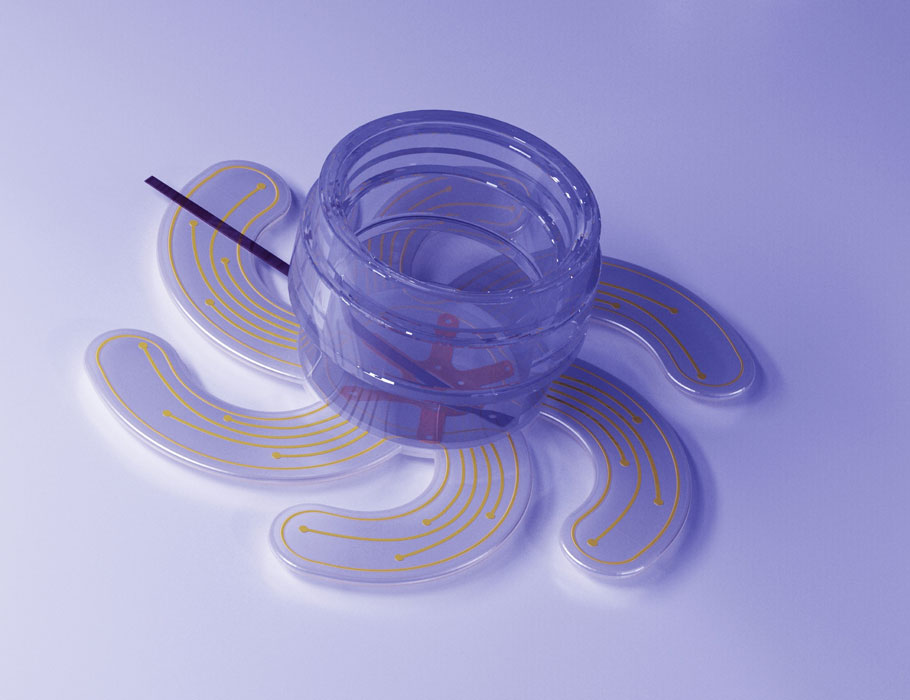
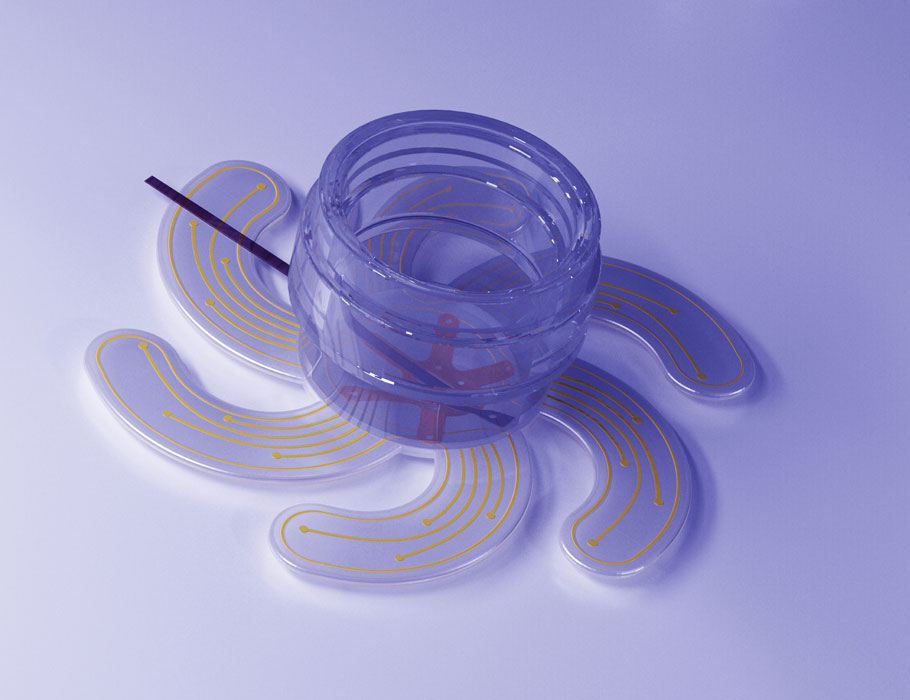
Tested in a minipig model, a new device can safely unfurl specially designed flexible electrodes across the brain cortex’s surface. @EPFL_en@SongSukho@splacour40
📄: https://t.co/8iYoSTvVdt
Focus: https://t.co/z9rrfVjB01
Des scientifiques de l’@EPFL ont développé un réseau d’électrodes déployable au-dessus du cortex cérébral. La technologie, testée avec succès sur un #minipig, pourrait fournir une solution minimalement invasive pour des patients épileptiques. #EARA
https://t.co/Qho0ov4dKM
Robot injected in the skull spreads its tentacles to monitor the brain https://t.co/y0sfxsyiKt "A soft robot inserted through a hole in the skull can deploy six sensor-filled legs on the surface of the brain to monitor electrical activity"; @NeurosoftBio#BCI
This network of electrodes can be inserted through a small hole in the skull and deployed over a relatively large area of the brain's cortex. This technology offers a minimally invasive solution for patients with epilepsy. https://t.co/CtLWDPBdzL https://t.co/PIZrJQiqN1
Ce réseau d'électrodes minimalement invasives et flexibles peut être déployé au-dessus d'une large surface du cortex cérébral à travers un petit trou dans le crâne. Une spin-off de l'EPFL prépare cette technologie en vue d'applications cliniques. https://t.co/c3JQWEjLyH
"Of all the soft robotics that I've seen, it's kind of the one that you say, ‘Wow, this is really going to change, potentially, the way we do things in neurosurgery."
https://t.co/lIKw35r2zS
We are excited to present our novel minimally invasive Brain-Computer Interface (#BCI) powered by our stretchable electrode technology. Check out the recent publication from the @EPFL_en lab of Prof. @splacour40 in Science Robotics https://t.co/BEcVmPmmdF
Congrats to my amazing colleague @splacour40 for setting a new milestone in #neural#interfaces with electrocorticography system with a soft robotic actuator now in @SciRobotics https://t.co/mnhQWIRB3W
New reading material: “invasive BCI that can be deployed on the brain through a pneumatic system (it leverages the fact that soft electrodes are stretchable and can be folded in extreme form factors without breaking). Spoiler alert: it’s awesome. Congrat…https://t.co/oa5T0TSPch
It was my great honor to work with @splacour40 on this exciting project for the development of soft robotic neural interfaces! This combination of soft bioelectronics & soft robotics can indeed have high impact!!
Deployable brain implant integrating soft bioelectronics & soft robotics!
Well done @SongSukho and EPFL LSBI team @Neuro_X_EPFL@EPFLEngineering
https://t.co/tNYrDio6k6
So happy to see this hard work finally bearing fruit in science robotics!! Soft robotics can find unique contributions in soft bioelectronics to mobilize the electrodes for minimally invasive implantation.
A new soft robotic system can deploy electrocorticography electrode arrays over a large surface area of the brain cortex via a small entry point on the skull. @EPFL_en@SongSukho@splacour40
📄: https://t.co/QoTeRthK5h
Focus: https://t.co/7yvcPxjUeS
Congrats to Donghoon and Musab that our work on controlled navigation of wireless millirobots inside brain type of soft tissues is just published in Science Advances @MPI_IS.
https://t.co/fSeRWqI5YQ
A half-sized coconut crab climbing a tree. The coconut crab is the largest land-based arthropod in the world, when fully grown they can weigh up to 4.1kg (9.0 lb) with a leg span more than 0.91m (3.0 ft).
Credit: pohnpei_surf_club/IG https://t.co/awgqbBE1pJ