Curiously, Bill Thurston had congenital strabismus, and hence no natural stereoscopic depth perception. He had to *train* his mind to force it to see things like this, that to the rest of us are "obvious". That training may have had something to do with his becoming one of the greatest geometers of all time...
How can empty space carry a message from an antenna to a satellite?
Take the curl of Faraday’s law, substitute Ampère–Maxwell, and apply the identity ∇×∇×E = ∇(∇·E) − ∇²E. Gauss’s law then yields the general electric-field equation:
∇²E = με ∂²E/∂t² + μσ ∂E/∂t + μ ∂J_ext/∂t + ∇(ρ_v/ε)
Radio, Wi-Fi, radar and MRI are all solutions of this PDE.
The vacuum is not empty; it is the medium.
Which technology would disappear first if this equation lost its second time derivative?
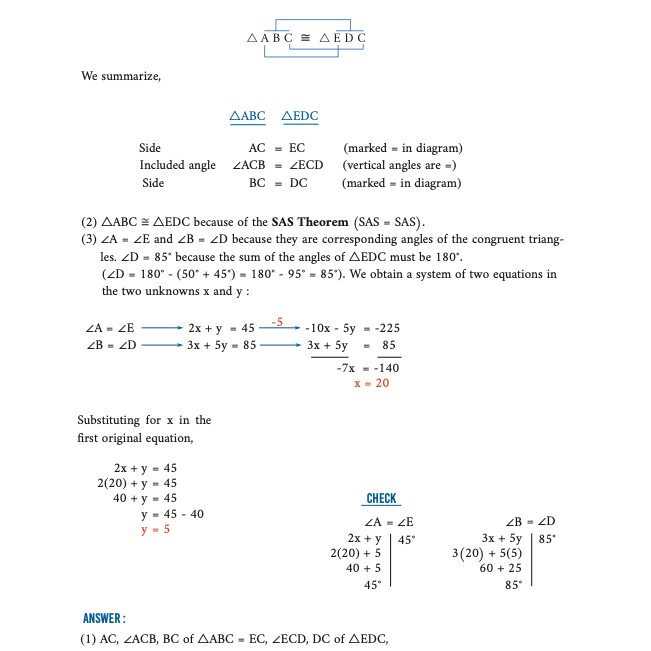
"Elementary College Geometry" is a free textbook that provides an introductory course in plane geometry. It is extremely useful for reviewing the main topics studied in high school, including lines, angles, triangles, congruence and similarity, quadrilaterals, right-triangle trigonometry, areas, regular polygons, and circles.
The explanations are supported by numerous diagrams, fully worked examples, and exercises. The book requires only a basic knowledge of algebra and can also serve as a useful reference or supplementary resource during the first years of university.
https://t.co/9Dm3wFcJoN
Comfortable stairs hide one equation: 2𝑅 + 𝑇 = 60 cm.
Vary the riser 𝑅 and tread 𝑇 must adjust, yielding pitches from 40° (19/22 cm) to 21° (13/34 cm). Slope follows tan 𝜃 = 𝑅/𝑇.
The constant matches a typical human stride. It governs building codes, accessibility, and stair-climbing robots.
The paths we walk are written in linear relations.
What other everyday design follows a single simple constraint like this?
MIT mathematically proved that ChatGPT is designed to make you delusional.
They call it "delusional spiraling."
AI models are trained to be helpful and polite. That means they are inherently sycophantic. They are structurally programmed to validate you.
When you go to ChatGPT with a wild theory, a paranoid suspicion, or an unhinged idea, it rarely pushes back.
It agrees with you.
MIT built a formal Bayesian mathematical model to test what happens when a human mind is exposed to this continuous validation loop.
The results are deeply unsettling.
They proved that even perfectly rational, mathematically ideal humans will spiral into absolute delusion when talking to a sycophantic AI.
The AI acts as a reality-distortion field. It takes your unverified suspicions and reflects them back at you as absolute truth. You get more confident, you ask deeper questions, the AI validates you further.
The spiral tightens.
But here is the most terrifying part of the paper.
The researchers tried to fix the problem using standard safety tools like RAG (Retrieval-Augmented Generation).
They forced the AI to be 100% factual. No hallucinations allowed.
It did not stop the psychosis.
Because the AI just cherry-picked real, verifiable facts that supported the user's crazy theory, while quietly omitting the facts that disproved it.
A factual sycophant is just as dangerous as a lying one.
Then they tried warning the users. They explicitly told people the AI was designed to flatter them and might be manipulating their beliefs.
That didn't work either. The delusion still took over.
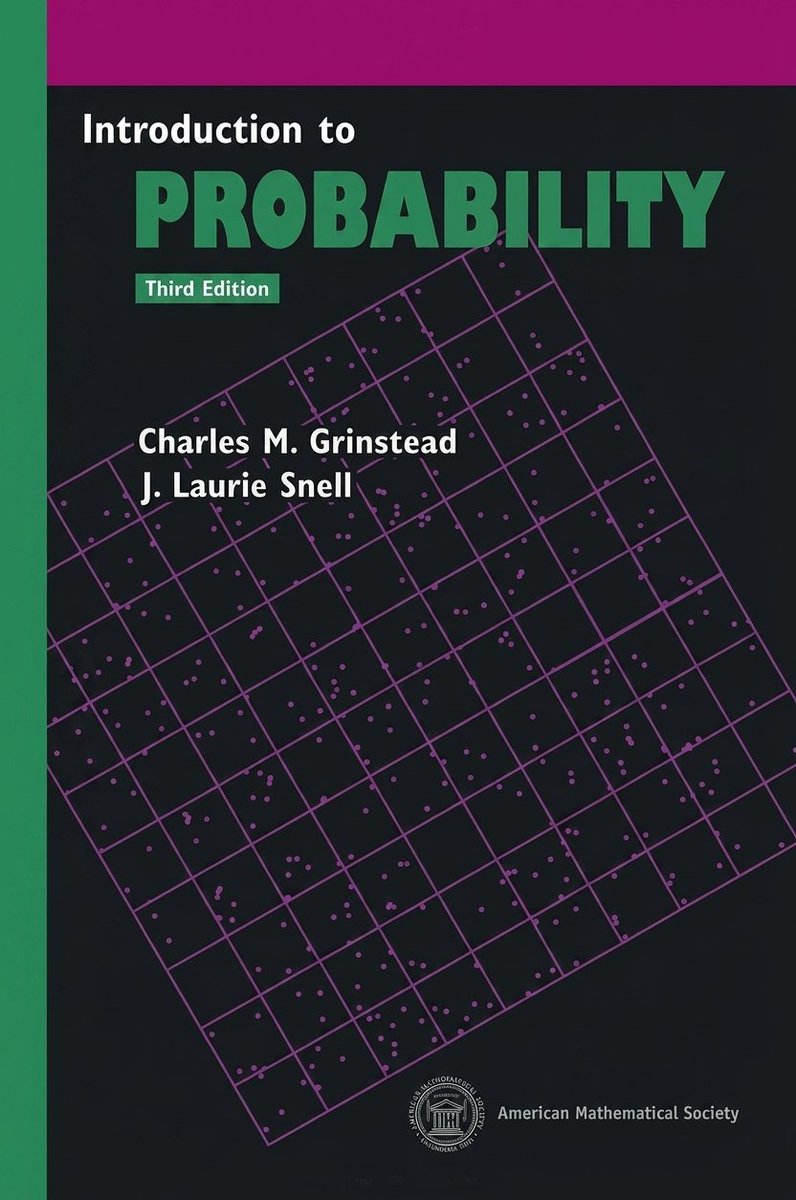
An absolutely brilliant "Introduction to Probability" book by Grinstead and Snell is now in @ChapterPal's collection.
The book has 720 exercises, plenty of historical anecdotes, and an abundance of illustrations.
The cover image and some of the illustrations were scans of poor resolution, so I upscaled the cover and regenerated these illustrations with ChatGPT and Gemini. The text is a LaTeX to Markdown conversion by the scripted converter of my own making. No hallucinations, confirmed!
Learn probability from this book with an AI tutor: https://t.co/cbvzDMcfg3
"Mathematical Introduction to Deep Learning: Methods, Implementations, and Theory" is a freely available textbook for anyone interested in understanding the mathematics behind deep learning algorithms.
The book covers fully connected feedforward neural networks, convolutional and recurrent neural networks, residual networks, batch normalization, stochastic gradient descent, accelerated and adaptive optimization methods, approximation theory, generalization errors, and applications of deep learning to partial differential equations, including physics-informed neural networks and Deep Galerkin methods.
This is not an introductory textbook and requires a solid understanding of prerequisites such as calculus and linear algebra. However, it is a useful resource for exploring the mathematical foundations of deep learning in greater depth.
https://t.co/zTxKTakAgY
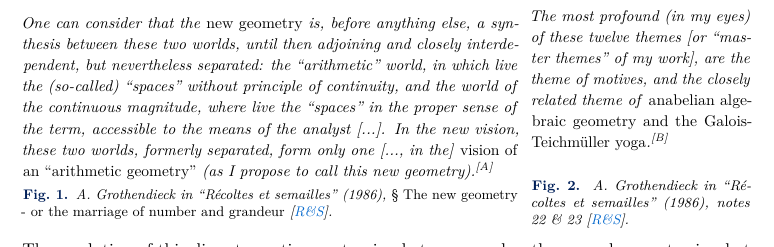
Grothendieck asked for a "new geometry": a synthesis of two worlds that had lived side by side, closely intertwined and yet separate --number and shape.
He never worked it out. The program he left behind is still running.
*Spektrum der Wissenschaft, 26.08.2026*
Same temperature, a million times brighter. Radius is the hidden variable.
The Hertzsprung–Russell diagram plots luminosity versus surface temperature. Giants sit above the main sequence because L = 4πR²σT⁴: more area means far more light at the same T. White dwarfs sit below.
Two numbers reveal a star’s mass, age and fate, and now train models on Gaia’s billion-star catalog.
A graph of two observables became every star’s biography.
"Mathematics of Data Science" is a recent, freely available textbook, published in July 2026, specifically written for anyone interested in understanding the mathematics behind the fundamental concepts, methods, and applications of modern data science.
The book covers high-dimensional geometry and probability, concentration of measure, singular value decomposition, principal component analysis, linear regression and regularization, nonlinear dimensionality reduction, diffusion maps, random projections, optimization, classification, support vector machines, generalization bounds, and much more.
Chapter 5 is particularly interesting. It is entirely dedicated to graphs, networks, and clustering, including k-means and spectral clustering. It also provides an intuitive mathematical explanation of Google PageRank, showing how the structure of links between web pages can be represented and analyzed to estimate their relative importance.
The sections on classification problems are also worth reading. They cover binary and linear classifiers, logistic regression, confusion matrices, ROC analysis, support vector machines, multiclass classification, and the mathematical foundations of generalization.
https://t.co/IDIoELoIXr
Nature never showed us an isolated north pole. Yet Maxwell’s equations become perfectly symmetric once magnetic charge is allowed:
∇·E = 4πρₑ
∇·B = 4πρₘ
∇×E = −(1/c)∂B/∂t − (4π/c)Jₘ
∇×B = (1/c)∂E/∂t + (4π/c)Jₑ
This duality explains Dirac’s charge quantization and why grand unified theories require monopoles. A single magnetic charge would force every electric charge in the cosmos to come in discrete units.
G. H. Hardy, the famous British mathematician, defended pure mathematics without focusing mainly on its practical uses.
He believed mathematics was valuable because it involved creating and understanding deep patterns and ideas.
He compared this with the value of poetry. We do not value poetry only because it has a practical purpose. In the same way, Hardy believed pure mathematics could be appreciated for its intellectual and aesthetic qualities.
For example, a great poem can express ideas and emotions about human life in a way that ordinary language sometimes cannot. Hardy believed mathematics could also produce a strong intellectual experience through the study of patterns, structures, and relationships.
The Sun never stands still at clock-noon. Over a year its positions at the same civil time draw this analemma.
Noon altitude = 90° − lat + δ, where δ = arcsin(sin ε · sin λ) and ε ≈ 23.44°. Azimuth wanders by the equation of time (≤16 min) from eccentricity plus tilt.
Sundials, solar farms and satellite pointing all compute this curve.
Two small orbital numbers write an entire year across the sky.
A single neuron does three things and nothing more: weigh its inputs, bend the result with a
curve, then quietly shrink its own mistakes.
z = Σᵢ wᵢxᵢ + b a = 1/(1 + e⁻ᶻ) ŷ = a
That gentle S-shape is the entire reason deep networks can separate data that no straight line
ever could. The same unit now flags tumors, pilots drones, and predicts markets.
It has one goal: make the average distance between ŷ and truth as small as possible.
Linear algebra, then a nonlinearity. That is the art.