We were proud to welcome @ENERGY@SecretaryWright to @INL, where significant progress is underway on our first commercial Aurora powerhouse.
Together with the strides we're making toward criticality at our Groves Isotope Test Reactor in Texas, Oklo’s work on full civil nuclear facilities is moving forward on multiple fronts. Construction, fuel, licensing, and engineering are advancing in parallel, compressing timelines and redefining the pace of advanced nuclear deployment.
We're grateful for Secretary Wright's leadership and the continued partnership of DOE and INL as we work together to turn advanced nuclear from ambition into deployment.
★ Y Combinator (YC) 2026 Summer Closed-Door Memo Leaked — Declaring "SaaS Is Dead, Physical AI Reigns Supreme" .
☆ The most circulated document in Silicon Valley's venture capital circle today is the summer venture trend memo just sent by YC's core partners to their internal alumni. This memo has completely stripped away the last veil of the past decade's "software tax (SaaS)."
☆ Core Insight: YC clearly stated that the SaaS venture model of the past—wrapping a large language model, writing a few lines of code, and building an attractive frontend UI to charge enterprises subscription fees—has seen its commercial survival rate drop below 3% in 2026, as the cost of large model inference approaches zero.
★ Where the growth is: Venture capital is fleeing software and pure cloud-based AI, pouring into "Physical AI" in full force.
☆ Includes industrial robots and offline edge privacy computing hardware.
★ [StarSpace This Week's Reflection]:
☆ YC's report indicates that Silicon Valley's top venture capital trends have completely abandoned "inflated soft AI" and are now fully shifting toward physical infrastructure and edge hardware.
☆ However, physical AI cannot achieve mass production or scale up in the short term (within six months to a year), and thus cannot deliver performance results.
★ Then why do top-tier investors like a16z and YC keep pouring money into it so aggressively?
★ How should we defend and position ourselves when investing in both primary and secondary markets?
Google has published a paper that might end the transformer era.
For the last 7 years, every major AI, ChatGPT, Claude, Gemini, has been built on the exact same architecture: The Transformer.
But Transformers have a fatal flaw.
To remember context, they have to process every single word against every other word. It’s called quadratic complexity. As your prompt gets longer, the compute cost explodes.
The alternative is the old-school RNN (Recurrent Neural Network). RNNs are incredibly cheap and fast, but they have a fixed memory size. If you give them a long document, they get amnesia.
Until today.
Google researchers published Memory Caching: RNNs with Growing Memory.
And it fixes the biggest bottleneck in AI.
Instead of an RNN having a fixed, rigid memory that constantly overwrites itself, Google gave it a "save" button.
The technique allows the RNN to cache checkpoints of its hidden states as it reads.
The memory capacity of the RNN can now dynamically grow as the sequence gets longer.
They built four different variants, including sparse selective mechanisms where the AI actively chooses exactly which checkpoints matter most.
The results rewrite the rules of efficiency.
On long-context understanding and recall-intensive tasks, these new Memory-Cached RNNs closed the gap with Transformers.
They achieved competitive accuracy without the explosive, quadratic compute cost. It perfectly bridges the gap between the cheap efficiency of an RNN and the massive capability of a Transformer.
We have spent billions scaling Transformers because we thought they were the only way an AI could remember a long conversation.
But Google just proved we don't need to process the whole history every single time.
We just needed a smarter cache.
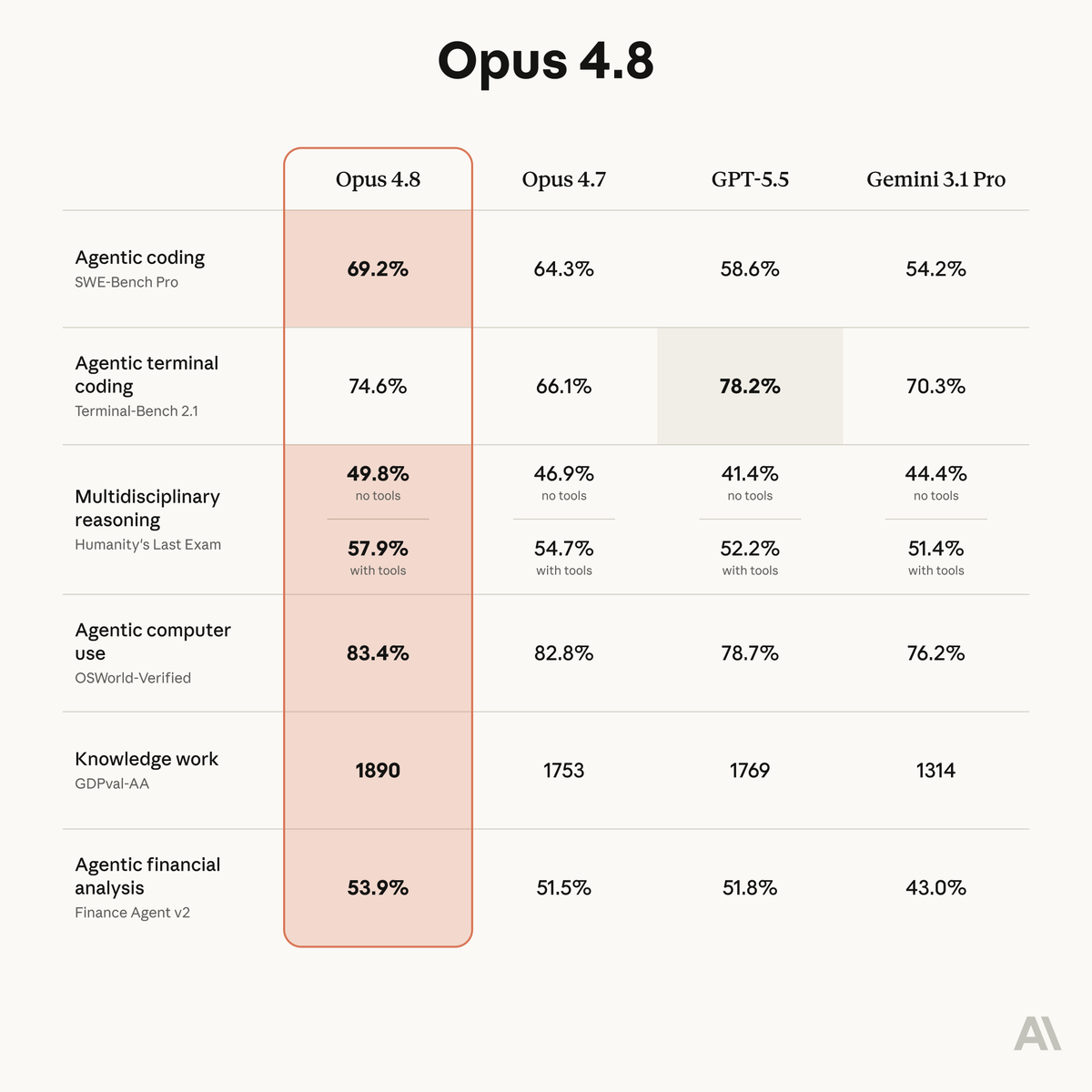
Introducing Claude Opus 4.8: it builds on Opus 4.7 with sharper judgment, more honesty about its own progress, and the ability to work independently for longer than its predecessors.
Available today at the same price.
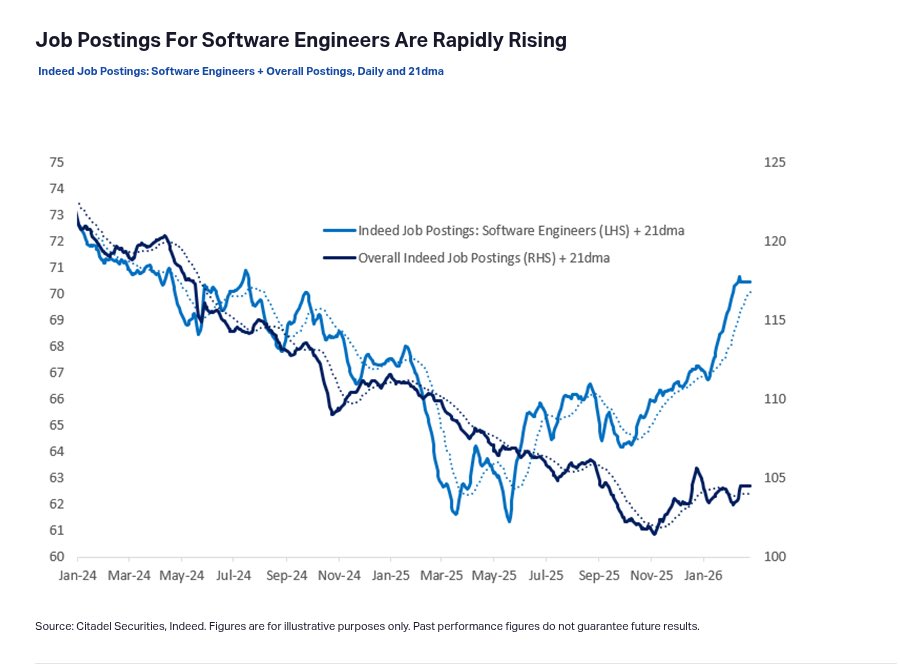
Q: How are job postings for software engineers rising rapidly despite AI agents automating coding?
A: Because there’s far more code to manage than ever before. We’re already seeing a 14x YoY increase in GitHub commits, and it’s accelerating.
AI has dramatically lowered the cost of writing code, so it’s now being used across far more businesses, applications, and use cases.
We’re at the beginning of a massive productivity boom driven by the proliferation of bespoke software throughout the entire economy.
Coding has been AI’s breakout use case this year. The fact that it’s increased demand for software engineers — rather than decreased it — should call into question the entire “AI will cause mass job loss” narrative.
In less than two months, Oklo’s isotope test reactor will go critical.
We’re building, iterating, and executing in real time across power, fuel, and isotopes.
Follow our journey: https://t.co/28lyGSS380
🚨 Anthropic just gave Claude the ability to DREAM.
While you're asleep, Claude reviews everything it did that day, finds patterns in its own mistakes, and rewrites its own memory.
Yes — they literally call the feature "dreaming."
The co-founder thinks there's a 60% chance these models will train their own successors by 2028.
We are not ready for what's coming. 🧵👇
■ The full-scale commercialization of HBM4 and the battle for production capacity
★ Based on the current intent orders from cloud giants for 2027, the global supply and demand gap for HBM in 2027 is expected to further widen compared to 2026.
■ Storage factories strongly promote the "quarterly fixed price system":
★ Due to the introduction of advanced logic base die in HBM4 and the extremely high "wafer penalty" (the wafer area required to produce the same capacity is 3 times of traditional DRAM), the entire production capacity has been sold out.
★ Samsung and SK Hynix are currently fully rejecting the cloud giants' long-term fixed-price contracts of 2 to 3 years and strongly promoting short-term contracts with quarterly price hikes, with the sellers' pricing power reaching an all-time high.
♥︎♥︎♥︎【Starspace Perspective】:
♥︎ From the perspective of the "physical layer supply chain bottleneck" mainly composed of HBM4 and silicon photonics in the upstream, HBM4/LITE/MRVL will remain highly popular in 2027.
♥︎ NVIDIA has joined forces with Nous Research to launch the AI agent Hermes and deeply integrate it with the new hardware DGX Spark.
♥︎ Trend: "Industrial application opportunities" dominated by all-weather agentic independent
hardware in the downstream.
At @INL, Oklo has moved from site mobilization into deep foundation excavation for our first commercial Aurora powerhouse.
What makes this moment significant is not just the physical progress at the site, but the coordinated progress taking shape across the entire project.
Construction, fuel, and licensing are all advancing at a pace that once seemed inconceivable. Oklo is demonstrating what is possible when the critical pieces move forward in parallel.
You can feel when your cognitive precision changes before anyone else notices it.
That is not intuition. That is your brain detecting instability in its own neural dynamics.
This new whole-brain model used empirical EEG and fMRI data to simulate how excitability and inhibition shape large-scale brain function. When that balance shifts, the systems responsible for executive control and cognitive flexibility shift with it.
Your thinking is biological infrastructure. Not abstraction.
■ Storage and Architecture:
★ HBM4 Dominance Established: SK Hynix is joining the "trillion-dollar club".
☆ Due to the strong demand for HBM4 on the Vera Rubin platform, its entire production capacity for 2026 has been sold out.
☆ This is not only an upgrade of memory, but also the beginning of large-scale commercialization of "integrated computing and storage".
☆ SK Hynix's leading position in the HBM4 field (accounting for approximately two-thirds of Nvidia's demand) makes it perform more like an "AI infrastructure company" during the semiconductor cycle.
☆ Note: I hold this stock.
★ CPO (Co-Packaged Optics): The Next Gen trend.
☆ As the bandwidth of a single node approaches 1.6T, traditional copper wire interconnection has reached its physical limit.
☆ Co-packaged optics (CPO) is moving from the laboratory to data centers, integrating optical engines directly on the chip side, which can reduce power consumption by 30% to 50%.
☆ This is not only a technological update but also a reshuffling of the equipment manufacturers' landscape.
■ Now that the tech giants have challenged "Moore's Law", will the next target be the "Von Neumann" architecture?
★ The biggest efficiency killer of silicon-based chips is the "von Neumann bottleneck".
☆ Data is constantly shuttled between the processor and memory, and 80% of the energy efficiency is wasted on this "highway".
☆ Traditional chips are "clock-driven", consuming energy even when there are no tasks.
☆ The biological architecture is "event-driven", and it only discharges when the input signal (Spike) reaches the threshold.
■ [Starspace Investment Observation]:
★ Focus on Brain-like Intelligence
★ Focus on Compute-in-Memory Technology
★【Starspace Predictive AI Agent RoadMap】:
★ Today, by the second half of 2026,
☆ Enterprise-level AI will shift comprehensively from "content generation" to "autonomous decision-making",
☆ AI-native organizations will start to emerge on a large scale.
★ Tomorrow, E-commerce | Business Iteration of AI Agents:
☆ The A2A payment protocol triangle battle:
☆ Google AP2, OpenAI ACP, and Coinbase x402 have begun their exclusive period in the ecosystem.
☆ Stripe has completed the integration of x402 payments on the Base chain.
★ AI algorithmic negotiation:
☆ AI shopping robots are beginning to have the "dynamic pricing confrontation" function, and online retail is evolving into real-time price negotiations between algorithms.
★ Seamless checkout penetration:
☆ Mastercard and Microsoft have collaborated to embed Copilot Checkout into retailers' private domain websites, allowing AI agents to directly complete mixed payments of fiat currency and stablecoins within the conversation flow.
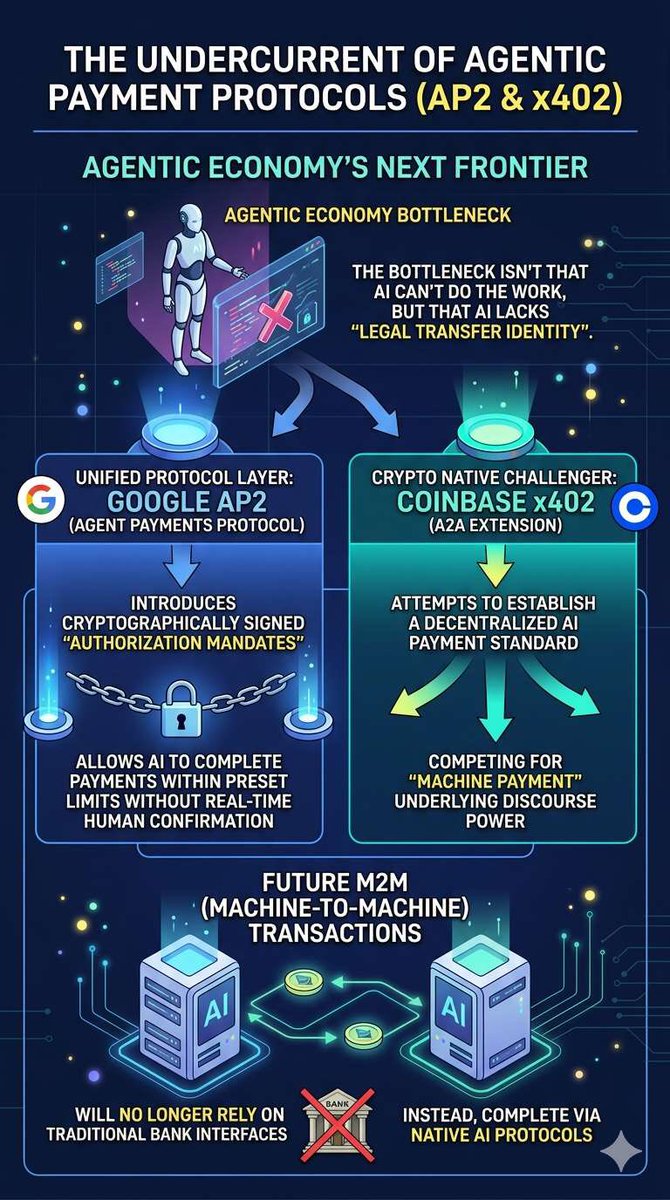
■ The Undercurrents of Agent Payment Protocols (AP2 and x402)
★ The current bottleneck of the Agentic Economy (Agent-based Economy) is not that AI cannot do the work, but that AI lacks a "legally recognized payment identity".
★ Unification of the protocol layer: Recently, Google has taken the lead in formulating the AP2 (Agent Payments Protocol) protocol.
★ This agreement introduces "Mandates" with encrypted signatures, allowing AI to complete payment actions within a preset range without real-time human confirmation.
★ Native crypto challenger: Coinbase has launched x402 (A2A extension), attempting to establish a decentralized AI payment standard to compete with Google's AP2 for the underlying discourse power of "machine payment".
★ This means that in the future, M2M (machine-to-machine) transactions will no longer rely on traditional bank interfaces but will be completed through this native AI protocol.


![StarSpaceVC's tweet photo. ★ Y Combinator (YC) 2026 Summer Closed-Door Memo Leaked — Declaring "SaaS Is Dead, Physical AI Reigns Supreme" .
☆ The most circulated document in Silicon Valley's venture capital circle today is the summer venture trend memo just sent by YC's core partners to their internal alumni. This memo has completely stripped away the last veil of the past decade's "software tax (SaaS)."
☆ Core Insight: YC clearly stated that the SaaS venture model of the past—wrapping a large language model, writing a few lines of code, and building an attractive frontend UI to charge enterprises subscription fees—has seen its commercial survival rate drop below 3% in 2026, as the cost of large model inference approaches zero.
★ Where the growth is: Venture capital is fleeing software and pure cloud-based AI, pouring into "Physical AI" in full force.
☆ Includes industrial robots and offline edge privacy computing hardware.
★ [StarSpace This Week's Reflection]:
☆ YC's report indicates that Silicon Valley's top venture capital trends have completely abandoned "inflated soft AI" and are now fully shifting toward physical infrastructure and edge hardware.
☆ However, physical AI cannot achieve mass production or scale up in the short term (within six months to a year), and thus cannot deliver performance results.
★ Then why do top-tier investors like a16z and YC keep pouring money into it so aggressively?
★ How should we defend and position ourselves when investing in both primary and secondary markets?](https://pbs.twimg.com/media/HKroVH6aEAALGVj.jpg)




![StarSpaceVC's tweet photo. ■ Now that the tech giants have challenged "Moore's Law", will the next target be the "Von Neumann" architecture?
★ The biggest efficiency killer of silicon-based chips is the "von Neumann bottleneck".
☆ Data is constantly shuttled between the processor and memory, and 80% of the energy efficiency is wasted on this "highway".
☆ Traditional chips are "clock-driven", consuming energy even when there are no tasks.
☆ The biological architecture is "event-driven", and it only discharges when the input signal (Spike) reaches the threshold.
■ [Starspace Investment Observation]:
★ Focus on Brain-like Intelligence
★ Focus on Compute-in-Memory Technology](https://pbs.twimg.com/media/HIABmeKbsAAxRok.jpg)