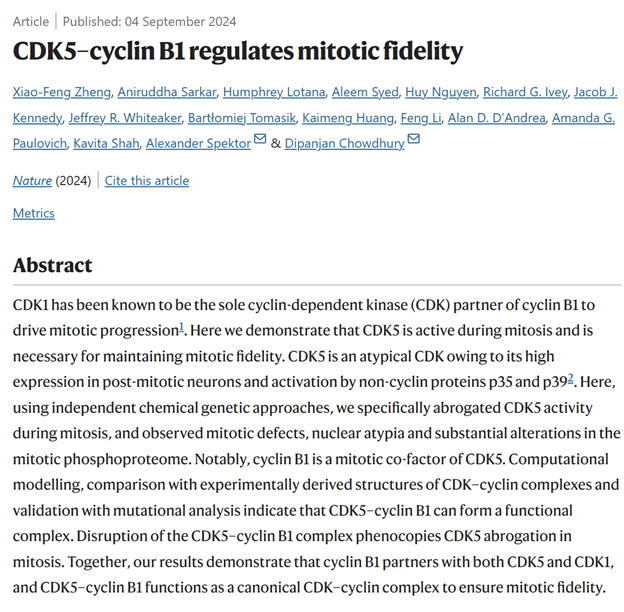
(1/5) I am delighted to share our study published today @Nature https://t.co/BjJbHT9qWe collaboration with @Chowdhury Lab, led by @XiaoZheng3and @aniruddhSark. Huge congratulations to all the authors and collaborators.
Because CDK5 is overexpressed in many cancers and is associated with a poor prognosis, our study raises the possibility that these cancers may be more dependent on CDK5 for their cell division and suggests that CDK5 may be an important therapeutic target.
The study alters the existing paradigm that CDK1-Cyclin B1 is the only CDK-cyclin complex essential for all stages of mitosis and raises the possibility that other atypical CDKs may also have a role in regulating the cell-division cycle.
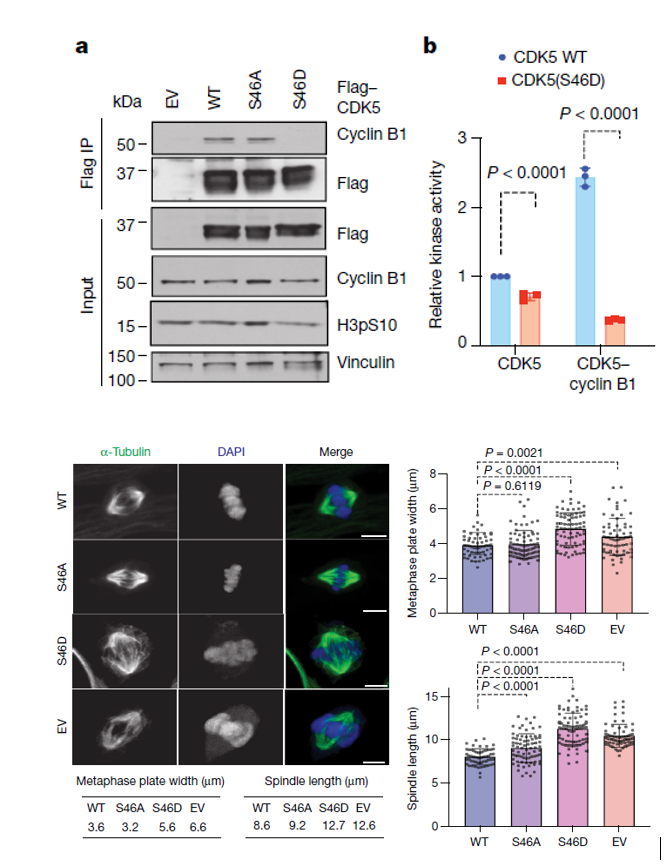
Loss of CDK5-Cyclin B1 interaction abolished CDK5 activity in vitro (thanks to our collaborator Kavita Shah) and phenocopied CDK5 abrogation in mitosis. CDK5–cyclin B1 is thus a canonical CDK–cyclin complex that plays an essential role in maintaining genome integrity.
Surprisingly, we discovered that CDK5 forms a functional complex with Cyclin B1, the mitotic cyclin that partners with CDK1 to complete all stages of mitosis.
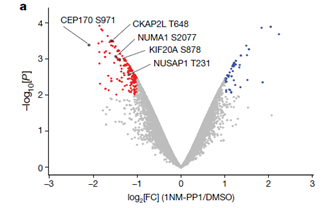
With the help of our collaborator @AmandaPaulovich, we used phosphoproteomic analysis to identify putative CDK5 substrates that may account for this phenotype.
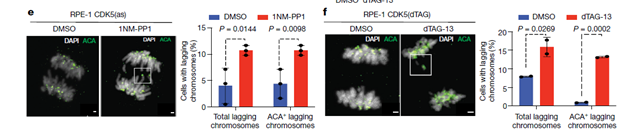
Using two orthogonal chemical genetic approaches, we show that CDK5, an atypical CDK essential in non-dividing neuronal cells, plays an important role in mitosis in preventing mitotic errors. Abrogation of CDK5 prior to mitosis led to chromosome mis-segregation and nuclear atypia
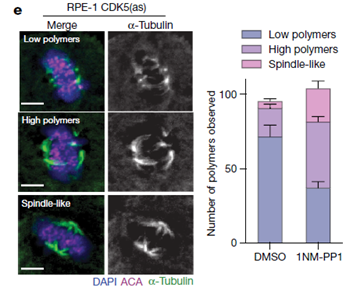
We found that these errors occur because spindle microtubules that separate sister chromatids during mitosis become abnormally stable in the absence of CDK5, preventing cells from correcting chromosome attachment errors.
Cyclin Dependent Kinases (CDKs) are critical for regulating different phases of the cell cycle and CDK1 was considered to be the only CDK essential mitosis.
We want your research at #ANESCR to help organizers @GodekLab, @LabSpektor, and more unpack the Consequences of Aneuploidy. Submit your abstract by July 21 and save your space: https://t.co/loFrxX4Hu1
Abstract deadline coming up! Hurry and register to the FASEB "Consequences of Aneuploidy" meeting in Florida (Sep 15-19). This meeting gathers top scientists studying chromosomes, cancer genomes, mitosis and meiosis, and more.
More details:
https://t.co/cdG98T1Xhe