@seanmcdonaldxyz@Code4_11 It's also interesting that the points aren't "moving" per se but "phase-shifting in Ɵ".
You can see what I mean if you follow any given dot/cluster and see that it always comes back to the same place.
You can see it better with fewer bigger points, color-coded:
The iconic laser sounds in Star Wars were created by sound designer Ben Burtt using real-world recordings.
One of the most famous techniques involved hitting a metal cable & recording the vibrating sound. This unique “pew” effect that became the signature blaster noise.
it's 2026 and Microsoft needs to briefly throttle your machine into full power maximum performance mode to open the start menu without lag, sorry, with less lag, and they think this is something worth announcing to the press and public and giving it a name
🌖 Amberspire is OUT NOW! 🌇
A dice driven science fantasy city builder. Grow your city atop a mausoleum moon, interact with strange weather and ecology, gain influence to make deals with powerful off-world factions.
PC, Mac, Steam Deck
https://t.co/LIlhD0n3UO
Dear Microsoft, when I hit the Windows Start menu key and start typing a word to autocomplete a search, I never, ever, EVER want it to return results of something not on my computer. Ever. Like, ever, ever, never.
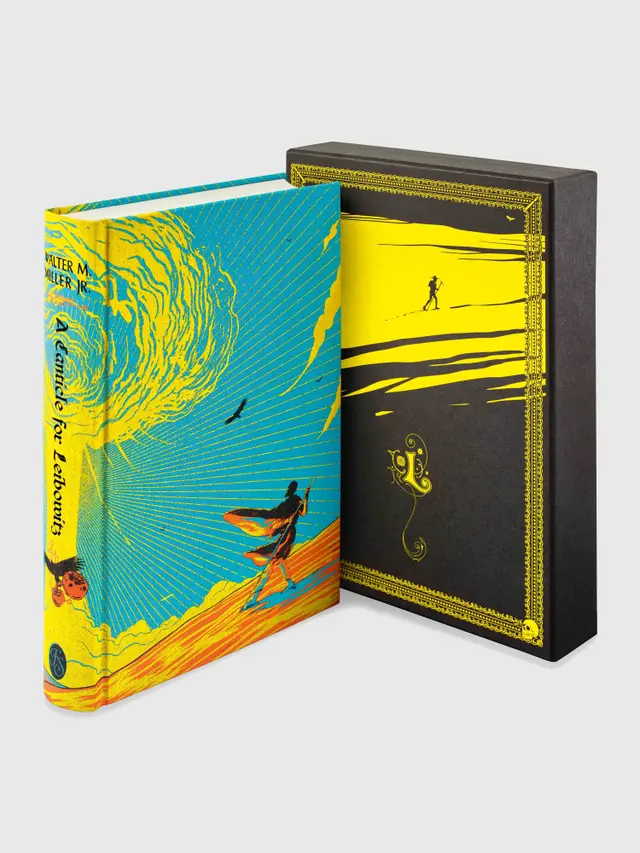
A Canticle For Leibowitz is a classic early (1959) post-apocalypse novel where an order of monks preserved the last remnants of learning (the memorabilia) after a nuclear exchange turned the remains of society into book and scientist burners.
I first read it in the 80s as a mass market paperback that I somehow lost along the way. Other paperbacks from that time are yellow with age and getting brittle, but still readable.
I read it again in the late 2000s on a first edition Kindle. I eventually migrated to iPads for Kindle reading, but every couple years I would come across an old Kindle in a drawer, charge it up, and check out what I had been reading on it. They eventually stopped working entirely.
I’m just finishing reading a new Folio Society edition, printed on heavy, acid-free archival quality paper. If it doesn’t get soaked or burned, it could still be in good shape for centuries.
The ephemeral nature of digital storage does give me some pause. We can still read Sumerian tablets full of administrative trivia from four thousand years ago, but there are no known copies of some important software products from just fifty years ago.
I am a proud supporter of the Internet Archive!
Love seeing these kinds of trajectory visualizations.
Orbital mechanics are so much more complex and interesting than they are often depicted, as all the bodies themselves are in [nonlinear] motion.
And that’s just relative to earth (most useful frame for a launch-and-return mission), which itself is in orbit about the sun, which is in orbit about Sagittarius A*…
There's a physicist at Stanford named Safi Bahcall who modeled this exact principle and the math is wild.
He calls it "phase transitions in human networks." When you're stationary, your probability of a lucky event is limited to your existing surface area: the people you already know, the places you already go, the ideas you've already been exposed to. Your opportunity window is fixed.
When you move, your collision rate with new nodes in a network increases nonlinearly. Double your movement (new conversations, new cities, new projects) and your probability of a serendipitous encounter doesn't double. It roughly quadruples. Because each new node connects you to their entire network, not just to them.
Richard Wiseman ran a 10-year study at the University of Hertfordshire tracking self-described "lucky" and "unlucky" people. The single biggest differentiator wasn't IQ, education, or family money. Lucky people scored significantly higher on one trait: openness to experience. They talked to strangers more, varied their routines more, and said yes to invitations at nearly twice the rate.
The "unlucky" group followed the same routes, ate at the same restaurants, and talked to the same 5 people. Their networks were closed loops. No new inputs, no new collisions.
Luck isn't random. Luck is surface area. And surface area is a function of movement.
The lobster emoji is doing more work than most people realize. Lobsters grow by shedding their shell when it gets too tight. The growth requires a period of total vulnerability. No protection, no armor, soft body exposed to the ocean.
That's the cost of movement nobody posts about. You have to be uncomfortable first. The new shell only hardens after you've already moved.
Totally. You always end up disabling auto-tick and replacing with with a minimum of “ticking things manually” or eventual total evolution toward “move this to a higher-level place that handles task X for the right things in the right order in bulk��.
It’s not a philosophical pro- or anti- sentiment in terms of OO/DO or any other religion; it’s just the inevitable reality of managing large and performant projects while trying to keep them easy to understand and quick to change.
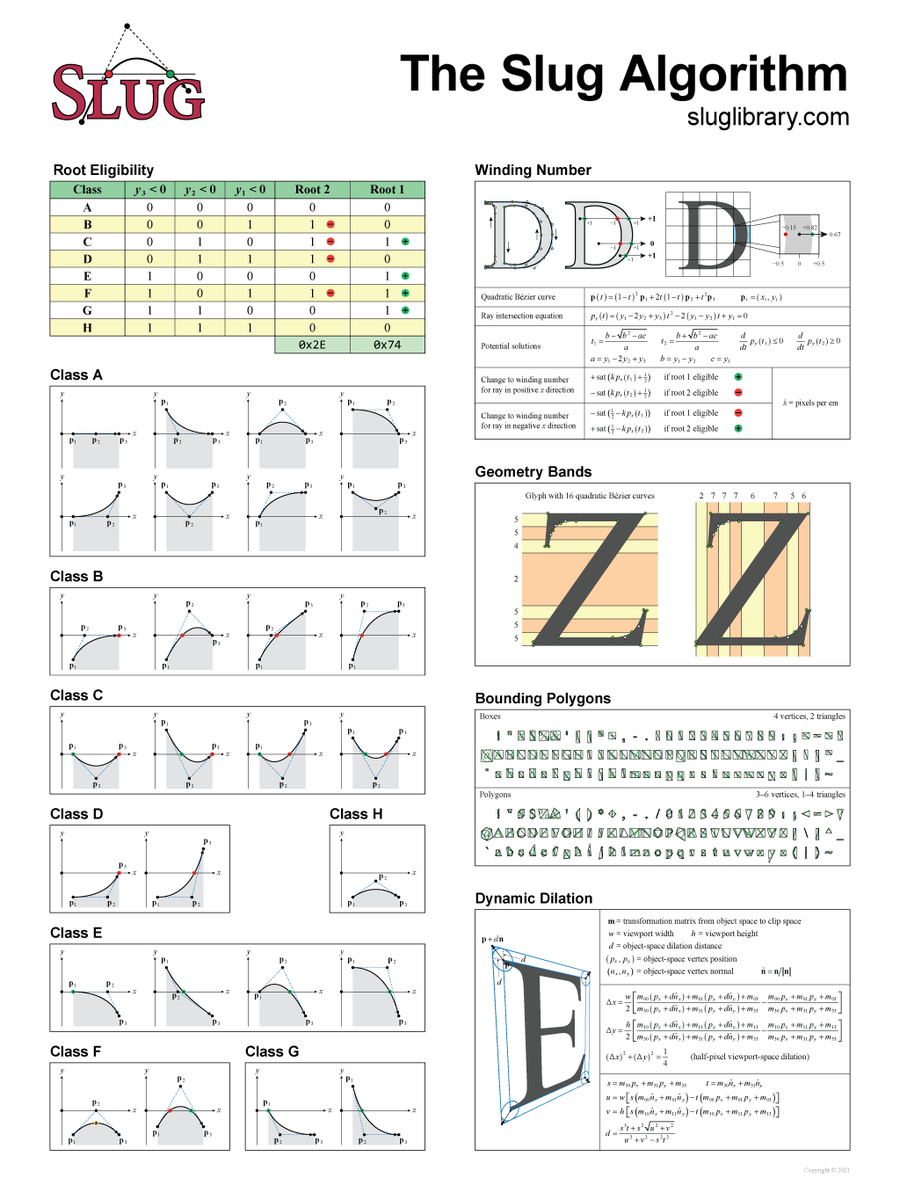
New blog post: A Decade of Slug
This talks about the evolution of the Slug font rendering algorithm, and it includes an exciting announcement: The patent has been dedicated to the public domain.
https://t.co/xWEz0q2c4N
I feel the same way. It totally confounds me.
Part of me thinks this is our C roots bias showing, but I’ve logged time in these languages and I can’t fathom how type fluidity isn’t just a huge additional conceptual burden threatening you at every step.
I would guess it’s similar existential terror as how they seem to feel about the ability to actually know about memory addresses.
The math on this project should mass-humble every AI lab on the planet.
1 cubic millimeter. One-millionth of a human brain. Harvard and Google spent 10 years mapping it. The imaging alone took 326 days. They sliced the tissue into 5,000 wafers each 30 nanometers thick, ran them through a $6 million electron microscope, then needed Google’s ML models to stitch the 3D reconstruction because no human team could process the output.
The result: 57,000 cells, 150 million synapses, 230 millimeters of blood vessels, compressed into 1.4 petabytes of raw data. For context, 1.4 petabytes is roughly 1.4 million gigabytes. From a speck smaller than a grain of rice.
Now scale that. The full human brain is one million times larger. Mapping the whole thing at this resolution would produce approximately 1.4 zettabytes of data. That’s roughly equal to all the data generated on Earth in a single year. The storage alone would cost an estimated $50 billion and require a 140-acre data center, which would make it the largest on the planet.
And they found things textbooks don’t contain. One neuron had over 5,000 connection points. Some axons had coiled themselves into tight whorls for completely unknown reasons. Pairs of cell clusters grew in mirror images of each other. Jeff Lichtman, the Harvard lead, said there’s “a chasm between what we already know and what we need to know.”
This is why the next step isn’t a human brain. It’s a mouse hippocampus, 10 cubic millimeters, over the next five years. Because even a mouse brain is 1,000x larger than what they just mapped, and the full mouse connectome is the proof of concept before anyone attempts the human one.
We’re building AI systems that loosely mimic neural networks while still unable to fully read the wiring diagram of a single cubic millimeter of the thing we’re trying to imitate. The original is 1.4 petabytes per millionth of its volume. Every AI model on Earth fits in a fraction of that.
The brain runs on 20 watts and fits in your skull. The data center required to merely describe one-millionth of it would span 140 acres.
This is a reminder that every diagram from my book Projective Geometric Algebra Illuminated is available on Wikimedia Commons under the CC-BY-4.0 license. They can be freely used in slides, papers, books, Wikipedia articles, etc., with proper attribution.
https://t.co/r9dUSDlr6n