Today’s the day - it’s finally out in @Nature! @humam_kadara, I still remember your words in the tissue culture room at the end of a long day & when our data was pointing to us a new discovery: trust the process & don’t give up!
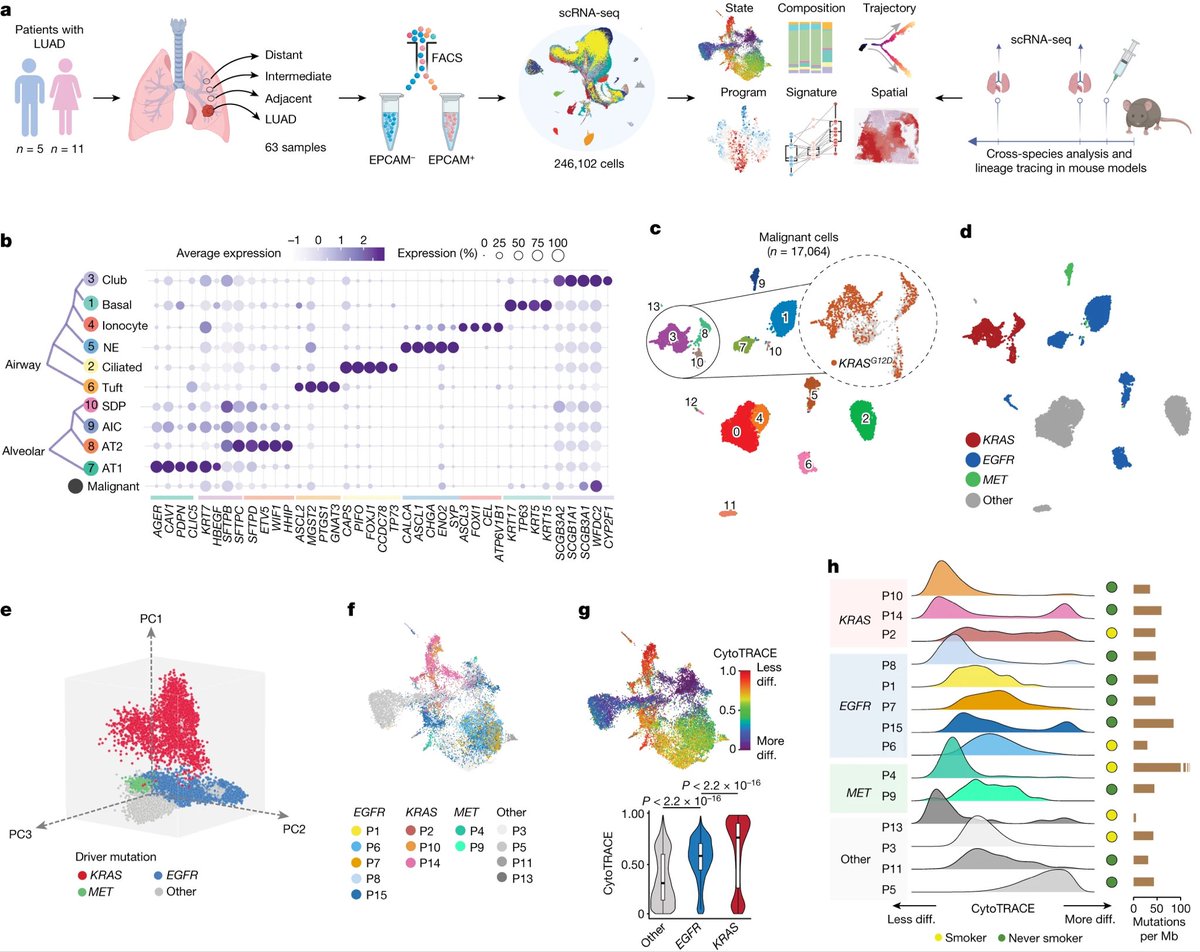
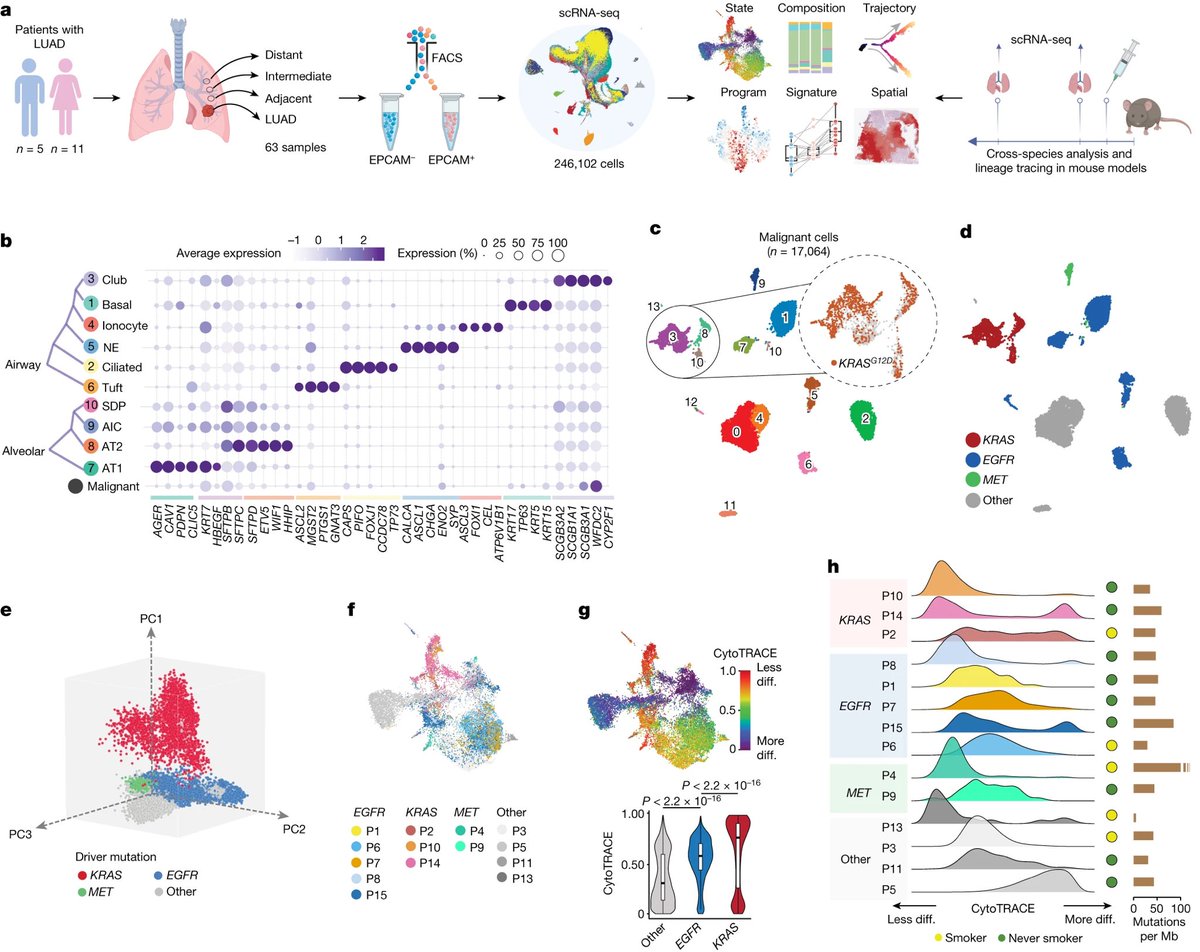
At last, at long last, our labor of love is out today in @Nature! 🥳By generating an atlas of normal and cancerous epithelial cells in lung adenocarcinoma we unearth cellular states/subsets that underlie inception of the disease. https://t.co/fKwADUpaCl. A thread! 1/19
Very excited to have our work on spatial profiling of lung precursor lesions and invasive lung cancers out in @Cancer_Cell. This work was done in joint collaboration with @IamLinghua and closely with many esteemed groups. Here is a run down of our major findings!
We studied multiple cohorts of normal lung tissues, precursor/preinvasive lesions and invasive lung cancer by multiple single-cell and spatial profiling modalities. We first find that invasive lung cancers, naturally, have more complex spatial expression patterns than their premalignant counterparts.
Phylogenetic reconstruction using our spatial transcriptomics analysis found that the earliest clones mapped to reactive pneumocytes, the histological resemblant of KRT8+ alveolar cells (KACs)/intermediates! This was super exciting! We previously reported that these transitional cells were not so transitional, they were stuck in limbo and acted as progenitors of lung adenocarcinoma.
KACs displayed spatial metaprograms that were distinct from normal alveolar cells and that were closely related to premalignant lesions. Remarkably, KACs had uniquely high expression of 'drivers' of inflammation (IL1R1) and were present in niches that were rich with IL1B high myeloid (macrophages) cells.
This epithelial-proinflammatory niche was disease stage-specific. Unlike oncogenic properties which we believe accumulate over the lifetime of the lesion, these niches peaked in early precursor lesions and faded in more advanced stages.
We functionally validated these KAC/epithelial-proinflammatory niches in lung carcinogenesis models showing that IL-1b treatment or co-culture with interstitial macrophages act as mitogens for KRT8+ high alveolar cells.
Importantly, there is preclinical value (and certainly clinical) value for our findings. We found that targeting IL-1B by neutralizing antibodies, including when combined with PD-1 blockade, was effective in preventing formation of precancerous lesions and their progression to adenocarcinomas. These effects were associated with reduced abundance of KACs!
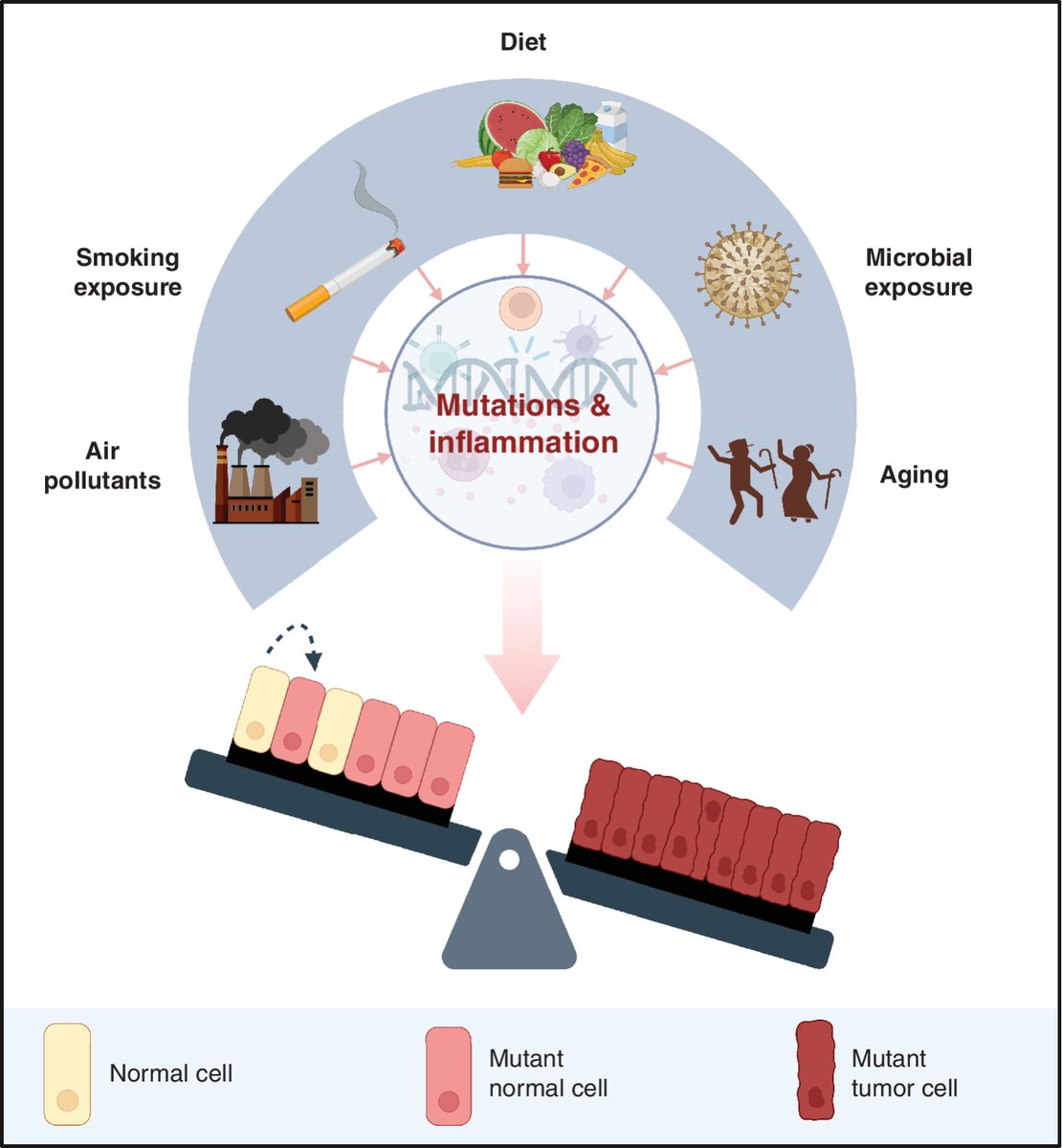
Inflammation appears to be operative in the earliest stages of lung adenocarcinoma development and likely drives oncogenesis of alveolar intermediate cells that function in tissue homeostasis/remodeling after injury. Indeed, it is long thought that tumors are wounds that do not heal, and it is in this healing process if chronic where the budding tumor can hijack inherent properties in the lung. It is also plausible that targeting inflammation is valuable for intercepting lung cancer rather than treating the disease in advanced stages. This supposition is supportive of earlier clinical studies with the IL-1B antibody canakinumab (CANTOS).
Very proud of Fuduan Peng joint fellow with the Wang group, now director extraordinaire @Squirrel_PhD, talented student @Yibo_Dai for leading this work, with strong earlier effort from @warapen. I am grateful for collaborations with many groups that I personally learned so much from. This work could not have been done without funding from @NIH@theNCI (NIH funding is important!), @CPRITTexas and @LUNGevity. Also thanks to the astute reviewers as well as the editors @Cancer_Cell who helped us improve our work. #lungcancer #endcancer @MDAndersonNews
https://t.co/YO15Wsrlpc
Glad to see our collaborative work now out in Cancer Cell! Really grateful for the tremendous support from my mentor @IamLinghua and fantastic collaborator and mentor @humam_kadara! Also thanks so much to the huge efforts from Fuduan and @Squirrel_PhD!
https://t.co/5nK3dizCCF
Overwhelmed with gratitude to have matched into Internal Medicine at @BrighamMedRes! This moment belongs to everyone who believed, loved, and lifted me, but most of all to @humam_kadara, my mentor, my compass, and the fiercest believer in me since my premed days. #Match2025
1/ A simple yet effective tool that integrates tissue #histology, cell morphology, and #SpatialTranscriptomics for profiling tumor and immune cell states, co-localization, and interactions within tissues https://t.co/lsIHblkVz0
We are hiring 🔥 Looking for a Data Scientist to lead the development and optimization of a multimodal single-cell analysis pipeline. The candidate will be part of @break_cancer, collaborate with TeamLabs, and benefit from #RadicalCollaboration. pls RT 🙏
https://t.co/FgR3DpMlSx
Deeply touched and honored to receive the Trainee Peer-to-Peer Mentor Award @MDAndersonNews. This recognition is very dear to me. I’m profoundly grateful for the mentors who shaped my journey and for the chance to pay it forward to my peers.
Thrilled to announce I’ve been awarded the Jeffrey Lee Cousins Fellowship Excellence Award in Lung Cancer Research for 2023-2024! @MDAndersonNews 🌟 Honored to follow in the footsteps of my role model and PI @humam_kadara and my amazing colleague @Squirrel_PhD 🎊🎉
Thank you #AACR24 for the opportunity to present our work in a minisymposium this year! Supported by our dream collaborative team at @MDAndersonNews, we are advancing the frontiers of how we look at lung #precancer, and bringing hope to the hype of early intervention 🫁
I was making new friends at the @MDAndersonNews booth at #AACR24 today, when a flock of high school students passing by were told by their usher “and here we are, at the Nr 1 Cancer Hospital in the nation”! Definitely made me feel proud to belong here! #endcancer
So lucky to be presenting on behalf of our amazing collaborative team! Ballroom 6, 2:30pm, no special glasses needed 😎 #AACR24#minisymposium#lungcancer
Excited for the #AACR24 profiling tumor ecosystems in native tissue context plenary session. Forget the solar eclipse and check out minisymposium talk abstract 3893 by our group @Squirrel_PhD on profiling #lungcancer and #precancer using multimodal #spatial omics @AACR#endcancer
Great first talk at #AACR24 opening plenary session on single cell & spatial omics and their power to understand cancer. ICYMI check our recent @nature paper how an atlas we generated of lung epithelial cells led us to identify #lungcancer progenitors
https://t.co/dVScW6rW7p
So honored to write this Commentary for @CD_AACR with my amazing collaborators (who have become dear friends) @DrMingyaoLi@tae_hwang. Thank you to @ElizSMcKenna and @CD_AACR for the opportunity to be part of this awesome special issue. https://t.co/cx2rm0GdxJ @MDAndersonNews
One of the most intriguing topics that drew me to my current work summarized in a very timely commentary by @ZahraaRahal @humamkadara & @pascheet, out now in @CD_AACR@MDAndersonNews
Beyond sharing data, resources & discoveries, team science is also about disseminating the right tactics & strategies for successful radical collaboration in #cancer research. Enjoyed reading this special commentary by @boehmjesse@LabJacks and @break_cancer out now in @CD_AACR
Thank you @CD_AACR for highlighting our recent paper about alveolar intermediary cells acting as precursors for #lungcancer#endcancer
https://t.co/zHPaYpRIJV
Always had a plan in place for when our superstar, first author, pregnant at the time @Squirrel_PhD might decide it's 'go time' in the lab—literally! Who knew she'd be delivering a beautiful work and her newest lab member almost simultaneously? Talk about multitasking! 😅