To earn true respect in the world, Indians have to develop deep capabilities in India. Achievements abroad won't do it.
I hope smart Indians keep this in mind.
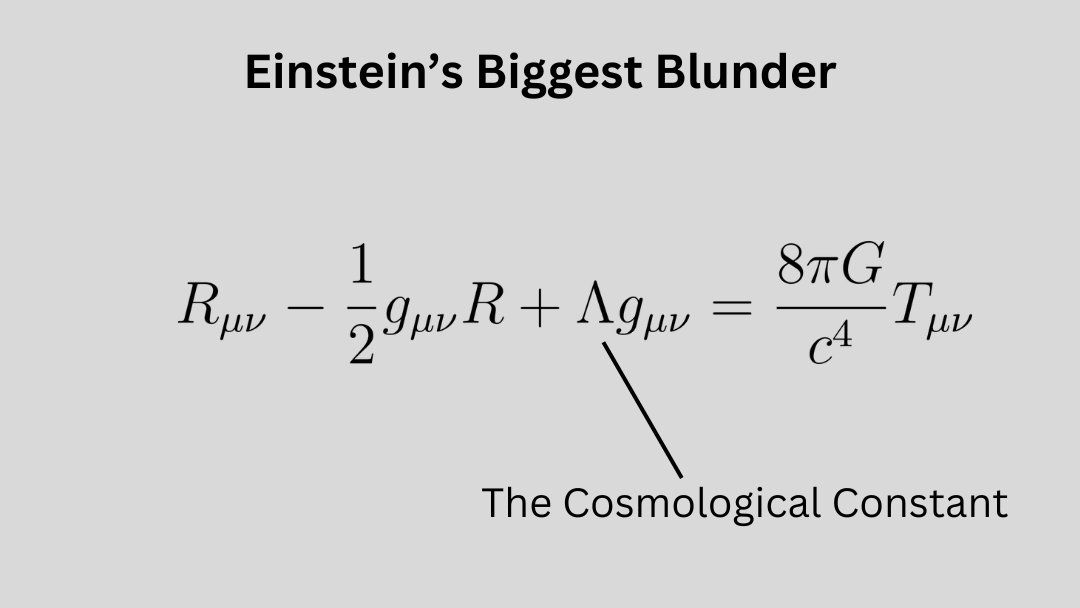
Albert Einstein introduced the cosmological constant (Λ) to his equations of General Relativity to maintain a static universe, aligning with the prevailing belief at the time. However, after Edwin Hubble discovered in 1929 that the universe was expanding, Einstein regretted the addition and called it his "greatest blunder."
Ironically, the cosmological constant later gained relevance with the discovery of the universe's accelerating expansion, potentially explained by dark energy. Einstein's so-called "blunder" is now considered a key element in modern cosmology.
India's 16-year-old para-archer Sheetal Devi produced a sensational effort in the final of the women's individual compound event at the Asian Para Games to win the gold medal. With no arms.
Telescope teamwork ✅
Hubble and @NASAWebb captured the galaxies in this image, while @ChandraXRay detected the superheated gas that these galaxies are immersed in, seen in purple.
Called MACS J0416, this cluster of galaxies is held together by gravity: https://t.co/VrYdjDPWtG
Srinivasa Ramanujan was an observant Hindu, adept at dream interpretation and astrology. Growing up, he learned to worship Namagiri, the Hindu goddess of creativity, who is also known as Namagiri Thayar or Namakkal. She is the consort of Narasimha, an avatar of Vishnu, who is depicted as a lion-headed man. Namagiri is said to bestow wisdom, knowledge, and artistic skills to her devotees.
He often understood mathematics and spirituality as one. He believed that an equation had no meaning unless it revealed the mind of God. He also said that Namagiri would appear in his dreams and place equations on his tongue, which he would later write down when he woke up. Some of these equations were so novel and complex that they baffled his contemporaries and mentors, such as G. H. Hardy. Even today, some of Ramanujan’s discoveries are still being explored and proved by mathematicians and physicists
Ramanujan’s belief in the Hindu goddess was not a mere superstition or a psychological crutch. It was a source of inspiration and intuition that guided him to explore the hidden patterns and symmetries of the mathematical universe. He saw the divine feminine as the mind beyond the mind, the awakening that happens when awareness is raised to the highest possible state. He also followed the Visishtadvaita philosophy of Sri Ramanuja, which asserts that the individual soul is not separate from the supreme soul, but rather a part of it. Ramanujan’s faith in Namagiri was a manifestation of his non-dualistic worldview, where mathematics and mysticism were intertwined.