That’s exactly the problem.
If FIC wants to keep the dollar dominant as the world reserve currency, it has to keep giving the rest of the world reasons to accumulate dollars and dollar assets.
That structural demand keeps the dollar stronger.
A stronger dollar makes US exports more expensive and imports cheaper.
That continues to hollow out US manufacturing and makes America more dependent on foreign production.
Then you have another problem.
If foreign governments, central banks and investors want fewer US Treasuries, but still want dollar assets, the capital goes somewhere else.
US equities.
Corporate debt.
Real estate.
Private equity.
Infrastructure.
American companies and productive assets.
So America increasingly exchanges ownership of its productive assets for the privilege of financing persistent deficits.
The less foreigners want the debt, the more attractive the assets become.
That means a larger share of America ends up owned or intermediated by domestic and foreign Financial Industrial Complexes.
With ownership comes influence.
That’s the paradox.
To preserve dollar reserve dominance, America needs the world to keep wanting dollars.
But if the world increasingly prefers American assets to American government debt, maintaining that dominance means selling a larger claim on America itself.
The dollar isn’t “going nowhere.”
Maintaining its position has a price.
& FIC decides.
The middle class is gone.
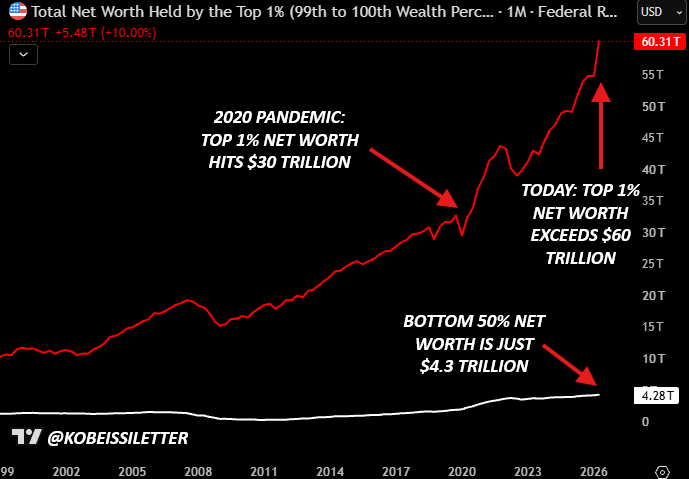
According to Fed data, the top 1% of Americans now control ONE-THIRD of all US net worth.
Since 2020, the top 1% have gained +$30 TRILLION in net worth, while the bottom 50% are worth just $4.3 trillion.
What is happening? Let us explain.
(a thread)
I've been a cardiologist for 25+ years. The last 90 days changed medicine more than the last decade, and almost nobody noticed. Here are the 10 biggest AI breakthroughs, and why you should be excited, not afraid 🧵
1/ 37,000 AI agents. One "virtual biotech." It analyzed thousands of trials, figured out which drug targets actually work in humans, and independently proposed a lung cancer strategy that a major pharma company later pursued. AI isn't a search engine anymore. It's a co-scientist.
2/ The first drug discovered AND designed entirely by AI (Insilico's rentosertib) just entered Phase 3. In patients, it reversed biological age by 3–6 years across six different aging clocks. Read that again!
3/ As a cardiologist, this one gives me chills. The FDA authorized "Queen of Hearts," an AI that reads a standard ECG and catches heart attacks, including the hidden ones doctors miss. 2x the sensitivity. Far fewer false alarms. It pages the cardiology team itself. In a heart attack, minutes are muscle.
4/ EchoNext spots 6 types of hidden structural heart disease from a cheap, 10-second ECG, and it does it better than cardiologists. It already flagged a patient who went on to get a heart transplant. Screening that used to need an echo lab now needs a test any clinic can run.
5/ UpDoc is the first FDA-cleared AI that talks directly to patients. It checks in between visits, adjusts insulin within limits the doctor sets, and documents everything in the chart. Chronic disease no longer has to wait for your next appointment.
6/ An autonomous AI agent called MIRA, with full access to medical records, went head-to-head with ER physicians on hundreds of real cases.
AI: 87.8% correct
Doctors: 78.1%
It ordered the tests, read the results, and wrote the plan.
7/ Google released MedGemma 1.5 and MedASR, open medical AI for imaging and clinical speech that anyone can build on. Every hospital. Every researcher. Every country. Open models mean medicine moves at internet speed.
8/ The FDA authorized Aletta, the first robot that draws blood on its own. It gets the vein on the first stick 94–95% of the time, even hard veins. One technician supervises three robots. The most common procedure in medicine just got automated.
9/ UCLA's SLIViT matches specialists on 3D MRI, CT, ultrasound, and retinal scans, and it's 5,000x faster. It isn't a new model for every organ. One architecture reads them all.
10/ The FDA has now authorized 1,600+ AI medical devices. They cover radiology, cardiology, and surgery, including real-time AI that checks breast cancer margins while the patient is still on the table. This isn't coming. It's here.
What this means to you:
→ Drugs that took 10–15 years are showing human results in a fraction of the time
→ Heart attacks get caught on a cheap ECG, not after a collapse
→ Doctors get hours back
→ Patients get answers between visits
→ Aging itself is becoming treatable
This isn't "AI will replace your doctor." It's AI finally becoming good enough that medicine starts to compound. The next 18 months will feel different.
Bookmark this. We're early. Stay positive!!!
@nic_carter What are your thoughts on data center getting tax brakes?
Theres a city called eaglerock in utah where the citizens arw angry about their taxes being raised while the data center gets tax breaks.
Reasonable in my view, and I am pro data centers too
Seedream 5.0 Pro. Unlimited. Now in 2K
Every "what if I try it again", at production resolution
→ Precise editing
→ Text that stays legible, even in dense layouts
→ 2K output, ready to post anywhere
Try it now on Magnific
Ethics in Washington - or the lack thereof - has been an issue for decades. I thought it was wrong and unethical when Vice President Dick Cheney awarded Haliburton a multibillion dollar contract for the Iraq War, despite Cheney (its former CEO) still being on Haliburton’s payroll.
I thought it was wrong and unethical when the @ClintonFdn accepted bribes - I mean donations - from foreign countries or nationals while @HillaryClinton served as Secretary of State. The same people who donated were granted meetings and access with Clinton.
Buying access to our government is an industry itself. During the @SBF_FTX trial we learned that Sam donated $10M to the Biden Administration for the purpose of obtaining “access to regulators.” It worked. He met with Gary Gensler privately twice and was rumored to have cut a deal with Gensler and the Administration just prior to FTX blowing up. He testified before Congress and was blown kisses 😘 from @RepMaxineWaters.
I thought it was wrong and unethical for @HunterBiden to be flown to China on Air Force One with his dad @JoeBiden - the President of the United States - to have meetings with foreign nationals and foreign companies.
And yes, I believe it is wrong and unethical for the President to have a Meme Coin wherein foreign investors can gain access to the President. I believe it is wrong and unethical for the President’s sons to invest in companies who then are awarded defense contracts and government guaranteed loans.
The fact that politicians go to Washington broke and within a decade become multimillionaires because of insider trading is wrong and unethical.
Whether it’s @SpeakerPelosi@sethmoulton or @EdMarkey or a number of Republicans who make millions off investing in companies they oversee while sitting on Congressional Committees - it is wrong and unethical.
The truth is: we’re living in the Corruption Era.
But you don’t shut down an industry or refuse to pass a law because one side seems to be better at cashing in on Washington Grift than the other side. How about you just start enforcing conflict laws and avoiding appearances of impropriety all together? Write a bill that bars these conflicts.
One thing for sure: People like @ewarren@sethmoulton & @EdMarkey hate @realDonaldTrump a lot more than they love America.
I was chatting with a fellow crypto OG last night. As much as we hate to admit, this bear market feels exactly like a simulation with the 4 year cycle.
This is my 4th bear cycle and things are moving exactly according to this script. Next few months will be very challenging before we finally bottom and get to pre-bull stage next year, at which so many of us will be so PTSD with crypto but it's actually the best time to buy and ride the wave for the next 2.5 years
happy birthday america.
the greatest place ever invented.
i’ll spare the cliche immigrant story or whatever but one thing i think about a lot is when i moved to london ppl would basically always tell me to tone it down (cuz i used words like awesome all the time) or ppl told me i was too optimistic or that would always be enthusiastic about something working. i had hard time doing this cuz i never learned any of this behavior, it was sorta just built into me. i found that to be strange & it took me a long time to realize they they were correcting all of my priors instead of simply correcting my vocab.
that’s kinda the thing that is hard to explain until you leave. what makes this place so damn unique is ppl here are unusually willing to have an absurd dream & then attempt to make it real. it’s the greatest concentration of individuals on the planet who actually try to make stuff *real*. that instinct feels almost pre programmed into americans. “why not me?” is prolly the macro that separates this country from anywhere else.
ppl love comparing here to other places using metrics like healthcare, trains, safety, etc. those things matter. but they are the outputs not inputs. the inputs matter way more. kinda like sports leagues trying to create the next generation of stars by investing in little league. the macro inputs of america are the belief that the future is not something that happens to you, but something you are allowed to build or change.
& here, far more than anywhere else on earth requires almost zero permission to attempt it all.. without asking for any sort of cultural consent. that’s why all of the shit you see around the world is basically invented in america.
what an astonishingly ridiculous beautiful country.
Here is a video of a North Korean IT worker being stopped dead in their tracks upon being required to insult Kim Jong Un.
It won't work forever, but right now it's genuinely an effective filter. I'm yet to come across one who can say it.
i can't believe nobody caught this.
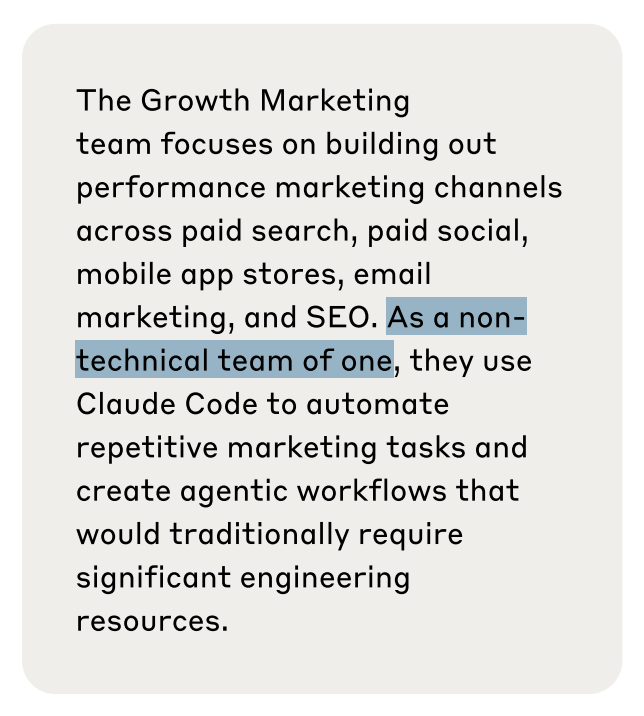
Anthropic's entire growth marketing team was just ONE PERSON
(for 10 months, confirmed)
a single non-technical person ran paid search, paid social, app stores, email marketing, and SEO for the $380B company behind claude
here's exactly how one human is doing the job of a full marketing team:
it starts with a CSV.
1. he exports all his existing ads from his ad platforms along with their performance metrics (click-through rates, conversions, spend, etc)
2. feeds the whole file into claude code
3. and tells it to find what's underperforming.
claude analyzes the data, flags the weak ads, and generates new copy variations on the spot
this is where he gets clever:
he then splits the work into 2 specialized sub-agents:
1. one that only writes headlines (capped at 30 characters)
2. and one that only writes descriptions (capped at 90 characters).
each agent is tuned to its specific constraint so the quality is way higher than cramming both into a single prompt
so now he's got hundreds of fresh headlines and descriptions.
but that's just the text.
he still needs the actual visual ad creative, the images and banners that go on facebook, google, etc.
so he built a figma plugin that:
1. takes all those new headlines and descriptions
2. finds the ad templates in his figma files
3. and automatically swaps the copy into each one.
up to 100 ready-to-publish ad variations generated at half a second per batch.
what used to take hours of duplicating frames and copy-pasting text by hand
so now the ads are live.
the next question is which ones are actually working.
for that he built an MCP server (basically a custom integration that lets claude talk directly to external tools) connected to the meta ads API.
so he can ask claude things like:
• "which ads had the best conversion rate this week"
• or "where am i wasting spend"
and get real answers from live campaign data without ever opening the meta ads dashboard
and the part that ties it all together and closes the loop:
he set up a memory system that logs every hypothesis and experiment result across ad iterations.
so when he goes back to step one and generates the next batch of variations...
claude automatically pulls in what worked and what didn't from all previous rounds.
the system literally gets smarter every cycle.
that kind of systematic experimentation across hundreds of ads would normally need a dedicated analytics person just to track
the numbers from the doc:
ad creation went from 2 hours to 15 minutes. 10x more creative output.
and he's now testing more variations across more channels than most full marketing teams
a $380 billion company.
and their entire growth marketing operation (not GTM) = just one person and claude code lol
truly unbelievable
Block just cut 4,000 people while posting its best quarter in company history. The stock jumped 23%. But the real story is what made this possible.
Block built an open source AI agent called Goose (powered by Anthropic’s Model Context Protocol) and deployed it across the entire company. One engineer says 90% of his code is now written by Goose. Non-technical teams are using it to write SQL queries, close support tickets, and manage inventory without waiting for engineers. Block’s CTO told Lenny’s Newsletter it saves employees 8 to 10 hours per week. When you multiply that across thousands of people, you start to understand how a company can look at its org chart and realize half the seats are redundant.
The financial proof is hard to argue with. Q4 gross profit hit $2.87 billion, up 24% year over year. Cash App grew 33%. Operating income went from $13 million to $485 million in twelve months. Block raised its 2026 outlook to $12.2 billion in gross profit. All of that growth came while the company was already quietly shrinking, down from 13,000 employees in 2023 to 11,000 by late 2025.
Now Dorsey is taking it to its logical conclusion. Block with 6,000 people generates roughly the same revenue as Block with 13,000. That’s not a guess anymore, the Q4 numbers proved it. Revenue per employee just doubled overnight. The company goes from ~$2.2 million per employee to ~$4.2 million, putting it closer to the efficiency ratios of companies like Shopify and Stripe.
Three weeks ago Bloomberg reported Block was cutting “up to 10%.” Three weeks later: 40%+. Dorsey saw Q4 numbers strong enough to absorb $450 to $500 million in severance costs and went all in. He’s betting that smaller teams with AI tools will outperform larger teams without them. And Block is one of the few companies that actually built the AI tooling internally before making the cut, rather than waving at “AI transformation” as a vague justification.
The severance package (20 weeks salary plus tenure bonuses, equity through May, 6 months healthcare, $5,000 stipend) is above average for tech. The company ended 2025 with $9.2 billion in liquidity. Dorsey kept communication channels open through Thursday and hosted a live farewell session. For a cut this deep, the execution was more transparent than most.
This is probably the first major case of a public company explicitly restructuring around AI productivity gains it can actually measure. If Block’s bet works, every CEO with an AI roadmap and a bloated org chart is going to be watching very closely.
WATCH🚨: Alex G just released insane first-person footage of sprinting onto the Super Bowl field... only to get FULLY tackled and piled on by Patriots WR Kyle Williams + security! 💥🏈 Shirtless chaos, Meta glasses rolling, "Trade with Athena" promo mid-run—this guy's next-level unhinged
There’s a lot of talk right now about Bitcoin’s recent weakness and whether the "institutional adoption" story was overblown. On balance, this seems like a classic case of an asset becoming "too big to ignore" and forcing its way into traditional models and risk buckets.
There are striking parallels between bitcoin today and the 2004 launch of the GLD gold ETF. Gold spent most of the first year in a "digestion" phase, followed by the euphoric year 2 rally, followed by another long grind as it became a standard line item in advisor statements.
With Bitcoin, IBIT was launched in 2024 and AuM growth was orders of magnitude faster than gold. This probably created a bigger positioning overhang as institutional managers are unlikely to just buy and HODL, they will rebalance and control risk.
If IBIT follows the GLD script, then what we are seeing isn’t a death spiral. Rather it is the messy maturation phase that comes from the asset going mainstream.