Despite the stellar share price performance, some large shareholders are not very content with Almonty’s Board of Directors 👀
CEO Lewis Black received only 79.23% votes for while directors D’Amato and Trachuk scored only 63.1% and 64.5% respectively.
Not a good look…
Why I think $ADUR will have no problem scaling:
First let's understand the biggest challenge most plastic recycling companies face. And it's not the chemistry, it's about the building the actual infrastructure:
- For conventional recycling like pyrolysis to make money, the plant has to be big. I mean, really HUGE.
- Small plants just don't pay off, so the first commercial plant often has to be large right out of the gate. And large gets expensive fast. Easily $3,500 to $7,500+ per tonne of capacity, which pushes you toward a nine-figure project before you've earned a cent.
- These plants also tend to run on custom-built machinery. And when something hasn't been built before, scaling it up is genuinely hard to predict, hard to staff, and super slow.
- There's also a step people miss: the oil pyrolysis produces usually isn't ready to use on its own.
- It carries contaminants a steam cracker won't accept, so it needs a second clean-up stage before it becomes a real feedstock.
None of this makes the technology bad.
- It just means the bar to get that first plant standing is incredibly high. Which is why a lot of "advanced recycling" projects get announced, then quietly stall and struggle a lot to be profitable.
Now look at how $ADUR is building.
- Their first industrial plant is small, 10,000 tonnes a year.
- And it's modular. This is important.
- Because their goal isn't to scale it by building a monster. But through adding more copies.
- It runs on standard, off-the-shelf industrial equipment. Not custom built equipment (this was validated by a patent they filled in January 2025).
- With known behavior comes easier hiring and faster pace to build as the scaling ratios are known.
- Also, the process is water-based and runs at a modest temperature without needing exotic solvents or a giant high-pressure loop.
- And Aduro says its oil comes out ready for a steam cracker in a single step. (This was validated a few months ago by an undisclosed chemical major.)
Btw, they have a major steam cracker right next to where they're building in the Chemelot Industrial Park.
- So, looking closer, makes total sense for $ADUR to call this plant a "First-of-a-Kind" (FOAK) plant.
- Because they're really building the first plant of its type ever built.
- Conventional recycling need big, custom and complex plants. So the very first plant becomes the hardest part of the whole journey.
- Aduro with their unique technology flipped that. They build small, simple and modular. Then, they just need to copy it.
That's why I don't think scaling will be the easiest part for $ADUR.
The hardest part of this industry - getting that first plant standing - is the part Aduro designed around from the start.
They're really building the First-of-a-kind.
Pilot plant update: 86% liquid hydrocarbon yield.
Our latest NGP Pilot Plant operating campaigns delivered a major step forward, with results consistent with our prior lab & R2 scale tests.
Key highlights:
• 86% liquid hydrocarbon yield
• 47-hour continuous experimental run
• 29 hours of steady-state operation
• 85% of the liquid product at C20 or below
• Product quality aligned with prior R2 results
This progress demonstrates that expected performance can be repeated, measured, and translated into the engineering data needed for our first-of-a-kind facility.
👉 https://t.co/ipyY098T6f
$ACT.TO $ADUR #CleanTech #EcoInnovation #PlasticRecycling #CircularEconomy
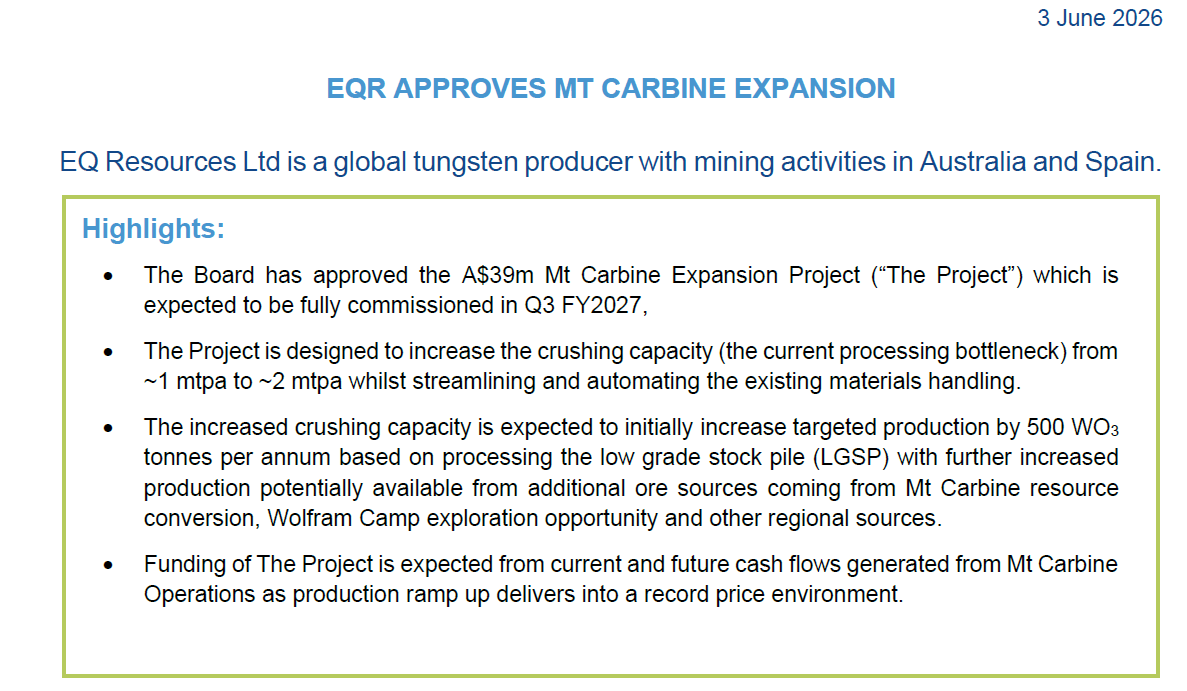
🟡 EQR expands regional growth pipeline around Mt Carbine
EQR has entered into a binding heads of agreement to acquire the Hodgkinson tenement package, comprising six prospective EPMs adjacent to Mt Carbine.
The acquisition supports EQR’s long-term hub-and-spoke strategy — leveraging Mt Carbine’s expanded processing capacity and supporting secure Western tungsten supply over the long term.
ASX: https://t.co/t7KTJRNTuy
#EQR #Tungsten #CriticalMinerals #ASXNews #MiningNews
📈The tide changes??☕️
$eqr.ax
Close🟩🟩🟩
0,24aud
+11,63%
#tungsten
Rotterdam 2925$,+0➡️
China 1705$,+0➡️
We finally got some news. EQR published that it will be beginning the expansion of Mt Carbine to make it a regional hub-and-spoke model for a longer term vision for the company and larger output in production. And this will be financed with current and future CASH FLOWS. Ain't that a good deal for a company that is known for diluting shareholders. The news got the share price to +11% jump but still no meaningful volume, there is a lot of room to run. Tungsten apt prices stayed the same. Could the negative tide be turning?
@HunterAllen4 Great!
At this APT price and at full production, EQR is going to generate roughly its current market cap in positive cash flow over the next 12 months.
An easy 10x coming over the next 12 months - maybe..
#Tungsten $EQR.AX 🍀
@HunterAllen4 Okay, Elmet is strong, but surely you understand that without EQ Resources, Elmet wouldn’t have tungsten to further process.
EQR is the West’s largest tungsten producer with its two mines in Spain and Australia. Elmet has offtake agreements for EQR’s tungsten.
#Tungsten $EQR.AX
Noniiin höpöhöpö, pois nuo karhuiset mielikuvat! Vähän joudutaan siirtelemään maalitolppia: seuraavakin kvartaali tulee todennäköisesti olemaan huonohko. Samoin $2-3+ skenaariot alkaa näyttää vähemmän ja vähemmän todennäkösiltä.
Mutta jokaiseen hurjaan nousuun kuuluu myös takapakkeja. If you can’t handle the lows, you don’t deserve the highs ja sitä rataa 😄
Turvamarginaalia piisaa. Viimeistään syksyllä euforia on taas vallitseva sentimentti - kyllä me ainakin dollarin raja rikotaan tässä syklissä! Se on liki 5x tuotto nykyhintoihin.
Ps. uskon edelleen että myös lännen APT:ssä on vielä vihreitä päiviä tulossa.
I see the coming 3-5 years as a period where a top-down approach like $NBIS has (software first, adding physical infrastructure and power later), will run into serious constraints.
The entire thesis of $IREN is that the physical world cannot keep up with the digital world, and I am not convinced that Nebius can break that concept by buying their power and data centers on-the-go.
I realize that's a very simplified version of this story, and it probably doesn't justify everything Nebius stands for, but directionally, I think that's where we are going.
I see Nebius as a faster car with a smaller tank, and IREN as a more durable car with a lot more gas in the tank.
The real question is: can Nebius get to a situation where they can buy their way out of that gas shortage, and will IREN be able to keep their car in good shape.
I totally accept that by being early with calling this out, I most likely face a lot of resistance and disagreement from the markets, but I will stick to this vision until I get proven otherwise.
And honestly, the $BE thing proves my point, albeit not material enough yet to cause a car crash.
New $IREN Deep Dive
Our new $IREN deep dive is finally live!
It's honestly the most comprehensive report we have ever released and something I'm firmly convinced will age like fine wine.
Even though it goes into great depth, it's written in a way that virtually every investor can understand. I purposefully went light on industry and finance jargon, and whenever I did use technical terms I made sure to explain them properly.
This time around I've also unlocked the entire first chapter for free Substack subscribers to read.
So if you're on the fence, I encourage you to read the first pages to get a sense of the depth and analytical quality you can expect from the rest of the deep dive.
I'm sure every $IREN shareholder, analyst, or investor curious about the company will derive great value from this deep dive.
I very much appreciate everyone's patience. This one took a while.
Enjoy! ✌️
https://t.co/HUkfni8Ltf
For too long, China has used its dominance over critical minerals processing to pressure industries, manipulate markets, and threaten global supply chains.
Today’s @StateDept Quad partners announcement is a major step toward building resilient, diversified supply chains with trusted partners, not strategic adversaries.
The U.S., Japan, Australia, and India are mobilizing up to $20 BILLION to secure supply chains for the minerals powering advanced technology, defense systems, batteries, and AI.
The era of relying on China for critical minerals must come to an end.
https://t.co/FlJbqS5P9J
$IREN: Financial Model 2.0.0
https://t.co/cNsypVJ1or
Summary
With more data from IREN's Q1 earnings call on buildout cadence (1), I made significant changes to the 1.2.5 financial model so this will be the first 2.0.0 version.
True to the ethos of the original model, the App allows the user to input all relevant variables and expose the App's calculation details in real time so that the user can audit and provide feedback.
Charting
As a corollary to the guidance on buildout guidance, we are able to implement great suggestions from @StockAnalystPro to chart "share price" vs "year". Additionally, the X and Y Axises can be selected so you can plot for example "share price" vs "MWs active" or "Earnings before Tax, SGA" vs "Market Cap".
I only read charts for TA. For FA, I'm always read numbers and never charts so there's probably improvements / suggestions that can be applied to improve the charting.
GPU Pricing Improvements
Previously I did improvement as a percentage of contract topline. Thanks to @GlobalCollapse for pointing out that's non-intuitive. I removed the odd mechanism completely and provide a flat GPU pricing for different years. For example I have "B300 - 2025 Pricing" which corresponds to both the unit price and hourly rate and "B300 - 2026 Pricing" correspondingly.
The default GPU pricing are either direct IREN datapoints or linearly extrapolated as described below.
Linear Extrapolation
I do mostly linear extrapolation. For example in the case of GPU pricing, IREN always gives GPU pricing included servers, Inter-rack Networking, cabling costs while publicly available figures are per GPU or per rack. To get IREN's all-in pricing for Vera Rubins I calculate = (IREN's All-In GB300 Price in 2025) * (Market Per GPU Vera Rubin in 2026) / (Market Per GPU GB300 in 2025).
Dilution
$IREN does Convertible Debt for their Datacenter Capex and GPU Backed Debt for their GPUs. Both the datacenter capex and GPU capex are subtracted off revenue before calculating "Earnings before Tax, SG&A". In practice this is equivalent to $IREN using revenue to pay off the convertible debt before it matures. Other Neoclouds like $NBIS also issues convertibles debt since it doesn't immediately count as dilution and can be paid back in cash. CRWV has more corporate debt which has higher interest rate but non-negotiable cash redemption.
On top of that I count 10% dilution per year up to 40% in 2029 to account for slippage in buying back convertibles even with the insurance that IREN buys and cost of site works, misc. In 2030+, cashflow should be strong enough so dilution stays at 40%.
Stock Price
The 2026 ARR supports a stock price of $94.63 while 2027 ARR supports $236.44 even though 2027 having lower PE and more dilution accounted for. This is because IREN has become a priority partnered of Nvidia and will get GPU deliveries that corresponds to their full buildout cadence with buildout guidance of 1210MW by 2027, a big jump from 480MW in 2026.
Important to note is that 2027 buildout will start with contracts signed in 2026 so in H2 2026 we may see partial pricing in of 2027 buildout as contracting gives market confidence on the supply side and concrete pricing.
Delays
IREN's build out cadence is bottleneck by GPU deliveries. Full system test of liquid cooling can only begin once the GPUs arrive so late GPU deliveries means late triaging of liquid cooling bugs. Then stress test networking scripts can only be run for long amounts of time after liquid cooling system is fully validated.
As you can see there is only so much theory preparation you can do. In engineering, debugging the real hardware is a process with many sequential locks.
Other
I'm pretty busy these days so my commentary is incomplete but number savy people like @_Sgr_A_Star, @GyujinAAIG might be able to good commentary on numbers. @_Sgr_A_Star has a great model for very zoomed in tracking of earnings financials that can probably validate or invalidate some elements of my model. I welcome feedback from everyone as that's the point of this open sourced model.
New $IREN Deep Dive dropping tomorrow (on Substack).
Over two weeks of work, 50+ pages, and honestly the most comprehensive report I've ever released.
I'm constantly on X reading everything there is on $IREN. I'm also routinely checking sell-side and institutional coverage of the ticker.
Trust me when I tell you that there is nothing in the public sphere that comes close to the depth this deep dive delivers.
Very excited for the release!
This post is actually hilarious. The CEO of Data One was so proud of his “net 0” gas turbine power plant. Yet he failed to get the necessary AIR QUALITY permits to run these (because they are not net 0!)
Ouh the irony… These are the charlatans $NBIS relies on for their site development 😂 Now $NBIS has to salvage the project by paying $BE hundreds of millions in annual fees for their fuel cells.
The only real winner here is $BE.
https://t.co/mVvWspGvXh
New CTIA/tungsten data.
Jan-Apr 2026:
China tungsten product exports: 3,655.57t, down 22.23% YoY.
China tungsten product imports: 10,600t, up 114.79% YoY.
Ore & concentrate imports: 10,200t, up 169.61% YoY.
China is pulling in feed while exporting fewer tungsten tonnes.
$EQR.AX
My take on @danroberts0101 new post
$IREN Co-CEO just dropped a beautifully written thread on the company's compounding competitive advantages.
Seriously, a must read for every $IREN investor or folks who are on the fence.
My highlights:
- Dan confirmed that the 60 MW cloud contract with $NVDA is in fact measured in 'gross' MW, not IT. That was already obvious to me based on the earnings call material, however, it's great to get definitive confirmation.
The implications of this is ENORMOUS. The $NVDA contract has incredible economics, something I've analyzed extensively in my upcoming $IREN deep dive (released in a couple of days on Substack).
- Dan firing shots at the likes of $NBIS & $CRWV:
"And the asset-light neocloud trying to compete by renting capacity is discovering that sites were locked up years ago, and the operators utilizing them aren’t subletting. By the time new entrants solve for land, power and permitting, IREN will have gigawatts online, execution track record, and customer relationships that took years to build. That gap doesn’t close. It compounds."
This is by far my favorite quote coming out of Dan. Eventually, everyone will realize that the real advantage $IREN has over the rest of the neo-cloud sector, is the fact that they are the only provider that's 100% vertically integrated.
They don't have to deal with any land-lords. They don't have to pay billions to $BE to secure fuel cells in a desperate attempt to salvage a project that is tied to a large customer contract. $IREN is in control of its own destiny, and eventually that will show up in the bottom line (profits).
The “asset-light” model never works in an infrastructure-heavy industry. It works for hardware, when you are the high-margin designer and outsource the manufacturing process to a specialized entity. But it doesn’t work when the infrastructure itself is the product.
In cloud, the value is not just in having access to GPUs. The value is in controlling the full stack, which mostly consists of physical infrastructure.
If you outsource all of that to colocation partners, you are not building an AI factory. You are renting someone else’s factory, layering a spread on top, and hoping the economics still work after the landlord, the power provider, the OEM, and the lender have all taken their share.
That model can look attractive in the early innings because it allows rapid capacity announcements without heavy upfront CapEx. But structurally, it leaves the operator with the worst part of the value chain.
I'm really looking forward to comparing the net income lines between $IREN, $CRWV, and $NBIS a few years from now. I wouldn't be surprised if two out of the three remain unprofitable by then.
- I really enjoyed Dan's section about becoming a global cloud provider.
He did a great job in explaining the importance of being locally present in the markets you want to source customers from. Not just due to local proximity for inference, but also due to compliance & sovereignty.
These were my highlights, I'll let you discover the other gems yourself. This is easily Dan's best post and I think it does a lot in terms of IR, especially as it's coming from him; the co-founder and co-CEO of $IREN.
As mentioned earlier, very soon I'll be releasing a new deep dive on $IREN. It goes deep into the implications of the $NVDA partnership and Mirantis acquisition, including a bunch of different topics worth exploring. So far, the report is 30 pages long (including graphs / images) and I'm in the process of finalizing it.
Honestly, one of my best deep dives to date. I know I'm saying that for each release, but the depth and quality of our work is undoubtedly increasing. Can't wait to publish it.
Cheers guys! ✌️
𝐓𝐡𝐫𝐞𝐞 𝐋𝐚𝐲𝐞𝐫𝐬. 𝐎𝐧𝐞 𝐂𝐨𝐦𝐩𝐨𝐮𝐧𝐝𝐢𝐧𝐠 𝐀𝐝𝐯𝐚𝐧𝐭𝐚𝐠𝐞. 𝐓𝐡𝐞 𝐈𝐑𝐄𝐍 𝐓𝐡𝐞𝐬𝐢𝐬.
There's been a lot happening at IREN recently.
Expansion across North America, Europe and Asia-Pacific.
The NVIDIA partnership.
The Mirantis acquisition.
New GPU deployments.
New customer discussions.
A growing global footprint.
Underneath all of it is a fairly simple view of where the world is heading, and a deliberate strategy for how we position IREN within it.
That strategy is built on three layers. Together, they compound into a structural advantage that gets harder to replicate every quarter we execute.
Layer 1: Physical infrastructure. Power, land, substations, data centers, cooling. The foundation that everything else sits on.
Layer 2: Compute infrastructure. The GPUs, servers and networking that go inside those buildings. Deployed at scale. Generating revenue. Building execution track record.
Layer 3: Software and operational capability. The orchestration, deployment tooling and enterprise expertise that makes the first two layers work harder for customers, and opens the door to a broader, higher-value market over time.
Layers 1 and 2 are where the overwhelming majority of IREN's value is being created today. Layer 3 is where that advantage compounds further over time, but only because Layers 1 and 2 are built, owned and controlled at scale by IREN, not subscale nor contracted from a third party.
Think of Amazon. They didn't win e-commerce by building a great website. They won it by controlling the fulfilment infrastructure at a scale nobody else could replicate. The foundation you don't control becomes the ceiling on your business.
That is exactly how we think about IREN. The physical infrastructure - the land, the power, the substations, the data centers - is owned and controlled by us. The compute deployed into it generates the revenue and execution track record. And the software, orchestration and enterprise capability we are more methodically building on top is what turns the total product into a vertically integrated AI Cloud platform that compounds over time and deepens into a competitive moat.
AI is still early. The bottleneck is increasingly physical. And we have spent eight years building the foundations.
$IREN: The Value of Secured Power for AI Datacenters
The intention here is not talk down $NBIS but to analyze what power is really worth to Neoclouds. It's good that Nebius get creative and be flexible. $ORCL also had "secured powered" in Abilene, Texas that was actually BTM gas turbines but the gas turbines + BESS architecture was "mis-designed" and couldn't support high power fluctuations of a GPU datacenter. Oracle fixed it with large capex to buy $BE fuel cells.
This 2.6B fuel cell purchase almost certainly corresponding to @ilzmcfly findings on $NBIS missing air permits for Bergen cruise ship engines for their Vineland datacenter. Vineland is scheduled to have 50MW from the grid and 250MW is exactly the amount that they need for 300MW. The additional 78MW is for redundancy is analogous to N+1 gas turbines redundancy architecture. The timing also matches exactly the Vineland datacenter ramp.
Value of Power
$NBIS pundits like to conveniently confuse the price of electricity with the cost of getting the power. Yes the price of electricity is cheap! However the cost of power is either:
1. 5-7 years of waiting on grid permitting.
2. Billion of dollars on gas power plants like $META is doing in Lousiana.
3. Billions of dollars on fuel cells like $ORCL is doing for Abilene.
Most important is that these fuel cells have a MTTR (mean time to replacement) of 6-8 years (1)! In the BE-NBIS contract, BE will provide the fuel cells as a service for 10 years including maintenance and repairs. The $2.6B cost is reoccurring every 10 years! This means that 250MW of grid connected power is worth 2.6B/10 years! The 78MW of redundancy on the grid is free because the grid is redundant with multiple power sources - that's the main functional advantage of the grid.
Thus every 1GW of grid secured power is worth 10.4B/10 years or 1.04B/year. IREN so far has 4.9GW of grid secured power and still a multi-gw pipeline left. From the 4.9GW of today's secured power alone, once built into datacenters, is worth 5.096B/year of profits as that's less cost subtracted from the topline. Put a 10x P/E on that and that's 50B for the power alone.
In this sense long IREN is in the same vector as long BE but IREN has a whole bare metal + Kubernetes Cloud on top.