The home services industry is at a turning point, and last week we got a pretty good look at how the incumbents are reacting to it.
@ServiceTitan gave about 1,000 of its own customers 30 days’ notice that they’re shutting off the @PodiumHQ integration, right in the middle of their busiest season.
We’ve asked them privately and publicly to give customers more time. So far, they’re not budging. We’ll keep pushing and make sure every affected customer has a path forward.
Why create that much disruption just to kill one integration?
I think it has a lot to do with what AI is doing to traditional software.
I started Podium in 2014, and in 12 years I’ve never met a business owner who loves their FSM.
They use it because they have to. Their data is in it. Their workflows run through it. Getting onto one is painful, and moving off one has historically been even worse. So even when the product doesn’t evolve, customer service declines, and prices go up, most people just stay.
We call it FSM jail.
For a long time, that was a pretty incredible moat. Software was hard to build, switching was brutal, and there usually wasn’t anything meaningfully better anyway.
AI changes that.
Three years ago, we started building AI agents and realized pretty quickly that this was going to change everything. Traditional software helps humans do work. Agents can actually do the work. And you can’t just bolt that onto an old system of record. You have to build from scratch around humans and agents working together.
That’s the bet we made at Podium.
We launched our AI Operating System for home services a few months ago, and hundreds of businesses have already moved over from their old FSMs.
Techs spend less time doing data entry. CSRs spend more time helping customers. Offices run more smoothly with less overhead. Businesses make more money.
But the thing I hear most: owners enjoy running their business again.
I have no doubt that companies like ServiceTitan started out innovative, fast and obsessed with their customers. But when customers almost never leave, you can raise prices every year without having to keep innovating. Over a decade or more, that changes the DNA of a company.
You get slower. You get less responsive. You stop pushing as hard.
Changing that DNA after 15 or 20 years is way harder than people realize.
That’s what AI is going to change for home services. Business owners will have more choice, and the software can actually do the work instead of just giving people another place to enter data.
The result will be businesses that grow faster, make more money, and require a lot less administrative work to run.
That’s exactly what we’re building at Podium, and it’s why I’m so excited about what’s ahead for this industry.
We’re just getting started. If you want to see what we’re building, DM me.
Clarence Thomas says Stanford Law School is off-limits for conservatives. As an SLS alum, I would be honored if he spoke at our law school https://t.co/YZYGckszUX
When anyone can ship an AI product in a weekend, what actually makes a company defensible?
@aranum is taking the stage at @stepconference for a panel on Moats in the Age of Infinite MVPs alongside @marianebekker of @youdotcom, @alysaaco of @BainCapVC, & @anuraggoel of @Render.
They’ll cover where durable differentiation comes from - proprietary data, customer-embedded workflows, & security & compliance choices that are harder to replicate than product features.
Attending STEP SF? Add it to your agenda: https://t.co/IOYtw2hNA2
If Sam Bankman-Fried did nothing illegal, he might have been the best VC in history
What SBF bought vs. what it's worth today:
• Cursor: ~$200K → ~$3B (+1,499,900%)
• Anthropic: ~$499M → $82.3B (+16,400%)
• SpaceX: ~$200M → ~$15B (+7,400%)
• Solana: ~$189M → $5.1B (+2,600%)
• Robinhood: $612.5M → $4.9B (+700%)
• Genesis Digital: $1.17B → $3.5B (+200%)
Had he done nothing wrong, he'd have an estimated worth of $114,000,000,000 today
Instead he's tweeting from Federal Correctional Institution
In 2025 +40% of enterprise software venture funding went to the top 20 largest deals.
A decade ago, that number was 8%. AI changed everything.
Capital is concentrating into a small number of AI-native leaders at a speed & scale the software market has never seen. The cost of being second-best has never been higher.
→ 14 rounds exceeded $1B in 2025 alone (more than the entire prior decade combined)
→ Close to 100 AI-native companies have already crossed $100M in ARR
→ $100M ARR scale in under 18 months (used to be a 5+ year journey)
→ Private enterprise software unicorns added $1.7T in value in a single year!
The concentration is accelerating in 2026. OpenAI recently announced a $122B round, the largest private fundraising event in history, & Anthropic is rumored to be coming with a new round soon.
CC: @SteveAbbott415, Kevin Burke, Lou Segall, Jake Randall
Fresh off HumanX: every conversation started the same way: @AnthropicAI vs. @OpenAI .
It's the biggest drama in tech right now, and hard to ignore. But after two speaking sessions and several reporter meetings, I can tell you what's actually driving the most meaningful dialogue among CEOs–how to build something with a real wedge that stands the test of time.
I joined Quentin Clark (General Catalyst) and Katelin Holloway (Seven Seven Six) for a panel moderated by George Hammond (Financial Times) digging into whether AI startups are building real value or just chasing hype + a Q&A with founders and VCs just prior.
We covered a lot of ground, but 3 things kept surfacing as what founders simply can't get wrong:
1. Team and ownership early on. Who is the CEO, how equity is split, how the board is structured. These decisions compound.
2. The first 10–20 engineers. They define your culture and trajectory. Get this wrong and you're rebuilding from the inside out.
3. Your pitch is also your marketing. You're not just building a company, you're telling a story to investors. Narrative clarity is a competitive advantage.
Here's my take: we're still in the early innings of enterprise AI. OpenAI could be the next Netscape. Anthropic could be the next Microsoft. The generational companies of tomorrow likely haven't been built yet.
That's the opportunity. And it's creative entrepreneurs who are going to drive what's ahead and change the world. It's our job as investors to fuel them.
Congratulations to @msoodx & the @Reltio team on joining the SAP family!
When we first partnered with Reltio, they had a bold thesis: that enterprises would need a modern, cloud-native platform to unify their data. They were right. Reltio’s trusted, real-time data has now become the foundation of AI strategy for Reltio’s Global 2000 customers.
Joining SAP, a key Sapphire Ventures LP, is a milestone achievement for Reltio & a natural next chapter. Together, they'll bring Reltio's AI-native data capabilities to SAP's global ecosystem of enterprise customers, accelerating data-driven operations at scale.
We are proud to have been a part of this journey and couldn't be more excited for what lies ahead.
Read more: https://t.co/wrhckITFNI
Yesterday Mark Cuban reposted my work, DM'd me, and told me to keep telling my story.
So here it is.
I'm a Master Electrician. IBEW Local 369. 15 years pulling wire in Kentucky. Zero coding background. I didn't go to Stanford. I went to trade school.
Every week I'd show up to a home where someone just bought a Tesla or a Rivian. And every time, someone had already told them they needed a $3,000-$5,000 panel upgrade to install a charger.
70% of the time? They didn't need it.
The math is in the NEC — Section 220.82. Load calculations. But nobody was doing them for homeowners. Electricians upsell. Dealers don't know. And the homeowner just pays.
I got angry enough to build something about it.
I found @claudeai. No coding experience. I just started talking to it like I'd explain a job to an apprentice. "Here's how load calcs work. Here's the NEC code. Now help me build a tool that does this."
6 months later — @ChargeRight is live. Real software. Stripe payments. PDF reports. NEC 220.82 calculations automated. $12.99 instead of a $500 truck roll.
I'm still pulling wire. I still take service calls. I wake up at 5:05 AM for work.
But something shifted.
Yesterday @vivilinsv published my story as Claude Builder Spotlight #1. Mark Cuban saw it. The Claude community showed up. And for the first time, I felt like this thing I built in my kitchen might actually matter.
I'm not a tech founder. I'm a dad who wants to coach little league and be home for dinner. I just happened to build something that helps people.
If you're in the trades and thinking about using AI — do it. The barrier isn't technical skill. It's believing you're allowed to try.
https://t.co/cDVdY5mcLv
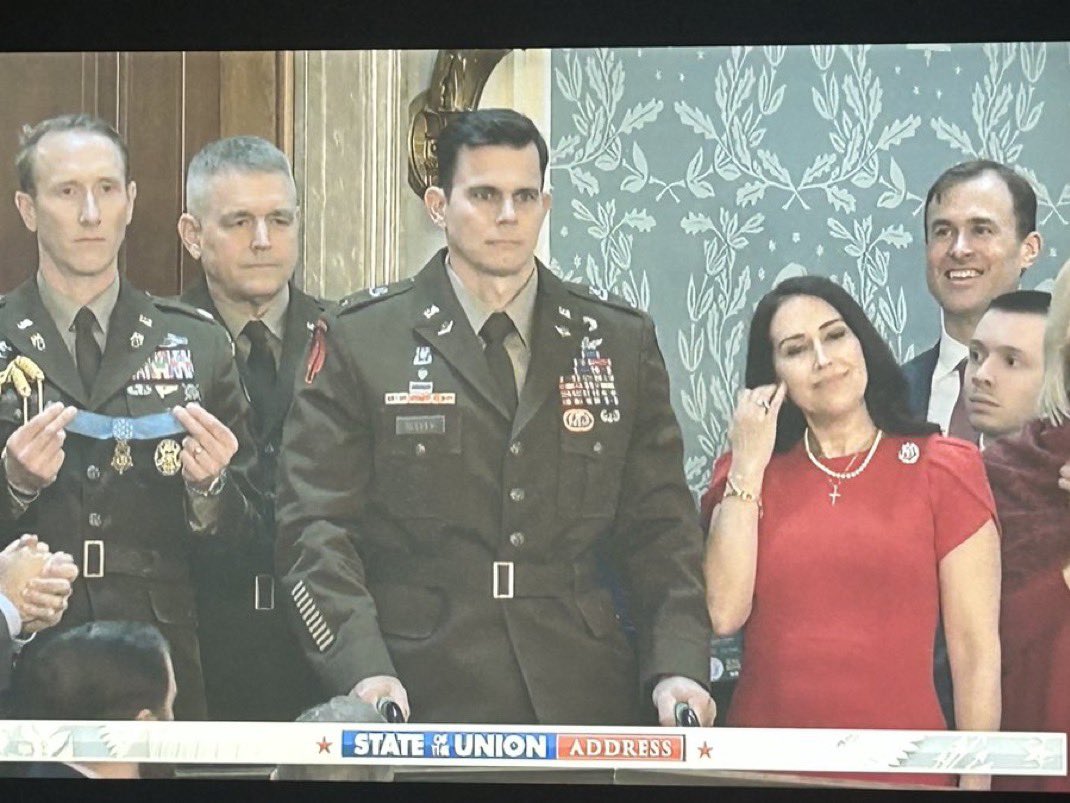
Chief Warrant Officer 5 Eric Slover is a real life Superman and I’ll tell you why:
-Obtaining CW5 in the Army is extremely rare in itself.
-Right shoulder is a combat patch with Special Operations Command. Essentially meaning he is “Delta Force” of Aviation.
-Eric was the first Chief Warrant Officer to receive in Medal of Honor in military history.
-Combat hashes on his right sleeve total up to 10. One stripe is given every 6 months of active combat service. He has been deployed for (at least) 5 years in a combat environment.
And this is on top of what he did in Venezuela.
American legend and hero.