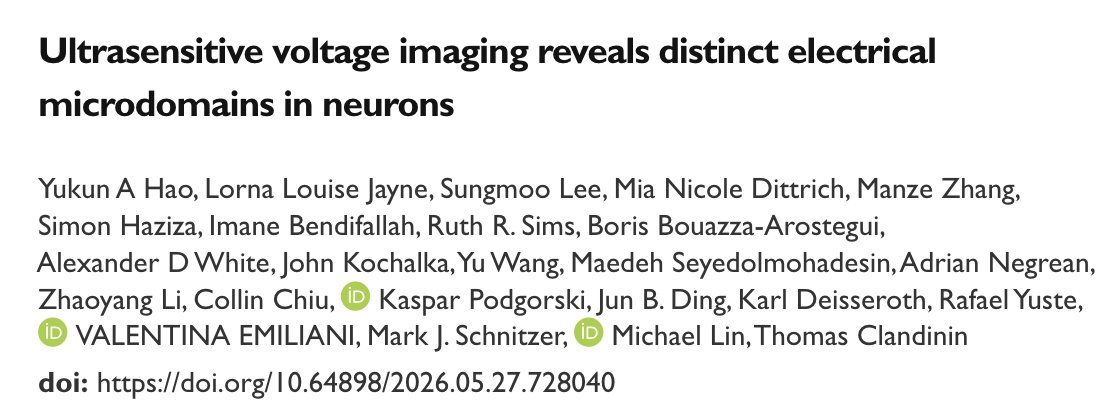
Excited to share the first work from my postdoc in the von Zastrow lab! We address a fundamental question about neuromodulator signaling: Can neurons tell the difference between multiple neuromodulatory inputs when they converge on few GPCR pathways? https://t.co/emaJdMaTL9
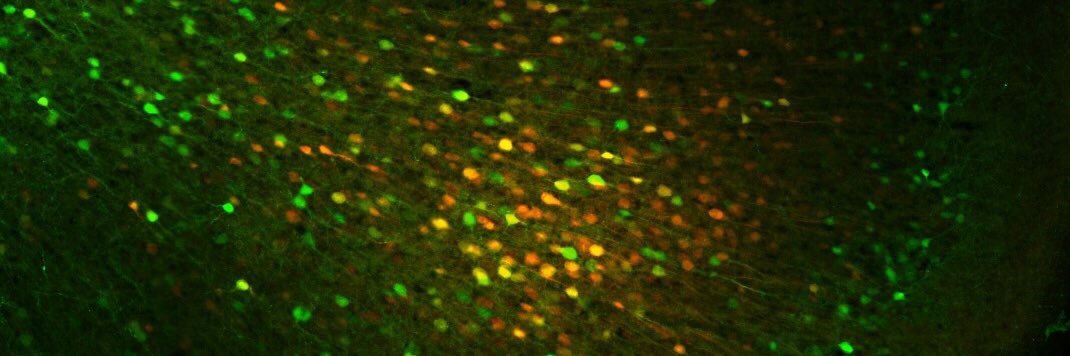
Excited to announce a powerful new one-two punch for voltage imaging from our lab and collaborators! In two new preprints, we introduce ASAP6c for high-throughput population spike-recording, and ASAP7yfor deep, subthreshold 2P imaging.
🧵 1/14
Directional elements: the preprints are out! Congratulations to our amazing team linked here:
https://t.co/SxNw2isNcd
https://t.co/f48w42FKcJ
https://t.co/o5NXdGcViw
We screened for principles governing global brain dynamics by developing a set of new methods: 1) conformal immersion microscopy for recording high-speed/high-resolution neural activity across dorsal cortex; 2) unbiased computational screening of brain-spanning activity for fast directionally-propagating spatiotemporal elements; and 3) novel genetically-encoded voltage sensing integrated with designed spectrally-compatible opsins (derived from our channelrhodopsin structure work) for systematic causal testing.
This unbiased screening/testing approach (which we show is applicable either to voltage or calcium imaging) allowed discovery and functional validation of a surprisingly well-defined set of directional elements that generalized across cell types and frequencies. The ability to work over long timescales at high speeds and with broad scope, anchored in optogenetic causal testing, unveiled rich spatiotemporal structure that was remarkably tractable.
From the perspective of natural brain function, the directional elements were found to be behaviorally relevant and robust to diverse perturbations; however, we also found specific conditions allowing elemental incidence and boundaries to be selectively modulated, which may provide translational as well as basic-science insight...
I'm so grateful to all our collaborators, and honored to work with all the outstanding students, postdocs, and staff who worked together to develop and apply this approach...
How does your brain filter out noise and focus enough to learn efficiently?
Our newest preprint uses intracranial recordings + computational modeling to explore how selective attention shapes learning and state representations in the human brain 🧠
https://t.co/5UdiULuAHR
1/🧵
Our special issue on control theory and behavior is finally complete. I was reluctant to edit this at first because I didn't expect much interest in this topic. But it turned out that I was wrong--there was a lot more interest than I anticipated (18 articles from people with diverse backgrounds). In fact I received inquiries recently from multiple researchers who wanted to contribute but unfortunately it was too late to accommodate them.
Control Theory and Closed-Loop Behavior in Humans, Other Animals, and AI/Robots. https://t.co/0Q8nv7oW23
Excited to share our new review in Trends in Neuroscience with Gouki Okazawa @gouki_okazawa:
"The 'neat' and 'messy' in task-dependent neural geometry and computation"
where we reviewed what we know about the 'task-manager' in the brain.
A thread 👇
AI is about to transform how scientific research happens, and neuroscience is no exception. What the future looks like is up to us. I don’t have the answers; here are some thoughts from working on the IBL AI agent. Aiming to start a discussion.
New preprint alert! Do words or numbers better capture our confidence?
We found that words (eg "very likely") predict choice accuracy more reliably than numbers.
I’m highly confident you’ll like it. Or is it 85% confident? :-) https://t.co/aGkPES5O7b
Excited to share our paper published today in @NatureNeuro: https://t.co/Ehr9zkTwwV
Using spatial proteomics, we identified a plaque-associated microglial population that emerged only when morphology and spatial context were integrated with protein expression.
Spatial genomics has existed for many years, but it has often been limited by complex imaging systems, specialized equipment, and $$$.
With IRISeq, we wanted to simplify this to a simple PCR rxn. https://t.co/jmS3N6PRu2
Our latest paper is out in @NatureNeuro! Cheese3D🧀 enables sensitive, quantitative analysis of whole-face dynamics in mice.
Manuscript: https://t.co/jL5z9snmbI
Code: https://t.co/bsw6AiA58w
Led by Kyle Daruwalla & Irene Nozal Martin, with contributions from the entire lab.
New paper online! How does plasticity at specific synapses drive specific forms of learning? Learning extradimensional rule shifts depends on strengthening long-range GABAergic projections from parvalbumin neurons to PFC-MD neurons in the contralateral PFC https://t.co/3UeyWh2TVT
How does TMS — a treatment for depression — reshape dysfunctional brain circuits?
In our new Cell paper, we identify a cell type-specific prefrontal mechanism linking accelerated iTBS to antidepressant-like behavioral effects and circuit plasticity.
https://t.co/XVx9fZ4M9d
Thrilled to share our paper out today in @CellCellPress! Transcranial magnetic stimulation can effectively treat depression, but how? We uncovered cell type-specific plasticity driving these antidepressant effects 👇
https://t.co/uKhDFRCUJ3
1/ Thrilled to share our new paper, out today in @Nature: "Non-invasive profiling of the tumour microenvironment with spatial ecotypes".
Paper (open access): https://t.co/EujZFqU7wi
Thrilled to share our work out in @Nature! Linking flexibility modeling, single-cell imaging, and targeted optogenetics allowed us to characterize how some prefrontal neurons, and mPFC-VTA neurons in particular, drive contingency degradation behavior. https://t.co/Dkk32XwGtX
Identify. Attack. Resolve.
The immune system follows a perfect defense program: ignore weak/self signals, attack true threats with force, then shut down to avoid damage. (1/2)
https://t.co/zh6Nf3Cwqo
Important announcement!!!🫵💥💫
Would you have a tooth pulled if it helped your chances to get an important grant funded?
Absurd question (obviously), but the situation right now is so bad funding-wise, that I bet some of you actually considered it for a second…
Well, don’t get desperate - we created a new tool that might help! (keep your teeth!)
I’m excited to announce that as of today we are officially releasing “QED for Grants” for everyone. What started off as an extension of our existing paper review platform, grew in the last few months to an entirely new design. We’ve been working like crazy on this, and although we have more things we want to add in the (very near) future, we decided to release our AI for grants NOW, earlier than planned. It’s not perfect, no AI is, but for the first time, when I run my own grants through @qedscience, I feel it gets the research, finds real problems, and gives me very useful feedback that I can implement before submission. It’s like sending it to 20 scientists from my domain, knowing they’ll agree to dedicate their entire week to carefully read and comment on every line.
It’s very important to write your own grants yourself, it makes you think hard and you learn a lot from doing it, and q.e.d’s system is designed to preserve these positive aspects and augment them - you get feedback on your own writing, we don’t write for you!!
But at the same time, a typical PI spends many months every year writing proposals and sadly only a tiny fraction gets funded, even if the ideas are good. When you are forced to submit an unreasonable amount of grants the quality of the writing drops, and rejection rates increase. Not because the essence is bad. It’s simply too competitive right now (the cuts made it so much worse) and if your proposal is not super clear and tight, and if it’s not a perfect fit for the grant you’re submitting, you’re doomed.
Our grant solution is not an authoring, text-generating tool. It gives you constructive feedback on your writing (it comments on the deep things, not grammar and typos). It’s meant to help you with the questions that torment you late at night (“is this a good fit?”, “Is this novel enough?”, “Did I miss something?”). Tens of thousands of you already use q.e.d to improve your manuscripts and critically read papers, we built the grant tool by the same principles (you’ll identify many of the features that you told us you like).
We’ve processed thousands of proposals, learned where things fail, where reviewers get stuck, why good ideas come out weak. We interviewed hundreds of scientists, and also experts who work in funding agencies and university research authorities, and implemented their feedback (we’re constantly looking for more feedback). Our AI is always happy to give you constructive (and polite!) critique, and it will go through your grant line-by-line, forcing you to improve clarity, flag weak points, and push the whole thing to a higher standard. We study, in scale, what gets funded and what doesn’t, and what is the perfect fit for each type of grant.
So please, use it, pressure-test it, tell us where it fails, and together we’ll improve it every day to put you in the best position for actually testing your ideas in the real world. As always with q.e.d, the system is completely secured and private, and we are NOT training on your data (see the FAQ on our website).
Please like, retweet, and share with your favorite colleagues! (link to the platform below in the thread👇)