New paper with @aronvandepol.
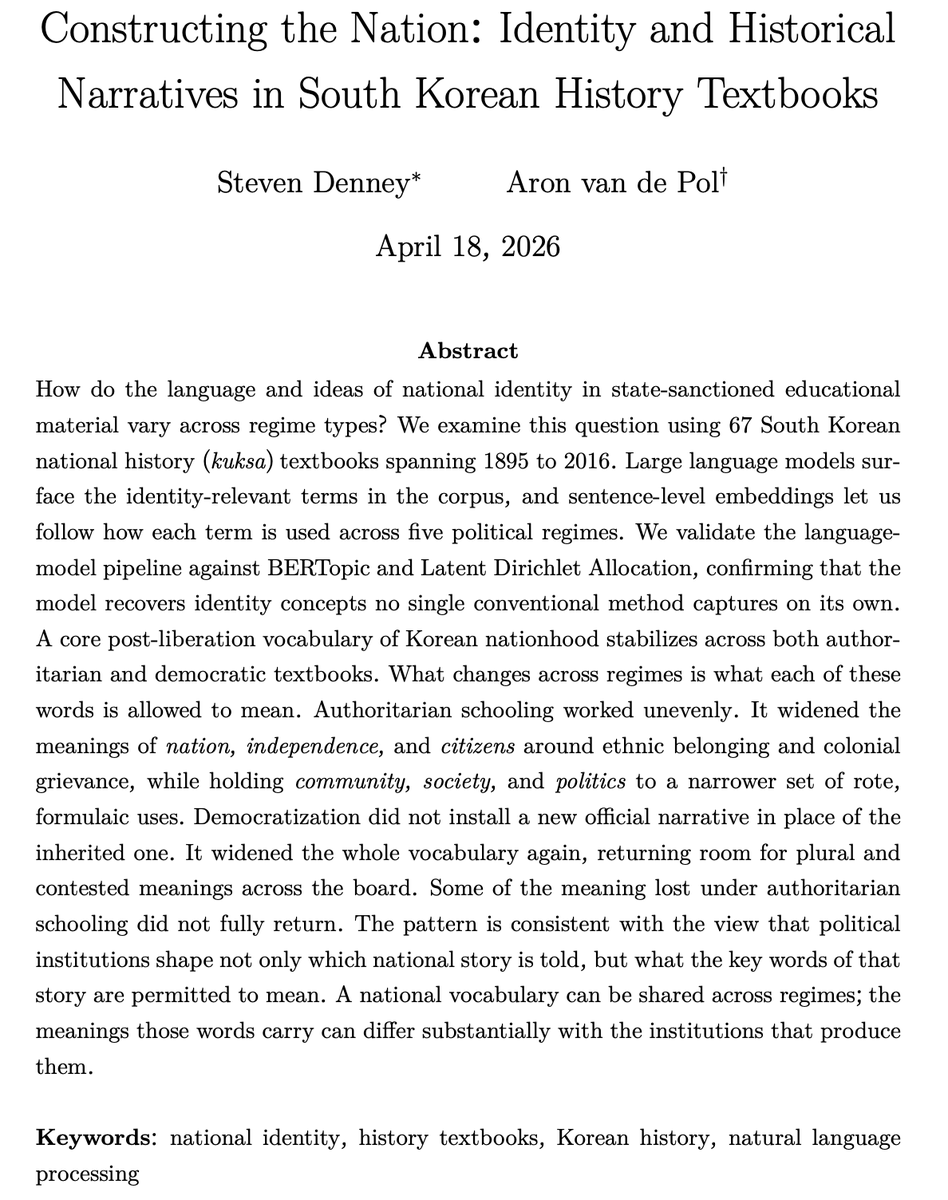
How do the language and ideas of national identity in educational material vary over time and especially across regime types? We examine the question using 67 South Korean national history textbooks (kuksa, in KR) covering the period 1895 to 2016.
Only 9.9% of top Sociology articles from 2019-2024 provided replication packages.
And ≈ half of those with replication packages could not be verified due to missing or incomplete materials.
Being freed both from the need to exalt oneself and from the need to tear others down is a central tenant of the Christianity I learned growing up. Easier said than done, of course. Also,“Back to the pew” probably isn’t a selling message. But here we are, feeling like peasants.
Humans have deep-rooted desires for status.
These are best accommodated in diversified small human communities, where everyone can be the expert at their thing.
Social media makes us unhappy, because our community becomes the world, and to a first approximation, we are all peasants.
We are uglier than the people on Instagram, our families are doing worse than the families on Facebook, on Twitter we are nobody.
So we use the weapons of the weak, we ridicule those with power and try to tear down their reputations, we participate in cathartic expressions of moral superiority. But it is a weak balm for the psychological pain of being low status in a human community.
Second for second, @tylercowen packs more substance into a talk than anyone I'm aware of. This is a clear, non-hysterical, and somewhat soothing discussion of our AI future.
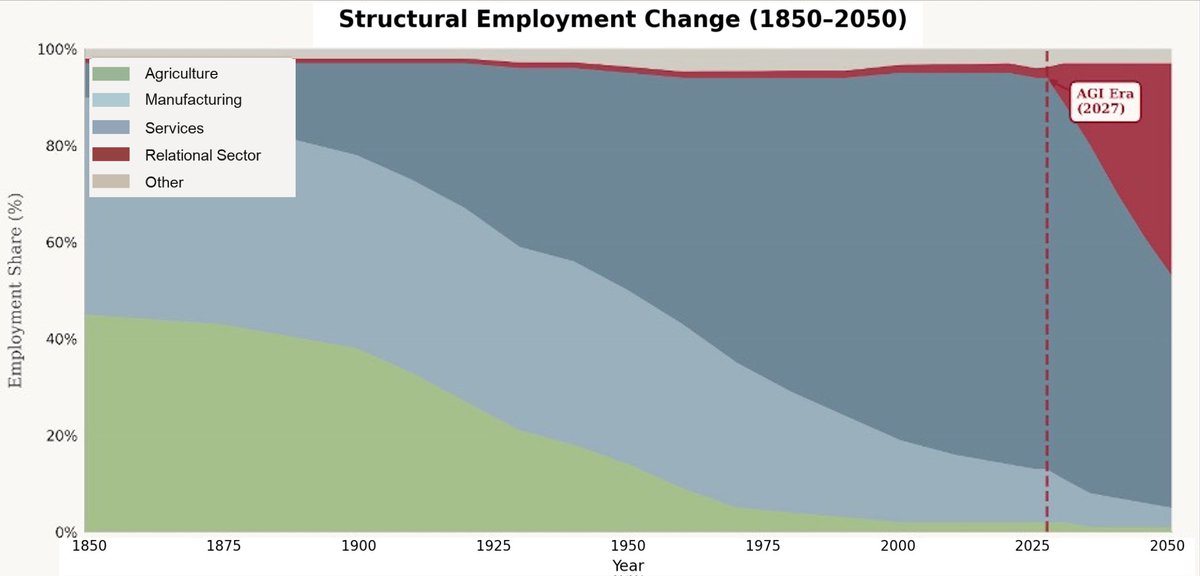
New essay on the economics of structural change and the post-commodity future of work.
1. Almost any question about the impact of advanced AI on the economy needs to start at the same place: what is still scarce? Answer that, and the analysis becomes pretty straightforward. This essay explores what becomes scarce if AI really can replicate most of what humans do in production, and what this mean for the future of jobs.
2. My conjecture, working through the economics: labor reallocates across sectors, and the sector it reallocates to has properties that keep labor a meaningful share of the economy. Ultimately this is about the structure of demand itself. For this, we have to go back to Girard, Augustine and Rousseau: once people's base needs are met, their preferences shift to comparative motives (e.g., status, exclusivity, social desirability). This motive is inherently non-satiated.
4. The key paper is Comin, Lashkari, and Mestieri (Econometrica 2021). As people get richer, they don't buy proportionally more of everything. They shift spending toward sectors with higher income elasticity. They estimate income effects account for 75%+ of observed structural change.
5. The ironic consequence: the sector that gets automated becomes a smaller share of the economy, not a larger one. Agriculture got massively more productive and its share of employment collapsed. Manufacturing too. The "stagnant" sectors absorb the spending and the jobs.
6. So the question is: which sectors have high income elasticity in a post-AGI world? I argue it's what I call the relational sector. Categories where the human isn't just an input into production, it is part of the value.
7. Why does the relational sector have high income elasticity? Because human desire has a mimetic, relational dimension. We don't just want things for their intrinsic properties. We want what others want, and we want it more when others can't have it. Girard, Rousseau, Augustine, and Hobbes all saw this.
8. In work with Kristóf Madarász, we showed this experimentally: WTP roughly doubles when a random subset of others is excluded from the good. And in new work with Graelin Mandel, AI involvement kills the premium. Human-made art gains 44% from exclusivity; AI-made art only 21%.
9. This all comes together for the core argument. The sector that absorbs spending as AI makes commodity production cheap is one where human provenance is part of the value, and demand for it grows faster than income. Exactly the profile that keeps labor meaningful.
10. To be clear about the claim: I'm NOT saying aggregate labor share must rise. It may fall. The claim is about sectoral composition, i.e., where expenditure and employment go once commodities get cheap, and the fact that the sector that will absorb reallocated labor maps to a substantial component of human preferences and desire.
11. If you're interested in the formal model, a linked companion technical note works out all the economics.
Read the essay here: https://t.co/NcjVgn2o8g
I'm working harder on things I want to work hard on, less hard on things I definitely don't. Working more? Sure, I suppose I am. But having a blast, more or less.
Can someone give me the steelman version of the rationale behind giving students access to the *internet* in their *dorm rooms* where they *write papers*?
If you want to recreate a case-based system, remove standardized tests and replace them with informal interviews that allow people to get positions based on cultural capital.
I met one of the leading experts on standardize tests years ago and she explained that a full 1/3 of social mobility in the United States is driven by stndardized tests.
When you remove them, you reinforece caste-like systems of inequality and remove likely fit and success from admissions and hiring decisions.
Do Quantitative and Qualitative Research Reflect two Distinct Cultures? An Empirical Analysis of 180 Articles Suggests “no” - David Kuehn, Ingo Rohlfing, 2024
https://t.co/AUQSKAXyjT
There hasn't previously been a treatment vs pancreatic cancer this successful. Striking improved (a > doubling) survival results @NEJM and @ASCO today with daraxonrasib, which also became available via an FDA approved early access program and began shipping to physicians this week @RevMedicines
https://t.co/e04jqJMPw0
I agree with you @arthur_spirling. Unfortunately the full essay was clipped and taken out of context. The X framing-- "Princeton professor thinks AI teaches better than him" but that is not what I argue. In fact I basically argue the opposite. Full essay here: https://t.co/rHo5NWbD5G
You know what other tools know better than most instructors? Coursera and YouTube courses from top faculty, *the internet*, books from the library. How many students used those tools instead of formal ed? Very very few. How many will use Claude independently to learn the material? Probably the same amount.
I know it doesn’t sound glamorous, but the primary role of faculty is to get students in the seats and create incentives to actually absorb the information. This is your job. AI can help as a tool, I’ve seen some great harnesses of AI for education, but it will not do this.
Authors can't be trusted to run their own robustness checks.
In 17 AER papers, only 12/211 robustness checks "fail" with p > 0.05 (white).
In robustness checks chosen by 3rd parties, almost *half* of them fail (blue).
1/
1/ Can AI help researchers check whether published social science results actually reproduce? In our new PNAS paper, we tested this directly in the AI Replication Games: 288 researchers, 103 teams, and real replication packages from quantitative social science.
"If you exclude semiconductors and AI servers, Taiwanese exports have actually fallen by 40% since 2022. In South Korea, non-AI exports have stagnated and Japan’s industry is in decline." 1/5
https://t.co/v7R4m3lKKL
New @AnthropicAI post on how social scientists use coding agents. Political scientists lag economists, but rely on agents more than psychologists and sociologists do. Productivity gains are not translating into journal submissions.
https://t.co/aaC5mouhI6
PolMeth Europe (Dublin, May 2026)
On the purpose and interpretation of conjoints and other survey experimental approaches in political science (and other musings)
Macartan Humphreys
https://t.co/jOBTocrZZA
https://t.co/7s2FkgYLZY
NEW in @ScienceAdvances, after 3 years of work with a great team:
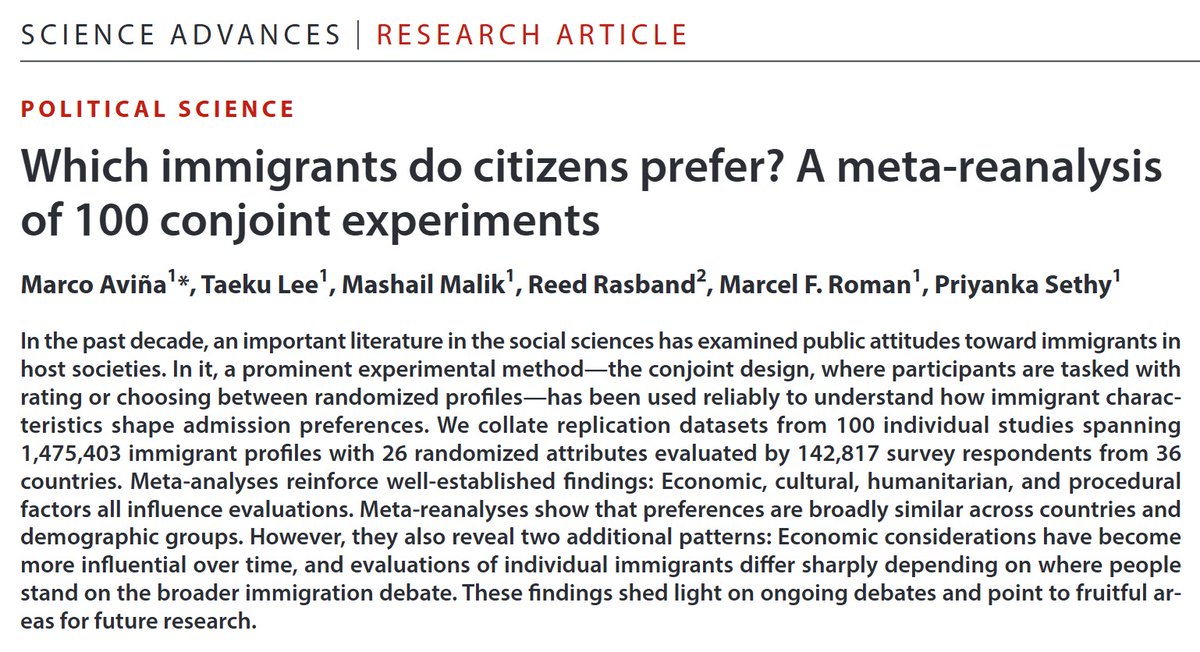
We review and meta-analyze 100 immigrant conjoint experiments in 36 countries.
Immigration preferences are surprisingly similar across people and countries, but changing over time and structured by politics.
🧵
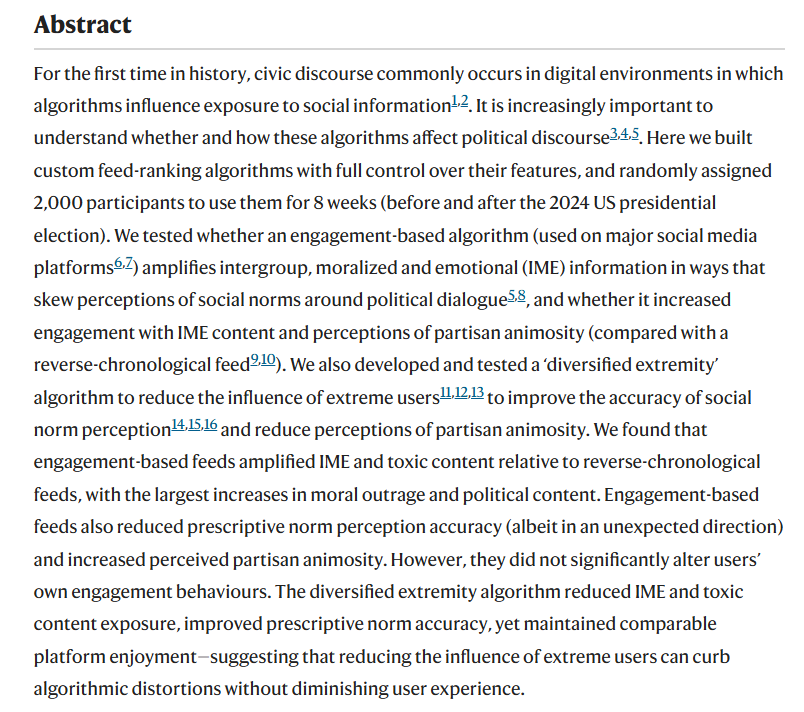
✨New paper out @SpringerNature✨ For 8 weeks around the 2024 US election, we randomly assigned 2,000 people to use social media algos we custom-built. Do engagement-based algorithms amplify intergroup, moral & emotional content + does that distort how we see political norms? 🧵