In 2008, Charlie Munger gave a legendary 1-hour lecture at Caltech on how to get rich by avoiding stupidity.
He revealed the mental models that made him a billionaire.
His frameworks:
• Inversion
• The lollapalooza effect
• A man with multiple tools
15 lessons on thinking:
The Sun is by far the biggest source of energy in our solar system
Even here on Earth, the Sun accounts for roughly 100% of all the energy we use - fossil fuels are just ancient sunlight stored in plants, while wind, hydro, biomass, and solar power are all driven by the Sun right now
Beyond Earth, the vast majority of spacecraft, satellites, and future Mars bases run entirely on solar energy
The Sun puts out 3.8 × 10²⁶ watts - more energy in a single second than all of humanity has ever used in its entire history
And just to put it in perspective: the Sun makes up 99.8% of the total mass of our entire solar system. Jupiter is only 0.1%. Everything else (Earth, Mars, asteroids, etc.) is basically miscellaneous
We’re finally learning how to use the only energy source that actually matters ☀️
"If I put $100 in Bitcoin in 2010, I'd have $730 million now."
No.
If you bought $100 of Bitcoin in 2010 and watched it go to:
$1k → $40k → $290K
and did nothing
Then watched $290K go to $26.3K
and still did nothing
Then watched $26.3K go to $2.5M
and still did nothing
Then watched $2.5M → $744K → $12.57M
and still did nothing
Then watched $12.57M deteriorate to $2.28M
Then watched $2.28M climb to $222M
and still did nothing
Then watched $222M shrink to $36.8M
and still did nothing
Then watched $36.8M surge to $730 million
and then for some reason finally decided to do something…
Then yes, $100 in 2010 would be worth $730 million today.
Warren Buffett on the Benjamin Franklin thought exercise anyone can use to be successful
Warren Buffett offers the following advice to the students at the Terry College of Business:
“Pretend I’ve made you a great offer: You can pick any one of your classmates and you get 10% of their earnings for the rest of their lives. What goes through your mind in determining who you would pick?”
He continues:
“You probably wouldn’t pick the person who gets the highest grades in the class. There’s nothing wrong with getting the highest grades, but that’s not going to be the quality that sets apart a big winner from the rest of the pack… I think you’ll find that it gets down to a bunch of qualities that, interestingly enough, are self-made… It’s integrity, it’s honesty, it’s generosity, it’s being willing to do more than your share.”
Then he asks the class to pick a classmate to sell short:
“Who do you think is going to do the worst in the class? It isn’t the person with the lowest grades, or anything of the sort. It’s the person who just doesn’t shape up in the character department.”
When Berkshire Hathaway hires people, they look for three things:
1. Intelligence
2. Initiative or Energy
3. Integrity
Buffett explains:
“If they don’t have the latter, the first two will kill you. If you’re going to hire somebody without integrity, you want them lazy and dumb. You don’t want them smart and energetic.”
Importantly, he points out that these are habit patterns:
“The person who always claims credit for things they didn’t do, cuts corners, and who you can’t count on — in the end, those are habit patterns. And the time to form the right habits is when you’re your age… Someone once said that the chains of habit are too light to be felt until they’re too heavy to be broken. And I see that all the time.”
Buffett concludes:
“When you write down the habits of that person you’d like to buy 10% of, look at that list and ask yourself, ‘Is there anything on that list that I couldn’t do?’ And the answer is that there won’t be. And when you look at the person you sell short and you look at the qualities you don’t like — if you see any of those in yourself (egotism, selfishness), you can get rid of that. That is not ordained.”
This is an exercise that Benjamin Franklin did, as well as Warren Buffett’s old boss:
“Ben Graham looked around and said, ‘Who do I admire?’ He wanted to be admired himself, and he asked why he admired these other people. Then he said, ‘If I admire them for these reasons, maybe other people will admire me if I behave in a similar manner.’ And he decided what kind of a person he wanted to be.”
Video source: @universityofga (2001)
Warren Buffett: "Degree of difficulty counts in the Olympics, [but] it doesn't count in business. You don't get any extra points for the fact that something is very hard to do. So you might as well just step over one-foot bars instead of trying to jump over seven-foot bars."
The books most billionaires recommend:
(the best list I've seen)
Mental models & judgment
– Poor Charlie’s Almanack
– Influence
– Thinking, Fast and Slow
– The Selfish Gene
Fiction (agency, morality, builders)
– Atlas Shrugged
– The Fountainhead
– The Lord of the Rings
– Brave New World
Science, technology & the long game
– Sapiens
– Guns, Germs, and Steel
– Superintelligence
– Life 3.0
– The Beginning of Infinity
Business & capital allocation
– The Intelligent Investor
– Zero to One
– High Output Management
– Only the Paranoid Survive
Fiction (scale, power, civilization)
– Foundation
– Dune
– The Culture series
– Snow Crash
– 1984
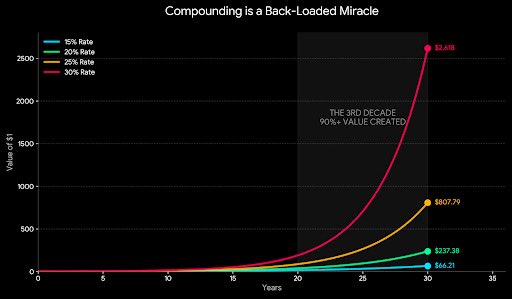
The power of compounding is widely understood. What’s underappreciated is when the value is actually created.
Compounding is continuous, but when you look at it in decade blocks, the pattern becomes obvious. Even moderate differences in the annual compounding rate are severely amplified over time. For instance, starting with $1:
At 15% annual compounding
10 years: $4.05
20 years: $16.37
30 years: $66.21
Last decade: 75.3% of the total value
At 20% annual compounding
10 years: $6.19
20 years: $38.34
30 years: $237.38
Last decade: 83.8% of the total value
At 25% annual compounding
10 years: $9.31
20 years: $86.74
30 years: $807.79
Last decade: 89.3% of the total value
At 30% annual compounding
30 years: $2,618
Last decade: 92.8% of the total value
A 2× difference in the rate (15% vs 30%) becomes nearly a 40× difference in outcomes over 30 years.
Compounding doesn’t add. It multiplies the entire base.
The first decade is impressive.
The second decade is extraordinary.
The last decade is unfathomable.
That’s when fortunes are made.
That’s why the ceiling matters. If the market size caps you early, compounding dies early. You need a category large enough to let it run for decades.
Once you see compounding this way, it permanently changes how you choose markets.
Health insurance, for instance, is roughly a $1.7T TAM in the U.S. alone. It may not be the sexiest space, but that’s one of the reasons I’m so excited about Curative Health long term.
What business today has a ceiling high enough to compound until 2056?
A Monk Once Said:
If you're 37. Instead of regretting that you can't wake up age 18 again, pretend to yourself that you're 90 and you've woken up age 37 again, and that you get to magically, wonderfully have the next 50 years again.