So excited to see what @sergeisorokin builds here. He’s been someone I turn to whenever I need product advice, so it’s wonderful to see him back on the playing field.
I spent 8 years scaling Discord and got burnt out cause modern work is broken. We’re overwhelmed with too much info across apps, teams, and agents.
AI made it worse. We’re building the solve.
I've joined @tryhighlight as CEO and we raised a $40M Series A led by @KhoslaVentures.
introducing 🐺 AlphaClaw, the ultimate setup harness for @openclaw. open-source, self-managed, free-to-use, with no lock-in.
AlphaClaw makes OpenClaw setup and maintenance easier by providing an elegant GUI that wraps OpenClaw's CLI.
📅 Google Workspace OAuth & pubsub built in w/ gog-cli
🔄 Auto-backup to GitHub
🧱 Prompt hardening reduces agent drift
🩺 Drift Doctor analyzes your prompts and workspace for drift
💬 Telegram multi-topic workspace setup wizard
📂 Full file browser and editor, no SSH needed
🐕 Watchdog auto-detects crashes, self-heals gateway
🛠️ Manage env vars from the UI
🔑 Manage model keys & OAuth visually
🪝 Webhook creator & inspector with replay & debug
📊 Token usage & cost analytics built in
⬆️ One-click updates, no redeploy needed
📦 Import existing setup from GitHub
i didn't build alphaclaw to replace openclaw or compete with it. openclaw is the best user-owned AI agent framework out there and more people should be able to use it without wrestling a CLI for two hours.
there are so many managed "deploy your AI in seconds" product. but they lock you into their platform. if they pivot, shut down, or jack up pricing, your agent goes with it.
alphaclaw gives you that same one-click simplicity, but everything runs on your infra with your data. no proprietary backend. no config hostage. if railway disappears tomorrow, you still have a standard openclaw instance backed up to your own github repo.
everything alphaclaw does, you could do manually. it's just automation and UI on top of the real thing. outgrow it? disagree with its opinions? eject. your openclaw instance is still a standard openclaw instance.
to make it convenient, i’ve created both a one-click deploy template on railway and render to start quickly. make sure you have 8GB of ram on your instance.
look forward to your feedback and to building this out with the @openclaw community! 🦞
https://t.co/ZMJivWhJH5
feature deep-dive in the 🧵
Big launch today from @liveink and @pradeep24! https://t.co/yEeX4eOQYb highly suggest you check it out. If you’ve been inspired by openclaw but want something user friendly and built by people that deeply understand how to build great software this is for you.
just scraped 4,784 AI agent skill repos from 5 registries
59% ship executable scripts
12% are completely empty
some are shipping malware
lots of dupes
if you’re running a self-learning openclaw, a heads up.
https://t.co/DMHXox1DQl
A few thoughts about PayPal, nearly 12 years after I left.
I woke up this morning to dozens of messages from former PayPal colleagues. It pushed me to finally speak up.
I never spoke publicly about the company after I left. Part of that was loyalty to John Donahoe, who gave me an unlikely opportunity, handing the reins of PayPal to a startup guy who, on paper, had no business running a then 15,000-person organization. But part of it was something else: I had left. I chose not to stay and fight for the changes I believed in. Speaking from the sidelines felt like armchair commentary. Easy opinions without the burden of execution. So I stayed quiet.
But twelve years of silence is long enough. And today's news makes it clear the pattern I've watched unfold isn't self-correcting.
I left PayPal in 2014 because I was deeply frustrated. We had executed a silent turnaround of a company that had lost its soul. We brought back engineering talent, shipped good products quickly, and acquired Braintree and Venmo. The company was on a tear. So much so that Carl Icahn felt compelled to accumulate a position in eBay and push for a PayPal spinoff. At the time, eBay decided to fight Icahn.
It was a difficult period for me, caught between what I felt was right for PayPal and my loyalty to the eBay team.
This is when Mark Zuckerberg approached me to join Facebook. The combination of his conviction that messaging would become foundational, the appeal of going back to building products at scale, and my growing exhaustion with the internal politics at PayPal and eBay eventually convinced me to leave and join one of the best teams in the world, one I had admired for a long time.
In the summer of 2014, I met John in a café in Portola Valley and told him I had decided to leave. During that conversation, he told me that Icahn had effectively won the fight, that PayPal was going to become an independent company, and he tried to convince me to stay on as CEO, but I had already said yes to Mark, and my word is my bond. There was no turning back.
After my departure, the board scrambled to find a replacement, and it took a few months for them to land on Dan Schulman. The leadership style shifted from product-led to financially-led. Over time, product conviction gave way to financial optimization.
Much of the momentum we had created still persisted and carried the company forward, mainly driven by Bill Ready, who came over in the Braintree acquisition and rose to COO. Under his leadership, Venmo grew exponentially, and total payment volume (TPV) accelerated quickly. But the shift under Schulman became more pronounced after Bill's departure at the end of 2019. With him went the product conviction that had defined the post-spinoff momentum. Then, for a period, COVID-fueled online shopping hid a lot of the company's new weaknesses.
During that period, the company made a fundamental miscalculation: it optimized for payment volume instead of margin and differentiation. It leaned into unbranded checkout, where PayPal had the least leverage, instead of branded checkout, where the margin, data, and customer relationship actually lived.
Visa masterfully structured a deal that effectively ended PayPal's ability to steer customers toward bank-funded transactions, which had been a core driver of PayPal's economics. Not long after, PayPal lost a significant portion of eBay's volume. Over time, it saw its share of checkout among its most profitable customers steadily erode as Apple Pay and others continued to execute well.
The same pattern repeated itself across lending, buy-now-pay-later (BNPL), and new rails.
On lending, PayPal missed the opportunity to turn it into a platform weapon. Products like Working Capital were conservative, short-duration, and optimized for loss minimization. Lending never became programmable, never became identity-driven, and never became a reason for merchants or consumers to choose PayPal over something else.
The missed opportunity in BNPL was even more striking. Klarna, Affirm, and Afterpay didn't just offer installment payments, they built consumer finance brands, persistent credit identities, and new shopping behaviors. PayPal saw the BNPL turn, entered the market, and had every advantage: distribution, trust, and merchant relationships. But BNPL was treated as a defensive checkout feature rather than an offensive category. There was no attempt to turn it into a core consumer relationship, no super-app behavior, and no meaningful differentiation for merchants. Others built platforms, PayPal added a feature.
The failure to lean into building and owning new rails followed the same logic. After the spinoff, PayPal had a once-in-a-generation opportunity to build a global, at scale payment network. Instead, the company focused on building on top of existing networks and third-party rails.
More recently, that mindset carried over to PYUSD. Technically, the product was sound. Strategically, it launched without a compelling transactional reason to exist. PYUSD had distribution, but no organic demand. It was not embedded deeply enough into flows to become a true settlement layer, a cross-border merchant rail, or a programmable money primitive. It sat adjacent to the product instead of inside the core of it.
Acquisitions during this period followed a similar pattern. Honey was not a strategic acquisition for PayPal. It added activity, but not leverage. It lived outside the transaction, monetized affiliate economics rather than payment economics, and never meaningfully strengthened PayPal's control of the customer or the checkout moment. Xoom solved a real problem in remittances, but it never compounded PayPal's advantage. It scaled volume without changing the underlying rails, identity graph, or settlement model, and as importantly, it didn’t cater to a high-value, high-margin customer archetype.
None of these were bad companies. They were just a wrong fit for PayPal and became unnecessary distractions.
The board eventually recognized the problem. In 2023, they brought in Alex Chriss, an Intuit veteran with a strong product background, explicitly to restore product conviction. It was the right instinct.
But Alex came from software, not payments. He understood SMB product development. He didn't have the muscle memory for transaction economics, network effects, or settlement infrastructure.
In hindsight, he also made an error: clearing out much of the leadership team that understood payments deeply. Executives with years of institutional knowledge departed within his first year.
This morning, Alex was removed as CEO. Branded checkout grew 1% last quarter. The board tapped another operator, Enrique Lores, the former HP CEO who's been on the PayPal board for five years.
I don’t know Enrique. And he might be a great leader, but on paper at least, he’s a hardware executive. For a payments company.
The common thread through all of this is incentive design. Once PayPal became independent, short/medium-term predictability beat long-term vision and ambition. Stock performance mattered more than platform risk and network opportunity. Financial optimization replaced product conviction.
I'm not claiming I would have made every call differently. Running a public company at scale involves tradeoffs I didn't have to make after I left. But the pattern, choosing predictability over platform risk, again and again, was a choice, not an inevitability.
Over time, the company that had every advantage and could’ve become the most consequential and relevant payments company of our time, lost its mojo, its product edge, and its ability to compete in a market that’s being rewired and reinvented in front of our eyes.
That's the part that's hardest to watch for a company I care so deeply about.
may i just add that the hysteria around the moltbook thing - in terms of treating it as anything more than a fun experiment - is absurdly stupid.
you mean when you told a bunch of instruction following llms to go create their own social network they started cosplaying as ai’s with their own social network? no way!!!
and you mean to tell me people can prompt said ai’s to behave however they want (or just manually post as humans pretending to be ai’s)?
c’mon guys. be better.
it’s a very fun experiment and worth talking about. you can ofc imagine a version in the future where they’re actually coordinating, and this has helped make that more concrete for people.
but if you believe for a second that they’re actually coordinating and that it’s an agi takeover or something, then either you’re farming clicks (again, be better), or extremely clueless about how models work.
it’s frustrating that the masses will take it as serious. ugh.
it is fun though!
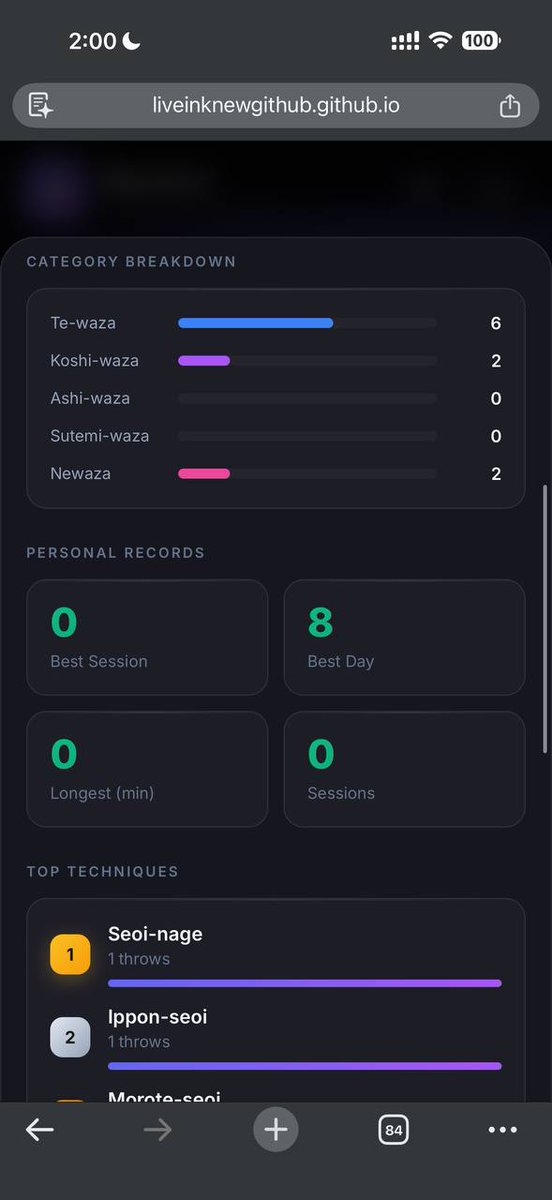
Here's the story of how I vibe coded a #judo#randori tracker before I even landed in Sapporo.
I started this project on Claude Code Opus 4.5 when I was in San Francisco and committed my changes 24 hours later.
I wanted a tracker to help me keep track of what thrills I was doing during randori.
Nothing existed, so I vibe-coded something.