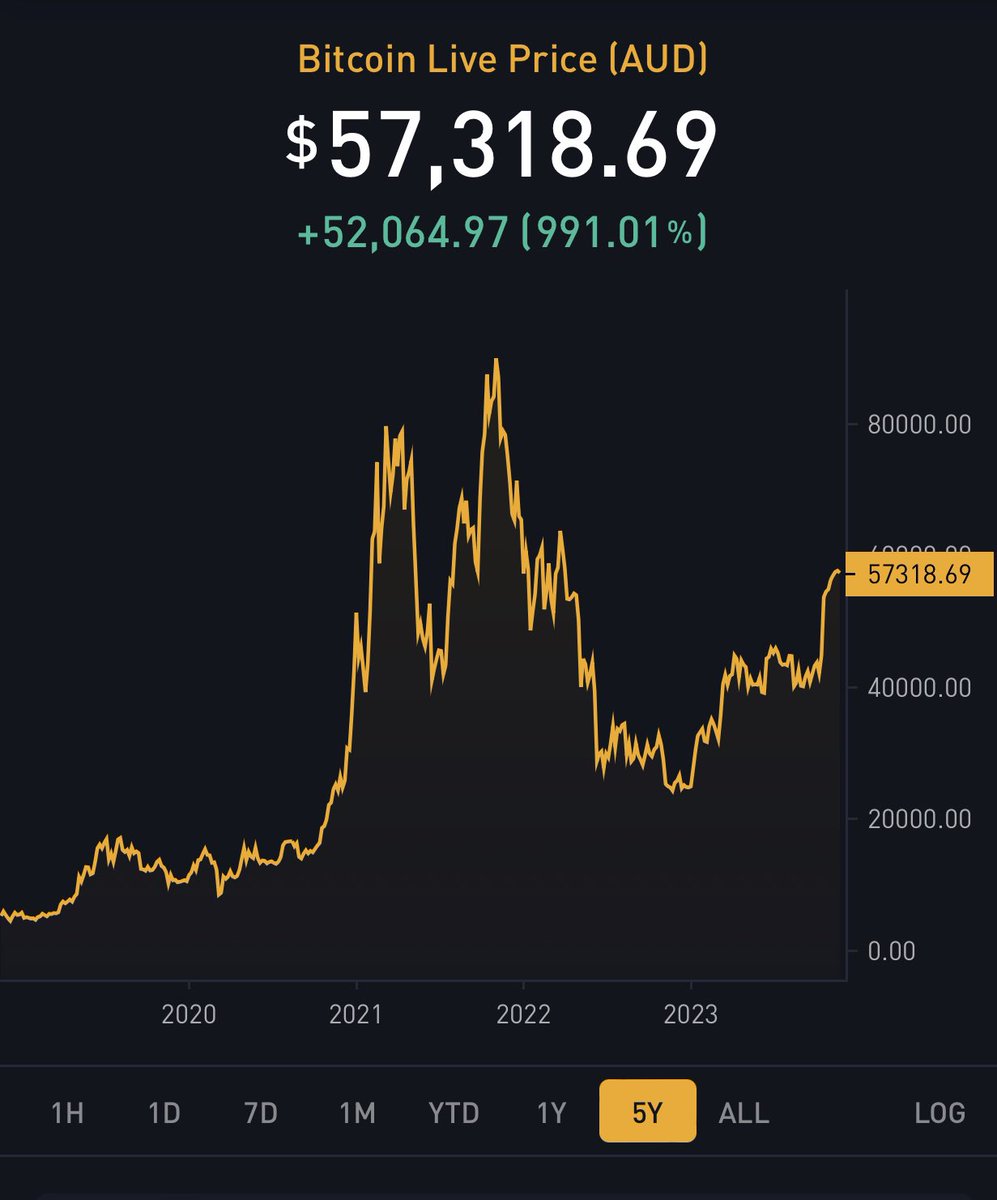
@AvidCommentator#BITCOIN is a monetary technology which is largely being adopted by young adults & the tech savvy. It’s rapidly outperforming other savings and investment options. Whatever happens, things are shifting quickly, rapidly improving their financial position.
Bitcoin is money
Having cap gains tax on a type of money is blasphemy
Removing cap gains taxes on Bitcoin transactions is the #1 most important this to happen to Bitcoin as of now
I’ll beat this drum until logic prevails!
I personally believe we actually bottomed at the Q1 power-law baseline.
The future will tell, but I feel very confident buying more at these levels.
This is what a asymmetric opportunity looks like in my books.
- Chart By @BitcoinPowerLaw
Western governments have engineered the greatest anti-natal program in human history, and most people are completely unaware of the causes or consequences.
Birth rates across Europe, East Asia, and North America have collapsed below replacement levels. Governments systematically destroyed the economic foundations that make family formation possible.
You cannot afford children when the state inflates away your purchasing power, taxes your income at confiscatory rates, then forces you to fund the retirements of previous generations through Social Security ponzi schemes. A middle-class American couple faces effective marginal tax rates exceeding 50% when you include federal income tax, state tax, payroll taxes, property taxes, and sales taxes. Meanwhile, monetary debasement ensures that housing costs consume 40% of median income versus 15% in 1970.
The regulatory state makes every aspect of child-rearing exponentially more expensive. Occupational licensing cartels inflate childcare costs. Zoning laws prevent affordable family housing. Department of Education mandates drive up school costs while destroying quality. FDA approval processes make basic medicines cost 10x their market price. Each regulation serves entrenched interests while pricing out young families.
Economic policy shapes demographics. When governments prioritize immediate consumption over capital formation, present voters over future families, and welfare recipients over productive workers, birth rate collapse becomes inevitable. The state subsidizes the childless while penalizing parents through the tax code and monetary policy.
Politicians promise family tax credits and paid leave programs to solve the crisis they created. They offer you breadcrumbs from your own stolen wealth while maintaining the very policies that make children unaffordable. The solution requires abolishing the systems that broke family formation, not expanding them.
@JoeConsorti It’s not complicated, if Bitcoin can remain on a long term power law trajectory, their leverage is modest relative to that. https://t.co/VfHhuLZoz8
Where are all of the Strategy doomers who were calling for "imminent collapse"?
Strategy is a Bitcoin transmutation machine.
Converting a 30% CAGR growth asset into 8% to 12% fixed income products.
This requires some selling, but they'll be a net-buyer indefinitely.
We didn't give it the name Power Law, it is the definition of a mathematical relationship y ~ x^β, an independent variable raised to some power, some exponent of repeated multiplication. It's simply the correct name used by scientists and mathematicians.
Some famous examples:
Newton’s gravitation
F ~ r^{-2}
(inverse-square law, a special power law)
Kepler’s Third Law
T^2 ~ a^3
Stefan-Boltzmann Law
L ~ T^4
Blackbody radiation (Rayleigh-Jeans limit)
another power-law regime.
Physicists were already accustomed to calling these “laws” because they appeared fundamental.
Saying “gravity is just a theory” is like saying “music is just a theory.” The notes are real; the theory explains how they fit together.
Some notes are better muted.
What's your favorite theory of gravity? General relativity, loop quantum gravity, scalar-tensor-vector, emergent (entropic)...?
To date general relativity has passed every test, so alternatives must reduce to general relativity under known circumstances.
Bitcoin, Perfect Scarcity, Imperfect Critics
Bitcoin’s fiercest critics keep missing the target. The new bear case is not about bugs in the code, but about one public company accumulating a perfectly scarce asset in a world of perfectly elastic money.
Strategy, the artist formerly known as MicroStrategy, has turned its balance sheet into a bitcoin vault. This, we are told, proves structural fragility: a single, promotional buyer supposedly props up the price, concentrates supply, and creates a future liquidation overhang. If that balance sheet ever de‑risks, the story goes, bitcoin and Strategy’s equity go over the cliff together. Never mind that the company controls less than 5% of outstanding bitcoin, a meaningful hoard, but hardly a corner. Many of the loudest market voices are happy to repeat the script, treating bitcoin as little more than a speculative circus act.
Yet in gold, the same behaviour is treated as statesmanlike. Central banks quietly warehouse bullion with opaque disclosures and openly political motives. How soon we forget the Brown Bottom. When they blunder, as with Gordon Brown’s infamous decision to dump UK gold near the secular low, it is remembered as bad timing, not as evidence that gold is unfit to be money.
Bullion trusts exist for the sole purpose of locking metal in a vault. Streaming companies such as Wheaton Precious Metals sign long‑dated claims on future production, giving shareholders geared exposure to the same finite resource. No one concludes that this pattern of hoarding renders gold “uninvestable.” It is simply how a reserve asset lives.
The double standard is not accidental. Implicit in the consensus is that central‑bank hoarding is respectable, while bitcoin hoarding is suspect. Markets yawn when official institutions add a few more tonnes of gold. They scoff when the Sec of the Treasury Scott Bessent in recent testimony, suggest that the United States methodically moving toward a strategic bitcoin reserve. Gold reserves are “prudence.” A bitcoin reserve is “crankery.” Hoarding is fine, apparently, so long as it never threatens to introduce perfect scarcity into a fiat system that depends on its opposite.
Bitcoin perfect scarcity in a fiat world run wild is now ignored, even by high profile pundits.
Seen clearly, Strategy’s accumulation is not a fatal bug in bitcoin, but a tell about its critics.
When gold is cornered by states and vehicles, it is applauded. When less than 5% of bitcoin is accumulated by a listed American company, it is denounced. That asymmetry says less about bitcoin’s weakness than about the political system’s fear of anything it cannot print. And yes the bias of many who should know better.
$MSTR #Bitcoin @theallinpod
The future has two Bitcoins.
One is bearer Bitcoin: cold storage, self-custody, personal sovereignty, exit from the fiat permission layer.
The other is institutional Bitcoin: ETFs, corporate treasuries, bank custody, collateral markets, structured products, lending desks, sovereign reserves, accounting frameworks, insurance wrappers, and capital-market machinery.
The first protects the soul.
The second drives scale.
Saylor is betting that the second layer brings trillions while the first layer keeps the whole thing honest.
That is probably correct.
Bitcoin will not reach full global monetary impact by staying a purist enclave. It reaches maximum force when the world’s existing balance sheets start treating it as superior collateral. Banks do not need to love Bitcoin’s ideology. Governments do not need to become libertarian. Pension funds do not need to understand cypherpunk culture. They only need to realize the asset is liquid, scarce, durable, politically harder to print, and increasingly unavoidable.
That is how Bitcoin eats the system.
Slowly, then through balance sheets.
The deepest signal in Saylor’s post: he is shifting Bitcoin from anti-system asset to open monetary network.
That language is designed to make Bitcoin acceptable to CFOs, boards, banks, regulators, sovereigns, and normal families. He is sanding down the revolutionary edge without abandoning the hard monetary core.
That will anger old-school maximalists.
It will also make Bitcoin much larger.
The forecast is clear: Bitcoin becomes more integrated, more regulated, more collateralized, more institutionally owned, more politically important, and more strategically protected. Self-custody remains the sacred base, but most economic activity around Bitcoin moves through institutions.
Price probably benefits.
Purity suffers.
Systemic importance rises.
State attention intensifies.
Bitcoin began as escape from the financial system.
It becomes world-historical when the financial system is forced to build around it.
Ah yes, peak institutional genius: record BTC ETF outflows dumping the scarce, under-owned asset (market cap ~1/4 of NVDA) at 2026 lows… just to chase AI stocks that already went full parabolic.
Nothing says “optimized rebalancing” like selling the laggard to buy the top.
Classic. ��
#Bitcoin #AI #Rotation
Did your hair catch on fire when Donald Trump said this? "when Bernie Sanders lost, you know that I got many of his people. They voted for me because we are on an economic plan. As far as economics is concerned, we have certain things that aren't that far apart." https://t.co/3047PHw0ZF
Bitcoin Maximalist: Bitcoin is the dominant digital monetary network: an ethical, technical, and economic breakthrough, and an instrument of economic empowerment. It offers superior property rights, monetary integrity, and hope to those facing economic misery.
The AFR View - “The government’s budget narrative about addressing intergenerational inequity and helping first home buyers break into an overheated property market has been reduced to a farce. As has Chalmers’ economic credibility. His bold claims that the tax changes are “the broadest productivity push in a budget since the 1990s” were directly contradicted by Treasury’s confirmation this week that they are more about equity and redistributing wealth than about growing the economic pie”.
I concur.
These tax hikes are economically damaging and won’t fix housing other than wipe off billions in market value for all home owners and see rents rise in inner and middle suburban house markets.
#auspol
US Unemployment Rate remained at 4.3% in May, the lowest level since last August & well below the historical average of 5.7%. 172k jobs were added vs. 85k expected. March/April jobs were revised up 93k. YoY wage growth: +3.4%. Overall: strong report, no Fed rate cut this month.
@RonSwanonson In October we had limited upside and now we have a huge upside.
The 30% down is like to turn into a much higher gain in the next few years.