@danfaggella Daniel, after reading your posts and thinking thoughtfully about them it seems to me that your conclusions are predicated on the fact that matrices can be conscious.
What would happen if that was impossible?
The 51 vol. edition of all the Christian Councils through history has just been AI translated at The Faith Received. Each has been linked next to the Latin volume on this RBO page:
https://t.co/IXwUeYhDdU
“Our technology exists to supplement rather than substitute for our agency. The katechon of our time is a spirit that delights in the human and sees in AI another tool that may lighten certain tasks, but that requires us to judge how it is ordered.”
“The response to the nihilism at the heart of the researchers’ romantic vision is not a counter-romanticism against technology, which would be equally stupid and equally tasteless. It is an orientation toward technology as a subordinate tool for human flourishing.”
We need a Christian METR. For theology to shape the trajectory of artificial intelligence, it cannot remain confined to philosophical generalities: it must translate those concerns and commitments into the computable argot of evaluations, harnesses, and environments.
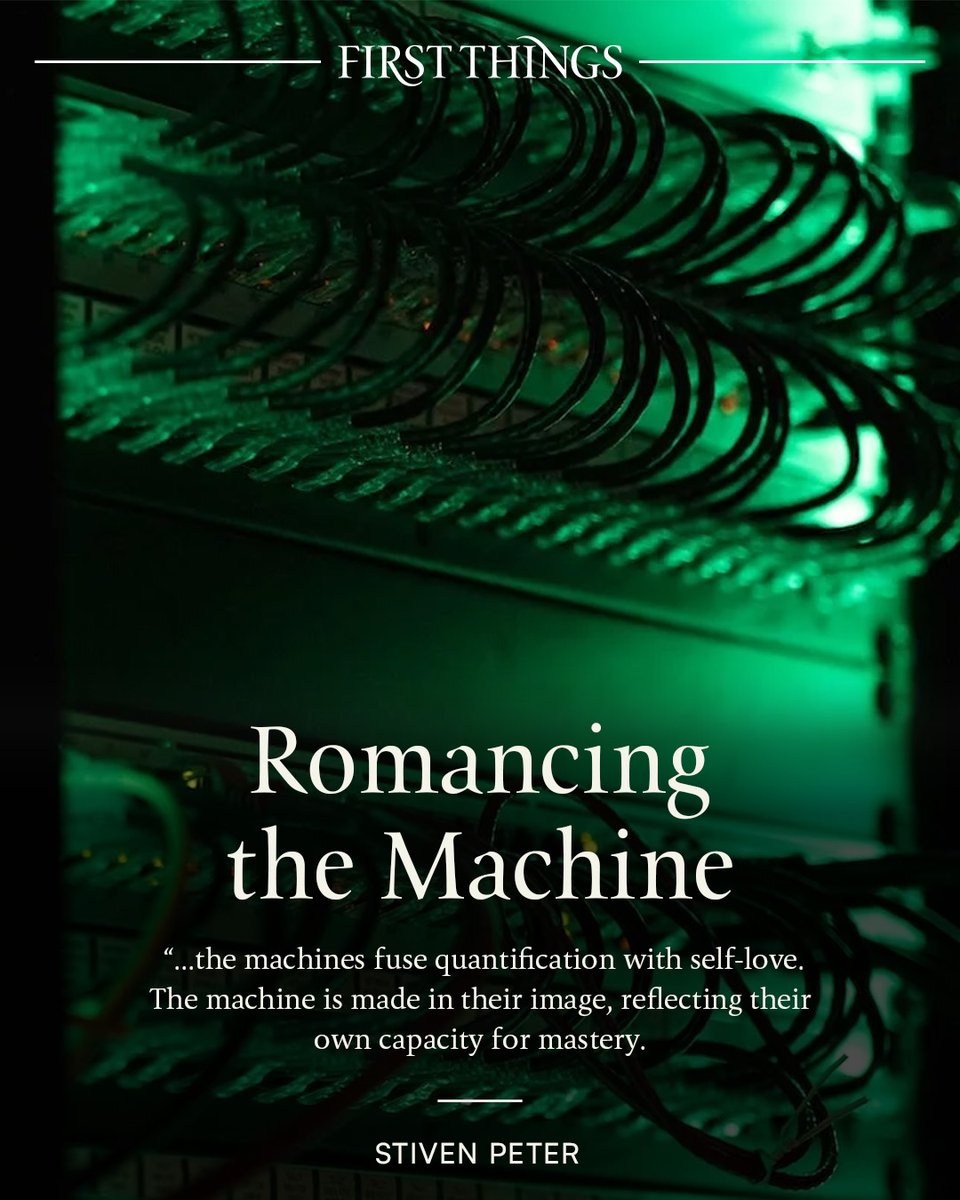
Why are the people building the most advanced technologies also so prone to treating them as objects of fascination, fear, and even faith?
In this piece, Stiven Peter examines the romanticism underlying today’s AI culture, from hopes for superintelligence and fears of extinction to the belief that human judgment itself can be coded into a machine.
To read the piece, visit https://t.co/JKZasBuW0m
"On the right, effective altruist organizations pursue pausing AI in the name of national security, classifying AI as a weapon of mass destruction. The effort was spearheaded by Georgetown University’s Center for Security and Emerging Technology, established in 2019 with a $55 million Open Philanthropy grant, as an overt project to make doomer ideas respectable in Washington, and carried forward by the Center for a New American Security and RAND. Outfits like Americans for Responsible Innovation and the Institute for Progress court Republican administrations while undermining those administrations’ AI policy."
https://t.co/LtvHpkcrBG
I have been mulling over trying to make sense of the demonic spirit that has taken over the AI Labs. Thanks to @firstthingsmag and @justindeanlee for running my thoughts.
https://t.co/lHYHRA9LsX
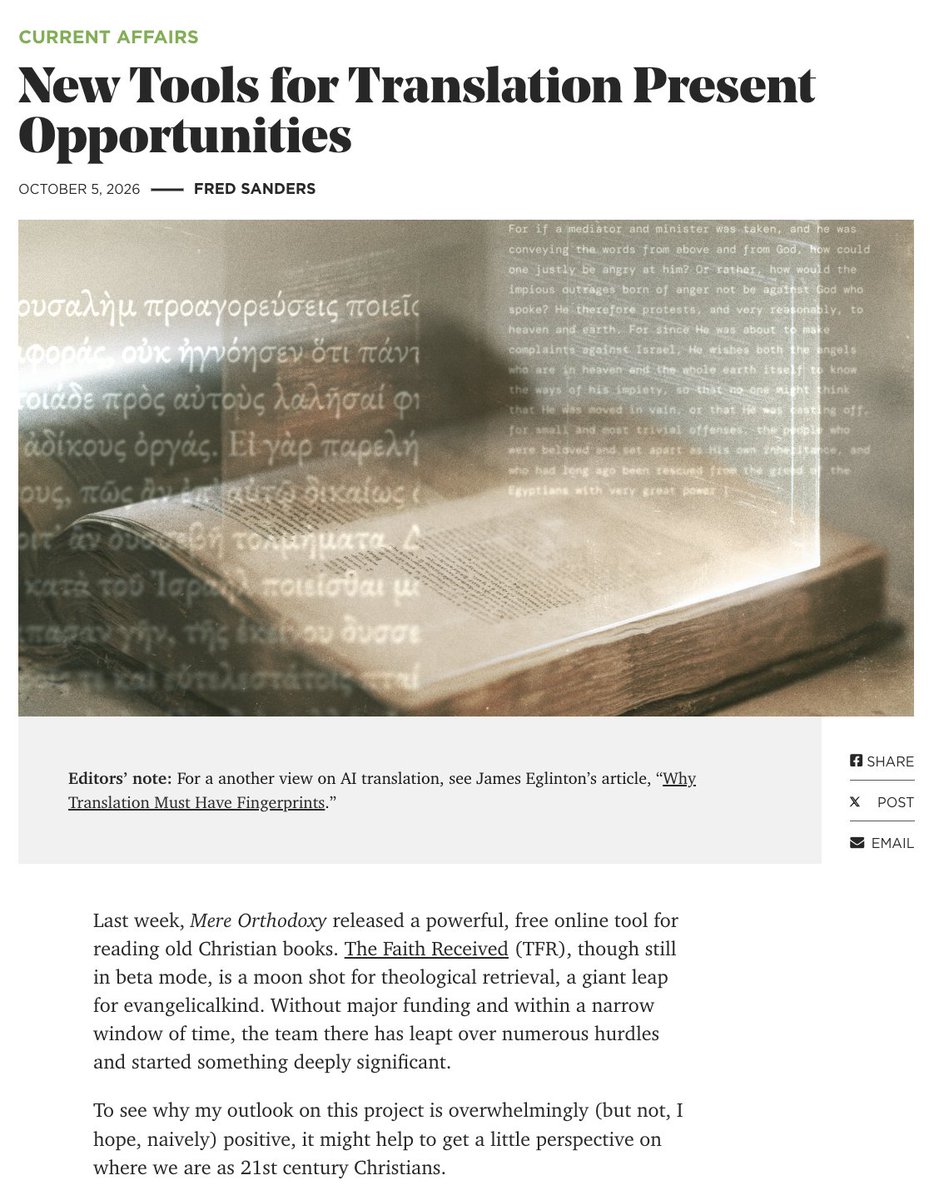
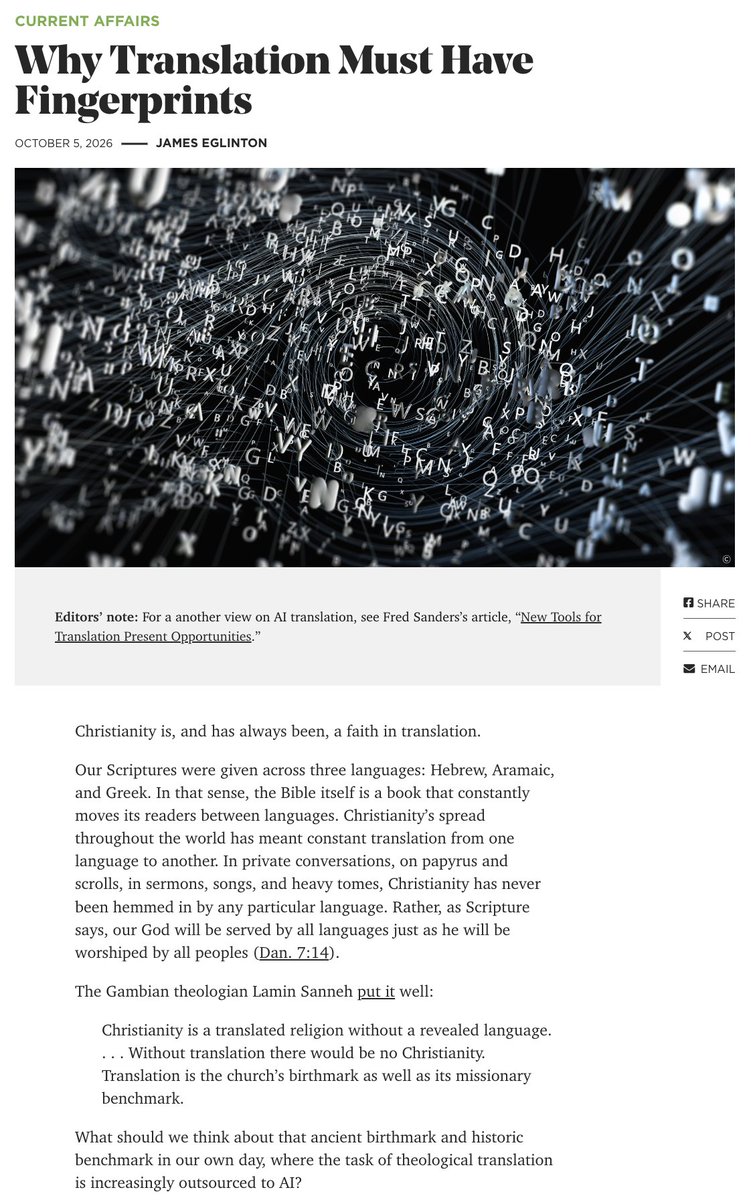
Last week brought news of a significant new resource from @MereOrthodoxy, The Faith Received, a vast online repository of theological texts. For the most part, those texts are in English as a result of AI translation. The discussion around this use of AI has quickly settled into a few camps.
Today at TGC, we published two articles related to this project and this kind of use of AI for text translation.
In the first, @DrJamesEglinton responds to the project urging caution. He argues that the shift from Christianity as a human-translated religion to an AI-translated religion is far from seamless and shouldn’t be overlooked glibly.
In the second, @FredFredSanders views the project as an overwhelming positive, describing the project as “a moon shot for theological retrieval, a giant leap for evangelicalkind.”
Both posts are linked below:
Two really thoughtful articles on "The Faith Received" @mereorthodoxy from friends: @FredFredSanders is pro and @DrJamesEglinton is con.
I'm bilingual, and I agree with nearly everything James says about the nuance of translation, but I lean more to Fred's take on how this particular resource is a positive force for accessibility and on-ramps to deeper theological study.
https://t.co/6pj2svRZbl
https://t.co/2GdBbzJrYW