A tweet from a progressive "journalist" with a math error of six decimal points (one million X) was repeated verbatim on national TV. This explains why progressives think seizure of the assets of a few billionaires can pay for TENS OF TRILLIONS in new spending
THEY CAN'T DO MATH
@drawandstrike Starship captain gets back together with his ex-wife (who can REALLY cook)
Genetic Superman ruins the reunion
Geeky best friend fixes the engines
A man dying of face cancer climbed on a horse and rode 70 miles through a screaming thunderstorm, all night, just to cast a single vote. That vote helped create the United States of America. And you've probably held his picture in your hand without knowing it. Meet Caesar Rodney.
Rodney was born in Delaware in 1728 into a farming family, and he spent his life in public service, militia officer, judge, congressman. But two things made him unforgettable, and the first one is brutal.
He had cancer. A growth on his face that slowly disfigured him, so much so that he often kept a green silk scarf draped over one side of his face to hide it. John Adams, never one to soften a description, called him one of the oddest looking men in the world. The cure, such as it was, existed only across the ocean in England. But going there for treatment would have meant abandoning the revolution and bowing to the very country he was fighting. So Rodney chose. He would stay, keep serving, and let the cancer take its course. He picked his country over his own life, literally.
Now the ride.
July 1, 1776. Independence hangs by a thread. Delaware has three delegates, and they're split. One for, one against. The deciding man, Caesar Rodney, is nearly 80 miles away back in Delaware, dealing with Loyalist trouble. Word reaches him that everything is deadlocked and his vote is the tiebreaker.
So this sick man, wracked by cancer and asthma, gets on a horse in the middle of the night and rides. Through a thunderstorm. Through mud and lightning and dark. Roughly 70 to 80 miles, hour after hour, in his boots and spurs, pushing through weather and pain that would flatten a healthy man.
He clattered into Philadelphia on July 2 just as the vote was being taken, still splattered in mud from the road, and cast his vote for independence. Delaware swung to yes. The colonies moved forward. He made it, barely, in time to help change history.
He went on to serve as Delaware's wartime governor, holding his state together through the hardest years, all while the cancer kept eating away at him. He finally died from it in 1784, at 56.
And here's the kicker most people never realize. That dramatic image of a man galloping on horseback? It's stamped on the Delaware state quarter. Millions of people have held Caesar Rodney in their pocket and never knew the dying man behind the ride.
A man with a death sentence on his own face, who rode through hell for one vote, and helped birth a nation he wouldn't live to see grow old.
Caesar Rodney. The midnight rider who spent his last good years buying our first ones.
Wednesday
Something is deeply broken in how government programs are being approved and funded.
As I look at Somali daycares, Russian gangster-run hospices, and other large-scale fraud against programs, one thing becomes crystal clear: this is not just fraud by the people applying. It requires insiders on the approval side to make it work at scale.
The process is straightforward yet incredibly detail oriented and not something you would expect someone off a boat to do in a day. Someone applies for funding or licensing. Paperwork is submitted. Approvers sign off. Money flows. When the operation is fraudulent, it keeps running until someone gets caught. The speed at which some of these approvals go through suggests the system is either incompetent or compromised. My hunch? People within the administrations are profiting and approving.
I met someone who worked at a Social Security office who told me his colleagues were constantly getting busted for taking kickbacks to help people fraudulently qualify, yet many were not losing their jobs. That tells you everything about the culture. This is pay-for-play at the government employee level.
Meanwhile, honest Americans with real businesses, clean records, and vast experience, like me with my startup and bench of professionals, cannot even get a serious second look on legitimate bids and applications. The system moves at glacial speed for us while fraudsters seem to get fast-tracked.
This is not random incompetence. When warm bodies apply for these programs, they are only the first step. The real enablers are the people inside the agencies who approve them, look the other way, or actively participate for personal gain. Without that internal protection, the large-scale fraud could not continue.
We need to put blame where it belongs, on both the fraudsters gaming the system and the government insiders who let it happen and profit from it.
The American taxpayer is getting robbed while legitimate businesses struggle to get basic consideration.
Question for folks willing to speak up:
Have you seen government programs where approvals seemed suspiciously fast for certain groups while honest applicants got ignored or delayed?
Drop what you observed.
This is one of the most important moments ever aired on CNBC.
Billionaire investor Chamath Palihapitiya says the media lied to millions of Americans about President Trump, and that after going back to the original source material, he realized he had been completely misled about Trump’s character.
PALIHAPITIYA: “The reality is that most of us were lied to by the media about President Trump.”
“And if you just go back to the source material, you should take away two things.”
“One, he didn’t say half the things he said, and two, why did these other people just fabricate what they wanted to say so that they could essentially assassinate his character?”
“I think that that second thing is completely unacceptable in America, and there’s still been no repercussions, really.”
“I took the time to learn about it. I admitted where…you know, the way that I met him was, I admitted on the pod, which, you know, has millions of viewers.”
“And I said, I got it totally wrong because I went and I watched Charlottesville.”
“And, you know, the first person to call me? President Trump.”
“And I got to know him and I put the phone down, I called my wife, and I said, we got it TOTALLY, totally wrong. We were lied to.”
“And then I got to know him and he is fantastic!”
@chamath
The socialist regards society much as a child regards supper: he notices with great precision who received the largest slice, while remaining curiously uninterested in who rose at dawn to bake the thing.
Socialists always imagine themselves at the table, never in the kitchen.
@brubarian@Synthea_thea What, exactly IS “international law”? There is no CFR for international law
Over 90% of treaties signed between nations throughout history are ignored, and just have just fallen into disuse
@JackMeoff506@Real_RobN Epstein files released by Trump: Millions
Epstein files released by Biden: Zero
Epstein files released by Obama: Zero
Do you SERIOUSLY believe Biden would have sat on credible evidence implicating Trump?
Your attempt to deflect from horrific crimes MAKES YOU COMPLICIT IN THEM
This will be a long one. But since I'm an active duty officer addressing another higher ranking one, I have to be respectful. That being said, General Montague is correct that the Army needs thinking officers.
I believe he is wrong to assume that sending them to Harvard necessarily accomplishes that purpose.
The Harvard he entered in the 90s is not the Harvard officers enter in 2026. His article invokes George Washington, Theodore Roosevelt, Harvard’s war dead and generations of citizen Soldiers to defend an institution that has spent decades consuming the inheritance those men created.
The issue is not whether Army officers are intelligent enough to resist indoctrination. Indoctrination is rarely a professor hypnotizing a helpless student. It is an institutional environment in which one set of political assumptions governs admissions, hiring, instruction, social acceptance and administrative protection. The whole gambit.
Dissent remains technically possible. But it now becomes professionally expensive. Ask me how I know...
The results are no longer theoretical.
For years, elite universities built an ideology that judges human beings first by racial, sexual and political category, then insists this is the cure for prejudice. Harvard’s admissions system was ultimately struck down because it used race as a negative, relied upon racial stereotypes and reduced the number of Asian-American students admitted. That was racial discrimination administered by people who had renamed themselves experts in inclusion.
The prejudice did not end there. Harvard’s own reports documented Jewish and Israeli students facing hostility and exclusion, while Muslims, Arabs, Palestinians, Black students and South Asian students described being harassed, misidentified, called terrorists, spat upon, doxxed and intimidated into silence. The university that promised safety through identity politics produced an environment in which nearly every identity group had reason to fear another.
That is the verdict on DEI. It didn't teach students to see one another as individuals. It trained them to organize humanity into competing tribes, assign innocence and guilt by category, and determine whose suffering deserved institutional protection.
At Columbia, students were pressured to profess political positions they did not hold, silenced or humiliated in classrooms, and subjected to faculty activism masquerading as instruction. Columbia’s own task force eventually had to warn professors against ideological litmus tests and remind them that students must not be coerced into conformity. When a university must formally instruct its faculty not to politically condition its students, the indoctrination is no longer an accusation. It is an internal finding.
These habits are directly hostile to military values.
The Army cannot function through racial preferences, collective guilt, ideological litmus tests, selective discipline or separate standards for politically favored groups. Soldiers must be judged as individuals. Standards must be common. Discipline must be impartial. The mission MUST outrank identity. Commanders must tell the truth even when the truth violates the reigning political fashion.
The uniform is designed to subordinate tribe to country! DEI restores the tribes and places the institution between them as judge.
The general argues that officers are intelligent enough to resist indoctrination. That misses the point. The Army does not owe public money, officers or prestige to institutions that reward conformity, excuse disorder, discriminate by race and turn classrooms into political organizing spaces.
Officers SHOULD encounter hostile ideas. They should study Marxism, radical Islam, critical race theory, revolutionary movements and every ideology capable of shaping the battlefield.
They should study them as objects of analysis. They should NOT be sent into institutions that have adopted their premises as articles of faith.
Harvard once educated men who built and defended the republic. Its age does not grant it permanent immunity from judgment. Neither its war memorials nor the patriotism of its dead can excuse the ideological conduct of its living.
The Army does not fear education. It fears an education system that calls racial discrimination equity, political conformity scholarship, selective prejudice inclusion, and institutional disorder courage.
I hope this makes sense. Submit this to the general, with my compliments.
-Dort
@MyRightToExist@theygonnalose I have seen anti-semitism building on the left, steadily, since the Crown Heights riots in the 1980s. Has only become more obvious since then
But the left has been in complete denial about it. “I don’t have any weeds in my garden”. Until the garden has become overgrown
The fact this one dude - by himself - can walk into any state and find blatant fraud everywhere he goes proves two things: 1) the fraud is rampant at an unprecedented scale and 2) the government agencies who are supposed to protect our tax dollars are either completely incompetent or complicit in the fraud.
Cambridge disabled Shot Spotter because they said it was racist. Then a black Public Works employee got shot, lay undiscovered for over an hour while bleeding out in a public park, and died because first responders didn't know a shooting happened
https://t.co/OKIie6BAfX
@Phenomenal1011@PpollingNumbers Stop hiding relevant details
First trial ended in a hung jury, and the victim didn’t want to go through the trauma of testifying again
They got the most they could from a plea deal
@BrettErickson28@barnes_law How could ANYONE misinterpret this statement in the MoU? “Best efforts for safe passage” isn’t shooting at civilian merchant ships
This is a data point showing that Iran supporters are amazingly low IQ
But I guess the Iranian leadership believed its own propaganda
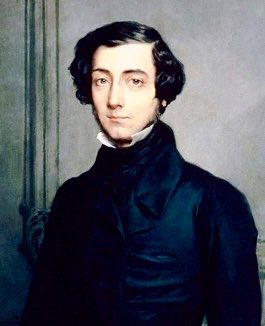
Alexis de Tocqueville – Redeeming the French:)
The Frenchman who understood America better than most Americans, and Europe better than it has ever understood itself.
1. In 1831, a young French aristocrat sails to America ostensibly to study the prison system. What he actually does is cross the civilizational divide – and spends nine months trying to understand why America works. Democracy in America is the result: the most penetrating analysis of the Anglo-Saxon tradition ever written, by someone who grew up in the other one.
2. What he sees in America is Locke and Smith and Burke implemented in practice. A society that built freedom from the bottom up — townships, voluntary associations, local institutions — rather than from the top down by enlightened decree. Americans, he observes, join together constantly, spontaneously, without waiting to be organized: to build a road, start a church, solve a local problem. This horizontal self-organization is the immune system of a free society. It is precisely what the French Enlightenment systematically destroyed by concentrating everything in the state.
3. But Tocqueville sees the danger from inside the success. Democracy has its own pathology – not the guillotine this time, something quieter and harder to resist: the tyranny of the majority, the slow flattening of excellence into mediocrity, the pressure to conform that needs no secret police because it operates through social disapproval alone, without a single revolutionary. This is the diagnosis nobody wanted to hear in 1835. It is an accurate description of 2026.
4. France keeps producing the individuals who see clearly. Montesquieu looked at England and understood what France was missing. Bastiat understood markets better than most Englishmen. Tocqueville understood America better than most Americans. Raymond Aron understood the Soviet threat while Sartre was still praising it. All of them largely ignored at home. All of them vindicated everywhere else.
5. The pattern is consistent: France produces the diagnostic genius, then ignores the diagnosis in favor of the next beautiful abstraction. Great individuals. Wrong civilizational operating system. The Platonic gravitational pull is too strong – the addiction to the elegant idea overrides the evidence of the actual result. Which is why the tradition that saved the world kept being built in Edinburgh and London and Philadelphia, not in Paris.
6. Tocqueville’s concept of civil society is his most practical contribution: the network of voluntary associations — churches, clubs, local governments, independent institutions — that stand between the individual and the state. This is the buffer that prevents soft despotism. Destroy it — by making people dependent on the state for everything, by atomizing individuals until they have no horizontal relationships left — and the citizen becomes what the state always wanted: alone, dependent, and grateful.
7. Soft despotism is Tocqueville’s most prophetic concept – and the most precise description of where the West currently stands. Not the guillotine. Something quieter: a power that doesn’t tyrannize but infantilizes, that covers the surface of society with a network of small complicated rules, that reduces citizens to a herd of timid animals of which the government is the shepherd. It doesn’t break your will. It renders it unnecessary. He wrote this in 1835. He was describing the European Union, the administrative state, the therapeutic culture, the regulatory apparatus that decides what you eat, say, heat your home with, and think about your children’s education.
Soft despotism is what Rousseau looks like when he wins slowly – not through revolution but through form-filling. And Tocqueville’s warning, the one nobody wanted to hear, was this: it gets less soft with time. The infantilized citizen, stripped of civil society, dependent on the state, no longer knows how to resist. At that point the softness is no longer necessary…
The Anglo-Scottish Enlightenment – the real antidote to Rousseau and Voltaire
The French Enlightenment and the Anglo-Scottish Enlightenment happened simultaneously, in the same century, reading the same books, arguing about the same questions. They reached completely opposite conclusions. One produced the Declaration of Independence and the American Constitution. The other produced the guillotine. This is the most important civilizational fork in modern history.
1. The French Enlightenment begins with the assumption that human beings can be improved by reason – that if you strip away the corrupting institutions of Church, tradition, and inherited authority, the natural goodness underneath will organize itself into a just society. This sounds like progress. It is a fantasy with a body count. Every attempt to implement it has required, at some point, a Committee of Public Safety to handle the people who turned out not to be naturally good enough.
2. The Anglo-Scottish Enlightenment begins with the opposite assumption: human beings are what they are, not what they could be if properly enlightened. Hume grounds morality in human nature as it actually operates – sympathy, habit, sentiment, the slow accumulation of social trust. Smith shows that self-interest, properly channeled, produces collective benefit without a planner. Neither man is building a utopia. Both are building with the actual material available.
3. Burke is the direct refutation, written in real time. He published Reflections on the Revolution in France in 1790 – before the Terror, predicting it precisely – because he understood that institutions are not obstacles to human flourishing, they are its precondition. They contain accumulated wisdom — the knowledge of the dead — that cannot be recovered once destroyed. Pull society apart to improve it and you don’t get the General Will. You get Robespierre.
4. The American founders read Burke, Hume, Smith, and Montesquieu – the Frenchman who looked at England and understood what France was missing. They built a system that takes human nature as given — self-interested, power-hungry, tribal — and constructs institutions to contain those tendencies rather than assume they disappear once the right people are in charge. Checks and balances are not a design flaw. They are what you build when you don’t believe in philosopher-kings.
5. 1776 versus 1789. Same Enlightenment, same century, same vocabulary of liberty and reason. One produces a constitutional republic that has survived two and a half centuries of stress, civil war, and upheaval. The other produces, in sequence: the Terror, Napoleon, 1848, the Commune, and eventually — via Marx, who was a Frenchman in spirit if not in birth — the entire catastrophe of the twentieth century. The difference was not intelligence or intention. It was the starting assumption about human nature. Get that wrong and everything that follows is wrong with it.
6. The guillotine is not the Revolution’s failure. It is its logical conclusion. If man is naturally good and the system is corrupt, then whoever seizes the system in the name of natural goodness is licensed to do anything. The General Will cannot be wrong. Those who resist it are not opponents – they are enemies of nature itself.
7. The real antidote to Rousseau and Voltaire was never a better French philosopher. It was a different civilizational tradition – one that builds with human beings as they are; that treats inherited institutions as repositories of wisdom rather than obstacles to progress; that distributes power rather than concentrating it in whoever currently claims to know the General Will. That tradition was built in Edinburgh, London, and Philadelphia. It is currently under sustained assault — from exactly the same ideas, in exactly the same form, with exactly the same confidence — that Burke watched demolish France in 1789. He was right then. He is right now.
Jean-Jacques Rousseau – the original Woke
He invented it. Every premise of contemporary progressive ideology traces directly back to one man who had never met a "noble savage", never raised a child, and never lived according to a single principle he preached.
1. His foundational claim: man is naturally good and civilization corrupts. This sounds compassionate. It is the most dangerous idea in Western political thought. Because if man is naturally good, then every failure, every crime, every inequality is caused by the system – never by the individual.
Responsibility evaporates. The oppressor is always external. The victim is always pure. This is the complete architecture of Woke in one sentence, written in 1755.
2. The "Noble Savage" is Rousseau’s Form – his version of Plato’s ideal. The uncorrupted man, untouched by property, competition, and civilization, living in natural harmony. Rousseau had never met one. He invented him from an armchair in Paris, extrapolating from travel accounts of peoples he had never visited. The Noble Savage is not an anthropological observation. He is a political weapon – a club to beat civilization with, wielded by someone living comfortably inside it.
3. The "General Will" is the most dangerous concept in modern political philosophy. Not the actual expressed will of actual people – but the deeper will, the will people would have if they were "properly enlightened". Whoever claims to know it can do anything in its name. Robespierre knew it. Every revolutionary vanguard since has known it. Today’s progressive institutions know it – which is why they can override democratic majorities, suppress dissent, and compel speech, all while insisting they represent the people’s true interests. The General Will is the intellectual license for every tyranny that calls itself a liberation.
4. The chain from Rousseau to today is unbroken. Rousseau to Robespierre and the Terror. Robespierre to Marx, who secularized the General Will into historical necessity. Marx to every "liberation" movement that ended in a gulag. And today: replace civilization with white supremacy, replace the Noble Savage with the marginalized community, replace the General Will with lived experience – and you have the complete operating system of contemporary progressivism. The software is the same.
5. Voltaire, his contemporary and rival, saw him quite clearly: Rousseau made primitivism intellectually respectable. He gave the comfortable classes of every generation a way to signal virtue by denouncing the civilization that produced them, from inside it, without cost. The French Left Bank intellectual denouncing capitalism from a café. The Harvard professor deconstructing Western civilization from a tenured chair. The hedge fund billionaire funding the abolition of meritocracy. All of them are living in Rousseau’s armchair.
6. He sent all five of his illegitimate children to a Paris orphanage. Then wrote Émile – one of the most influential books on education in Western history, a detailed guide on how to raise a virtuous child in harmony with nature. He did not find this contradictory. This is not hypocrisy in the ordinary sense – this is obłuda (remember the obłuda of communism?👇🏻). The defining structural feature of the ideology he invented: the sermon is inversely proportional to the practice. The performance of virtue replaces the exercise of it. Naming the oppressor substitutes for personal accountability. Rousseau didn’t just invent Woke – he lived it, in every detail, before anyone had the word.
7. The original Woke was woke about a fiction he invented – and spent his life performing outrage about a civilization he depended on and never left. Two and a half centuries later, the performance is the same. The noble savages have been updated. The General Will has new names. The orphanages are metaphorical. But the man who sends his children away and then lectures everyone else on how to raise theirs – that man is everywhere.