For those who don't know @kalshimarketman , he’s behind all the great regulatory work that we’ve done. He’s been with us over 5 years and, like an owl, he’s a nocturnal animal. You can find him in the Kalshi office between 5pm and 8am, feet on his desk, with War and Peace on his table, and the bookmark on the same page for the past many years.
I sent Xavier this message in early 2025. As always, he delivered on yet another insane goal. Thank you, sir 🫡
Last night, the power to decide what America sees changed hands.
I have spent a ton of time in DC over the last few months. The elites were certain the markets were off. I heard many variants of “no chance markets are right about X” and “I’ve been in politics for a decade. ‘These people’ don’t really know much.”
Last night, ‘these people’ beat the elites.
Prediction market favorites won 479 of the first 487 races. That’s 98%.
The elites live in a bubble. They theorize, write, ideate, and mistake credentials for an understanding of lives they’ve never lived. They don’t see and feel what the everyday man, on the ground, sees and feels.
Knowledge is not exclusive to the elites but scattered across millions of people.
Someone knows their hometown better than any national pundit. Someone has followed a local race passionately for months. Someone has followed a local race dispassionately for months. Someone notices a shift in their community before it makes the headlines. Someone is shaped by an incident at work. Someone is shaped by what’s getting harder or easier for their families.
Each holds a piece of the picture that no expert can see in full.
And for the longest time, that knowledge had no way to reach the rest of the world.
For generations, election night meant turning on the TV and waiting for a handful of people to tell you what happened.
Prediction markets change that.
You don't need a title, a large following, or an editor to publish you. All you need is a perspective and the conviction to back it.
That changes who holds power over information.
Anyone can see the market. Anyone can contribute to it. Anyone can question it. No title gives you the final word. No gatekeepers can filter your view.
Sometimes the signal can be wrong. But anyone can challenge the consensus and improve it.
And when people consolidate their knowledge together, something remarkable happens: millions of individual perspectives become a signal that we all can learn from.
Over the last few months, the people showed up on Kalshi to tell the world what they were going to do.
Last night, the megaphone was passed to them.
The past 2+ years have given me a completely different appreciation for what a high-performing team can accomplish together.
None of this happens overnight. It's the result of people showing up every single day, through the highs and lows.
Many thanks to @beckhardt, @mansourtarek_, @luanalopeslara for the opportunity to be a part of it and the trust they've placed in me over the years.
Kalshi just raised an additional $1B, valuing the company at $40B. This will help us expand into stocks, compute, indices, and institutional.
Tomorrow marks 8 years since we got accepted into YC and the journey began.
The odds of a kid from Lebanon getting here were pretty low.
Growing up there was great, but very challenging. We went through war. We had bombs explode in front of my house. I watched brilliant people’s lives destroyed for reasons beyond their control.
Lebanon is an unpredictable country. That unpredictability made it hard to plan for success. And yet despite it all, my mom sacrificed everything to give me and my brother the chance to go back to the US.
I found my refuge in two things: anime and math. Especially math.
I loved math because it calmed me. It was the opposite of unpredictable: clear, deterministic, orderly, and consistent. The proof is either right or wrong. I find that elegant and beautiful.
I was lucky.
I made it to my dream school, MIT (largely thanks to my mom), and my love for math quickly translated to a love for statistics, probability, and markets.
I love markets for a lot of the same reasons. Their incentives are clear: you get rewarded for being right and for pursuing knowledge. They are effective weighting machines for people’s opinions. They provide an incentive to be truthful, because they separate good information from bad information. They let people challenge the consensus and be rewarded for being right.
IMO, Hayek, Surowiecki, Hanson, Tetlock were the founding fathers of prediction markets. The more I read them, the more obsessed I got with the idea of applying market-based pricing to more things.
Markets bring rigor and critical thinking to more questions. And in an increasingly polarized and information-positioned word, I believe we need that more than ever.
Markets would also let people predict and manage more things outside of their control. And the world was becoming increasingly more unpredictable, and more like Lebanon, not less.
That love for markets got Luana and me to build Kalshi.
At first, it was mostly an idea we couldn’t stop talking about. We didn’t have much money. Luana’s sister bought the Kalshi domain name for us (for ~$1.7k). We moved to SF to get started, and embarked on a long, uncertain journey to build a regulated exchange.
The paranoia and anxiety from my childhood never left me. Even when things are going well, I think about what could go wrong. When people trust you with their money, that instinct serves a purpose.
I wanted us to build something that would hold up under pressure.
The first principle we defined at the company: regulatory-first. We worked with regulators for years before we listed a single market. We took every step to do things the right way and always asked for approval before proceeding. It was very hard at times, especially when we were being overtaken by competitors, but we believe doing things the right way matters.
Luana and I aren’t the only ones.
Our team put years of their lives into something far from certain. That’s especially true of Lior, Brandon, Rainer, Luis, Xavier, and Josef, who stuck with us for years. They believed when there was little to point to. And they stuck with us no matter how long it took. Kalshi is the result of an arduous journey through a long desert where, at times, most people didn’t understand why we were making the walk.
Many people still don’t understand what we’re doing and some disagree with us. Markets have historically taken time to be understood and accepted by some. But while not always obvious, their benefits are vast: capital markets help allocate capital and derivative markets help predict and manage uncertainty.
I firmly believe in these benefits, and that’s why I am dedicating my life to building this market.
Markets have caused issues many times in the past, and they certainly can present harms (manipulation, insiders, and addictive behaviors). These harms are more acute for certain types of markets (sports, short-term options, etc.) than others. It’s why I believe that guardrails need to exist and why we have taken the approach we have taken. We have consistently prioritized thinking critically about the risks and building the appropriate safeguards, sometimes beyond what the regulators require us to do. Many believe more needs to be done, and that’s a conversation I welcome.
Over time, I believe more people will see what we see: markets can help us get smarter and manage the future with more rigor, more precision, and more certainty than we have today.
To our tens of millions of users: you have made Kalshi bigger than anything Luana and I could have possibly imagined. Thank you for trusting us and thank you for coming along on the journey. I feel a strong responsibility to build a company worthy of that trust.
I am so lucky to spend my life building something I love. I hope everyone finds something they care about that much. Something that keeps you curious. Something that pushes you to your limits. Something that may put you at odds with the status quo. Something worth the hard days.
For me, it’s still markets. The more I learn, the more I want to understand.
Congress provided the @CFTC with exclusive regulatory jurisdiction over derivatives markets so that exchanges could operate and innovate across the country with confidence, certainty, and clarity under a single federal rulebook. This has made our markets the envy of the world, with the widest range of tradeable products and deepest liquidity globally.
Yesterday, the State of Utah brought criminal felony charges that can carry long prison terms against the executives of a lawful, federally regulated derivatives exchange that is registered with the CFTC and subject to its exclusive jurisdiction.
Threatening felony convictions and prison time for operating a lawful business is a blatant overreach that threatens the rule of law and the legal certainty that our financial markets depend upon. Utah has set a dangerous precedent that may have a chilling effect on financial services professionals within its state.
The consequences of states using criminal prosecutions to circumvent federal law and undermine the CFTC’s authority will extend far beyond derivatives markets. The integrity of our financial markets depends on clear rules, consistent oversight, and respect for federal jurisdiction.
Utah cannot unilaterally override federal law simply because the state disagrees with it. The CFTC will defend its statutory authority and protect the integrity of federally regulated markets.
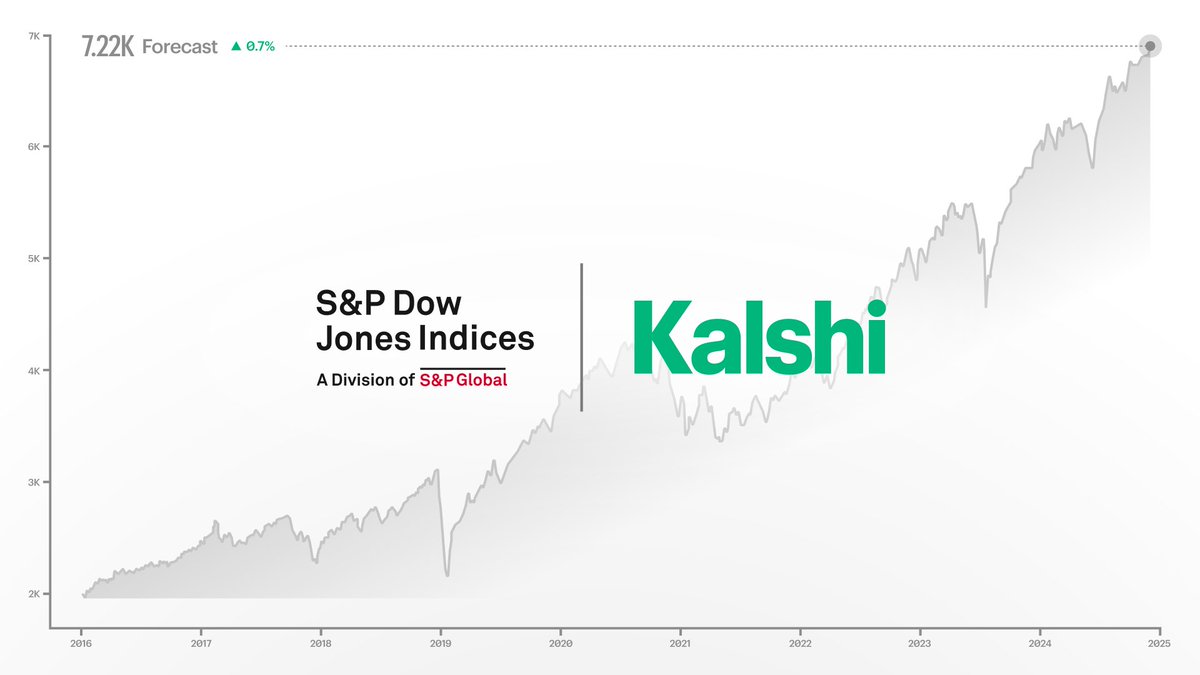
S&P Dow Jones Indices and Kalshi are joining forces to build the next generation of financial markets.
The Dow launched in 1896. The S&P 500 in 1957. The idea was simple: bring individual stocks together into a single benchmark, giving people a clearer view of the broader market.
Over time, products built around those benchmarks transformed investing. Index funds, ETFs, futures, and options gave investors ways to gain diversified market exposure and hedge broad market swings.
These indices became foundations of global finance. More than $20 trillion is indexed or benchmarked to the S&P 500 alone.
Today, this structure extends beyond stocks to bonds, commodities, currencies, and more.
The next step is to bring that structure to the events that shape everyone’s lives.
Through this partnership, S&P Dow Jones Indices and Kalshi will work together to create indices composed of Kalshi event contracts.
Think about what that opens up.
An index of political power. An index of supply chain risk. An index tracking AI’s impact on employment. An index of sports outcomes that affect broadcasters, advertisers, cities, and small businesses. An index of weather risks that shape harvests, energy demand, and business revenues.
Each would bundle event contracts into a single indicator, helping people understand how related risks are evolving.
Over time, products built around these indices could offer diversified exposure to those events and new ways to hedge their impact.
The events that shape our lives could become as easy to track and gain exposure to as the S&P 500.
Unlike casino-style gambling, @CFTC-regulated prediction markets operate under a federal regulatory system designed to protect market integrity and prevent manipulation.
Conflating the two ignores the fundamental distinction between gambling and regulated financial markets. @BloombergTV@tylerskendall
Thank you for having me @CBSLosAngeles to speak about prediction market hedging!
Many speculate (or "bet", as you call it) on prediction markets, just like they do on any derivatives market. But the exchange structure harnesses that speculation for price discovery and enables risk management for individuals and businesses, big or small.
Over time, prediction markets will let people manage exposure to most things outside of our control. We're in the early innings of that. Incredibly excited to be part of building that future.
This is the first full election cycle for which Kalshi markets have been available. They provide a real-time signal on political outcomes across the country that fills the gap left by polling.
Great to see our markets featured on CBS and have the opportunity to chat through what’s driving them. Looking forward to next time!
I think we're very much aligned here. You wrote that the prop vs. market-making line is porous and hard to enforce, and Volcker proved it.
We agree, which is why we don't recommend relying on that line.
In my view, the real risk is open-ended prop trading for profit outside a filed program. Hence our proposal: affiliate trading only within a filed MM/liquidity program, only as that program needs, and under a hard 5% cap per execution method.
Truly appreciate the engagement here. 🙏
@amandalfischer A correction here - our proposal is to limit affiliated trading to what is reasonably necessary to take part in a market maker or liquidity program filed with the CFTC. No prop trading and no trading beyond what the program needs.
Plus the 5% cap on volume as you noted.
Kalshi recommended that the CFTC not try to distinguish between market-making and prop trading, and instead just limit aggregate affiliate trading to 5% of the CLOB or RFQ per quarter (not on a contract-by-contract basis). Paradigm generally agreed.
@ASATNshow We explain why our incentives don’t reward wash trading, how Kalshi prohibits and monitors for it, and why the activity in question isn’t wash trading here:
https://t.co/9oplCwc6pe
Long time coming.
Capital efficiency is the real requirement for institutional adoption and this meets it without loosening a single risk standard.
Narrow scope, conservative methodology, modeled on sound clearinghouse approaches.
Proud of the team on this one.
We just submitted a regulatory filing to introduce margin on a subset of long-dated prediction markets. This will not apply to sports, culture, and a few other categories.
We are very excited to be taking what we believe is our most important step toward institutional adoption so far.
Capital efficiency has been the biggest bottleneck for institutions, and margin is the single most requested feature. Fully collateralizing long-dated contracts ties up substantial capital for months or years, making participation impractical for many institutions. It is very difficult for a large institutional market to develop without margin.
Margin addresses that problem by reducing capital requirements, subject to strict risk standards.
Some important characteristics of our proposal:
• Margin applies only to a narrow set of categories, excluding sports and culture.
• It is geared toward institutions and subject to strict eligibility requirements.
• The risk methodology is modeled on approaches used by established clearinghouses and tested over decades. It incorporates conservative safeguards around volatility, liquidity, concentration, and event risks, as well as measures to limit sharp increases in margin requirements during market stress.
The goal is a better trading experience for users. Greater capital efficiency enables more institutional participation, bringing deeper liquidity and better pricing. That makes our markets more attractive to more traders, whose participation further strengthens liquidity and improves the experience for everyone.
We just submitted a regulatory filing to introduce margin on a subset of long-dated prediction markets. This will not apply to sports, culture, and a few other categories.
We are very excited to be taking what we believe is our most important step toward institutional adoption so far.
Capital efficiency has been the biggest bottleneck for institutions, and margin is the single most requested feature. Fully collateralizing long-dated contracts ties up substantial capital for months or years, making participation impractical for many institutions. It is very difficult for a large institutional market to develop without margin.
Margin addresses that problem by reducing capital requirements, subject to strict risk standards.
Some important characteristics of our proposal:
• Margin applies only to a narrow set of categories, excluding sports and culture.
• It is geared toward institutions and subject to strict eligibility requirements.
• The risk methodology is modeled on approaches used by established clearinghouses and tested over decades. It incorporates conservative safeguards around volatility, liquidity, concentration, and event risks, as well as measures to limit sharp increases in margin requirements during market stress.
The goal is a better trading experience for users. Greater capital efficiency enables more institutional participation, bringing deeper liquidity and better pricing. That makes our markets more attractive to more traders, whose participation further strengthens liquidity and improves the experience for everyone.
@MorePerfectUS Margin trading is common in all financial markets.
Some important features:
- This is geared for institutional clients.
- It is a way to reduce cost of capital for long dated markets and introduce efficiency.
- It is not for a number of categories including sports and culture.