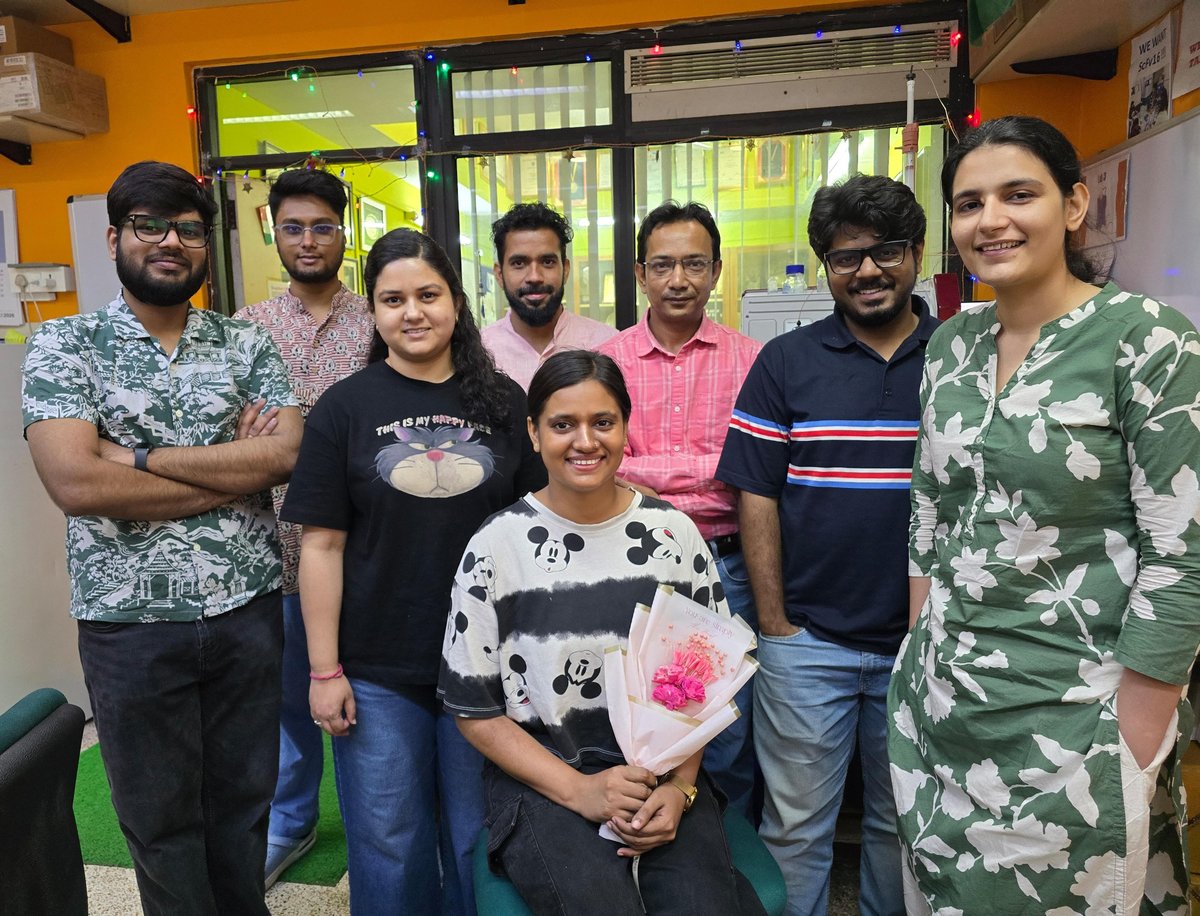
🧬 IIT Kanpur scientists' research reveals how a promising vaccine booster switches on immune cells
Scientists at IIT Kanpur have revealed how an experimental molecule called EP67 switches on an important receptor found on human immune cells. EP67 is a candidate "adjuvant", an ingredient added to vaccines to make them work better.
Published in the @PNASNews, the study gives researchers the first clear, close-up view of EP67 gripping its target, providing a blueprint for designing safer vaccines and new immune-based treatments.
The research, led by Prof. @arshukla from the Department of @BSBEIITK1, found that EP67 activates two kinds of immune cells—dendritic cells and macrophages, which help the body build lasting protection, while having minimal effect on neutrophils, the cells most responsible for unwanted inflammation.
Using cryo-electron microscopy (cryo-EM), the team captured EP67 locked onto the C5aR1 receptor, revealing how the molecule switches it on. The findings are expected to support the refinement of EP67 and advance the development of safer vaccines and next-generation immune-based therapies.
Contributors from Professor Shukla's lab include Annu Dalal, Manish Yadav, Sudha Mishra, Manisankar Ganguly, Shachie Sinha, Nabarun Roy, Divyanshi Tiwari, Debdatta Mukherjee, Nilanjana Banerjee, and Ramanuj Banerjee. The work also drew on the laboratories of Professor Cornelius Gati at the University of Southern California and Professor Trent Woodruff at the University of Queensland, Australia, and was supported by @ICMRDELHI, @ANRFIndia, @DBTIndia and @IndiaDST.
#IITKanpur #Research #VaccineResearch #Immunology #CryoEM #BSBE #PNAS #ScientificResearch #HealthcareInnovation #LifeSciences
Our pharmacological and structural insights highlight how differences in EP67 activity at the human and mouse receptors may affect conclusions from animal studies and stresses the need to develop better animal models to more accurately reflect the effect in humans.
Excited to share our newest study where we characterize EP67, a peptide derived from the complement anaphylatoxin C5a, across the complement receptors from both human and mouse species!
https://t.co/MzwGu1rq8F
Huge congratulations to @ANNUDALAL7 , @manish31247914, @gangulymoni and all the co-authors on this wonderful achievement 🥳. A special thanks to @arshukla for his exceptional mentorship, constant encouragement, and invaluable guidance throughout this work.🌟
Excited to share our latest publication in PNAS! 🎉
We reveal the structural basis of complement anaphylatoxin receptor activation by the immunostimulant lead candidate EP67.
https://t.co/9lT9kqUdCv
Our study shows that EP67, a C5a-derived peptide, is a more potent agonist for C3aR than C5aR1, and structural comparisons explain the molecular basis of this unexpected pharmacological preference.
A step forward in understanding GPCR ligand recognition and receptor selectivity.
Happy to share our latest paper out in PNAS! We have resolved 4 Cryo-EM structures of C3aR and C5aR1 complexes to uncover how the immunostimulant lead candidate EP67 drives activation.
Delighted to share our latest study on the activation of complement anaphylatoxin receptors, now published in PNAS!!! 1/n
Structural basis of complement anaphylatoxin receptor activation by an immunostimulant lead candidate | PNAS https://t.co/BxSlTVxiAE
@IITKanpur An excellent collaboration with the laboratories of Cornelius Gati at USC and Trent Woodruff at University of Queenslad!!! Thank you so much!!!
@CorneliusGati@neurocomplement
Spearheaded in our laboratory @IITKanpur by truly amazing students and fellows including Annu, Manish, Sudha, Manisankar, Ramanuj, and supported beautifully by Shachie, Nabarun, Divyanshu, Nilanjana, Debdatta, Ashna, Calvin, and Ameesha !!! Congratulations to all of you !!!
Excited to celebrate the publication from our lab,"Molecular mechanisms of naturally encoded signaling bias at the complement anaphylatoxin receptors"Congratulations to all the lab members and collaborators whose dedication and teamwork made this achievement possible.
@MolecularCell A journey spanning pharmacology, signaling, and cryo-EM structures-made possible by an incredible team.💥
Deep thanks to our collaborators and the entire team whose collective effort made this work possible. 🙏
@MolecularCell I am especially grateful to my mentor @arshukla, whose patience, guidance and infectious enthusiasm shaped this project at every stage. Thank you for your unwavering support and for making even the most challenging phases of this journey exciting and rewarding. 🙏
@MolecularCell We show that the endogenous ligand C5a-desArg selectively favors G-protein signaling at C5aR1, while structural studies reveal the basis of intrinsic β-arrestin bias in C5aR2. Together, these findings provide a molecular framework for naturally encoded GPCR bias
Excited to see our work published in @Molecularcell today! 🎉
Our study uncovers how nature fine-tunes immune signaling through intrinsic GPCR bias, revealing both ligand bias and receptor bias in complement immunology.
https://t.co/xvOwmynurB
OMG! So incredibly proud of my lab fam at the GPCR Biology Lab, IIT Kanpur! Their latest paper on CXC chemokine ligand binding just dropped in @MolecularCell and it's MIND-BLOWING! Seriously, you have to read this. I'm bursting with pride!