Can neuroimaging predictive models survive across diverse real-world data?🧠🌎We put models to the test across 3 large-scale unharmonized datasets with over 2,800 participants. See our new work in this special issue of Developmental Cognitive Neuroscience: https://t.co/vxoYYrOKV6
Algorithms that could help neuroscientists better understand human behavior are trained and tested on separate datasets to ensure accuracy. A new Yale study assesses how data “leaks” from one set to another undermine model performance. @YaleMed#Yale https://t.co/tB4G0gWDSf
Excited to share that our paper "Data leakage inflates prediction performance in connectome-based machine learning models" is now out in @NatureComms https://t.co/ZCwD2TGuqu (with @LinkTejavibulya, @925452096Andy, @sNeuroble, and @DScheinost )
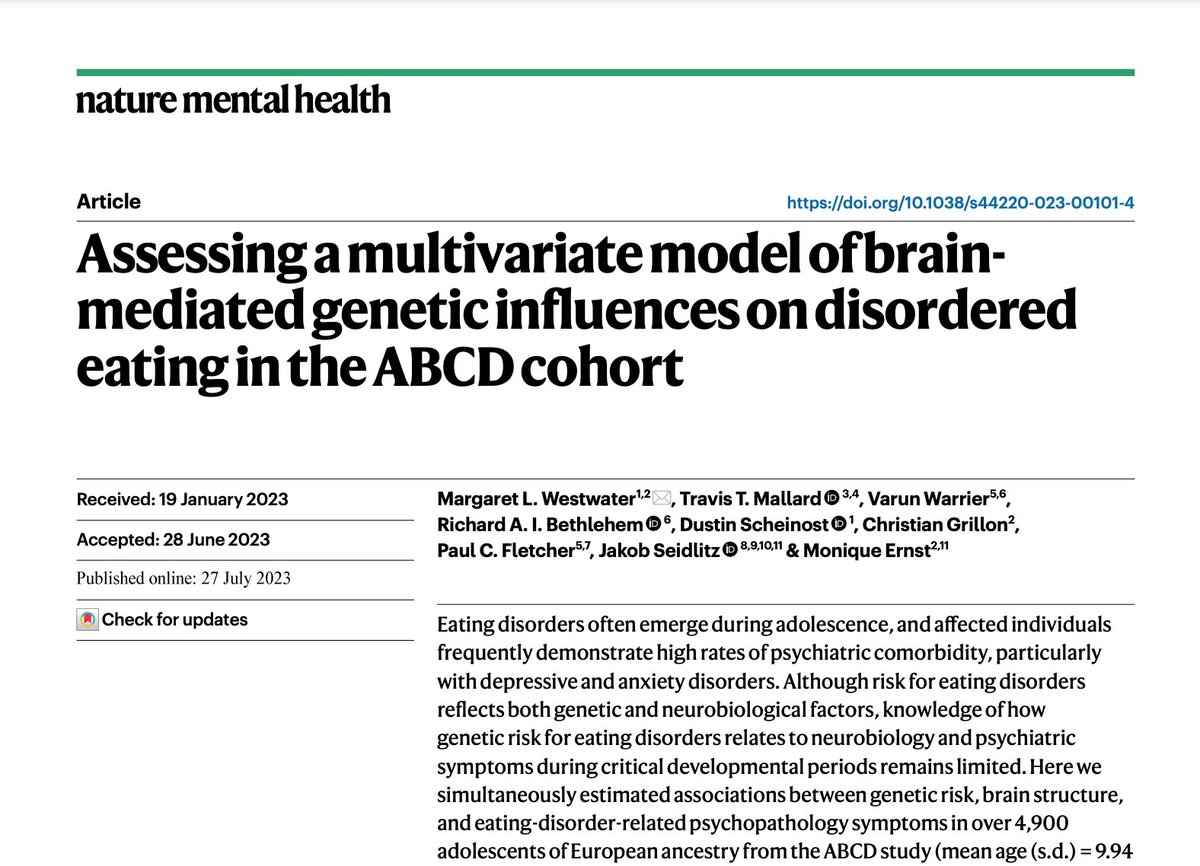
I'm thrilled to share our new paper on #eatingdisorders out now in @NatMentHealth! https://t.co/nB3SYoirmj
'Assessing a multivariate model of brain-mediated genetic influences on disordered eating in the ABCD cohort' 🧬🧠📉
Here's a brief 🧵
Asociaciones de la fragilidad física con los resultados de salud y la estructura cerebral en 483 033 adultos de mediana edad y mayores: un estudio poblacional del Biobanco del Reino Unido
https://t.co/saWBbvMe5F
Maps of brain connectivity are built on brain atlases, of which there are many. A new tool allows researchers to compare maps built on different atlases. @YaleMed @YaleSEAS #Yale https://t.co/mXjBUOjdYH
Curious about how frailty may be an indicator of other health outcomes? We present new work that suggests a link between frailty and >300 health-related outcomes, especially those relating to mental health, which may be mediated by brain structure. Now out in @LancetDigitalH
This latest edition of Insights & Outcomes is coming at you with all the feels. Yale researchers study a biomarker for craving, a link between climate change and certain bacteria, and a neurological route for vicarious thrills. #Yale https://t.co/s8Rh6laNvo
A bit late in posting this …
Now out (and on the cover!) of the June issue of AJP: “Transdiagnostic Connectome-Based Prediction of Craving“
Using task-based functional connectomes, we predicted self-reported cravings in 274 individuals with CPM.
https://t.co/h1wovxAOl9
In new work out in Medical Image Analysis, we present CAROT: Cross Atlas Remapping via Optimal Transport. CAROT touches on some of the vibrant areas of functional MRI, predictive modeling, neuroimaging, & connectomics including privacy & open science 1/16 https://t.co/mVhmCZarfB
Ever wondered how data leakage can affect neuroimaging (specifically functional/structural connectivity) predictive models? Check out our new preprint⬇️
https://t.co/hjC4ncR1yt
What are your favorite papers on Predictive modeling, Neuroimaging, Deep learning, Data science and Computational psychiatry / cognitive neuroscience? I add 9 of mine here. Yours?👇👇👇
Use machine learning in🧠research or for other high-dimensional data?
Curious about its robustness to data manipulations ("trustworthiness")?
Check out our new article in @Patterns_CP and thread ⬇️ https://t.co/WH6fkdRWEi
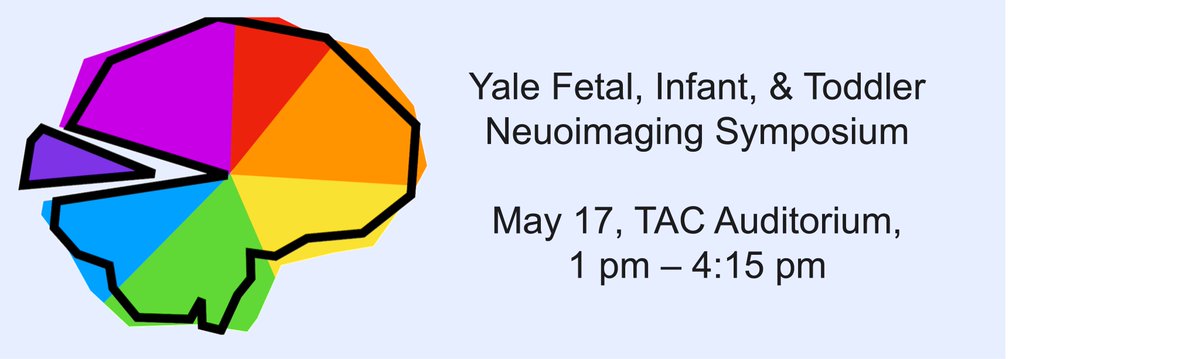
Hey, fetal, infant, & toddler (FIT) neuroimagers
Come to our symposium if you’re at or around Yale on May 17.
We will showcase exciting current FIT neuroimaging work at @Yale.
More than half of seniors are frail or getting frail.
Poor oral health is bidirectional with frailty.
We are testing #Prevora's abilities to help the frail in a randomized controlled study. Stay tuned.
https://t.co/yVIewPw5Mk