900 million people just experienced the hottest July on record, including in:
🇺🇸
🇲🇷
🇳🇪
🇧🇫
🇸🇩
🇰🇪
🇪🇹
🇹🇩
🇲🇽
🇸🇻
🇳🇮
🇭🇳
🇧🇷
🇫🇷
🇪🇸
🇬🇧
🇨🇳
🇮🇩
Climate change is not a hoax. It is an emergency.
The way to win at capitalism is to focus on what it actually does (make customers' lives better) rather than the socialist caricature of it (squeeze every penny out of them). The latter gets you 2x returns at best, whereas making new things for people can get you 10x.
“Stripe’s share price has compounded at 31% since our Series D fundraise 10 years ago, versus 14% for the S&P 500 and 18% for the Nasdaq”
It is deeply unfair to the American public that companies like Stripe are staying private indefinitely.
Would public perception of AI be so low if the average citizen had participated in the wealth creation of OpenAI, Anthropic and others over the last several years?
Probably not. Technological progress is only palatable politically if its rewards are broadly shared. I would encourage every investor who believes endless individual riches are more important than a healthy society to instead consider this Q: what can I contribute to the United States of America? The answer might be as simple as encouraging your portfolio companies to go public earlier
Our American society cannot be solely measured by the wealth it creates, but by how widely our citizens are able to participate in that abundance, while retaining our liberty
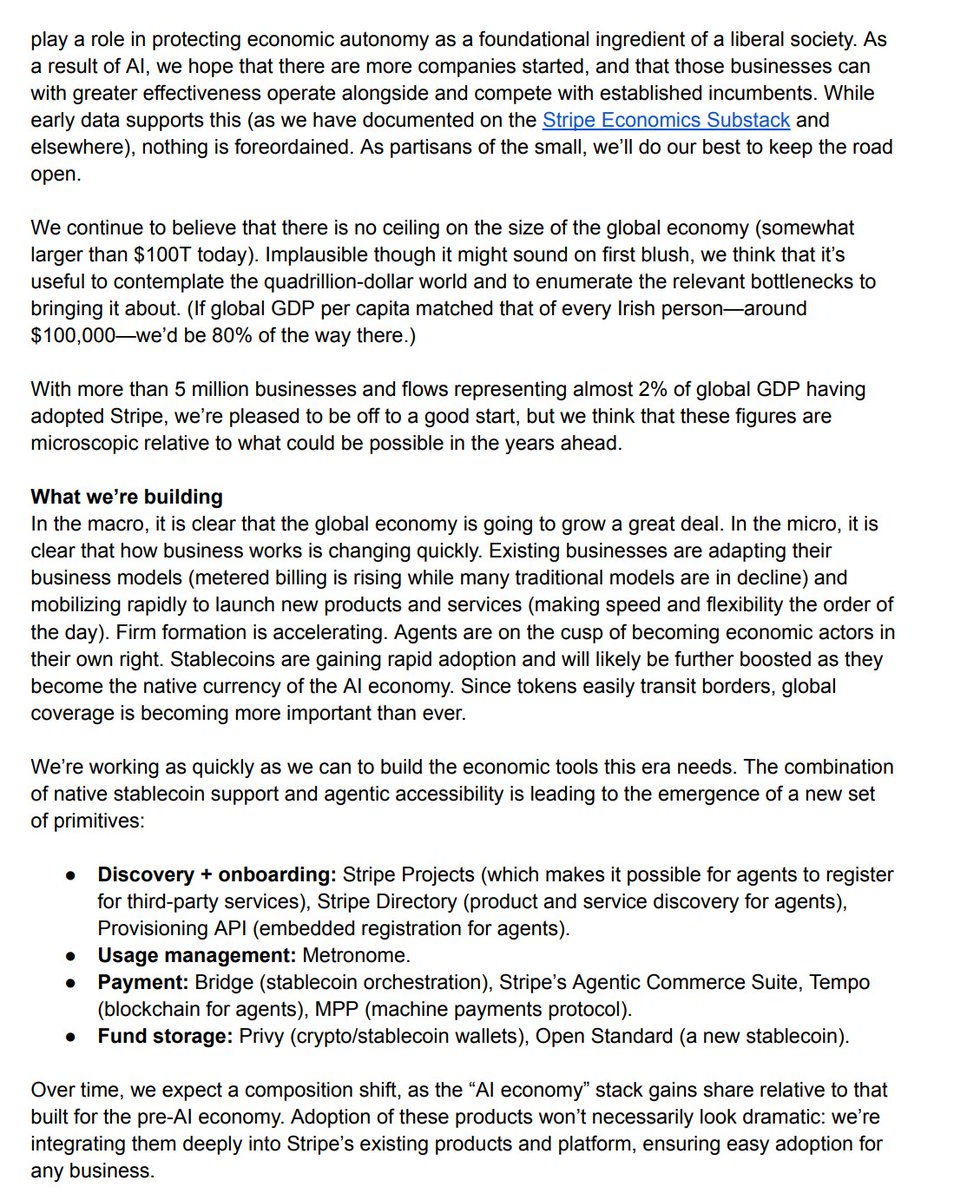
This is the most important strategy document published in fintech this year, disguised as a routine M&A announcement.
If you build in AI infra, read the whole letter. Twice.
https://t.co/lU4miUqt7W
The company that runs billing for 88% of the Forbes AI 50 and moves ~2% of global GDP just published its investor letter.
Almost nobody outside their cap table will read it.
They said some genuinely wild things. Here's an overview. 🧵
They explicitly frame staying private as a strategic advantage for navigating the singularity. "Deft helmsmanship will be required of every company."
Translation: we're going to make decade-scale bets and we don't want quarterly earnings calls while we do it.
And the framing of intelligence as capital: "expensive, heterogeneous, constantly changing... businesses must reason about cost and return of every unit."
How valuable is this task? Which model handles it? Who pays, when, and what's the time-value of delay?
These are questions for a Federal Reserve, not a payments company.
Stripe is pivoting from a payments company to a full-stack monetary system for a non-human economy.
SWIFT + Fedwire + a central bank, but for an internet of intelligence.
The line everyone will meme: Stripe formally declared that "the singularity" began January 1st, and that they've been operating on that basis since, with the numbers to back it.
This is an investor letter, which is typically the most conservative document a company produces.
First, the headline: Stripe is acquiring OpenRouter for $7B. Their largest acquisition ever.
I run a public company building a consumer AI routing app. And this letter is essentially the same blueprint of how and what I have been building Potentially towards.