Team SunTrain! We move utility scale batteries by rail overcoming massive transmission bottlenecks to help datacenters, large industries, & renewables scale.
62,000 Dams
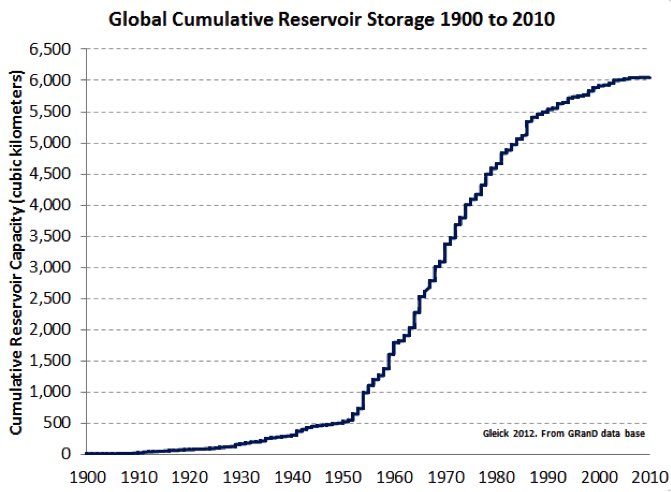
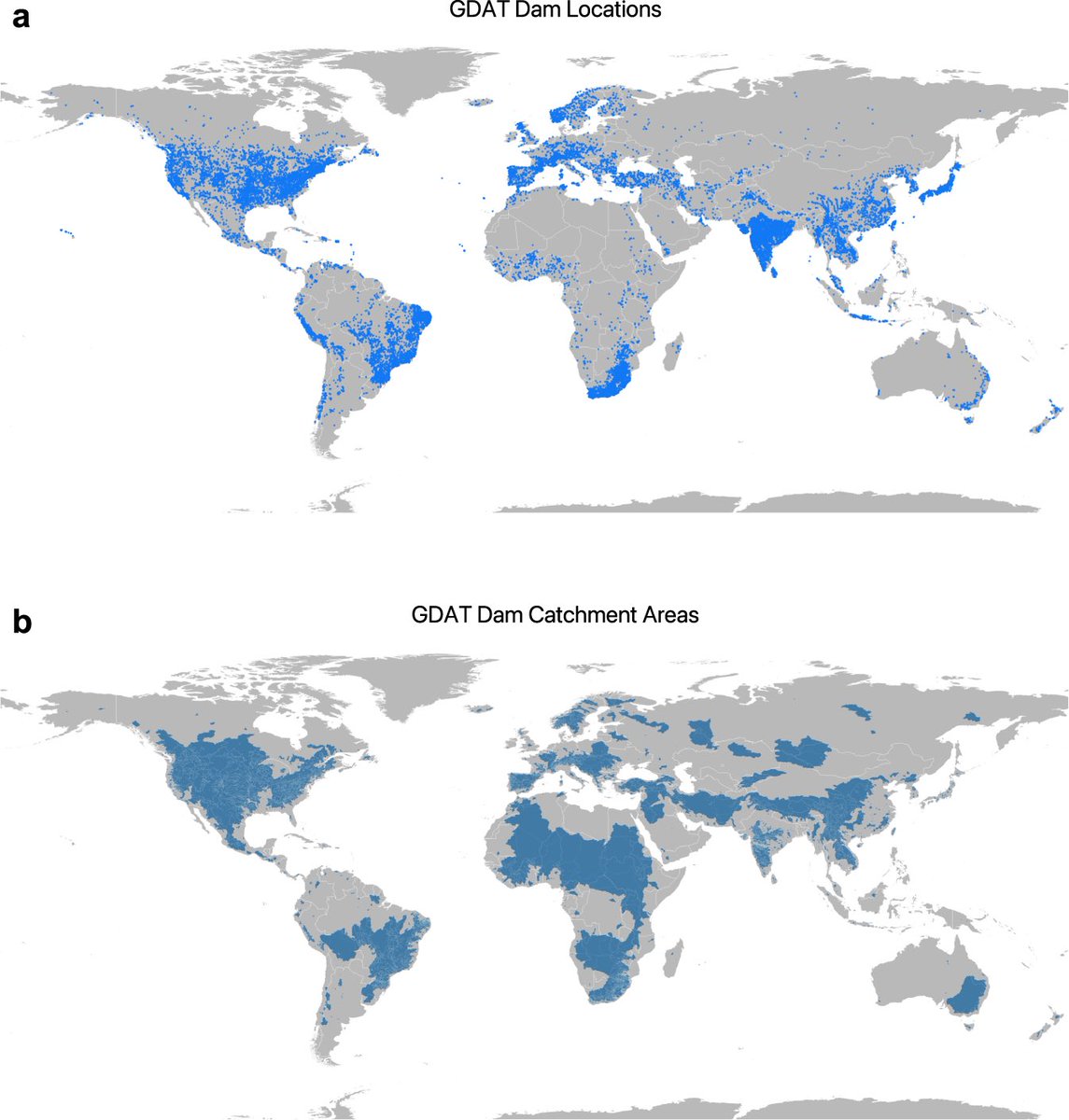
Around the world there are 62,000 dams that are more than 15 meters tall, that’s a big dam.
There was a big surge in dam building in the 1970s and a lot of dam building continues, but in the end global reservoir storage is a sigmoid and has already started to plateau out.
This is because all the best sites are already taken, and there is diminishing returns with further investment and development of new hydropower sites.
Several things globally are like this.
Worldwide all potential oil & gas basins have been drilled and mapped. We have already explored the whole world for new hydrocarbon basins and we know where they are and where they are not. We have already drilled all of the best geological features in every basin. There’s plenty left, but there aren’t that many places where we could find significantly more oil.
All natural resources follow this dynamic.
It has important implications for cost structures too, on the plateau the resource is scare the price is high and supply is limiting. But before the plateau things can generally scale predictably and at low cost.
Thermal power stations, require sites with ample cooling water, that usually means a major river or a coastline, there is only a finite number of such sites. Therefore every nation has a limit on how many GW of thermal power plants it can build.
Every nations potential primary energy stack consists of a number of sigmoid curves that are unique to that territory.
ERCOT is half the size of PJM and has added 2.5x the amout of power generation over the last four years. PJM could take some lessons from ERCOT, as Tyler explains below.
Rising demand is also part of the formula for lowering power costs... (cont.) 1/🧵 #txenergy
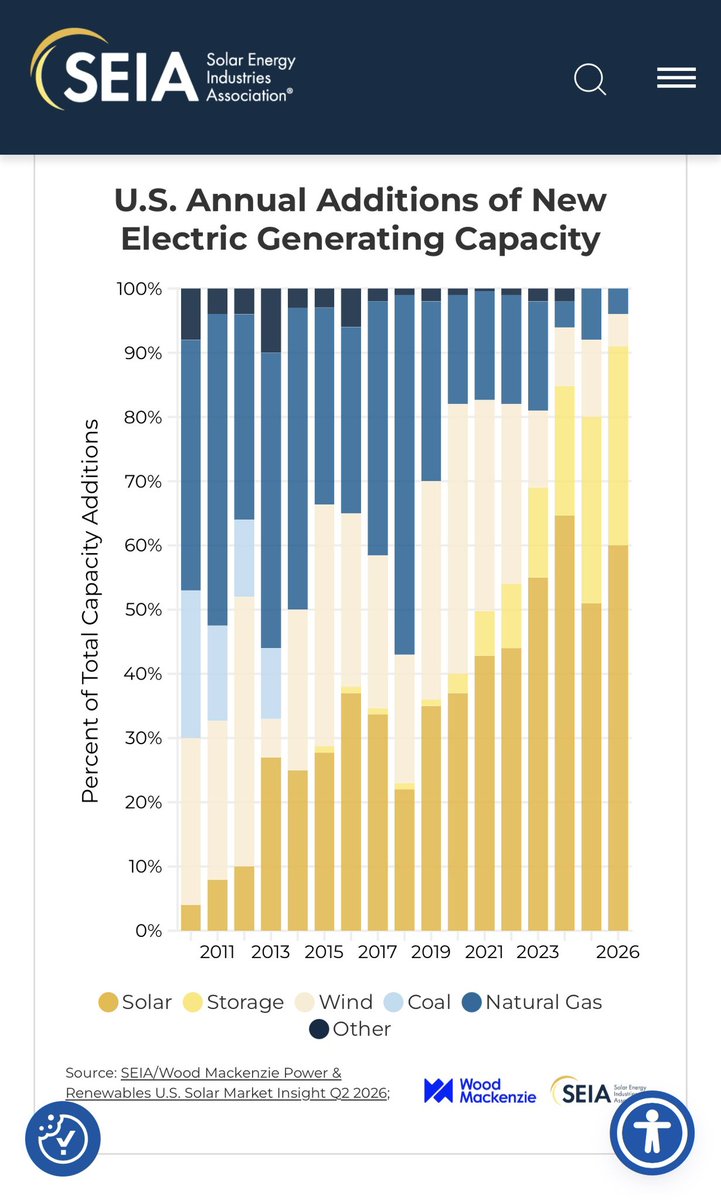
Markets trumping empty political rhetoric: In Q1 2026, US solar and storage made up a record 91% of all new grid capacity additions, the highest share ever
Wires chewing pipelines
BREAKING | The EU is targeting 46% electrification by 2040 according to its new Electrification Action Plan ⚡
"Delivery on this plan is the bare minimum needed to unlock a more competitive future for Europe, powered by homegrown clean energy," says Ember's Chris Rosslowe.
This is concerning. For the first time, a Chinese model Kimi K3 has taken #1 on the Frontend Code Arena and is scoring at or near the frontier on other benchmarks.
Meanwhile America is tying itself in knots: politicians and bureaucrats are banning new data centers, piling on state regulations, and pushing for new federal agencies to pre-approve frontier models.
This is how you lose the AI race. The rest of the world won’t play by our rules if we bog ourselves down. Permissionless innovation is how America won the internet and became the technological envy of the world. We can do it again with AI -- while addressing risks in a targeted way -- or we’ll watch our lead evaporate.
Battery technology has come on faster than anyone – including renewable energy optimists – could have predicted. Twelve years ago, a grid-scale battery cost around $300 per kWh.
Now, batteries cost closer to $60/kWh and we’re starting to approach a real milestone.
With wind, solar, energy efficiency, interconnection, grid upgrade and batteries, the economic case for burning fossil and fissile fuels disappears.
The fact that batteries can ramp up their delivery very quickly also means that they can take over the job currently done by “peaker” gas turbines that kick on when there is sudden high demand for short periods of time.
https://t.co/NFf6ZSyOAy
Solar was the EU's single largest source of electricity in June!
Solar reaches 25% in June!
Wind and solar were 33% of EU's electricity in the first 6 months of 2026, up from 31.5% in 2025.
Solar and wind now are boosted by batteries.
New energy world!
https://t.co/m3X2tM5SmS
China's utility-scale battery fleet has outgrown all other countries combined in 2025 🔋📈
Total battery capacity in China DOUBLED in 2025 with the addition of 189.5 GWh in “new energy storage”.
https://t.co/Mle4oKaOeh
CATL says they will mass-produce sodium-ion batteries this year.
Key advantages of sodium batteries:
- Sodium instead of lithium
- Hard carbon instead of graphite
- Aluminum instead of copper (mostly)
- Better safety
- Better cold performance
These will be particularly important for large-scale energy storage systems where energy density matters less.
BREAKING: Electrification Action Plan dropped.
The EU just committed to doubling electrification: 46% of final energy consumption by 2040, up from 23% today, where it has sat for a decade.
My rapid response analysis of the Electrification Action Plan:
https://t.co/LHFI41ZH0i
China’s Electric Truck Moment Has Arrived — And It’s About To Hit Global Diesel Demand
Heavy trucks are emerging as the next big lever in the shift to electrification of transport
Prof Ray Wills and Prof Peter Newman
https://t.co/YGze2jW1fM @cleantechnica
US Grid Connection Queue
The US transmission system consists of various synchronous grids, totalling 1,330 GW of capacity and producing 690GW of power at the moment.
Further there is 1,312 GW of power generation waiting for a grid connection and 749 GW of dispatchable/chargable power storage waiting for connection.
The queue is shown below with markers for each county. It’s interesting to see the geography of the connection queue, where the queue is crowded and where it is not.
The queue is very clustered around Texas and the Rust Belt, which goes some way to illustrate the is industrial demand, and how US industrial growth is limited by the development of transmission infrastructure.
Tennessee, Kentucky and Luisiana don’t seem to have the same congestion we see elsewhere.
US transmission infrastructure is pretty old, nobody is envious of US transmission, it’s a bottleneck for GDP growth.
The total depreciable value of the US transmission system is $2 trillion, and it currently capture only $60bn of revenue.
That’s 3% ROCE, obviously this isn’t enough to justify expanding / developing the grid and so that forces 2 future scenarios:
i) US transmission infrastructure remains undeveloped and is a major headwind on US industrial growth.
ii) US transmission infrastructure starts to charge higher prices to finance infrastructure expansion and accelerated US industrial growth.
What you are going to get is ii) because we are now at the start of an industrial revolution and there is a demand shockwave that is spreading out from semiconductors that is going to rip through everything over the course of 20 years.
Grid-scale batteries reshape our electricity system.
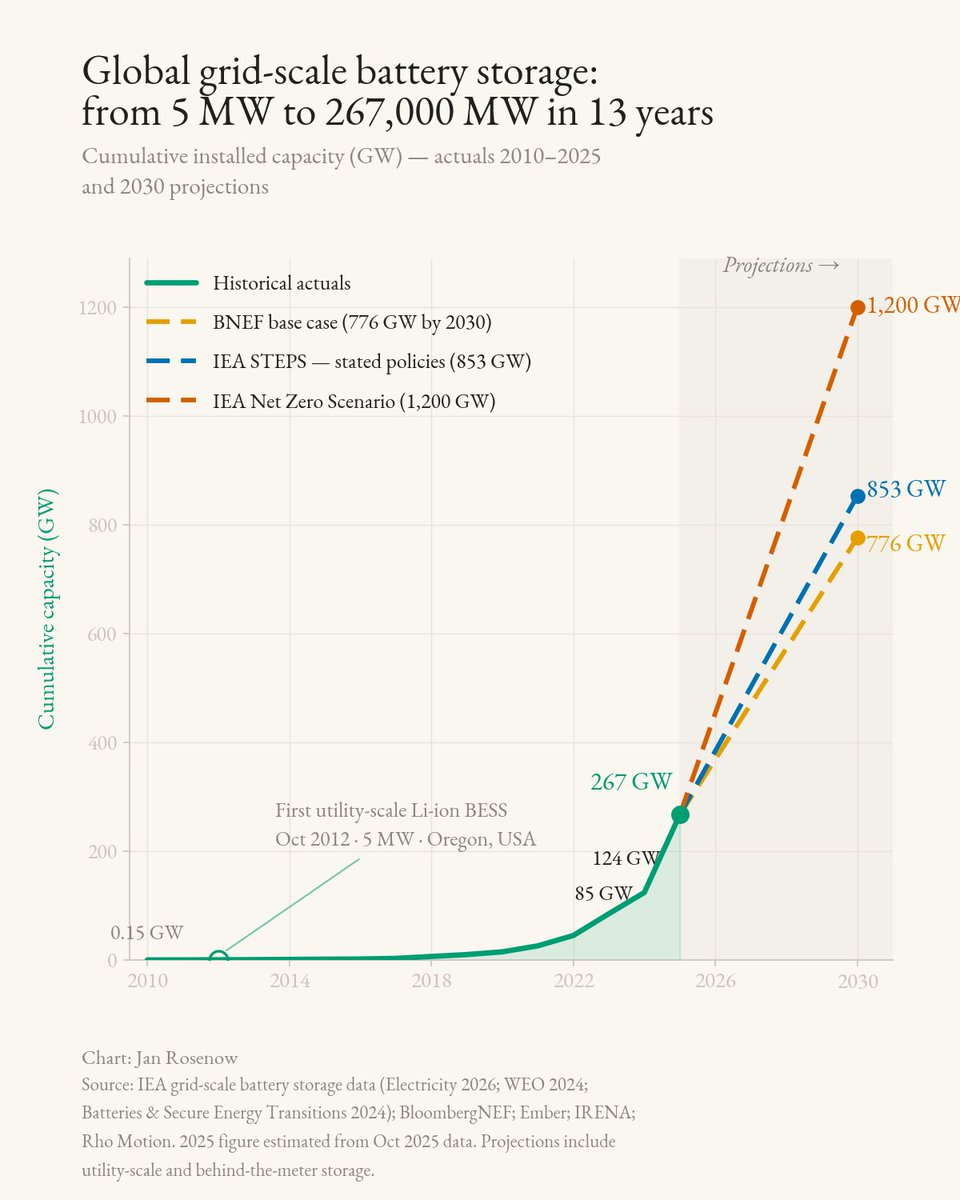
The first grid-scale lithium-ion battery in 2012: 5 MW.
Today: 267 GW globally.
A 53,000-fold increase in 13 years.
And 2025 was the biggest year yet.
More in my next Bright Spots article: https://t.co/In5lBaF2ox
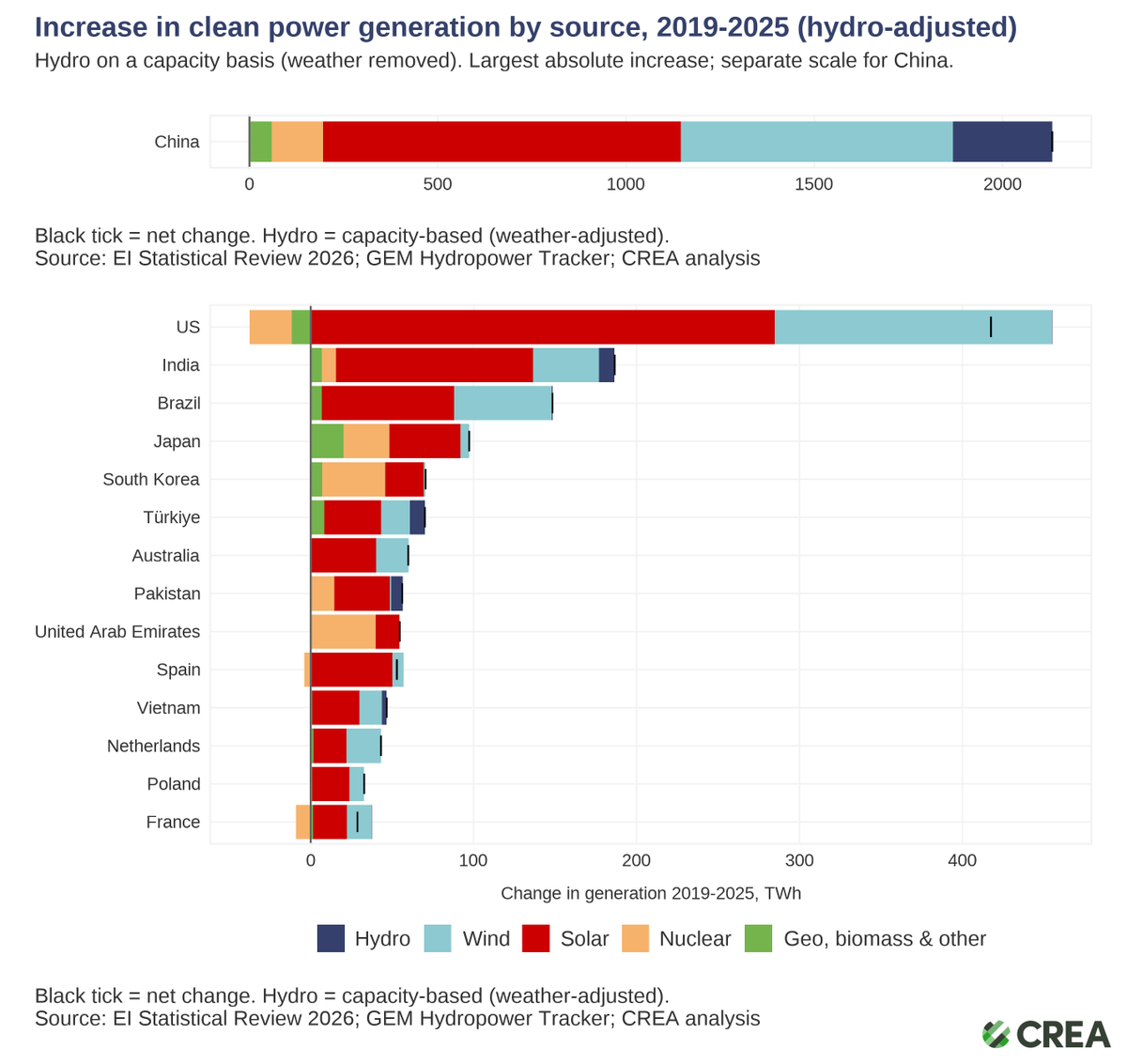
Which countries are actually succeeding in building clean energy? China leads in absolute volumes, no surprises there, but relative to the size of the energy system, five other countries achieved larger increases in the past six years.
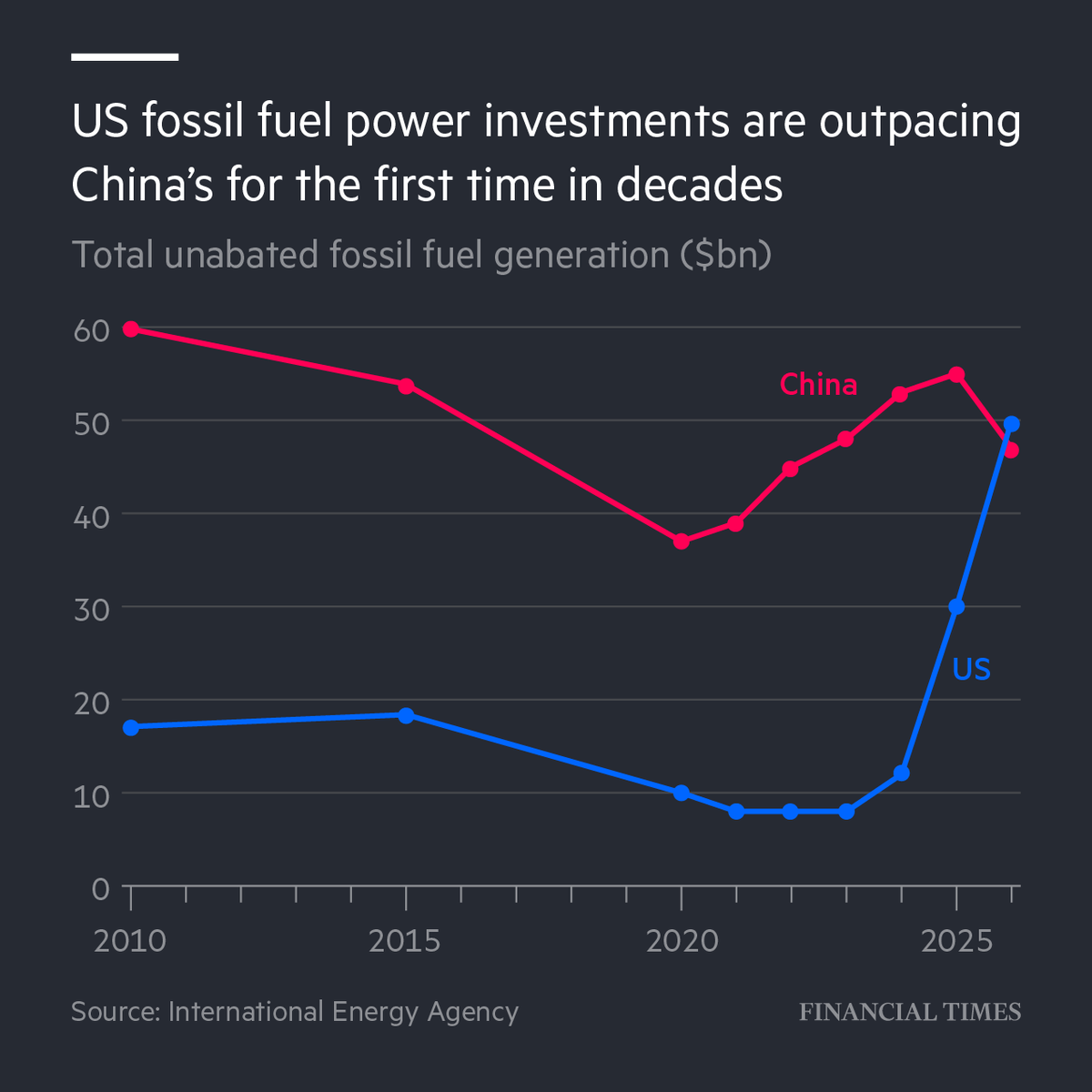
FT Exclusive: The International Energy Agency has forecast US-based spending on power plants fuelled by coal and gas will reach $50bn this year, as companies rush to build out data centres. https://t.co/cd3XQoAPsW
Solar has overtaken gas power in Asia to become the continent’s third-largest source of electricity, according to new analysis by Carbon Brief... #DisruptionofEnergy#RethinkX#SWB
*US APPROVES PLAN FOR AI DATA CENTERS TO CONNECT TO GRID: AP
The assumption is data centers will power themselves; the reality is that will happen in 5-10 years and in the meantime they will be a drain on the grid.
China’s 100% electric high-speed rail network is, at 40,493 km, more than that of the rest of the world combined and saves 1.5M barrels of oil every single day. Wires chewing pipelines.