Great to speak to @Iam_AReporter on making it easier and simpler for investors and issuers in the late-stage VC-backed pre-IPO space. @CoinDesk
Glad to go from just consuming @matt_levine columns on private markets to building something!
Mega-bank @Citi and Swiss digital assets exchange @SDX_global are teaming up to tokenize multibillion dollar pre-IPO shares market. By @IanAllison123
https://t.co/xF6z8KO7zy
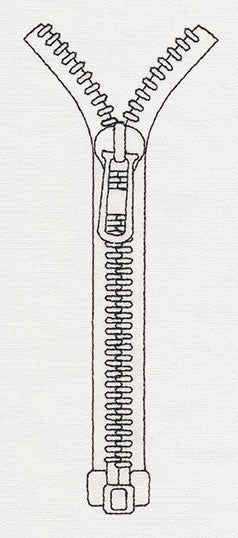
the zipper is one of the most underrated mechanical engineering achievements in history and I think about it more than is probably normal
let's actually look at what it's doing. you have two strips of interlocking teeth, each one a tiny precisely-shaped hook. a slider (which is just a wedge with a very specific internal geometry) runs along them. on the closing side, the wedge forces the teeth together at exactly the right angle so they lock. on the opening side, it drives them apart cleanly. no motor. no electronics. no power source. just geometry doing exactly one job perfectly, every single time, for the entire lifespan of the garment.
that slider is doing something mechanically elegant that most people never think about: it's converting linear motion into a locking and unlocking mechanism across two independent flexible tracks simultaneously. if you tried to explain that as an engineering problem without showing someone a zipper, it would sound extremely hard to solve.
and it essentially never fails. think about how many times you've zipped and unzipped a jacket. thousands of times over years of ownership. the mechanism works. it degrades gracefully when it does wear out - usually it just gets a little stiff, it doesn't catastrophically break. for a mechanism that costs almost nothing to manufacture and gets used daily, the reliability is almost unreasonable.
but here's the part that actually gets me: the zipper was invented in 1851. it didn't reach mass adoption until the 1930s. that's 80 years of a working, functional, elegant mechanism just sitting there waiting for the world to figure out what to do with it.
it wasn't a technology problem. the zipper worked. it was a use case problem. nobody could figure out where it fit. early versions were marketed for boots and tobacco pouches. the fashion industry wanted nothing to do with it. it was considered a novelty.
then B.F. Goodrich put it on a rubber boot and called it a zipper (named after the sound it makes) and suddenly people got it. then it went on flight suits. then trousers. then everything.
80 years. not because the engineering was wrong. because the context hadn't caught up yet.
there's a version of this story that applies to almost every transformative tool. the technology exists. it works. it's elegant. and it just sits there, waiting for someone to find the use case that makes it obvious. the zipper just happens to be the most literal example of that gap between invention and adoption that we interact with every single day, usually without thinking about it at all.
OpenAI has just chosen London as its largest research hub outside US!
The UK has always been home to amazing technical AI talent (in a large part thanks to Demis Hassabis and DeepMind) and now OpenAI is doubling down here.
It currently has 30 researchers, but according to The Times, will be "significantly increasing the size of the site".
The company referred to London's “unique concentration of world-class talent across machine learning and the sciences as well as its strong culture of cross-disciplinary collaboration” as to why it's expanding here.
And it is NOT WRONG
This is amazing validation of the strength of the UK tech ecosystem.
(article is linked below. It is a TRAVESTY they didn't ask OpenAI's @LauraModiano for a comment who has become one of the leading figures in European Tech - anything to add Laura?)
@lennysan@stewart What a gem, hearing @stewart share his wisdom and takes on product design and user behaviour…
His intellectual honestly, generosity, and relentless prioritisation shines through
@wtylerchristie@paulbz It’s painful, but having been through it twice, I’d argue it also gets them to a good level of automaticity with core concepts, especially in maths, which would be critical to help scaffold for more advanced learning in secondary schools.
@leif@tobi Interestingly, it doesn’t make all relationships “dysfunctional”, only the ones where something is “off-truth” to start with.
Strongly reinforces relationships with vectors aligned to the true north.
The UK is a great country with an extraordinary history. Our stagnation is real, but it's fixable and worth fixing.
Enjoyed giving this talk at @lfg_uk last week and so encouraged by the optimistic responses I've had from people who are building a brilliant future for Britain 🚀
A message from a Kindergarten teacher:
After forty years in the classroom, my career ended with one small sentence from a six-year-old:
“My dad says people like you don’t matter anymore.”
No sneer. No malice. Just quiet honesty — the kind that cuts deeper because it’s innocent. He blinked, then added, “You don’t even have a TikTok.”
My name is Mrs. Clara Holt, and for four decades, I taught kindergarten in a small Denver suburb. Today, I stacked the last box on my desk and locked the door behind me.
When I started teaching in the early 1980s, it felt like a promise — a shared belief that what we did mattered. We weren’t rich, but we were valued. Parents brought warm cookies to parent nights. Kids gave you handmade cards with hearts that didn’t quite line up. Watching a child sound out their first sentence felt like magic.
But that world slowly slipped away. The job I once knew has been replaced by exhaustion, red tape, and a kind of loneliness I can’t quite describe.
My evenings used to be filled with construction paper, glitter, and glue sticks. Now they’re spent filling out digital reports to protect myself from angry emails or lawsuits. I’ve been yelled at by parents in front of twenty-five children — one filming me with his phone while I tried to calm another child mid-meltdown.
And the kids… they’ve changed too. Not by choice.
They arrive tired, anxious, overstimulated. Their tiny fingers know how to swipe a screen before they can hold a crayon. Some can’t make eye contact or wait in line. We’re expected to fix all of it — to patch the gaps, heal the trauma, teach the curriculum, and document every move — in six hours a day, with resources that barely fill a drawer.
The little reading corner I once built, full of soft beanbags and paper stars, was replaced by data charts and “learning metrics.” A young principal once told me, “Clara, maybe you’re too nurturing. The district wants measurable results.”
As if kindness were a weakness.
Still, I stayed. Because of the small, holy moments that no spreadsheet could measure —
a whisper of, “You remind me of my grandma.”
a shaky note that read, “I feel safe here.”
a quiet boy finally meeting my eyes and saying, “I read the whole page.”
Those tiny sparks were my reason to keep showing up.
But this last year broke something in me.
The aggression grew sharper. The laughter in the staff room turned to silence. The light went out of so many eyes. I watched brilliant teachers — my friends — vanish under the weight of burnout, their joy replaced by survival.
I felt myself fading too, like chalk on a board that’s been wiped one too many times.
So today, I began my goodbye. I pulled faded art off the walls and tucked thirty years of handmade cards into a single box. In the back of a drawer, I found a letter from a student from 1998:
“Thank you for loving me when I was hard to love.”
I sat on the floor and cried.
No party. No applause. Just a handshake from a young principal who called me “Ma’am” while checking his notifications.
I left my rocking chair behind, and my sticker box too. What I carried with me were the memories — the faces of hundreds of children who once trusted me enough to reach out their hands and learn. That can’t be uploaded. It can’t be measured. It can’t be replaced.
I miss when teachers were partners, not targets. When parents and educators worked side by side, not in opposition. When schools cared more about wonder than numbers.
So if you know a teacher — any teacher — thank them. Not with a mug or a gift card, but with your words. With your respect. With your understanding that behind every test score is a heart that cared enough to try.
Because in a world that often overlooks them, teachers are the ones who never forget our children.
Pro tip: you can point Deep Research at The Math Academy Way by @justinskycak to generate a learning system for nearly any skill domain.
I'm using mine to learn traditional art (I'm following it and actual results shown)--put the time in and do the reps!
True, that’s the norm. But even in big organizations, it’s harder to build something targeting big customers than it is targeting early adopters. But going after early adopters leads to other challenges. Notably, big organizations aren’t setup to serve small nimble players well, by design.
Yup. Assignments should be like “use AI to do ___ complex project” and then have an oral component where the student explains each step of the process they used and their thought process behind it. Schools should prepare kids to accomplish things with the tools of their world.
Great to speak to @Iam_AReporter on making it easier and simpler for investors and issuers in the late-stage VC-backed pre-IPO space. @CoinDesk
Glad to go from just consuming @matt_levine columns on private markets to building something!
Mega-bank @Citi and Swiss digital assets exchange @SDX_global are teaming up to tokenize multibillion dollar pre-IPO shares market. By @IanAllison123
https://t.co/xF6z8KO7zy
What the salad tried to do to us.
The first ambition of any plant is to make itself uneatable. Long before anything clever walked on earth, plants settled on poisoning anything with a mouth. If you can’t run, you better taste terrible. The only way to stay alive was to face your predator (dinosaur, beetle, goat, man) with chemistry. Plants got clever in the only way available to them. They made toxins, astringents, enzymes, fibrous defences. Which made them and their parts bitter. Also indigestible, and outright poisonous.
In evolutionary terms, it was a cunning move. Not that the plant knows anything about cunning. But the natural consequence was deterrence. You bite, you suffer. You learn. You stop biting.
Humans responded in the human way. By using fire and other things. We boiled, we burned, we soaked, we crushed, we fermented. We pickled. We found ways to take the bitter poisonous offerings of plants to our hungers. We hacked our own biochem, made over 50 types of CYP450 enzymes. They’re fascinating. A plant toxin molecule (alkaloid, glucosinolate, cyanogenic glycoside, saponin etc) is like a greasy stain. CYP450s act like detergent: They grab it, break it apart, make it dissolve in water, and wash it away. Cats don’t have a lot of this stuff. The thiosulfates in a couple of cloves of garlic can trigger a dangerous oxidative crisis in cat blood. About four cloves (of garlic) can be a potentially lethal dose. A tiny amount of solanine from a raw potato can sicken and kill a rabbit. Without a particular kind of P450, a potato would be your last meal.
We figured out how to eat the enemy. And then we got kinky about it. Our tongues learned to relish the sting. And the rot. We started liking the burn and the bitterness. We started having poison for the plot. Hot sauce. Tannins. Coffee so strong it peels paint. Flavour is a toxin we’ve come to applaud.
Plants spent a hundred million years trying to kill us. We’ve spent a hundred million years learning to savour their attempts. That’s the story, give or take a few famines and a few million deaths.
@justinskycak@yevgenydevine Useful for me as I’m consciously working my child to structure “deliberate practice” sessions for her outside of school. Thanks for taking the time to write it out.
New randomized, controlled trial of students using GPT-4 as a tutor in Nigeria. 6 weeks of after-school AI tutoring = 2 years of typical learning gains, outperforming 80% of other educational interventions.
And it helped all students, especially girls who were initially behind