#HMPV is a respiratory virus causing cold and flu-like symptoms, especially in young children and older adults. HMPV is not a new virus, it has already been in circulation globally since 2001
@DHFWKA in coordination with @MoHFW_India, is closely monitoring the situation.
1/2
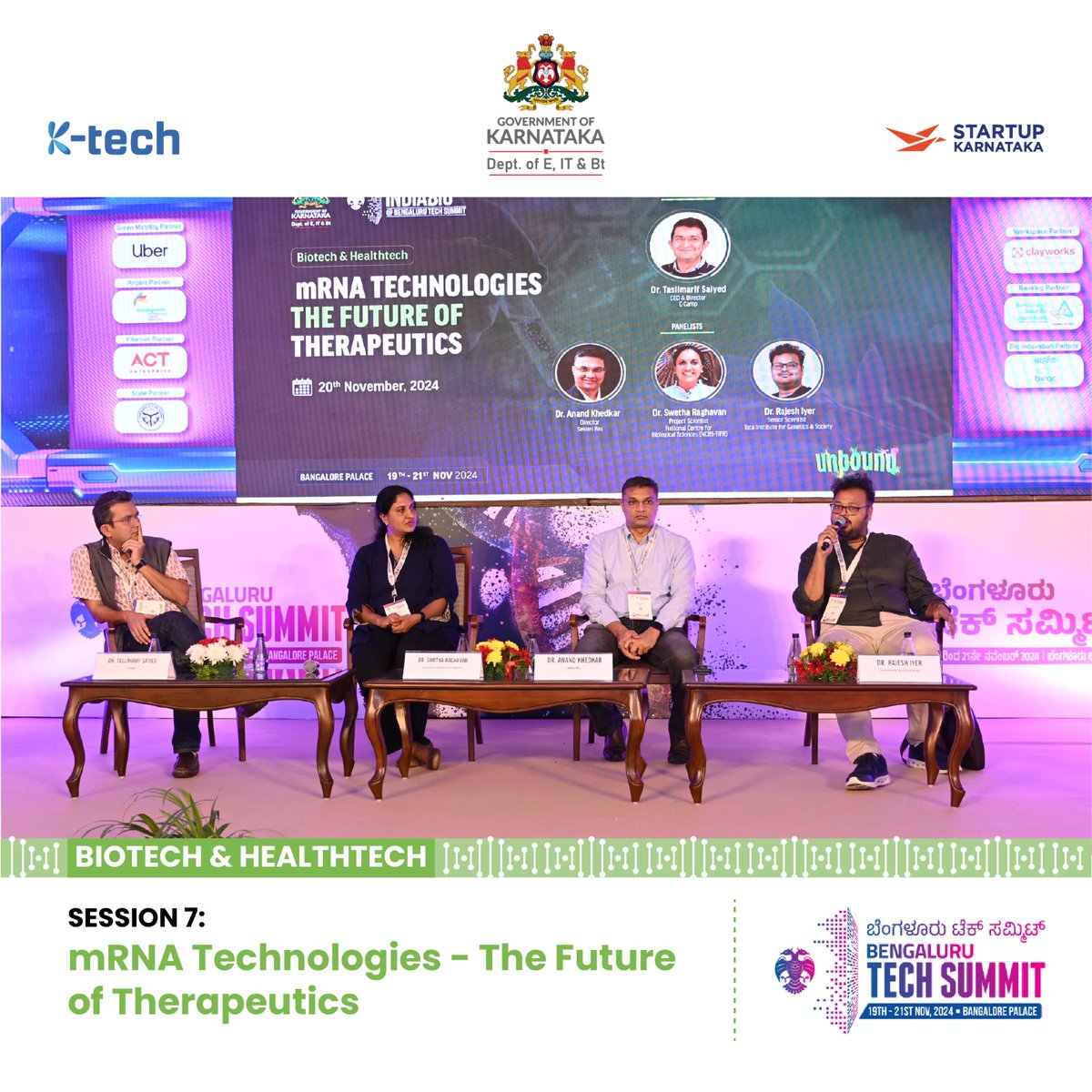
"mRNA Technologies – The Future of Therapeutics" explored the groundbreaking advancements in mRNA technology and its potential to revolutionize medicine.1/3
Our public event from Nov 2023, in collaboration with @bicblr on "Demystifying Vaccines: Evolution of mRNA based platform in vaccines and therapeutics", is now available online.
Click here to watch https://t.co/qA0FqxU4Ql
@CCAMP_Bangalore @TIGS_India
#DidYouKnow
Here is our new series presenting some of the interesting tidbits of information from our #labs and #campus.
The first one is on #GFP. Check the pictures to know more on what it is that makes the cells glow green.
#science
As part of our International Grants Awareness Program (#iGAP), we bring to you curated resources of International #funding opportunities for the Indian life science community.
Do follow this thread for #funding schemes with open calls 🧵 👇
Wondering what's all the buzz surrounding mRNA vaccines?
Come find out, at this exciting event at @bicblr tomorrow.
Time: 4-6.30 pm
Venue: Bangalore International Centre, Domlur.
All are welcome.
Dengue has arrived in the city .
Please remember :
1) The NS1 antigen test becomes positive after 24 hrs from first episode of fever .
2)Please avoid NSAIDS like Brufen/Combiflam/Sumo/Nimulid/Voveran to reduce fever .
3)Usually only treatment needed is Paracetamol and fluids.
The Teetotaler's Alcohol Problem.
What do men who never drank but with detectable alcohol in their livers, a bunch of mice, a terrifying bacteria and a bacteria-killing human friendly virus have in common?
Stay with me, to know about the futuristic hunt for a new type of warfare against non-alcoholic fatty liver disease.
Almost a year back, scientists at Amsterdam University Medical Centers looked at a group of people who never drank, but had fatty liver disease.
For fatty liver disease to develop, alcohol use is a common reason. But these people had non-alcoholic fatty livers because they never drank.
They did something interesting.
They took fasting blood samples from a vein the arm and samples from the portal vein, the largest vessel supplying blood to the liver.
In those with non-alcoholic fatty liver, the arm samples did not show alcohol content, but the portal vein blood did.
In individuals with non-alcoholic fatty liver disease, the alcohol (ethanol) concentrations were 187 times lower in peripheral (arm samples) as compared to portal vein (inside liver) blood.
When they looked at patients with non-alcoholic fatty liver who had disease progression, the alcohol content in the portal vein increased so much more.
The scientists were stumped. The patients were not drinking alcohol, but alcohol in the liver was found to cause fatty liver and further, progression of fatty liver.
Were they lying?
No they were not.
The patients were truthful, because alcohol was not detected within the main blood system. It was only inside the vein supplying the liver.
The liver was getting hit from "a ghost source" of alcohol and like the defender that it was meant to be, it was destroying all that alcohol that was coming into it, so that excess alcohol never made it to the main system, which is why arm blood samples did not have detectable alcohol. And in the process, the liver was developing fatty deposits.
Then they thought of and did something very cool. The liver was strategically placed near the intestines for it to "detox" the body from harmful byproducts of digestion/metabolism. And one of the toxins formed from metabolism - was alcohol.
They ran studies on intestinal tissue to see why the liver was getting hit by alcohol which they never drank - and found something surprising.
A group of bacteria in the intestines were producing alcohol from within, to which the liver was getting exposed to and in the process, developing fatty liver.
And this group of bacteria were more in those with metabolic diseases - obese/overweight, diabetes, high blood pressure and high lipids even when they did not drink alcohol and were absent in a group of people without metabolic disease.
But to their dismay, the team could not identify specific bacterial strains that produced high levels of alcohol - they could only find a correlation between a family of bacteria called Lactobacillacea (lactic acid bacteria)
But a specific high-alcohol-producing bacteria was already identified among Chinese non-alcohol drinkers with fatty liver previously - a terrible and sinister fellow by the name Klebsiella pneumonia
When a specific strain of the bacteria Klebsiella pneumonia (HiAlc Kpn) was transplanted into the intestines of germ-free mice (sterile mice) - the rodents developed severe fatty liver in the absence of alcohol feeding.
But there was something more disastrous. When mice were fed pure sugar (glucose) or high fat diet - when specific strain of Klebsiella was present, alcohol formation increased so much that it was detectable even in the blood as well as liver. The rodents were getting 'drunk' on sugar and fat without the need for alcohol.
In June 2023, just a month ago, a group of Chinese researchers did something incredible. They injected a bacteriophage - a type of large virus that eats bacteria - with special appetite for Klebsiella pneumonia into mice with severe fatty liver and found that as the big virus rammed through and ate up the dirty alcohol-producing bacteria, the fatty livers improved!
Crazy right?!
This brings forth a future of medical therapy called "Phage Therapy" where we use human friendly large viruses that can kill bad bacteria that harm us without our knowledge. Maybe a future treatment for severe non-alcoholic fatty liver disease is to use a special type of virus that can help us.
Remember their name - Bacteriophages.
Sources:
1] Identifying the fact that bacteria in intestine produces alcohol in non-drinkers with metabolic syndrome: https://t.co/EJjfRT4PqC
2] Identifying the bacteria that produces high-volume alcohol in the intestines: https://t.co/XCVHRwHvgu
3] Using bacteriophage to kill bad bacteria in severe fatty liver disease: https://t.co/4jKPPRDbsk
Stressed plants make audible sounds that can be heard many feet away, and the type of sound corresponds with the kind of bad day they are having. https://t.co/47yK0fFMx5
Young women who received at least one dose of AstraZeneca’s Covid vaccine might have been more likely to die of a heart problem in the 12 weeks after their vaccination. https://t.co/1wiw9wi02u
52/52 I hope you've found this thread helpful.
Follow me @theliverdoc for more such educational real-life patient stories on liver health and disease diagnosis and management.
If you enjoy my tweets, please share with others.
Please Like/Retweet the first tweet below to share!
Okil looked at his rear view mirror. His passenger tucked an errant lock of hair behind her ear. That gesture always melted his heart. She was immersed in her work. Correcting a notebook. Like everyday. A cyclist swerved in front of his auto. Okil swore at him. +







![theliverdoc's tweet photo. The Teetotaler's Alcohol Problem.
What do men who never drank but with detectable alcohol in their livers, a bunch of mice, a terrifying bacteria and a bacteria-killing human friendly virus have in common?
Stay with me, to know about the futuristic hunt for a new type of warfare against non-alcoholic fatty liver disease.
Almost a year back, scientists at Amsterdam University Medical Centers looked at a group of people who never drank, but had fatty liver disease.
For fatty liver disease to develop, alcohol use is a common reason. But these people had non-alcoholic fatty livers because they never drank.
They did something interesting.
They took fasting blood samples from a vein the arm and samples from the portal vein, the largest vessel supplying blood to the liver.
In those with non-alcoholic fatty liver, the arm samples did not show alcohol content, but the portal vein blood did.
In individuals with non-alcoholic fatty liver disease, the alcohol (ethanol) concentrations were 187 times lower in peripheral (arm samples) as compared to portal vein (inside liver) blood.
When they looked at patients with non-alcoholic fatty liver who had disease progression, the alcohol content in the portal vein increased so much more.
The scientists were stumped. The patients were not drinking alcohol, but alcohol in the liver was found to cause fatty liver and further, progression of fatty liver.
Were they lying?
No they were not.
The patients were truthful, because alcohol was not detected within the main blood system. It was only inside the vein supplying the liver.
The liver was getting hit from "a ghost source" of alcohol and like the defender that it was meant to be, it was destroying all that alcohol that was coming into it, so that excess alcohol never made it to the main system, which is why arm blood samples did not have detectable alcohol. And in the process, the liver was developing fatty deposits.
Then they thought of and did something very cool. The liver was strategically placed near the intestines for it to "detox" the body from harmful byproducts of digestion/metabolism. And one of the toxins formed from metabolism - was alcohol.
They ran studies on intestinal tissue to see why the liver was getting hit by alcohol which they never drank - and found something surprising.
A group of bacteria in the intestines were producing alcohol from within, to which the liver was getting exposed to and in the process, developing fatty liver.
And this group of bacteria were more in those with metabolic diseases - obese/overweight, diabetes, high blood pressure and high lipids even when they did not drink alcohol and were absent in a group of people without metabolic disease.
But to their dismay, the team could not identify specific bacterial strains that produced high levels of alcohol - they could only find a correlation between a family of bacteria called Lactobacillacea (lactic acid bacteria)
But a specific high-alcohol-producing bacteria was already identified among Chinese non-alcohol drinkers with fatty liver previously - a terrible and sinister fellow by the name Klebsiella pneumonia
When a specific strain of the bacteria Klebsiella pneumonia (HiAlc Kpn) was transplanted into the intestines of germ-free mice (sterile mice) - the rodents developed severe fatty liver in the absence of alcohol feeding.
But there was something more disastrous. When mice were fed pure sugar (glucose) or high fat diet - when specific strain of Klebsiella was present, alcohol formation increased so much that it was detectable even in the blood as well as liver. The rodents were getting 'drunk' on sugar and fat without the need for alcohol.
In June 2023, just a month ago, a group of Chinese researchers did something incredible. They injected a bacteriophage - a type of large virus that eats bacteria - with special appetite for Klebsiella pneumonia into mice with severe fatty liver and found that as the big virus rammed through and ate up the dirty alcohol-producing bacteria, the fatty livers improved!
Crazy right?!
This brings forth a future of medical therapy called "Phage Therapy" where we use human friendly large viruses that can kill bad bacteria that harm us without our knowledge. Maybe a future treatment for severe non-alcoholic fatty liver disease is to use a special type of virus that can help us.
Remember their name - Bacteriophages.
Sources:
1] Identifying the fact that bacteria in intestine produces alcohol in non-drinkers with metabolic syndrome: https://t.co/EJjfRT4PqC
2] Identifying the bacteria that produces high-volume alcohol in the intestines: https://t.co/XCVHRwHvgu
3] Using bacteriophage to kill bad bacteria in severe fatty liver disease: https://t.co/4jKPPRDbsk](https://pbs.twimg.com/media/F0mC5pyaQAIsGDR.jpg)