A progressive Bengali social and climate justice campaigner. President European Action Group on Climate Change. Trustee Soyten Sen School of Performing Arts UK
My recent article in Humanisten explores Lalon's human-centered vision. At a time when singers of his songs in Bangladesh facing threats from Islamic extremists, revisiting Lalon’s philosophy feels more urgent than ever. https://t.co/YJCo3HmLcj
The decision today by the International Crimes Tribunal (ICT) to issue production warrants against the Ekattor host Farzana Rupa, the Ekattor TV managing director Mozammel Babu and the Awami League politician Dipu Moni - in relation to their alleged involvement in crimes against humanity arising from the Hefazat-e-Islami deaths of May 2013, known as the Shapla Chattar case - is very troubling indeed. So too is its earlier warrant against the activist Shahriar Kabir.
Before explaining why, it is important to note that it is entirely legitimate for the ICT to consider the May 2013 killings as a possible crime against humanity; the deaths can quite plausibly be characterised as forming part of a "systematic attack against a civilian population". That said, prosecutors face a significant evidential challenge: to succeed, they must establish that the killings were carried out pursuant to a pre-existing policy or plan on the part of the government. That may be difficult to prove — and indeed may not reflect what actually occurred
The deeper concern, however, lies elsewhere. The statements made by Prosecutor Gazi MH Tamim in court on Thursday, and by Chief Prosecutor Aminul Islam to the media, suggest that the ICT is proceeding on two legal theories that are without foundation in international criminal law:
(a) that ordinary journalistic practice - broadcasting speeches and critically analysing, or indeed condemning their content - can amount to aiding and abetting a crime against humanity; and
(b) that efforts made after the killings to minimise or deny their scale can amount to criminal involvement in a crime against humanity.
On point (a):
According to The Business Standard, Prosecutor Tamim claimed that journalists Farzana Rupa and Mozammel Babu had, "from the very beginning," broadcast the Hefazat-e-Islam rally through Ekattor Television as "provocative speeches."
There is nothing remotely criminal in that. Hefazat-e-Islami holds views well outside the mainstream in Bangladesh. Several of their thirteen demands - including prohibiting the mixing of men and women and imposing the death penalty for blasphemy - were, and remain, widely regarded as extreme. It was lawful for journalists and broadcasters to report on and critically scrutinise those demands (even if it was done in a biased or prejudiced manner deserving criticism from a TV ethics perspective.)
Critically, there is no evidence that anything broadcast on ETV during the rally incited or called upon the government to use lethal force against those present.
On point (b):
According to the Business Standard, Prosecutor Tamim told the tribunal that Dipu Moni, who served as Foreign Minister at the time of the Shapla Chattar killings on 5 May 2013, had "internationally portrayed" the events as law enforcement agencies having "eliminated a group of unruly people." Chief Prosecutor Aminul Islam separately alleged to journalists that Babu and Rupa had attempted to conceal the true scale of the killings, sought to divert public attention from them, and had broadcast a programme - hosted by Rupa - that spread misleading information creating the impression that no casualties had occurred at Shapla Chattar. Islam further alleged that the programme featured statements from "controversial individuals" and was designed to steer public perception away from the actual events.
The legal difficulty with all of this is straightforward: every act attributed to Moni, Babu, and Rupa took place after the killings, not before or during them. There is no established case in the entire history of international criminal law - not at the ICC, the ICTY, the ICTR, or any equivalent tribunal - in which a person has been prosecuted for crimes against humanity on the basis of having denied or minimised an atrocity after the fact. The law does not permit it. However morally indefensible it may be, denial of a crime against humanity is not, in itself, a crime against humanity.
In issuing warrants against Moni, Babu, and Rupa on this basis - where there is no evidence connecting them to the actual commission of the underlying offences - the ICT is, arguably, not applying international criminal law. Rather, it seems to be departing from it.
এই ছবিতে যে নারী সাংবাদিককে টকশো হোস্ট হিসেবে দেখা যাচ্ছে, তিনি এমন এক ম্যানিপুলেটিভ কৌশলের মাধ্যমে একটি নির্দিষ্ট ন্যারেটিভ প্রতিষ্ঠা করতে উঠেপড়ে লেগেছেন, যার মূল লক্ষ্য হলো—বঙ্গবন্ধু শেখ মুজিবুর রহমান বাংলাদেশের স্বাধীনতা চাননি বা ঘোষণা করেননি। বাংলাদেশের স্বাধীনতাতে বঙ্গবন্ধু শেখ মুজিবের বিন্দুমাত্র অবদান নাই এই বিষয়টা সে প্রমাণ করার জন্য টকশো নাযিল করেছে।
এই ডিলিউশানাল হোস্ট কাজী জেসিনের বুদ্ধির দুর্বলতা এবং তার ইতিহাসের সোর্স দেখলে একেবারে পার্সোনাল কমপ্লেক্স বলে মনে হয়। তার ইতিহাসের একমাত্র “সোর্স” হলো শারমিন আহমদের সেই বিতর্কিত বই, যা ফ্যাক্ট-লেস এবং মূলত কেবল ‘বেডরুম কনভারসেশন’ বা ব্যক্তিগত অনুমানের ওপর দাঁড়িয়ে।
তাজউদ্দীন আহমদের মতো পলিটিক্যাল লিজেন্ড পরিবারের সদস্য হয়েও শারমিন আহমদ যে বিভ্রান্তি ছড়িয়েছেন, সেটাকেই আজ এই তথাকথিত সাংবাদিক কানেক্টিং দ্য ডটস হিসেবে প্রচার করছে। ইতিহাসের শিক্ষক বাটপার ডিপ স্টেট এজেন্ট সলিমুল্লাহ খানের মতো চালাক শব্দবাজ, ধূর্ত এবং তাদের মতো তাত্ত্বিকরা, যারা আজীবন বঙ্গবন্ধু বিরোধিতা করেই নিজেদের অস্তিত্ব টিকিয়ে রেখেছে—তারাই তার ইতিহাসের সত্যতার একমাত্র সোর্স।
এছাড়া, বদরুদ্দীন ওমর নামক আরেক বিতর্কিত বাটপার ব্যক্তির কথা উল্লেখ না করলেই নয়, যিনি মুক্তিযুদ্ধের ইতিহাসকে বিকৃত করার জন্য বরাবরই পরিচিত। মুক্তিযুদ্ধের সময় তার স্বাধীনতা যুদ্ধের ঝাঁপিয়ে পড়ার উপযুক্ত বয়স ছিল সেটা সে করে নাই কিন্তু সেই ১৯৬৫ সাল থেকে সে মুজিবের বিরোধিতা করে আসছে। ওই বাটপার বদরউদ্দিন ওমর হচ্ছে এই মহিলার প্রিয় ব্যক্তি।
তার পৃষ্ঠপোষকতা এবং এই সমস্ত বাটপার তাত্ত্বিকদের সহায়তায় ইতিহাসকে নতুন করে সাজানোর চেষ্টা করা হচ্ছে।
আমার প্রশ্ন খুব সোজা:
১. যদি শেখ মুজিব পাকিস্তানের অখণ্ডতাই চাইতেন, তবে আপনাদের এত এনিমোসি কেন? যে ব্যক্তি পাকিস্তান ভাঙতে চায়নি, তাকে কেন ইয়াহিয়া-ভুট্টো রাষ্ট্রদ্রোহী মামলায় কাস্টডি দিয়ে ফাঁসির মঞ্চে পাঠিয়েছিল? কেন তাকে বারবার পাকিস্থান ভাঙ্গার ষড়যন্ত্রে বারবার মামলা দিয়ে গ্রেফতার করা হয়েছে, তার ৫০ বছরের জীবনে ১৬ বছর থাকে বারবার জেলে আটক করা হয়েছে? সে যদি পাকিস্তানকে ভালবাসবে পাকিস্তান এক থাকুক এটাই চেয়ে থাকে তাহলে পাকিস্তান তাকে কেন শত্রু ভাববে?
কোনো কনসিসটেন্সি থাকে কি এখানে? একজন মেজরের ঘোষণায় পাকিস্তান ভাঙতে বিশ্বাস করা কি হায়পারবোলিক নয়? একজন মেজরের পূর্ব পাকিস্তানের স্বাধীনতার ঘোষণায় পাকিস্তানের কোন বা/ লটা ছিড়া যেত? এই বাটপার মহিলাকে কেউ বুঝাও যে স্বাধীনতার ঘোষণা রাতারাতি হয় না।
২. ১৯৭১ সালের ২৭শে মার্চ, যখন আমেরিকা, ব্রিটেন, জার্মানি ও ফ্রান্সের বড় বড় সংবাদ সংস্থাগুলো শিরোনাম করল—“Leader of East Pakistan, Sheikh Mujib, has declared independence”—তারা কি ফ্যাক্ট-ফ্রি ছিল? এমনকি খোদ পাকিস্তানের সকল নিউজ পেপার টেলিভিশন সেই সময়ের সবাই নিউজ করেছে পূর্ব পাকিস্তানের নেতা শেখ মুজিব স্বাধীনতার ঘোষণা দিয়েছে এবং তাকে গ্রেফতার করা হয়েছে। কিন্তু এই বাটপার প্রমান করার চেষ্টা করতেছে না দেয়নি দেয়নি।
আরে গাধী একজন পার্লামেন্ট লিডারের ঘোষণার ইন্টারন্যাশনাল রেকগনিশন ছাড়া কারো আন্তর্জাতিক গ্রহণযোগ্যতা পাওয়া প্রায় অসম্ভব ছিল।
৩. ৭০-এর নির্বাচনের পরপরই শেখ মুজিব কেন চিত্তরঞ্জন সুতারকে কলকাতার সানি ভিলায় মুক্তিযোদ্ধাদের জন্য শেল্টার হোম বানানোর নির্দেশ দিয়েছিলেন? কেন পাকিস্তানের Hamoodur Rahman Commission Report সরাসরি শেখ মুজিবকে পাকিস্তান ভাঙার প্রধান কারিগর হিসেবে চিহ্নিত করেছিল? তারা কেন দাবি করেছিল মুজিব ভারতের সাথে যোগাযোগ রাখছিলেন পাকিস্তান ভাঙার জন্য? ডিপ্লোম্যাটিক ফাইলস এসব কি আপনি সলিমুল্লাহদের থেকে কখনো পড়েছেন? নাকি আপনার মন্থরা শারমিন এই তথ্য দিতে পারে নাই কারণ তার জ্ঞানের চর্চা কতটুকু সেটাও তো বোঝা যাচ্ছে।
তাজউদ্দীন ও জোহরা তাজউদ্দীনের ব্যক্তিগত মুহূর্তের কথা কোনও ফ্যাক্টবেসড প্রমাণ ছাড়া ইতিহাস হিসেবে চালানো সম্ভব নয়। বিশেষ করে জোহরা তাজউদ্দীন নিজে আমৃত্যু আওয়ামী রাজনীতির সাথে সম্পৃক্ত থেকে এই বয়ানকে পার্সোনালি নাকচ করে দিয়ে গেছেন।
সলিমুল্লাহ, বদরউদ্দিন উমরদের তাত্ত্বিক কচকচানি আর শারমিন আহমদের আবেগ দিয়ে ইতিহাস কখনও পরিবর্তন করা সম্ভব নয়। ইতিহাস প্রতিষ্ঠিত হয় ডকুমেন্টেড প্রমাণ আর পিপলস রেভেলিউশনের মাধ্যমে। এত লাখ লাখ প্রমাণ থাকা সত্ত্বেও এই মূর্খ গাভী গুলা টেলিভিশনে রাজাকার জামাত-শিবিদদের ডেকে এনে এটা প্রমাণ করার চেষ্টা করতেছে কিন্তু সেটা স্বপক্ষে কোন প্রমাণ হাজির করতে পারতেছে না যে তারা জিয়াকে ওই জায়গাতে বসাবে।
1/2
The Pakistan Army is an army of rapists and perpetrators of genocide—the most brutal and barbaric army in the world.
On this day in 1971, one of the most brutal incidents of violence against women in history took place at Rokeya Hall, University of Dhaka.
There is also a mass grave there, where around 60–70 people were killed and buried by Pakistani forces.
A report sent by the U.S. Consul General to the U.S. State Department during the Liberation War, later published in 2002 as part of declassified documents, mentioned accounts from a businessman (not affiliated with the Awami League).
According to the report, several female students were found dead, indicating they had been subjected to severe abuse before being killed.
From The Cruel Birth of Bangladesh by Archer K. Blood, it is known that Rokeya Hall was set on fire. When female students tried to escape the flames, Pakistani forces reportedly opened fire indiscriminately. Communication records between military units suggested that approximately 300 students may have been killed.
According to the book on the Liberation War by Rafiqul Islam, on the night of November 10, 1971, armed Pakistani soldiers and their collaborators entered Rokeya Hall. They carried out attacks on around 30 female students, looted belongings, and several victims required emergency medical treatment afterward.
A report published in the Pakistani English daily Dawn on November 11, 1971, titled “Dacca hostel girls robbed,” described an armed attack on Rokeya Hall, where assailants terrorized students and staff for about two hours.
Testimonies documented in Volume 8 of Documents of the Liberation War, edited by Hasan Hafizur Rahman, include accounts from a municipal worker who was sent to remove bodies from Rokeya Hall in March 1971 after reports of a strong smell. He described finding multiple victims in different locations within the hall and surrounding areas.
In Days Trapped in Pakistan by Nurul Islam Khan, a letter recounts the experience of a Bangladeshi student who met a woman claiming to be a former Rokeya Hall student. She stated that she and many others had been taken to Pakistan and were being subjected to severe exploitation. She appealed for help and justice.
History shows that whenever oppression has occurred, the women of Rokeya Hall have been among the first to resist and break free. They are resilient and unyielding. ( AI TRANSLATION)
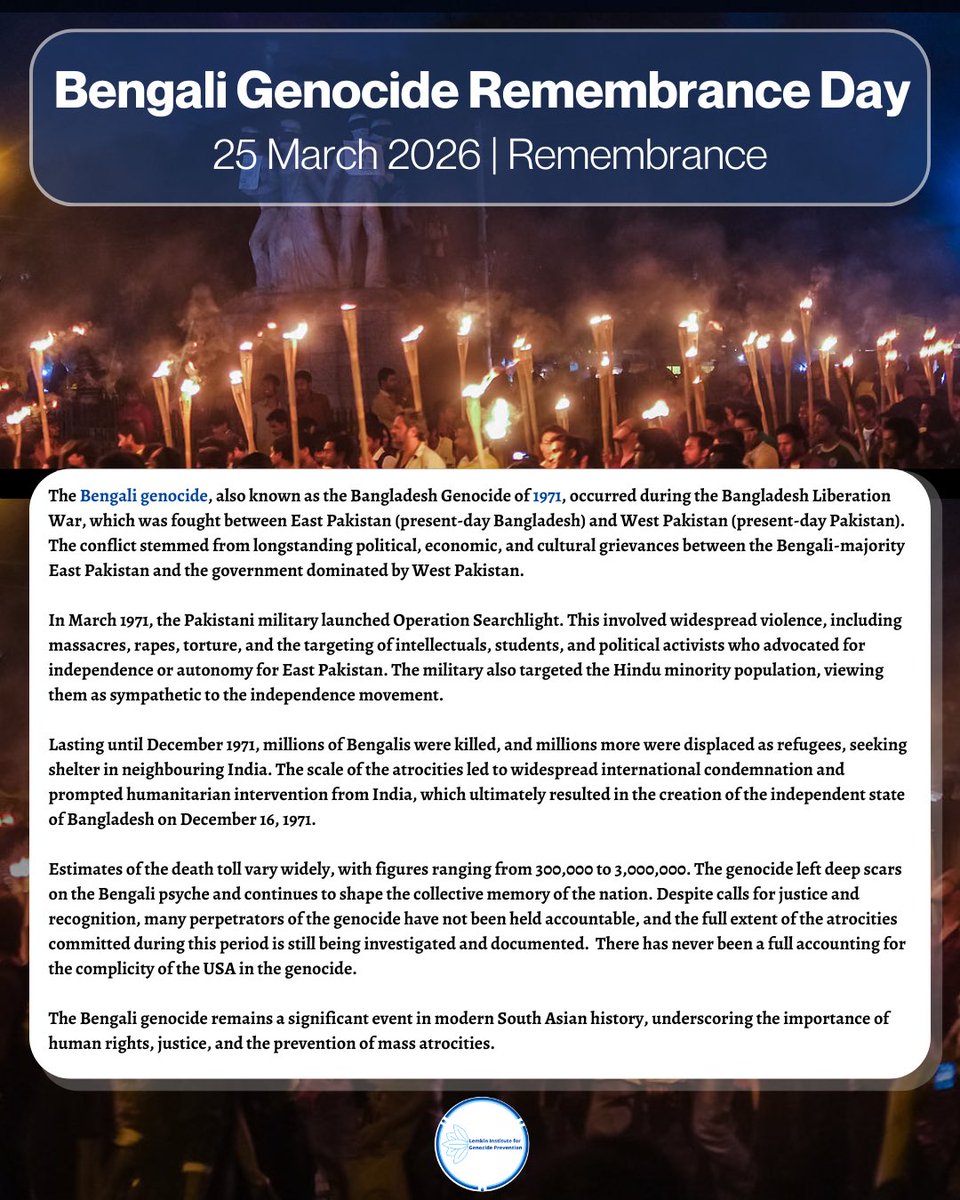
The @LemkinInstitute stands in solidarity with the people of Bangladesh on this Genocide Day commemoration.
We call for the universal recognition of the Bangladesh case and for accountability for the perpetrators in Pakistan and for those states, such as the USA, who were deeply complicit in this crime.
উত্তাল ২৩ মার্চ ১৯৭১, মঙ্গলবার,
বঙ্গবন্ধু শেখ মুজিবুর রহমান এর ধানমন্ডি ৩২ নম্বর বাসভবনে বিদেশি সাংবাদিককে দেয়া সম্পূর্ণ সাক্ষাকার।
#REPORTER: "YOUR FEELING ABOUT THESE PEOPLE COMING HERE ?
#SHEIKH : "IT DOES NOT MEAN A THING TO ME, BECAUSE I LOVE MY PEOPLE AND MY PEOPLE LOVE ME, AND I CAN DIE FOR THEM AND THEY CAN DIE FOR ME. BECAUSE I AM FIGHTING FOR THEIR CAUSE AND I WANT THE SEVENTY MILLION PEOPLE OF MY BANGLADESH SHOULD BE EMANCIPATED."
#REPORTER: "DOES IT FEEL GOOD THAT WHEN YOU ARE DISCUSSING SUCH MATTERS AT THE MOMENT THAT YOU HAVE THE SUPPORT OF THE PEOPLE ?
#SHEIKH: "ALL SEVENTY MILLION PEOPLE ARE BEHIND ME, AND BEHIND THE CAUSE."
#REPORTER: "ARE YOU SURE TO WIN THIS..?
#SHEIKH: "OH YES, NOBODY CAN STOP IT."
#REPORTER: "THE AUTONOMY OF EAST PAKISTAN.?
#SHEIKH: "NOBODY CAN STOP IT, AUTONOMY? OH DEFINITELY, NOBODY STOP IT."
#REPORTER: "MORE THAN THAT? MORE THAN AUTONOMY?"
#SHEIKH: "I WANT MY RIGHTS."
#REPORTER: "EMANCIPATION?"
#SHEIKH: "I WANT MY EMANCIPATION. I WANT THAT...I WANT TO LIVE LIKE A FREE CITIZEN OF A FREE COUNTRY."
#REPORTER: "YOU MEAN INDEPENDENCE?"
#SHEIKH: "THAT I DON'T MEAN. IT CAN BE DONE IN MANY WAYS."
#REPORTER: "ULTIMATELY?"
#SHEIKH: "ULTIMATELY IT CAN BE DONE IN MANY WAYS....BY AMICABLE SETTLEMENT.....BY.....MANY WAYS IT CAN BE ACHIEVED."
#REPORTER: "AND WEST PAKISTAN CANNOT DO ANYTHING ABOUT IT?"
#SHEIKH: "WE CAN DO ANYTHING WHEN SEVENTY MILLION PEOPLE ARE UNITED BEHIND US."
#REPORTER: "WHAT THEN WITH THE ARMY?"
#SHEIKH: "WHAT DAMN ARMY CAN DO? WE DON'T CARE ABOUT THE ARMY. THEY CAN SUPPRESS PEOPLE WITH BULLETS?"
#REPORTER: "SO YOU ARE ALREADY THE CHIEF OF INDEPENDENT BENGAL? DE FACTO -- NOT LEGALLY, BUT DE FACTO?"
#SHEIKH: "OBVIOUSLY I AM THE PRESIDENT OF THE PEOPLE OF BENGAL -- LEGALLY, MORALLY -- I AM THE MAN WHO CAN GOVERN THIS COUNTRY."
সৌজন্যেঃ- ডকুমেন্টারি-অফ-বাংলাদেশ
There is at least ONE sexual predator in parliament 2.0.
Children are his focus, but adults are not let off easily either.
This predator talks about ethics more than anybody else in the house!
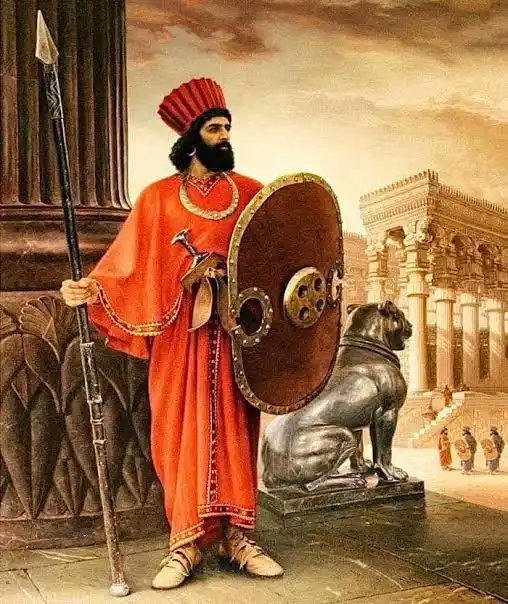
Persians, the ancient inhabitants of what is now Iran, created one of the ancient world's largest and most powerful empires that flourished from 550-330 BC. At its height, Persian Empire, also known as Achaemenid Empire, stretched from eastern Mediterranean Sea to western border with India and included a diverse array of cultures and ethnic groups. It was finally conquered by Alexander the Great during his invasion of Asia in 4th Century BC.
"The Achaemenid Empire was something drastically different from its predecessors," said Touraj Daryaee, the Maseeh chair in Persian Studies and Culture at the University of California, Irvine, and the editor of "Excavating an Empire: Achaemenid Persian in Longue Dureé" (Mazda Publishers, 2014). "It was the first world empire. It's an Afro-Eurasian empire because it included parts of Africa, Asia and Europe."
Ancient Persians were an Indo-Iranian people who migrated to the Iranian plateau during the end of 2nd Millennium BC, possibly from Caucasus or Central Asia. Originally a pastoral people who roamed the steppes with their livestock, they were ethnically related to the Bactrians, Medes and Parthians. In 5th Century BC, Greek historian Herodotus described them as being divided into several different tribes, the most powerful of which was the Pasargadae, of whom the Achaemenid clan was a part.
"We first hear of the Persian people from Assyrian sources," an ancient ethnic group indigenous to the Middle East, Daryaee told Live Science.
The 9th Century BC, Assyrian king, Shalmaneser III, recorded encountering a people who were settled in the area that is now southwestern Iran and went by the name Parsua. This reference, written in cuneiform, appears on his "Black Obelisk," which was found in 1846 and commemorates and records Shalmaneser III's deeds and military campaigns. Scholars suggest the limestone obelisk was probably engraved in 825 BC, according to the British Museum. The translated reference to the Persians reads as follows:
"Moving on from the land Namri, I received tribute from twenty-seven kings of the land Parsua. Moving on from the land Parsua I went down to the lands Mēsu, Media (Amadāiia), Araziaš, (and) Harhār, (and) captured the cities Kuakinda, Hazzanabi, Esamul, (and) Kinablila, together with the cities in their environs."
By 1st Millennium BC, Persians were well established in southwestern Iran, with their capital at Anshan, an old city of the Elamites, an ancient ethnic group from the Iranian plateau. The Persians were ruled by kings who claimed descent from a semi-mythical king named Achaemenes. For several centuries, Assyrians and later Medes, an Indo-Iranian people who were settled in northwestern Iran, dominated the Persians, according to World History Encyclopedia. But during mid-6th Century BC, an ambitious and capable ruler named Cyrus came to power. Later known as Cyrus the Great, he revolted against the Medes, conquered them, and then embarked on a campaign of conquest, adding the kingdoms of Lydia, Elam and Babylon to his burgeoning empire. At the time of his death in 530 BC, his Achaemenid Empire stretched from the Balkans in Europe to India and as previously discussed on Live Science, is considered to have been one of the largest empires, both geographically and in terms of population, in the ancient world.
Herodotus is one of the main sources of information on Cyrus's life. In Book I of his Histories, Herodotus depicted the early life of the Persian king, recounting in mythological terms how a series of dreams led Astyages, the king of the Medes, to attempt to kill the infant Cyrus. But Cyrus survived these murder attempts, grew into manhood and overthrew the Medes. According to Britannica, this story of Cyrus's infancy is likely a fabricated tale designed to show that Cyrus's reign was destined and ordained.
#archaeohistories
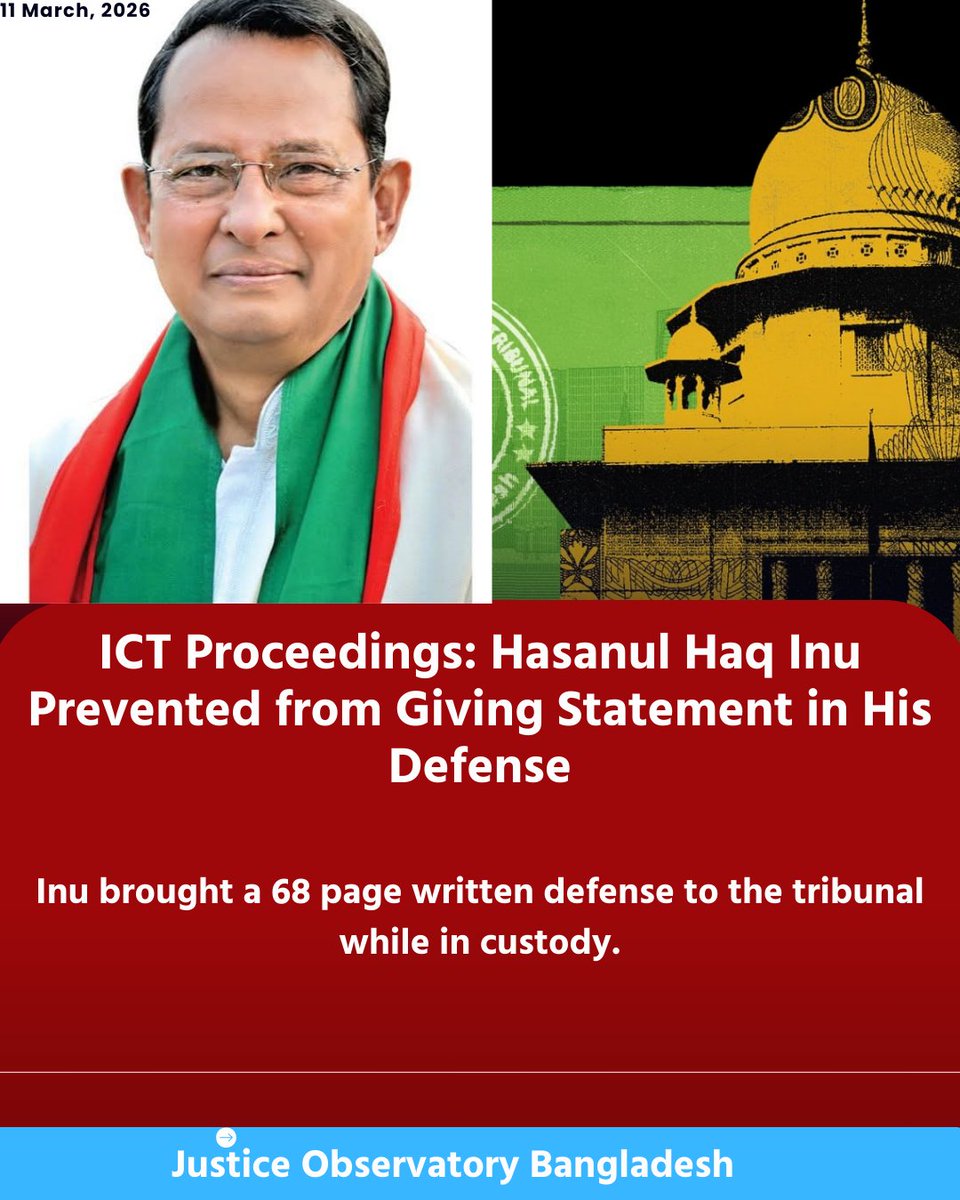
Justice Observatory Bangladesh condemns the prevention of Jasad President Hasanul Haq Inu from giving his defense statement at the ICT. Despite bringing a 68 page documented defense, he was denied the right to speak.
We demand fair trial & rule of law. #HumanRights#ICTBD
He’s known what needed to be done all these years and now he is getting it done. Love him or hate him he has ALWAYS had America’s best interest at heart 🇺🇸
Alarming: Extremism grows under the BNP government's patronization
Al-Qaeda leader Mufti Harun Izhar meets with Law Minister Asaduzzaman, seeking release of imprisoned militants and withdrawal of anti-terrorism cases. During Yunus' mobocracy, over 300 militants, including Jasimuddin Rahmani, got bail, and dozens of cases involving militant attacks were quashed, with the interim administration labeling them as Islamic scholars and pious Muslims.
Mufti Harun Izhar was behind these legal pushes as he got the support of the then adviser Asif Nazrul and the then attorney general, Asaduzzaman.
He is linked to Tehreek-e-Taliban Pakistan (TTP), Lashkar-e-Tayyiba, the Bangladesh chapter of Pakistan's HuJI-B, Hizb ut-Tahrir, Hefazat-e-Islam, and Jamaat-Shibir.
Since the launch of HuJI-B in Bangladesh in 1992, his Lalkhan Bazar madrasa in Chittagong has been used as a den, training center, and bomb-making factory. His father, Mufti Izharun Islam, was a patron of HuJI-B.
During the BNP-Jamaat-Hefazat rule of 2001-06, HuJI-B carried out nearly a dozen grenade attacks and killed scores of people linked to the Awami League, leftist parties, churches, and cultural organizations. The deadliest attack was the blasts at Sheikh Hasina's rally at Bangabandhu Avenue on August 21, 2004, which killed 23 people; the Awami League president narrowly survived the grenade attack.
Mufti Harun Izhar actively supported the terror attacks by AQIS and ISIS that took place from 2013 to 2019. But these groups faced tough actions by the Awami League government and merged for survival as the Jama'atul Ansar Fil Hindal Sharqiya. Backed by the CIA, this group was active in the July-August riots and police massacre in 2024 for a regime change.
#Jihad #extremism
My dear compatriots,
Decisive moments lie before us.
The assistance that the President of the United States had promised to the brave people of Iran has now arrived. This is a humanitarian intervention, and its target is the Islamic Republic, its apparatus of repression, and its machinery of killing—not the country and great nation of Iran.
However, despite the arrival of this assistance, the final victory will still be achieved by us. It is we, the people of Iran, who will finish this task in this final battle. The time to return to the streets is approaching.
Now that the Islamic Republic is collapsing, my message to the country’s military, law enforcement, and security forces is clear:
You have sworn an oath to protect Iran and the Iranian nation, not the Islamic Republic and its leaders. Your duty is to defend the people, not to defend a regime that has taken our homeland hostage through repression and crime. Join the nation and help ensure a stable and secure transition. Otherwise, you will sink with Khamenei’s ship and his crumbling regime.
And my message to the President of the United States, President Trump, is this:
The honorable people of Iran, despite the brutal repression and killings carried out by this regime, stood bravely for nearly two months. I now ask you to exercise the utmost possible caution to preserve the lives of civilians and my compatriots. The people of Iran are your natural allies and the allies of the free world, and they will not forget your assistance during the most difficult period of Iran’s contemporary history.
And to you, my dear compatriots in Iran:
In these sensitive hours and days, more than ever we must remain focused on our ultimate goal: reclaiming Iran.
I ask you, for now, to remain in your homes and remain calm and safe. Stay alert and ready to return to the streets for the final action at the appropriate time, which I will communicate to you.
Follow my messages through social media and satellite media. If disruptions occur in the internet and satellite broadcasts, I will remain in contact with you via radio.
We are very close to final victory. I hope to be with you as soon as possible so that together we may reclaim Iran and rebuild it.
Long live Iran.
Reza Pahlavi
February 22, 1969: Sheikh is released from prison. Later that year, he visits England, sharing his vision in rare interviews with BBC Bangla’s Serazur Rahman, captured at the start and end of his trip.
Watch it here: https://t.co/2BAdS76wCK
https://t.co/lG1mFFI7cG
Mithat’s Dream — Shahriar Kabir’s documentary — explores Sufi humanism through the journey of a young dervish inspired by Rumi.
At a time of polarization, the film reminds us:
Spirituality without compassion is empty.
Love is resistance.
Peace is power.