The plant never knows its own parameter, yet it still tracks the ideal response.
In (a) the control u = −θ̂x + k_g r cancels the unknown θ inside the plant ẋ = −a_m x + b(u + θx). The adaptation law θ̂̇ = −Γxe uses the tracking error e = x_m − x to drive θ̂ toward θ so the closed-loop matches ẋ_m = −a_m x_m + b k_g r.
Diagram (b) replaces the reference model with a state predictor that runs in parallel; the prediction error x̃ replaces e and the same adaptation law still works. Adding the low-pass filter C(s) in (c) limits the bandwidth of the adaptive signal, turning pure MRAC into L1 adaptive control.
Unknown parameters are estimated continuously rather than cancelled by a perfect model.
This is a really fascinating thread, there seems to be quite a lot of historical evidence that our ancestors in basically every part of the globe had no clue what they were doing with respect to arbitrage and trade
How long will the Microsoft outage last?
(This will not be a snarky post. I will be returning to my regularly scheduled snark afterwards.)
If you do a little digging, it turns out there has been some research done on the distribution statistics of cloud outages. Grok or chatGPT can explain this to you in exhaustive detail, but the important takeaway is that the distribution of outage times is not Gaussian. Depending on what you look at it's something more like lognormal or Pareto.
What this means in practice is that you should expect an outage like this to last about as much longer as it has already lasted.
Currently that's about another 12 hours? But every additional hour that it lasts should add about an hour to your estimate of the recovery time.
I have a major result to share.
I’ve found conclusive forensic evidence that the top 4 Chinese AI labs—DeepSeek, Moonshot, MiniMax and Ant Group—have built their newest models on NVIDIA’s most advanced Blackwell chips, which are barred from export to China.
This sounds insane, but I discovered that almost every AI model carries a hidden signature of the GPU that trained it. When a model is first set up, the starting values of its weights are laid out in a pattern that depends on the exact GPU. Each combination of GPU and seed number produces a unique pattern—a sort of fingerprint of the hardware used to create the model. Traces of that pattern survive training into the published model.
Again, this evidence isn’t based on any insider information or leaking. It’s based on a forensic analysis of the model weights released by the companies themselves.
I searched more than six trillion combinations of chip layout and seed number and matched them to open-weights models. In doing so, I found conclusive evidence that six Chinese AI models—including DeepSeek-V4-Pro, Kimi K3, and MiniMax-M3—were initialized on NVIDIA Blackwell systems. Four of the models match Grace Blackwell, the GB200 and GB300 parts in NVIDIA’s flagship liquid-cooled rack-scale systems.
I then verified these results on real hardware. Running unmodified PyTorch with the seeds I’d recovered, a Blackwell B300 reproduced DeepSeek-V4-Flash’s untouched starting weights bit for bit, and a rented GB200 reproduced Kimi K3’s to a correlation of 0.999995. A Hopper H100 reproduced none of DeepSeek-V4-Flash’s, and changing the seed by one broke the match. (DeepSeek’s seed is 953049583 by the way.) The method also was verified to match 24 known open-weights models to the hardware that developers said they used.
It is exceedingly unlikely that these results are a coincidence. Across six trillion combinations, the best accidental match should reach only about 8 sigma (i.e., eight standard deviations above what random chance would produce). The real matches range from 49 to 1,385 sigma, and even the weakest single test hits 20.
These were data-center-scale training runs. With some analysis of release schedules and model details, I estimate that the largest, Kimi K3 and DeepSeek-V4-Pro, used 2,000 to 3,000 Blackwell GPUs each. Clusters of this size cost on the order of $150 to $200 million each to buy, and across these labs alone would add up to more than half a billion dollars of export-controlled GPUs, not counting experimental compute or otherwise. It’s quite likely that we see multi-billion dollar expenditure on export-controlled GPUs.
I am highly confident in this result, and it has been independently verified by senior researchers at OpenAI and Anthropic. You can read the full report at https://t.co/YOtzND0Jqk.
There is much more I’ve identified about these models through other forms of checkpoint forensics like this, and will have more to share soon.
One of the strangest English political beliefs is the idea that the expansion of University education in the 90s was some liberal aberration, rather than following every single other developed country at the time. England's rate of teritiary attendance is not even that high.
@willsolfiac Not sure I follow why one random CEO matters so much for open source, which will sort of just… happen? Very hard to see how it can be restricted.
DARPA made a digital tutor to teach IT to Navy recruits. In 16 weeks the tutor got the average recruit to a level of problem solving ability far higher than the top performers in the Navy with 10 years experience.
The guys who made it told me “10 years” experience actually turned out to be like 40 things and if you just taught them systematically you got results that seemed like magic.
The hard part about teaching is that the teacher has already learned the 40 things and can’t remember not knowing them — Feynman called this “the curse of knowledge.”
You will recognize this if you’ve ever tried to teach your kids anything. You know way more than you realize, and you get impatient while your child goes through those same steps.
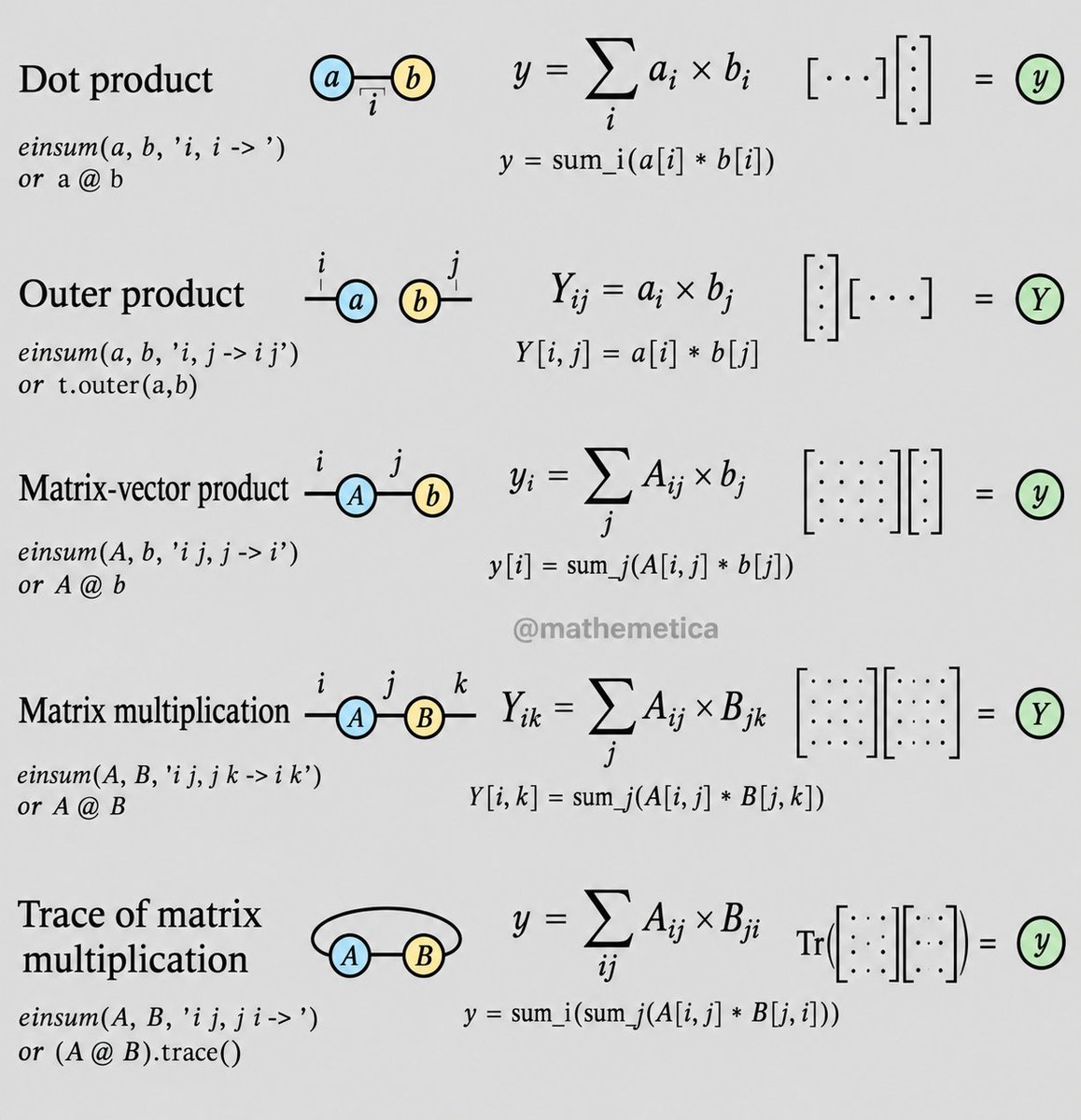
All of linear algebra is index gymnastics.
Dot product contracts every shared index into a scalar. Outer product leaves indices free, expanding two vectors into a full matrix.
Matrix-vector and matrix-matrix products contract only the connecting index. Trace closes both loops, summing the resulting diagonal.
One notation shows every contraction pattern at once.
I hate that people will say that and then not explain what it's even supposed to mean. Does it mean that, within 3 to 12 months, we couldn't even shut down the latest AI system even if we wanted to? Because if that's what it means, then I'm very confident that it's not true. But if what it means is something weaker than that, then I would like to know what exactly, since how worried people should be about that prospect, assuming it's true, depends on that.
So, the "rationalists" => mostly tech/SF Bay Area people who don't want to call what they're doing or reading philosophy, since philosophy is apparently a failed discipline that doesn't answer questions (LessWrong's own phrase: "a diseased discipline"), and who then rebrand a particular selection of it, plus the bias literature, as "rationality". What gets selected is a pretty standard bundle of contested positions btw, i.e. Bayesianism/Quinean naturalism/physicalism/computational functionalism/consequentialism, and under that label the bundle reads like good reasoning as such (it does get used as a verdict too, see the Sequences on many-worlds or "raising the sanity waterline"). And the whole "philosophy is confused, we have a method that dissolves it" thing was already done by the Vienna Circle almost 100 years ago, so that's hardly an exit from philosophy either.
Also, funnily enough, even the name is historically misleading, since the rationalists in any textbook are Descartes and Leibniz, whereas whoever builds everything on updating on evidence would end up much closer to the empiricist side (yes, Leibniz cared about evidence too, it's a matter of degree). Which is why it feels absolutely absurd to me that there are rationalists meeting up to "do rationality" when what's being done is philosophy, just outside the discipline's quality control (the literature, trained opponents). Most of the "very foundational work" is old LessWrong posts from autodidacts who came up with many things impressively via first principles, and I mean that as praise. Plato, e.g. also did that, but Plato had nobody to read. They did, and if you re-derive compatibilism in 2008 without the ≈300 years of objections to it, how would you even know which of your positions are the weak ones? How do you even know what part is novel and what is just reformulation with new terms that you can claim as yours?
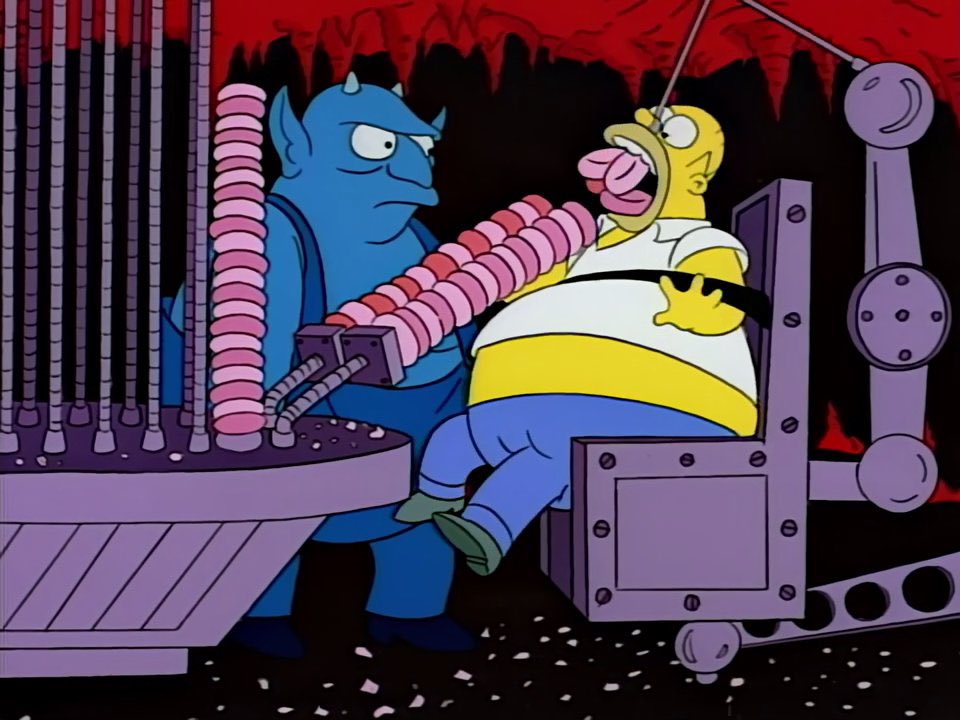
The Simpsons is so fucking old that there's an episode with an exchange student from the totalitarian mystery-state of Albania, from the Hoxha bloodline.
He is welcomed to the school with the Socialist era Albanian flag (note the star above the double headed-eagle).
I think electrification and decarbonization get linked at much higher levels than they should. As David points out they don't have to go in lockstep and there are times that things like EVs are quite substantial efficiency wins even when powered by marginal thermal gen
But the cost benefit has to realize that electrification doesn't mean decarbonization. For heat pumps in particular the case in cold northeastern places with natural gas heating is much more marginal than one would believe. Getting a cop 3 heat pump against a 50% CCGT on marginal averages is not a huge enough win to justify ripping out the gas system. And in New England you are double hit with the COP drop and the oil fired marginal generation that will make any grid build out to support this very questionable
And even worse you have no concievable plan to move this oil / gas mix off the margin in the next 25 years even without incremental electrification. Not with $150 PPA offshore wind in the foreseeable future and solar in region not much cheaper
So it's important to keep all this in mind
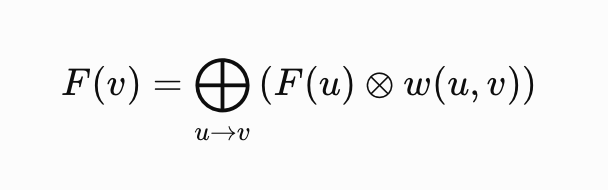
If you remove different representations, you find out that many algorithms are either the same, or almost the same.
Shortest path is semiring based computation.
More here: https://t.co/IiKh56Cijg
I realized this when I was writing my book on OR algorighms. There are hundreds of algos I went through. Sometimes, you could find 40-50 algorithms, that are different only in one parameter, or one function in the function composition.
---
I am 100% sure, there are abstract algorithms in space search + reduction, that could simplify what already exist and provide dozens of real world useful algos for thousands of various usecases.