Having worked remotely most of my career I know it works well & have been frustrated that so few employers of bioinformaticians accept it, causing much lost talent. I will now be working full time to provide needed services & remove these barriers for bioinformaticians worldwide. https://t.co/GLGa4nNIgp
Hello world! The Bioinformatics CRO is a computational biology contract research organization and consultancy with a focus on genomics. We are an all-remote company now hiring bioinformaticians for flexible moonlighting, and soon for full time positions. https://t.co/xRG6em3zpV
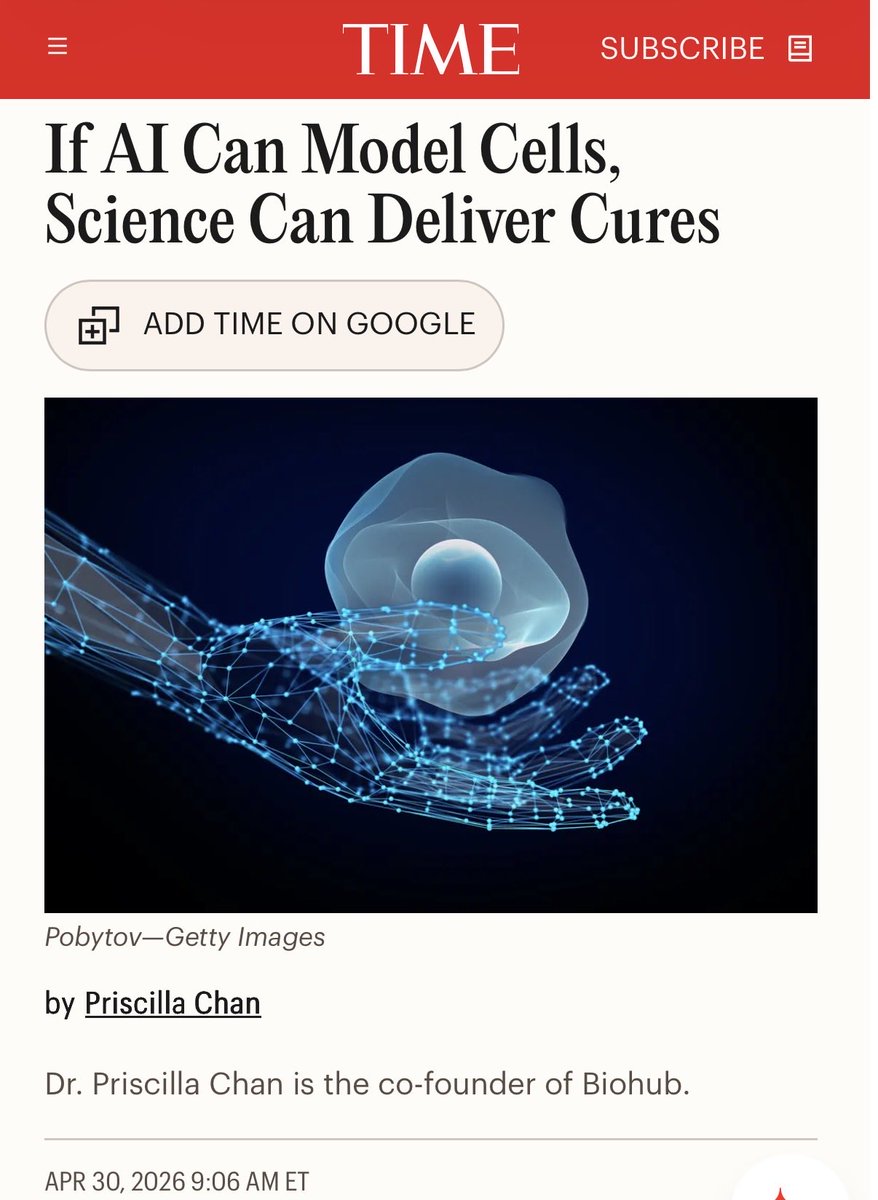
“If AI can model cells, science can deliver cures”
Great article from @TIME about virtual cell 🔥
Every breakthrough AI model needed a data moat. ESM had evolution (ie, billions of years of implicit perturbation experiments encoded in sequence diversity). AlphaFold had the PDB. What does a Virtual Cell need?
Biohub just committed $100M to answer that: partnering with Allen Institute, Arc, Broad, Wellcome Sanger, NVIDIA, and the Human Cell Atlas to build open data infrastructure for AI biology. The Virtual Biology Initiative. It's the right bet at the right moment.
The initiative focuses on observation: image more cells, measure more states, build bigger atlases. Critical and necessary.
Personally, I think perturbation data should be added to learn more causal biology. Knowing what a cell looks like at rest tells you its structure. Knowing what it does when you push it tells you its logic.
Great piece by the Biohub team. The data foundation they're building is necessary.
https://t.co/475MjrykDt
From statistical genetics to novel target discovery 🧬 Our VP of Computational Genomics, Sun-Gou Ji, joined @TGrantBelgard on the @BioinfoCRO Podcast to talk data-driven genomics and our approach to genetic target validation. Tune in here: https://t.co/KWI3Y1v4ev
I am looking for a postdoc to develop high-performance algorithms in computational genomics. Email or DM me if interested. For more information, see https://t.co/6JJn0i5k3F. RTs appreciated!
Announcing Topos-1, an all-atom generative model that sets a new benchmark for predicting structural ensembles of intrinsically disordered proteins. Topos-1 outperforms existing models by a large margin, with implications for designing drugs for challenging targets ranging from cancer to neurodegenerative disease.
Read the full technical report on our website: https://t.co/3UtTSdmddf
Big news 🎉 Michael Boehler, MD joins https://t.co/dqBwJojbno as Chief Business Officer!
👉 Ex-BioNTech exec who built its global commercial org
👉 Senior roles at Takeda, Kite & Amgen
👉 Now driving rejuvenation biology to extend human healthspan
🔗 https://t.co/RWcUaFJ72L
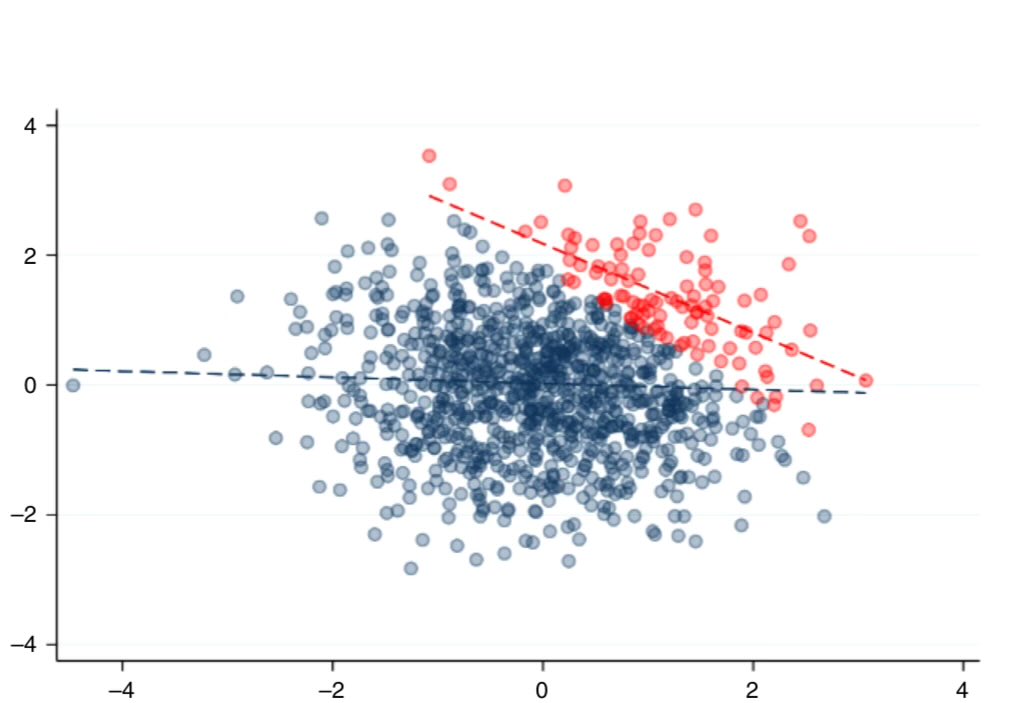
This is probably just collider bias. Consider impressiveness as a function of talent and execution (organization). If you select only highly impressive people, you’re conditioning on a common effect of both variables. That induces a negative relationship (red) vs the pop (blue).
In our new episode of The Bioinformatics CRO #podcast , @AfshinBeheshti , director of the new Pitt Center for #Space Biomedicine, discusses the application of #spacebiomedicine to health on Earth. Listen wherever you get your podcasts, or on our website: https://t.co/ofZ8LfMs5t
Catch up on the latest episode of The Bioinformatics CRO #podcast , where @kenbwork , co-founder and CTO at @LatchBio , tells us the shift he expects in #biology R&D tooling in the near future. Listen wherever you get your podcasts, or here on our website: https://t.co/WSzZWrZQew
Can LLMs predict the results of CRISPR screens in silico, before the experiment is run?
A team led by Aly Khan, AI/ML head at #CZBiohubCHI, has built a scalable LLM-based prediction framework. Read the 📃 just accepted to #BioNLP workshop at @ACLMeeting!
https://t.co/ihg2e7IcVu
On the latest episode of The Bioinformatics CRO #podcast , @kenbwork , co-founder and CTO at @LatchBio , discusses his experience engineering a cloud platform for modern biology research. Listen wherever you get your podcasts, or here on our website: https://t.co/WSzZWrZQew
We ran a randomized controlled trial to see how much AI coding tools speed up experienced open-source developers.
The results surprised us: Developers thought they were 20% faster with AI tools, but they were actually 19% slower when they had access to AI than when they didn't.
NEW: No technology currently exists to repair damaged brain tissue and fully restore lost function. FRONT aims to enable millions with what is considered permanent brain damage to regain lost functions, including motor control, vision, and speech. https://t.co/uaAhiQV7bf
@JSheltzer To the private sector, yes, but unfortunately many will have no choice but to leave research. Biotech has had a larger collapse in funding in recent years than NIH is now facing and it looks likely to get worse before it gets better.
Check out the latest episode of The Bioinformatics CRO #podcast , where Wolfgang Brysch, co-founder and CSO of @iulabs_ and MetrioPharm, discusses his research into natural and pharmaceutical remedies. Listen here: https://t.co/hleLXX7ffr or your preferred podcast platform.
In our new episode of The Bioinformatics CRO #podcast , Wolfgang Brysch, co-founder and CSO of @iulabs_ and MetrioPharm, discusses research into plant-based compounds to support healthy cellular metabolism. Listen here: https://t.co/k1BAqem5e9 or your preferred podcast platform.
Excited to share that https://t.co/YBwNKX6e6r will be at the #AgingCodeSummit in Boston on June 11–12! Our CEO Markus will be speaking about the next wave of startups in longevity biotech. In town or attending? Let’s connect → [email protected]#LongevityBiotech#Startups
@timberowl It is a little further to Disney, but NW Seminole County between the Wekiva River and I-4 meets all the other criteria and also has great bike trails and abundant beautiful conservation land for hiking, paddling, etc.