i soft-launched my course last week. 154 people are currently working through it 😱
it's $99. it contains everything i know about thought leadership content:
~ ideation frameworks
~ writing techniques
~ distribution tactics
~ examples and teardowns
https://t.co/RROAagZXuK
the .@ahrefs blog team now works out of a shared Letaido workspace, with access to every frontier LLM, tons of connectors to tools like Wordpress, Linear and Slack, full Ahrefs data, and a shared whiteboard full of custom apps and reports 💕
it has TRANSFORMED how i spend my day. for example, today i:
- reviewed a live mockup of a new research report prototyped by @Lou_Linehan, complete with custom graphics and charts
- dictated notes for a new article in my custom vibe-writing app 🌴
- reviewed my automatically-generated monthly performance report, and added my notes and comments before sharing with the team
- scanned my content freshness dashboard to see which articles i want the team to update this quarter
- browsed through my competitor feed to see all the new articles published this week, alongside data for the keywords they target (and saved the best ones to my swipefile)
these are all custom tools that our blog team has built to our unique specifications, with ZERO developer or designer input, just creative content marketers playing in a shared sandbox and trying to make work easier and more fun :)
i highly recommend a shared AI workspace for content teams to collaborate!
NEW: My first research report into how companies are deploying AI to grow ✨
I've wanted to write this for a long time, and went through hundreds of notes to put this first edition together.
I'm calling the series "Deployed", and would love to make it a regular thing if there's interest.
The aim was to share enough examples that no matter what kind of business you're in, you'll be inspired by at least a few of them.
Inside you'll find insights from the great reporting of others (with links for further reading), as well as stats and quotes I uncovered which seemed to go under the radar.
I'm still as obsessed with SEO (and now, AI search) as ever, but also excited about the possibilities AI has opened up for all aspects of growing businesses online.
I really hope you find it valuable, and would sincerely appreciate any feedback on whether you would like to see a v2.
Link in the graphic and first reply.
Thank you!
calling all SEOs! i want to publish an article about SEO for vibe-coded websites, especially optimising static site frameworks like Astro, Gatsby, 11ty, etc.
anyone got experience here and open to answering a few questions over email? you'll get quoted in an Ahrefs article :)
i want to understand common pitfalls for vibe-coding noobs like me (e.g. my Jekyll sites all went live with HUGE image files, there was no image compression out of the box)
leave a comment here if you're game and i'll DM you
SORCERY! we publish tons of data content at @ahrefs, and that usually necessitates hours of tedious content updating: pulling fresh data from the API every month, analyzing it, generating new data visualizations, passing off to design, updating in WordPress...
now we all have tasks set up that automatically:
- pull fresh data from the right endpoints, every month
- generate updated charts and tables
- insert the updates into WordPress drafts
- make any minor copyedits required (e.g. changing dates, sample sizes)
...and email us to say the updated article is ready for review!
this was my dream for AI, *actual* automation, genuinely saving us hours of drudgery, and it is finally here! SORCERY!!!
i realised i want my kids growing up surrounded by art, pictures, beautiful things, but art is expensive...
so i bought used frames from a charity shop and printed some of my (very amateur) landscape photos :)
four framed photos for £30 (including wooden frames, prints, framer's tape, picture wire, etc.)
here's my human-centric vibe-writing process for going from keyword idea to published article in 91 minutes :)
i've shared a lot of content about full-bore AI automation, using tons of chained skill files to build pipelines that create great content without any human intervention.
but... it's not a particularly *fun* process.
it's fun to build the system, and fun to see nearly-publish-ready content spit out at the end, but... i like writing! i have ideas to share! sometimes i want to be more involved in the process, and not less!
both @timsoulo and @m_makosiewicz use AI to support their writing, but they do it very differently to me: they vibe-write, they talk and joke and ramble to their AI agent, and let the AI refine their creativity and impose structure. so i tried out their process today (and recorded this short video about the result).
and honestly, it was the most fun i've had writing for @ahrefs in ages. you should try it out too: all you need is a microphone, a head full of good ideas, and a capable marketing agent like Agent A :)
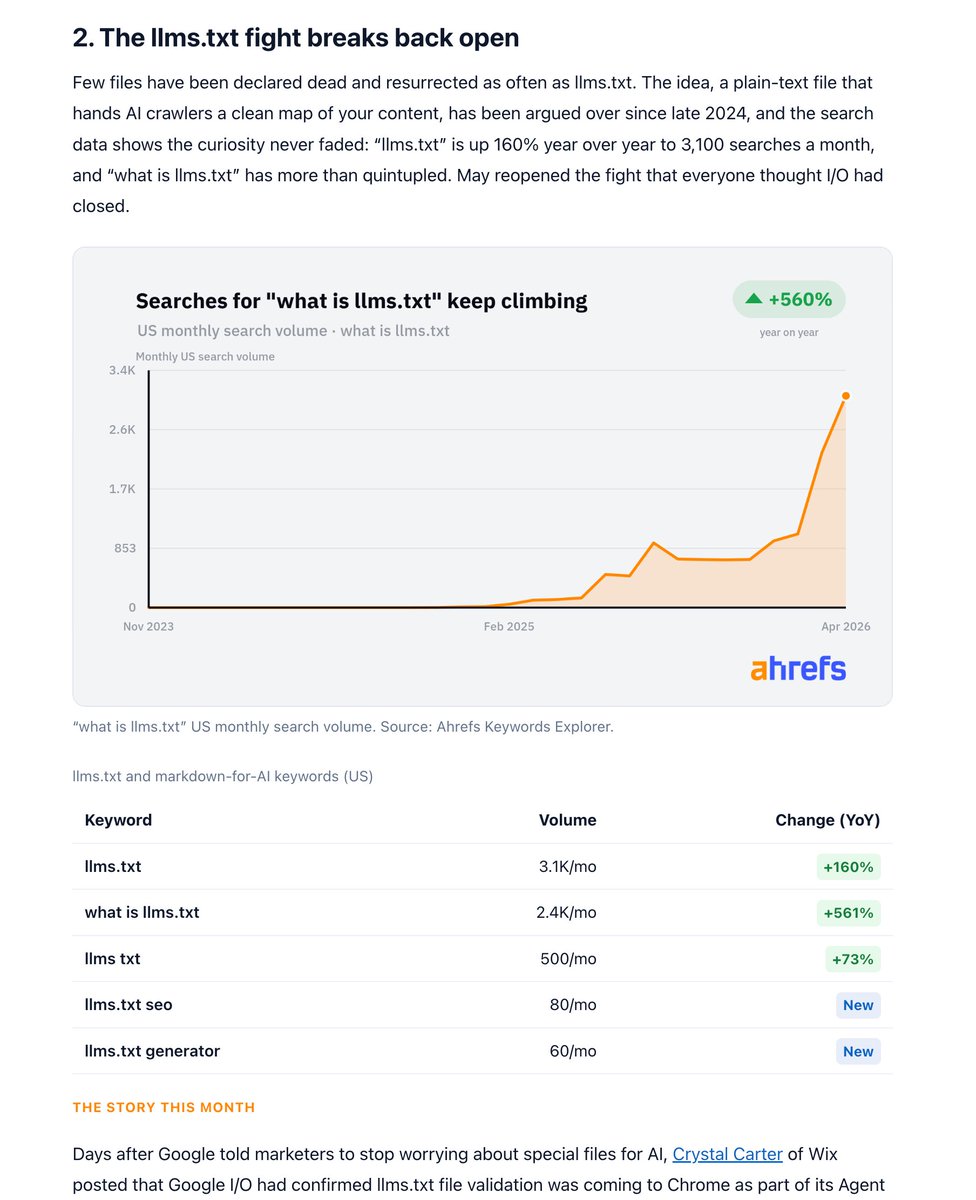
new research! 28% of websites use llms.txt... but 97% of llms.txt files are never requested 🙃
tons of extra data, including a detailed analysis of the bots that *actually* fetch llms.txt, in this article from my awesome colleagues @Lou_Linehan and Xibeijia Guan:
https://t.co/wB56R8LNFs
"does AI content work?" is entirely the wrong thing to ask. a much better question is "how is AI content materially different from 'normal' content?"
usually when people publish "AI content" they are unwittingly engaging in a *different* strategy to traditional content marketing, and creating something *different* from traditional content. they create obvious hallmarks of AI use.
for example:
- publishing content much faster than usual, often on newer domains with little authority, no branded search demand, etc.
- relying entirely on an AI model's internal knowledge, without sourcing information from a range of external sources
- failing to include internal and external links, images, visual interest, first-person experiences
- leaving obvious artefacts of AI use in the article, like obviously AI-generated imagery, obvious AI turns-of-phrase
- AI writing patterns and watermarks that haven't been "humanised" by anchoring text generation in specific writing examples.
some of these hallmarks make the content WORSE than normal (and hence contribute to poor performance), others are very DIFFERENT from normal (and make it easy to single out content as likely AI-generated) - both of which can contribute to that content not performing well.
i obviously don't know the exact mechanisms at play when Google sinks an AI-generated blog after 3-months, but i DO know that many of these aforementioned signals are very obvious to Google: indexing requests, branded search demand, AI content detection (even if only directionally accurate), user engagement signals.
we use generative AI a lot at Ahrefs, and i'm happy to do this because we do not compromise on our editorial standards. our AI process mirrors our human editorial process, step for step; it is better and more detailed than the human equivalent in many areas, because LLMs are more tireless researchers, more thorough adherents to brand voice.
we are substituting one tool for another, one method of construction for another, but the end product is the same. we have even now published AI-generated content that is subjectively BETTER than our previously human-made content, because AI removed the data, design and updating constraints that previously limited our team. i am excited for the new experiences we can build for readers.
you need to determine your own risk tolerance, but in my opinion, using AI to create content is not a problem - but using AI to create something that is WORSE or DIFFERENT to "normal" content marketing is. "creating bad content" or "scaling content too soon" is where problems emerge, and many people do this unwittingly when they use AI.
if you know that you are compromising on your content through your use of AI, or trying to scale content on a site that barely exists in Google's consciousness, you should probably feel a bit nervous.
if you want to win, change your framing and use AI to make content that is cooler and better than you were able to do before ✌
if i was starting my FIRST DAY as a new Head of Content, here's what i would do:
- build a new blog using a static site generator, host with GitHub, deploy with Netlify or Cloudflare Pages. for an existing blog like WordPress, set up an MCP connector. the goal is a fully AI-native blog, analysis, content creation, updating, all from the terminal, all in my control
- get access to Gong/Intercom/Slack and extract common entities and n-grams. find the language customers and prospects really use, use this as seed keywords for topic research
- build key "source of truth" files in markdown i can reference throughout my workflows: a master list of product features and use cases, canonical writing voice with specific reference articles, key strategic priorities to shape everything we do
- crawl our sitemap and generate vector embeddings for every article. use this to analyse topical authority (and topic "drift") and automate internal linking
- schedule a recurring, automated content audit: pull rankings and backlink data via the Ahrefs MCP, analyse AI search visibility with Brand Radar, flag technical issues with Site Audit, look for traffic decay via GSC and make a priority list of content updates
- set up a daily cron job to refresh our highest priority articles: extract the article content, run through AI Content Helper to fill topic gaps, update old claims and statistics, save as a draft for my review
- run a content gap analysis using the Ahrefs MCP to find key topics our competitors have covered that we haven't. use Firehose to get a daily update of new articles and industry news emailed to me
- build my Content OS: a centralised dashboard that pulls all of these reports and workflows into one place. this is exactly what i've done at Ahrefs using Agent A
- get fired for spending $80M in AI credits in my first day (maybe?)
---
i sound like an obnoxious AI hype bro, but all these workflows are things my team have actually built. many of them will become the norm sooner rather than later
AI is truly putting the "manager" into "Content Marketing Manager". we now operate at a higher-level of abstraction, building systems to support our work instead of doing everything ourselves
we don't have to consign ourselves to Google Docs and rely on developers and designers: we can build AI-native blogs as malleable as plasticine and shape every facet of them to our exact specification. if you can imagine it, you can build it!
and as crazy as this sounds, this isn't so much the "first 30-days" of content marketing as the first 30-MINUTES, because so much of this infrastructure can be built agentically. you just need to have the vision, know what to ask for, and use your taste and experience to nudge as these systems get built for you
if you don't know where to start: pick one of these ideas, login to Claude Code or Codex or Agent A, paste the bullet and ask it to build it (and some of these are already available as free apps in Agent A!)
@mar3tus i had fun making a simpler version of this with local LLMs, nowhere near as sophisticated as using frontier models, but still very very good relative to a year ago etc.
@ashr0se the funny thing is you could literally build this once and then fork it to different companies, roles etc. like a professional operating system
so lots of set-up time to get right, but then the ability to scale its application nearly infinitely
it is a different world already, the unit economics of blogging are vastly different to what they once were, content is cheaper and easier to make and offers vastly less reward at the same time
i think we'll see even more of a bifurcation, expensive media strategies on one end, full content automation on the other