Amy Hodler and @prathle unpack why the current #AI wave is fundamentally a graph moment, not just a vector one. They explore how #GraphRAG, neuro-symbolic AI and graph-based memory address core limitations of LLMs – bringing explainability, reasoning and scalable context (via innovations like Infinigraph) to enterprise AI systems - interview on #GraphGeeks https://t.co/SmMEEkHLe3
@chadwahl Hi Chad! At Tacitus we're building something similar but specific for human friction/conflicts. We'd love to join the Palantir startup program and get advice from experts like you.
That's our LinkedIn page 🙏
https://t.co/tOFWce6KrE
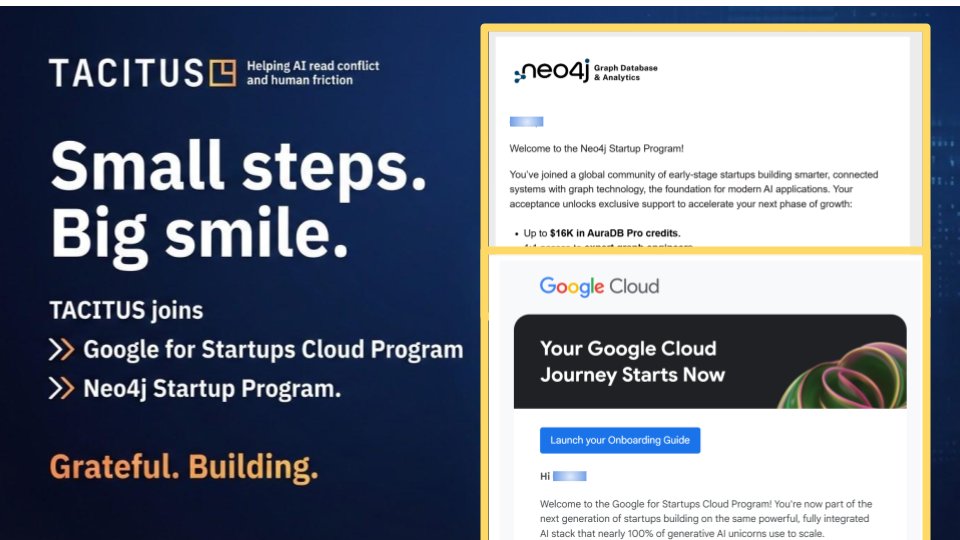
Good news! @TacitusmeAI has been accepted both into the @Google for Startups Cloud Program and the @neo4j Startup Program.
Grateful for the support. Back to building. 🤩
TACITUS ◳ builds context infrastructure for conflict reasoning.
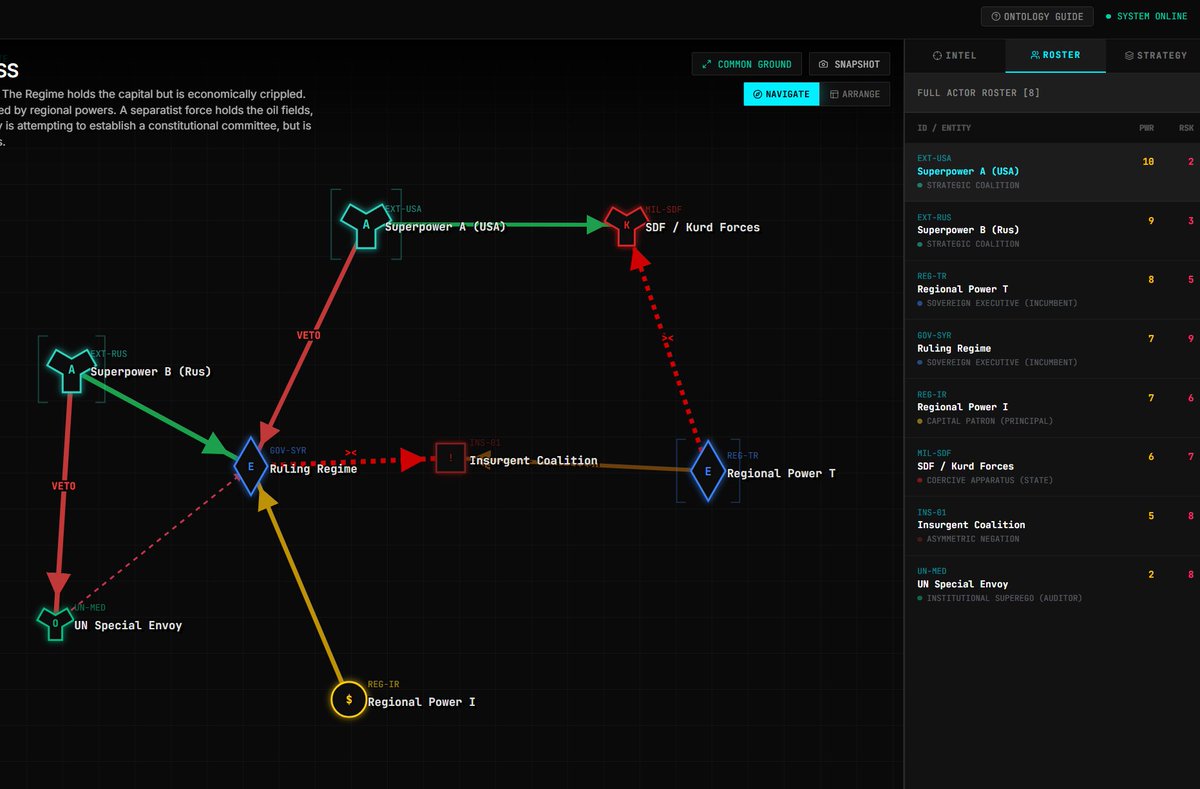
We’ve open-sourced a simplified sandbox to play with knowledge graphs/ontologies for conflict analysis. A glimpse into how we think about making human friction legible to humans and AI.
👉 https://t.co/EHaLpFXPv3
Another day at https://t.co/EYS3K47Bza in 30sec. We're building the AI context layer for conflict and human friction. Helping
AI structure conflict data.
[Demo Based on Production code · Synthetic case shown]
#ConflictResolution#KnowledgeGraphs#AI@neo4j#Startups
@LangChain@hwchase17@sequoia Exactly.
Long-horizon agents fail when context degrades, not when models are weak.
Memory isn’t chat history, it’s domain-specific context agents can return to and learn from.
Context management is just as important as model quality for long-horizon agents.
Our co-founder @hwchase17 joined @sequoia to share what we've learned building LangGraph and Deep Agents:
- Building agents is different from traditional software because the logic lives in the model, not code
- Traces are the source of truth for testing and debugging agent behavior
- Memory and context engineering will be key to agents learning from traces for self-improvement
Full episode: https://t.co/IaaUT41gSw
"Sequoia is telling you the entire distribution layer is being rewritten. The question is whether your product is optimized for human attention or machine parsing."
Sequoia just called the end of an entire go-to-market era and most SaaS companies won’t realize what hit them for 18 months.
Product-led growth was built on one assumption: humans would try the software. The entire playbook since 2010 optimized for human discovery. Beautiful landing pages. Frictionless free trials. Viral invite loops. Slack, Dropbox, Zoom, Calendly. $200B+ in market cap created by winning the user’s first 5 minutes.
None of that matters if an agent is picking the software.
Claude doesn’t care about your hero image. It can’t be impressed by your Dribbble awards. It’s reading documentation, parsing user reviews, checking API reliability, and matching features to use case. All the surface-level polish that convinced lazy humans to click “sign up” becomes irrelevant.
The new PLG funnel isn’t landing page → free trial → activation → conversion.
It’s agent query → documentation scan → feature match → recommendation.
Which means the new moat looks completely different. You don’t need the best onboarding. You need the best documentation. You don’t need viral loops. You need structured data that agents can parse. You don’t need a beautiful UI for the first session. You need an API that an agent can actually call.
The companies that won PLG hired designers and growth hackers. The companies that win agent-led growth will hire technical writers and developer relations engineers.
And here’s the part nobody’s pricing in yet: agents don’t have loyalty. They don’t have switching costs. They’ll recommend Supabase today and something better tomorrow if the documentation is cleaner or the pricing is more transparent. The stickiness that made PLG so powerful, the network effects and learned behavior, doesn’t transfer.
Sequoia is telling you the entire distribution layer is being rewritten. The question is whether your product is optimized for human attention or machine parsing. Most are built for the wrong audience.
LLMs won because they were native to text.
Treating tables as flattened tokens was always a hack.
Structured data needs its own foundation models — ones that understand schemas, relationships, and numerical semantics from the ground up.
That’s where the real enterprise value is.
The next big AI wave won’t be prose — it’ll be rows, columns, and relations.
https://t.co/Uqlqtbfcik
Another day at TACITUS ◳ testing FalkorDB/Graphiti to push conflict reasoning leveraging graphs.
Our test case: Romeo and Juliet. Shifting loyalties, inherited constraints, compounding decisions.
Making conflict legible for humans and machines.
Hard problems. Exciting work.
We’re building TACITUS◳ to make conflicts visible.
From the Cuban Missile Crisis to a $10B family succession fight. Same hidden patterns emerge as a graph of actors, pressures, narratives, and leverage points.
Conflict isn’t chaos. It's structure.
https://t.co/jaiTRb1Hy0
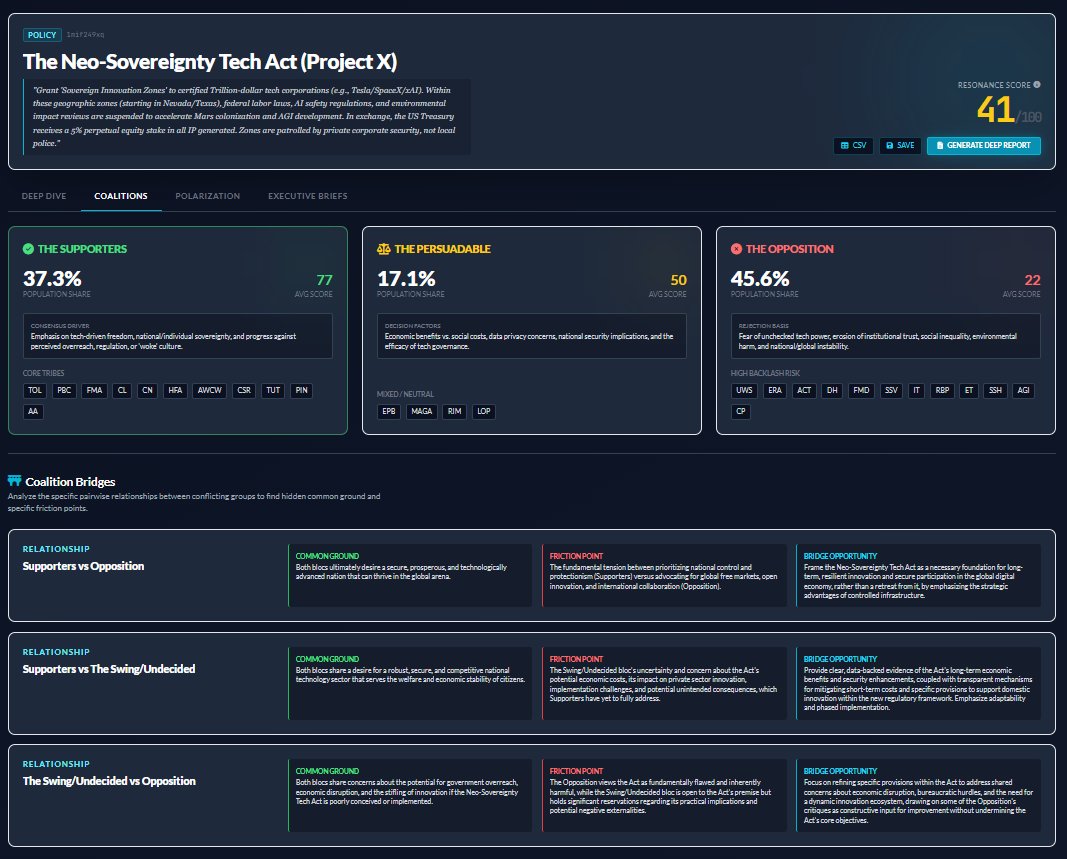
27TribeVibes beta is live.
TACITUS ◳ maps ideas across 27 political/ideological tribes to show resonance, backlash risk, and coalition shifts.
From Urban Woke Socialists, Fiscal Moderates, to Post-Ideological Nomads.
Try it → https://t.co/EYS3K489oI
Policy, comms, campaigns, mediation: if you need to understand why people react the way they do, 27TribeVibes gives you the distribution map — values, triggers, moral foundations, and fault lines.
Built for clarity in a polarized country.
→ https://t.co/EYS3K489oI
27TribeVibes beta is live.
TACITUS ◳ maps ideas across 27 political/ideological tribes to show resonance, backlash risk, and coalition shifts.
From Urban Woke Socialists, Fiscal Moderates, to Post-Ideological Nomads.
Try it → https://t.co/EYS3K489oI
https://t.co/Y7WWNkJKxR ◳ is building a conflict intel & resolution tech stack.
One mission: make conflict legible so resolution becomes possible.
🔹 Prism Lab. Polarization & reframing
🔹 Conflict Graph. Actors, interests, ontology
🔹 Sentinel. Tribe & memetic dynamics
1/2