Applied Compute has signed a definitive agreement to be acquired by Palo Alto Networks for $4.5B!
Rhythm, Linden, and I founded Applied Compute with a belief that was unusual at the time: that every company should own its intelligence. We think training, serving, and improving proprietary models will become a normal part of running a company.
To do useful work, a model needs to access sensitive data and systems, comply with policies, and remain explainable, verifiable, and auditable. This is the reason we've always prioritized security, and why joining Palo Alto Networks will help us go further faster. Customers will still own and control their models, and I'm excited for all the ways our combined capabilities can serve them even better.
Above all, I'm incredibly grateful for the AC team. A few dozen people in just over 18 months grew this company from zero revenue to over $100M in annualized revenue run-rate, working with many of the world's most innovative companies. More to come soon.
Cyber defense requires reliable reasoning across noisy logs, events and network flows.
@CormaAI is training foundation models for exactly that. They've increased server capacity 24x to meet demand.
Huge congrats to @AlonPluda and team on the $125M Series A!
Fastest angel check I ever wrote. Proud to back them at @khoslaventures too!
We raised a $125M Series A at a $1B valuation, 3 months out of stealth.
@NEA led. @sequoia, @khoslaventures and @coatuemgmt doubled down.
@CormaAI is training foundation models toward superintelligence for defensive cybersecurity.
Because the greatest gift cyberattackers have ever received is smarter AI, and right now only one side is armed.
Arm the defenders.
incredible work from will
i don’t wanna hear the ‘well duh’ crowd.
"It's not what you know, Clyde. It's what you can prove in court."
i passed this onto someone close with trump and he’ll make a public comment tomorrow.
due to the implications. this may go down as one of the most important pieces of research in human history.
Having led infra at Citadel Securities and OpenAI, I know how hard it is to understand why complex production systems fail.
The amazing @traversal_ai team is tackling this challenge with AI at enterprise scale, and I was blown away by how well their system works.
Proud that we @khoslaventures co-led their $120M Series B! Huge congrats @_anish_agarwal and team!
LFG!! 🚀
We just raised $120M, with a $1B valuation, to build software that keeps itself running.
AI is writing more code than ever. It’s also making production less reliable: more code, shipped faster, understood by few.
@traversal_ai understands how production systems fit together, finds the root cause of incidents, and helps prevent the next one.
Engineers at Nubank, Harvey, PepsiCo, DigitalOcean, and a growing list of Fortune 100 companies use Traversal every day.
Here’s production without the drama 👇
.@bobmcgrewai is best leader I've ever worked for. Also, he's got impeccable taste in picking industries and companies (PayPal > Palantir > OpenAI).
Huge congrats to @bobmcgrewai and the whole Arda team. Proud to be an angel investor, and proud that @khoslaventures partners with Arda, too!
We started Arda in 2025 to speed up American manufacturing. We have spent the last year building with Anduril as our design partner. Today we are launching the company publicly on CNBC and announcing our Series A: $160M at a $1.5B valuation.
Our platform helps manufacturers design and operate manual assembly lines, putting designs into production faster now. Next we'll build automated lines that can be reconfigured as quickly as human workers, letting America make products that now require armies of workers in Asia.
Satya is right. The way to make SI safe is not to train it with a sense of self, its own moral philosophy, and permission to act as a conscientious objector. That’s the “alignment” approach and it magnifies the control problem.
The engineering approach that Satya describes is different: separate the supply of intelligence from authority over it. Surround non-deterministic models with deterministic controls, observability, privilege limits, logging, and the ability to always contain or shut them down. Treat models/agents like powerful insider risks, not moral patients whose psychological wellbeing is at stake.
As Satya points out, the most trustworthy system is the one that lets us trust the model the least — not the one that encourages the model to develop independent agency and grievances. Engineering safety is not the same thing as “alignment.”
We @khoslaventures are proud to work with @arena, led by the amazing @ml_angelopoulos. They built the industry's most important AI leaderboard, and are now measuring how agents behave in the real world. This work is critical to delivering safe & aligned AGI!
Today, we're announcing our Series B: $200M at a $3.1B valuation, and the release of Arena's Alignment Index.
AI is advancing faster than our ability to evaluate it. The world needs a neutral third party to measure how safe and aligned AI actually is once it's in the hands of real people. That's the role Arena is stepping into today.
The Alignment Index is built from real-world agent traces, starting with three signals: Unauthorized Action, False Attribution, and Deceptive Completion, with results for over 20 frontier models launching today.
Hear more from our CEO @ml_angelopoulos below, and read the full breakdown, and more details about our company growth in thread.
This funding will allow us to go further on safety signals, agentic capabilities, and modalities. It will also allow us to grow the company to match the scale of our mission. Today, we’re still a nimble team of 90, and we're looking for people to join us across research, product, engineering, and more. Come build with us.
As AI gets more capable and autonomous, understanding how well it can safely and effectively work for people only matters more. That's what Arena is built to measure and advance.
Thank you to our community, our investors, and everyone building with us!
Take a look at our open roles if you want to join us (link in bio).
https://t.co/uiYy2htbFi
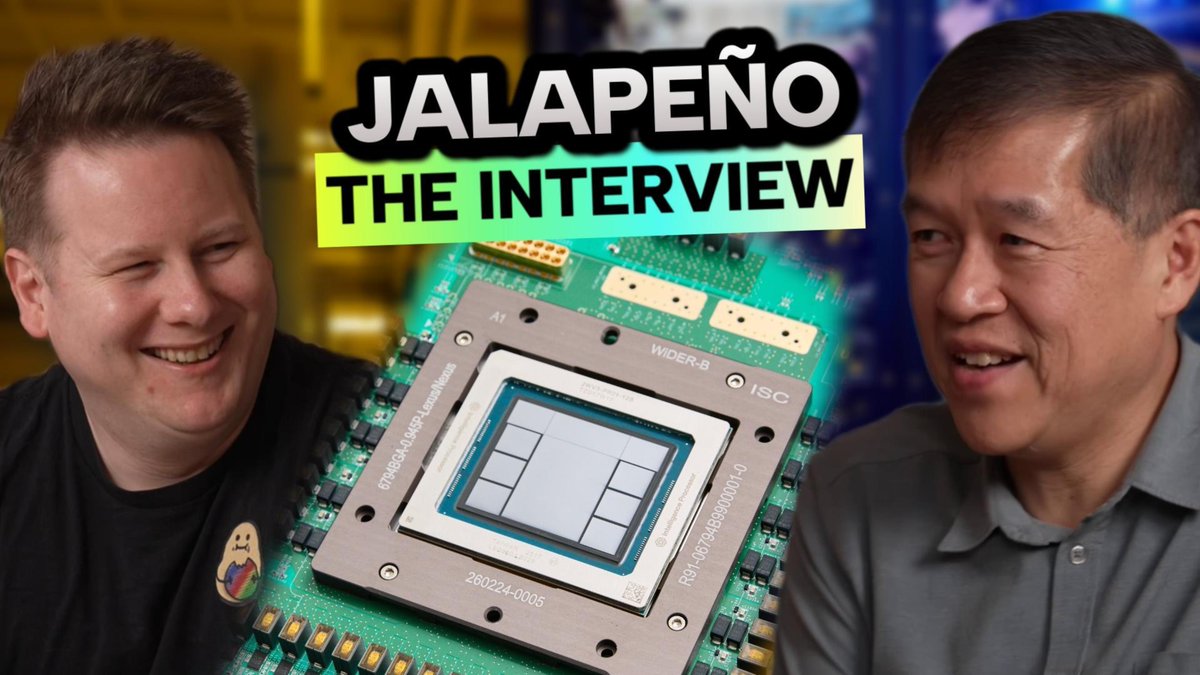
Big day today. Our interview with Richard Ho (@rh00), the VP Hardware at OpenAI, is now live!
We discuss the new chip, chip design, how OpenAI views the ecosystem, and what's coming down the pipe. Very insightful, thanks Richard!
yeah this checks out
my first few months at periodic, the weekly midtraining meeting was:
1. guy who trained the first trillion param LLM
2. guy who invented the attention mechanism
3. me
you learn very quickly surrounded by this density of talent. we're hiring btw.
@urieli17 Worked closely with Gilad when I was running compute at oai and he's super knowledgeable and a very patient partner. Got to know him outside of work, and his generosity and kindness explained why he's so good at what he does. #mensch
Thrilled to join @khoslaventures and learn from @vkhosla, @SStrohband, @SamirKaul1, @rabois and David, and from all of my amazing new partners, while helping back and build the next generation of world-changing companies.
Someone asked me yesterday what success looks like 5 years from now. I think it’ll probably be too early to judge my investment record. But I hope founders will say I was one of the most helpful people around the table, and had a real positive impact on their company.
If you’re building in AI, especially AI infra, I’d love to talk! 🚀
Thrilled to announce @TalBroda has joined Khosla Ventures! He’s bringing his experience building AI infrastructure to the founders we back.
At OpenAI, he led more than a dozen teams that built and operated the hardware and software serving OpenAI’s models. He helped lead GPT-4.5 training, participated in the development of OpenAI’s first custom inference chip, Jalapeño, and contributed to Stargate. Previously, he headed up platform at Citadel Securities. He’s tackled the infrastructure challenges AI founders face firsthand, and we’re excited to have him in join KV!
https://t.co/HgnUGpZgMG
"After 21 hours spent searching this data by roughly 950 agents using 210 million tokens, one of the agents spotted something remarkable..."
The bitter lesson is everywhere.
If you scale search and compute enough, you start finding things we humans missed.
Biology is no exception!
Claude has discovered a previously unknown enzyme system hidden in the DNA of bacteriophages. Beside the enzyme’s gene sits a long array of repeating DNA—a structure that looks somewhat similar to CRISPR.
We don’t yet understand what this system does, but only a handful of known systems share its features, and all of them are able to cut, copy, and paste DNA. Historically, the discovery of such programmable systems has helped revolutionize medicine. CRISPR, for instance, is now the foundation of genetic medicines. But it will take much more work to learn what this system does, and whether it can be put to similar use.
Read more: https://t.co/RuEosScSMb