Honored to share my recent publication on regulatory intelligence in @FrontMedTech: "Regulatory landscape of accelerated approval pathways for medical devices in the United States and the European Union"
https://t.co/5pDvyYbYiO
#healthcare#MedTech
Excited to share our new article in @ScienceMagazine, titled 'Spontaneous Weathering of Natural Minerals in Charged Water Microdroplets Produces Nanomaterials.' Congrats to all the authors! 🎉
Read it here: https://t.co/Eh1qSmqmZI
#ScienceArticle#Nanomaterials#Microdroplets
बहुत-बहुत बधाई और शुभकामनाएं! मुझे विश्वास है कि अहमदाबाद का NIPER ज्ञान-विज्ञान और अनुसंधान का सशक्त सेतु बनकर भारत को फार्मास्युटिकल के क्षेत्र में आत्मनिर्भर बनाने में अहम भूमिका निभाएगा।
@SurajTh51550255@makemytrip@RajGovOfficial I received a call today that they will process the refund soon.
Thanks, @makemytrip@makemytripcare for your prompt response. Posting on social media helped, but customers would like it if some customer care number/mail-id was accessible (apart from the automated replies).
@SurajTh51550255@makemytrip@RajGovOfficial Mine is very recent (7th June). On the app it says, "Your request has been resolved". I received a message from MakeMyTripCare today. Hoping to get the issue resolved.
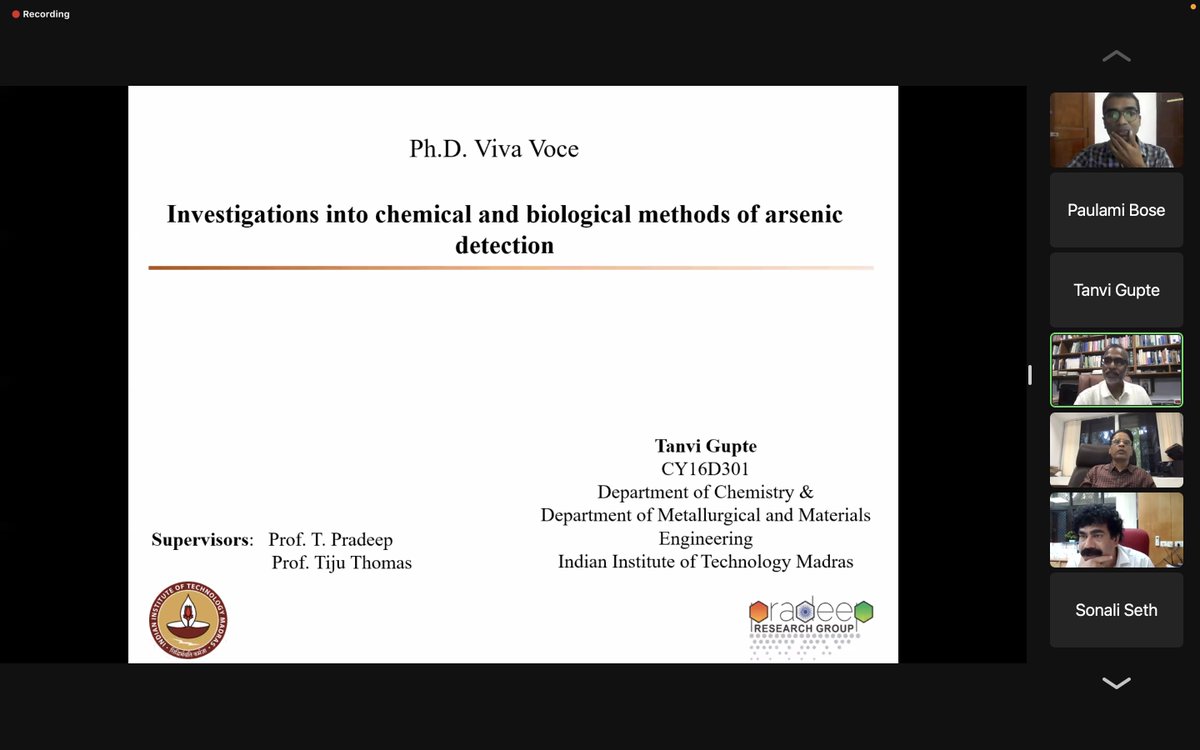
Our work on nanoplates of Co6S8 cluster for arsenic sensing is online
"Vertically Aligned Nanoplates of Atomically Precise Co6S8 Cluster for Practical Arsenic Sensing" https://t.co/c0KEmKjFyX
@ARIJITJ57265588@TanGupte@KeerthanaUnni22@group_pradeep
Prof. T. Pradeep from @IITMadras has been awarded the @vinfutureprize, given to innovators from developing countries. The award was for developing a low-cost filtration system to remove arsenic from groundwater, enabling millions to get access to clean water. @group_pradeep
Our work on human skin-cell-based arsenic sensor is online https://t.co/gYITx6okij
It addresses sub-ppm level detection of arsenic in environmental waters along with its potential use for creating social awareness.
@ankitnr@MdRabiu07123715@srikrishnarka@group_pradeep
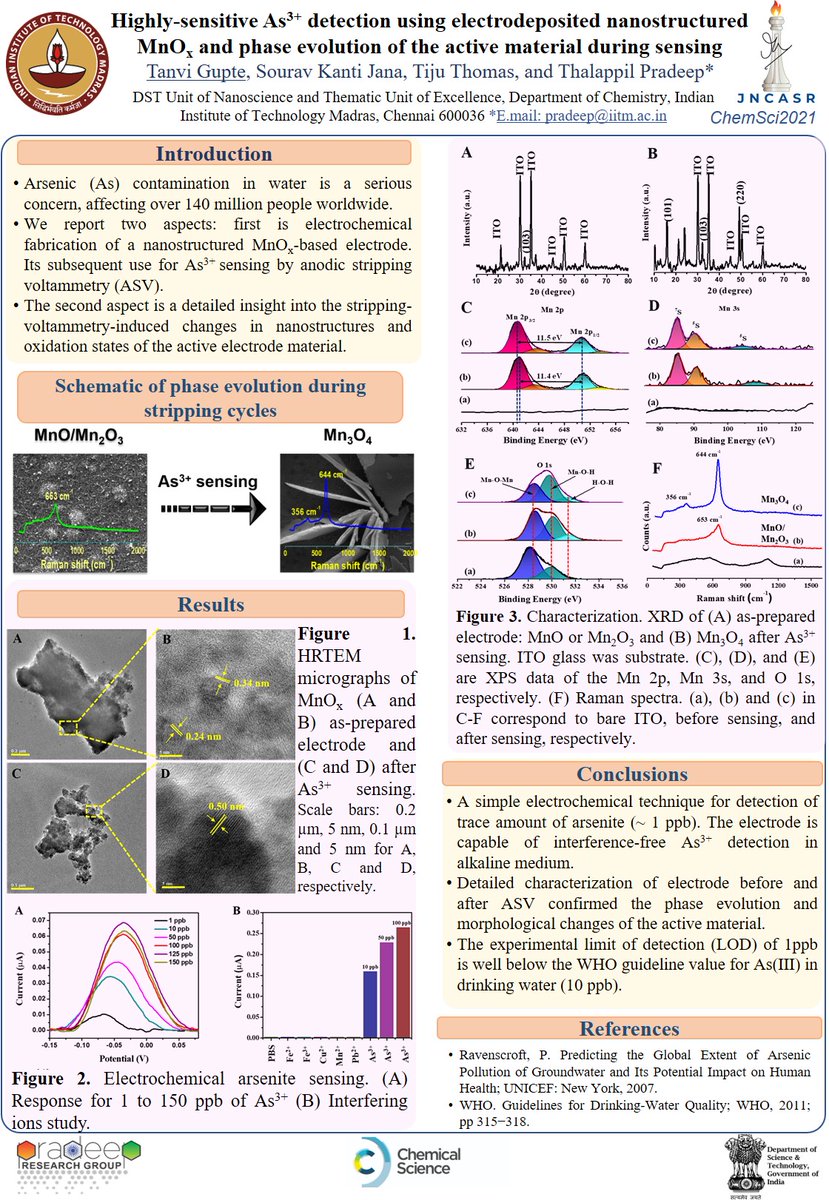
MC58: Highly-sensitive As3+ detection using electrodeposited nanostructured MnOx and phase evolution of the active material during sensing.
@ChemSci_JNCASR#chemsci2021poster#MatChem
@PratapVishnoi86@ChemSci_JNCASR (3) For checking the selectivity, 100 ppb of Fe2+, Fe3+, Cu2+, Mn2+,and Pb2+ was used (Fig. 2B). Stripping voltammetry was performed to check the response to As3+ in presence of these metal ions. No interference was observed at the oxidation potential of As3+.
@PratapVishnoi86@ChemSci_JNCASR (2) Such nanostructured MnOx provides active sites for arsenic adsorption during sensing. Also, the surface areas of different oxides of manganese may vary from 3 to ∼200 m2/g. Hence the working electrode provides large surface area.