@Tocelot@speedrun Creative writing storytelling app :)
https://t.co/GdAD6FTeAR
We’ve received high level of interest from teachers, students and parents. Founder and my partner was engineer at Story protocol.
Paul Graham on why starting with a “small, intense fire" is the key to startup growth
“You’ve got to find people who want what you’re making A LOT. And that's necessarily going to be a small number at first. But that's ok. That’s how these giant things get started… You don’t have to do any better than Apple and Facebook.”
Apple started by selling just 500 Apple I computers. Today it’s the largest company in the world.
"You have to know who those first users are and how you're going to get them. Then you're going to sit down and just have a party with those first few users and focus entirely on them and making them super super happy."
He gives another example of a startup in a Y Combinator batch with a beta group of just one user: Sam Altman.
This startup was building a new mobile email client and their goal was to just make Sam happy. Sam uses email a lot on the go and knows all of the other email client options, so he is sufficiently demanding.
If they can build a product that makes Sam happy, odds are it will make lots of other people happy too.
"One of the things we tell startups in these extreme cases where they can make just one user happy is to act like a consultant. Act like Sam has hired you to make an email app just for him. All you have to do is make Sam happy--it can say 'Sam Altman' at the top of the screen. That's ok! Just so long as Sam would feel bummed if you stopped working on it. That's the test."
Video source: @twistartups@jason (2014)
Paul Graham explains what it means to do things that don’t scale
“What doing things that don’t scale means specifically is doing things in a sort of handmade, artisanal, painstaking way [even if it’s not scalable.]… It’s so important to get early customers that if you have to do a ton of manual stuff, that’s okay.”
Paul shares his own experience from building Viaweb, an online store builder. They couldn’t get anybody to buy their software in the beginning, so Paul offered to build stores for customers himself using the software.
“It seemed so lame, but having to use our software myself made it much better… I would change the software in the middle of using it and then go back to working on their website.”
Three years later, Viaweb was bought by Yahoo for $49 million.
As Paul explains in his essay Do Things That Don’t Scale, most founders ignore this path because they think this can’t be how the big, famous startups got started. But they underestimate the power of compound growth:
“In the beginning, you only have 10 customers. You want to grow 10% next week because 10% a week is an ambitious goal. Well you only have to get one more customer. You can go out and do that very manually right? And then next week, you have 11 customers, and you have to get 1.1 customers. Which is basically one. You just keep going out there and doing things manually. As long as your growth rate is good, it doesn’t matter how small the number is because a constant growth rate means exponential growth and that means the base number will soon take care of itself.”
Video source: @ycombinator (2018)
Charlie Munger: "We can all go back and [wish we could] make some decision better. But it's the nature of things that you're gonna blow one occasionally. My general idea is there's no point in fretting too much about what you can't fix."
"It's a big mistake to fill yourself with resentments and hatreds and so on. It's such a simple idea, but so many people ruin their lives unnecessarily."
We’ve worked hand in hand with @cLabs every step of the way as we returned home to @Ethereum, became the leading L2 by DAUs, and pioneered infrastructure from fee abstraction to ZK-powered fault proofs for everyday blockchain usage.
After last year’s record momentum scaling Celo’s accessible onchain economy, we’ve reached a new inflection point. This is why we’re combining cLabs and the Celo Foundation - unlocking faster execution under unified leadership and ensuring the network evolves in real-time with the growing market.
Thank you to everyone whose contributions have brought us to this moment. Our team members, partners, developers, and users have played critical roles in reaching this point, and some of them are impacted by this decision. Please don’t hesitate to reach out for intros to some of the industry’s best minds. I’m proud to build with you as we reach the next chapter of Celo’s growth and maturation.
Hohn’s story is wild.
In 2008, he lost 43% and watched his fund collapse from $19 billion to under $5 billion. Investors fled. He publicly swore off activism after getting humiliated in a railroad proxy fight.
17 years later, he just posted the largest single-year hedge fund profit in history.
Here’s what happened in between:
From 2003 to 2007, Chris Hohn was the golden boy of activist investing. He ran TCI like a wrecking ball. Bought 1% of ABN Amro and sent a scathing letter demanding breakup. Triggered a $100 billion bidding war at the peak of the market. Forced out the CEO of Deutsche Börse after killing their London Stock Exchange bid. German politicians called him a “locust.” He didn’t care. Assets soared 30-fold in five years.
Then 2008 hit.
TCI lost 43%. His CSX railroad battle turned into a public disaster when the stock dropped 50% after he won four board seats. He declared defeat, sold his shares, and told the press he was done with activism. By 2012, assets had collapsed to $4.9 billion. Most of his team quit.
What most people don’t know is what Hohn did next.
He looked at his portfolio and realized he’d been playing the wrong game. Special situations. Distressed plays. Banks. He’d strayed from concentration into complexity.
So he rebuilt TCI around a single thesis: own monopolies.
Not “companies with moats.” Actual monopolies. His test: can they price above inflation? If competition can compress margins, he walks. Airlines grow 5% annually and make no money. Airports grow 5% annually and print cash. He wants the airports.
The result is a 10-stock portfolio where GE Aerospace represents 23% of a $50 billion fund. Five holdings account for 73%. Portfolio turnover sits at 21%. Average holding period rivals some marriages.
Griffin’s $16 billion record in 2022 came from running hundreds of strategies across thousands of positions with 2,900 employees. Hohn’s $18.9 billion came from sitting in credit rating agencies and aerospace duopolies for a decade with a team of 8.
Same destination. Opposite paths.
Citadel wins by being everywhere during chaos. TCI wins by being nowhere except inside tollbooths.
The real lesson here: Hohn turned a 43% drawdown and near-total investor exodus into the highest annual profit any hedge fund has ever generated. He did it by becoming the opposite of what made him famous. Less activism, more patience. Fewer stocks, longer holds. No banks, no airlines, just monopolies that can raise prices faster than inflation.
Sometimes the real alpha comes from nearly losing everything.
Many issues can be solved with doom walking
Feeling down? Unsure about your job? Relationship issues?
Just go outside and walk. No music. No podcasts. Ideally in nature with some sunshine.
I always find my brain will naturally start thinking through things.
BRUTAL.
META Layoffs are HAPPENING today.
Reality Labs is cutting almost everyone working on its virtual reality and metaverse products. About 1000-1500 job cuts reported.
Twisted Pixel and Sanzaru studios have been closed as well.
Reality Labs lost $4.4B in Meta’s most recent quarter -- yeah.... in 3 months. OUCH.
Meta is shifting focus... and wearables are taking center stage.
Instacart founder Apoorva Mehta on doing things that don’t scale
“Y Combinator encourages startups to do things that don’t scale. I find that this is one of the biggest competitive advantages that a startup has over a larger company… The idea is that once your product has demand, you can figure out how to scale your product.”
Apoorva explains how in the early days of Instacart customers could place orders even if there weren’t shoppers online to fulfill those orders.
“Of course, this meant that I would drop everything I was doing and fulfill the order myself.”
They also ran into the issue that Trader Joe’s didn’t have an API or website with catalog of the items in the store. So the team literally went to their local Trader Joe’s, bought one of every single item, took it back to their office, photographed every single item, and manually entered it in the Instacart catalog.
“Using the same unscalable techniques, we added Whole Foods, Costco and many other stores, and we realized we had the best product in the market.”
Having the best product on the market allowed Instacart to quickly expand to 10 cities and maintain 10% week over week growth for 20 weeks. This traction would allow Instacart to raise more money, hire more people, and then make everything scalable.
Video source: @ycombinator (2014)
Peter Thiel explains his principle of only working on problems that wouldn’t get solved without you
Thiel shares that he’s “a little bit skeptical” of social entrepreneurship:
“Social entrepreneurship is always ambiguous because it’s unclear what the word ‘social’ means. Social can mean that it’s ‘good for society’ or it can mean that it’s ‘good as seen by society’. In the second meaning, you often end up with something that many people are doing.”
He gives education startups as an example of a social startup - it’s seen as objectively good and lots of people are working on it.
Thiel contrasts this to a mission-oriented company:
“A mission-oriented company is one where if you didn’t work on this problem, nobody would.”
He gives the example of Elon Musk starting SpaceX with the mission of going to Mars and making humans interplanetary. If Elon wasn’t working on it, this problem might not get solved.
Thiel believes this is an important principle in general:
“We always want to do things where… if you weren’t working on it, it wouldn’t get solved. Always go for that sort of counterfactual meaning. You don’t want to ever be in a place where you’re just one of a hundred cogs in the machine… You want to be in a place where you’re doing something that can’t be easily replicated or replaced - either on an individual level or the level of a company.”
Video source: @Wharton (2014)
Most founders lose VC deals before the first slide. Before they even enter the room.
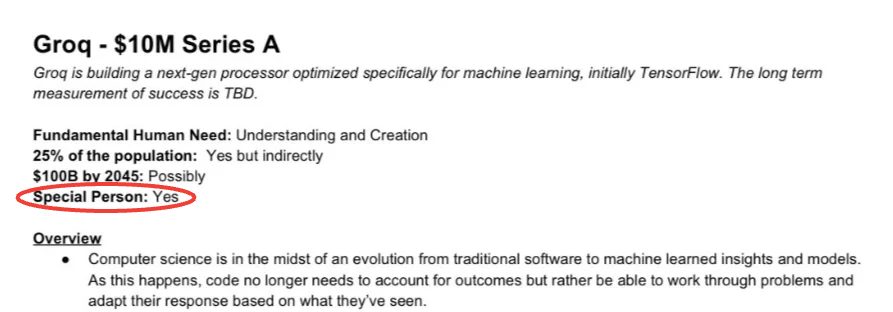
Here’s the single line from Chamath’s Groq memo that explains why.
The $10M check into Groq’s $25M valuation Series A — an investment that will return billions through the Nvidia deal.
Most people will stare at the returns.
But the most important line in the memo isn’t financial at all:
“Special Person: Yes”
I’ve been on both sides of the table.
As a founder, I pitched hundreds of VCs.
Now I’ve sat in partner-level investment committee meetings, listening to how real decisions actually get made.
And here’s something that surprised me early on:
A shocking number of IC discussions are not about product, models, or decks.
They boil down to one question:
“Is this founder special?”
I used to press investors on this.
What does special mean?
Pattern match? IQ? Grit? Vision?
No one could give a clean answer.
Not because they were hand-waving — but because “special” isn’t a checklist.
It’s a conviction.
It’s that feeling where, after seeing hundreds of founders a quarter, one person creates a pause in the room, an inevitability.
The partner leans back.
The conversation slows down.
Someone says: “I don’t know how big this gets… but this person will figure something out.”
That’s what “Special Person: Yes” really encodes.
At the earliest stages, most deals are 80–90% team.
And that judgment is formed before the spreadsheet is opened, often before the person even enters the room.
Founders should internalize this:
You don’t need to be special at everything.
But you do need to be world-class at something that matters.
Technical depth others can’t touch.
Insight from living the problem for years.
An execution engine that makes normal timelines look slow.
Or scar tissue from doing the impossible once already.
Investors see hundreds of founders a quarter.
They’re subconsciously asking:
Why you?
Why now?
Why should I bet my reputation on this person?
Sometimes the answer becomes a single quiet line in a memo.
“Special Person: Yes.”
And that one line can be worth billions.
Celo is entering a new era. 2025 has been a year of transformation and massive growth, becoming the #1 L2 by DAUs, leading transport layer for USDT, and real-world apps onboarding millions of users to the Celo ecosystem. This progress makes it clear - we’re ready for upgraded tokenomics that scale with our rapidly growing network, considering CELO buybacks & burn mechanisms, and refine long-term economics to support the next decade of the ecosystem.
We propose the CELO Tokenomics Initiative, a community-wide effort driven by @cLabs and the Celo Foundation to redefine network economics. While tokenomics have evolved over the five years since mainnet launch, including the Great Celo Halvening, which reduced inflation to 1%, it’s time for an economic model that reflects Celo today: a leading Ethereum Layer 2 used by millions and still growing.
Together, we invite the community to shape CELO economics that are optimized for the millions of transactions the network facilitates every day.
Our Vision 2030, bringing a trillion-dollar economy onchain to @Celo, positions the network for significant revenue growth. We’re already on the right path, with network revenue up 10x since early 2024, and killer apps like @MiniPay onboarding 11M+ users and facilitating 300M+ stablecoin transactions since launch.
The pieces are in place: we have cutting-edge infrastructure, we have global distribution. Now, our work is ensuring network usage benefits the community supporting and driving this activity. This next step is for all of us, together, and will help define the ecosystem for years to come.
Join the discussion in the Celo Community Forum as we build the future of CELO together and shape this new era.
https://t.co/9N499mU02D
@zebird0 Hey Robin! We’re currently building an AI storytelling app, similar to what Jon Lai had requested. Long term we’d like to leverage Improbable’s technology to bring meaningful mass story worlds and an alternate reality into life. Merry Christmas!