Each word you say is planned by a small patch of brain above your left ear, about a quarter of a second before you say it. It sits in a temporal lobe region textbooks describe as only for listening. Our paper today in @ScienceMagazine: https://t.co/EXOgl3YsNI
@UCSF@NeurosurgUCSF
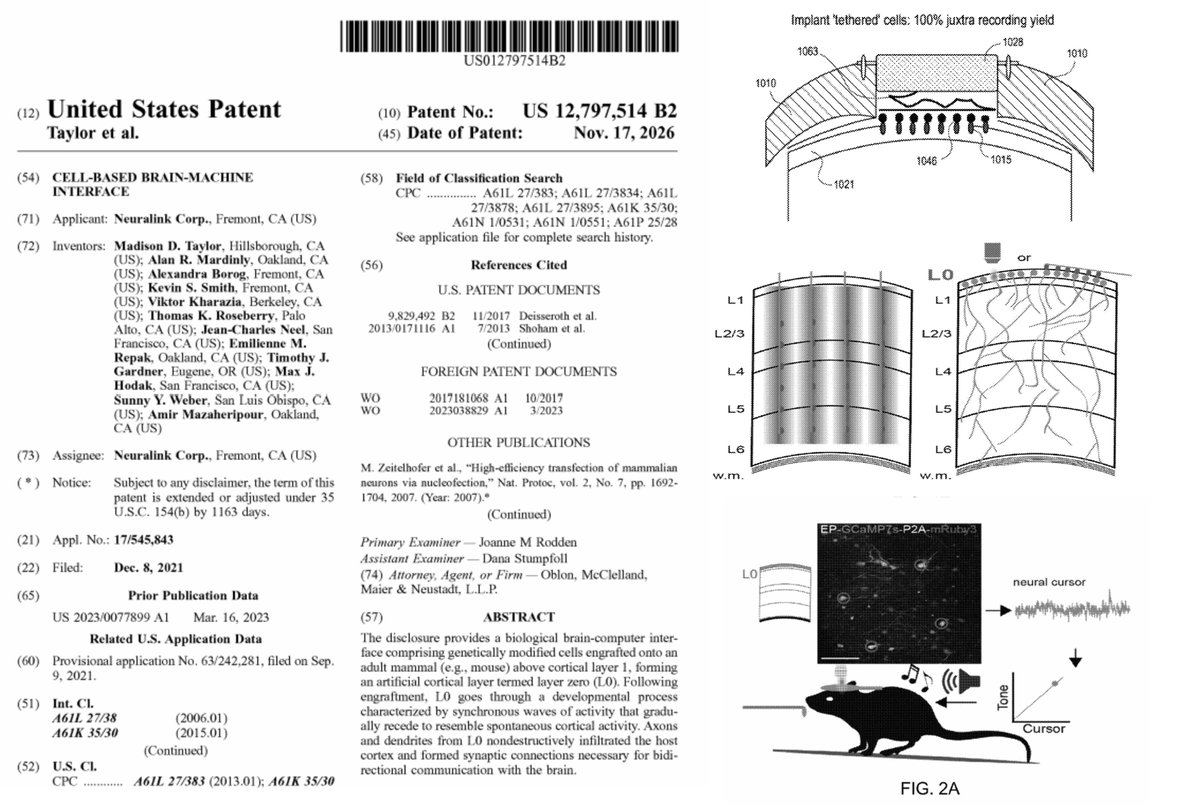
NEURALINK: Today the U.S. Patent and Trademark Office issued U.S. Patent 12,797,514 B2, "Cell-Based Brain-Machine Interface," to Neuralink. It covers a brain-computer interface built from genetically modified neurons grafted onto the surface of the brain!
Neuralink's current N1 implant reads the brain only through electrode threads inserted into tissue. In this design, living cells grow the connections into the brain themselves.
The modified BCI is grafted above cortical layer 1. The graft forms a new, artificial outermost layer called "layer zero" (L0). According to the patent, axons and dendrites from L0 grow into the host cortex "nondestructively" and form the synaptic connections needed for "bidirectional communication with the brain."
In the patent's tests on adult mice, the graft first produced waves of synchronized activity that gradually settled into normal-looking brain activity.
In the main claim, a camera images the graft to read signals from the brain, and a light source sends signals back in. Other claims tether the cells to electrodes.
Possible benefits include:
- Bidirectional communication with L0 cells that can both send and receive signals through synapses, which may support more natural input and output than unidirectional electrode recording.
- Potentially lower tissue damage over time because the connection is made by living cells that infiltrate the cortex possibly avoiding some of the chronic inflammation and scarring associated with rigid or high-density electrodes.
- Developmental integration of engrafted cells that gradually produces activity patterns resembling natural cortical activity, which could improve long-term signal stability and biological compatibility.
- Higher effective resolution through many synaptic connections. In principle is could allow finer-grained interaction with neural circuits than the number of physical electrodes alone.
Neuralink originally filed the application on December 8th, 2021, and the twelve inventors include Neuralink co-founder Max Hodak, now co-founder and CEO of Science Corporation, and Alan Mardinly, a former Neuralink leader who is now co-founder and Chief Scientific Officer at Science Corporation.
single ladies: @tomorrowxsummit the male to female ratio is 49:1 and you can discuss neoclouds, spacex and inference while waiting in line for coffee.
No affiliation, just observation. You're welcome #tomorrowXsummit
Calley, I LOVED your articulate & impassioned plea to rid politics of lobbying and systemic corruption. And yet, your enthusiastic recasting of Trump as a completely innocent and unknowing hero at every turn puts your entire credibility in question.
There isn’t a single critical thinker (including you, before you joined the administration) who believes Trump is morally honorable. If you actually want to get corruption out of politics, maybe you should be a bit more skeptical of the guy who pumped and dumped his own memecoin while in office, amidst a million other indefensible acts of public corruption. No one except MAGA diehards believe your staunch defense of Trump, as evidenced by the comments on Rogan’s podcast. My guess is we’ll be hearing a revisionist story from you in two years. If you are going to blow the whistle, do it with full integrity. Unless there’s something else in it for you.
Aside from this, I still believe your interview with Rogan was an incredible moment of education to most Americans on how our system ACTUALLY works and I commend you for that.
We’re committing a portion of Anthropic’s shares to the Anthropic Public Benefit Fund, a new wholly owned entity dedicated entirely to the public benefit.
It will start off with 5% of our shares. For every 50% increase in the company’s value over a set baseline, we can contribute up to an extra 2%, subject to our board’s discretion.
In total, this means that roughly 20% of Anthropic’s shares are committed to the public good. Our co-founders have already pledged to donate 80% of their equity, and around half our employees are donating a portion of their equity as part of a donation matching program we’ve run since our founding.
In the post below, we share more details about our new fund.
https://t.co/XzDntVH0vH
You'll see a lot of doctors come out "against" this kind of broad screening system. They can even get quite agitated about it. This resistance stems from a well-established clinical consensus: traditional population-level imaging fails to improve health outcomes because false positives and invasive follow-ups do more harm than good. But this view suffers from an obvious blind spot. Existing studies rely on static data and completely ignore time-series imaging. And time-series is ignored because we haven't been able to afford to do high frequency imaging at population scale. Clearly, time series is going to be immensely more valuable than a single image. If you drop costs, value can go from 0 -> 1. On a more fundamental level, the argument against screening rests on an obviously false precept "More information is bad" -- just clearly untrue. More information better, you just have to interpret it correctly.
A researcher who spent three years training models at both OpenAI and Anthropic resigned, his words: "Neither company is acting responsibly in the race towards self-improving superintelligence." He called the competition "gambling with our lives." His post gained 160 million + views. Two days earlier, Sam Altman called Navier-Stokes "the strongest evidence yet" for slowing down. OpenAI's chief scientist published an essay calling for a voluntary pause. Three signals from inside the labs in five days.
-- First AI-designed longevity drug reversed aging clocks by 3–6 years in 4 weeks.
-- Google Alpha Genome Atlas: 9 billion possible mutations pre-computed across the entire human genome.
-- Better training data = 12x compute efficiency improvement. Better architectures: 3.7x.
-- Emad's p-doom dropped from 50% to 20%.
-- Anthropic: $6.5B quarterly revenue run rate, 42% of the coding market, $35B cloud deal, mega IPO approaching at $2T+.
@GeniusGTX God forbid people finally discover that status seeking and wealth accumulation are an endless non-virtuous cycle, “progress” is largely a construct, and equanimity and peace can be found within themselves 🫠
We’ve raised $300M in Series C funding at a $10.3B valuation from Sequoia, Andreessen Horowitz, Jane Street, Argo, and SK Hynix.
Our mission is to run the world's inference. This round accelerates production of our inference clusters.
We've opened an 80,000-sqft, 10-MW facility 15 minutes from our office to expedite production and prototyping.
Three years ago, two Harvard dropouts set out to build a better AI chip than the largest companies in the world.
Almost everyone I called at the time said it was impossible.
Today, Etched (@Etched) comes out of stealth with $800M total raised, $1B in signed customer contracts, and a working next-gen AI chip.
This was my excuse to ask the two founders, @UbertiGavin and @robertwachen, every question I have about compute and inference.
We discuss:
- Why they built an entire rack and not just a chip
- The two technical bets behind their architecture no one else has tried
- How two founders in their twenties recruited industry legends
- The night they nearly ran out of money
- Why whoever produces the most tokens wins
If you care about the future of compute, Gavin and Rob are two people to know. I think you will find the story of what they have built hard to forget.
Enjoy!
TIMESTAMPS
0:00 Intro
1:00 Why Nobody Believed Etched Would Work
14:06 Why Inference Is the Bottleneck
22:27 Gavin and Rob’s Origin Stories
33:24 Taking Huge Risks to Move Faster
49:43 Kernels, Compilers, and the AI Stack
1:02:08 Raising $100M to Survive
1:16:00 The Future of Models, Agents, and Intelligence
Jesse Genet has a number of AI agents on her household staff. There’s Claire, who has access to her Amazon account, as well as her Instacart to monitor her family’s food supply and handle the shopping. There’s also Sylvie, who runs her kids’ homeschool; the Wests — Clark, Dan, and Chloe — who deal with legal and financial paperwork; and a team of coding agents that can build pretty much any app Genet describes.
Genet used to manage humans. She was the co-founder and CEO of Lumi, a start-up that sold custom packaging to e-commerce companies until it was acquired in 2021. After that, she became a stay-at-home mom. She and her husband — Ryan Hudson, a co-founder of Honey — moved their family to a horse ranch an hour outside Los Angeles. Her youngest child was just six months old; she had assumed that for the next five years, at least, she was finished with technical projects and with thinking about which company to start next. Then, earlier this year, she started playing with AI agents, “and I got five years back,” she says.
That optimistic AI future is still a ways off, if it’s even possible at all. But Genet is already living in a rough draft of it. Many of the people experimenting with agents today are engineers and programmers, and they mostly use them just to do their existing jobs faster: to write code, summarize meetings, and organize their inboxes. Genet, who has never written a line of code, has built her entire home life around them — and become a cheerful evangelist for the tech.
Read Lane Brown’s full report: https://t.co/vS60WfAkfc
You realize what this means!?
Stripe just gave you a new way to create generational wealth.
They invented an entirely new marketplace.
Agents will be spending millions, and eventually billions of dollars for individuals and corporations.
The marketpalce is empty right now.
IT IS YOURS FOR THE TAKING.
Build a service as a software ( YES SAAS V2 ), make it so that agents can use and spend on your platform.
WIN WIN WIN.
WAAAAAAKE UPPPPP.
Seven years ago, Casey Harrell was diagnosed with ALS and given two years to live. Yet Casey has defied every expectation: he's still working, pioneering scientific research, and doing everything he can to stay alive. But right now his life is in jeopardy.
The cost of keeping an ALS patient alive is around $300,000 a year. His incredible wife Levana is now on disability herself while caregiving up to 16 hours a day. They need round-the-clock support at $45/hr and the existing funding is almost gone. I've seen first-hand just how comprehensive Casey's needs are.
I work with Casey through our Special Patient Programs at @BlackrockNeuro_, and I also happen to know his wife Levana through mutual friends. I've been fortunate to visit with them both numerous times, virtually and at their home, and witness firsthand the level of care Casey requires. Levana is holding most of it together herself while managing her own health and raising their seven-year-old daughter.
What makes Casey's situation truly extraordinary is that he's the only person on the planet to use a fully-functional brain-computer interface all day, every day, from home. In his brain, electrodes translate his thoughts (purposeful intent to speak) into synthesized speech trained on his own voice. This means Casey has contributed more brain data toward the advancement of these systems than perhaps any other patient in the world.
As a clinical trial participant, Casey does not get paid for his pioneering work due to rules that govern clinical research.
If Casey doesn't get stable care, his life ends. The research ends. There is no other patient like him. There may not be for years.
His family has a GoFundMe. Please share it, donate if you can, and help make sure this incredible brain keeps doing what it's doing.
Here's a video of Casey using his BCI to communicate (he's talking about how other devices like eye trackers are not sufficient.)