I love making this show for many reasons, but chief among them is physically being in the room for these conversations, and literally feeling the electric energy between two people who are truly excellent at what they do⚡️
‘The Cornell Daily Sun’ spent months reporting on the ‘Cornell Seven’ lawsuit. We spoke with lead reporter Cereese Qusba and editor-in-chief Sophia Dasser about their work, the paper’s blistering editorial, and what’s next. https://t.co/SMeJlMBJlI
AI has a distribution problem.
Massive data center investment creates intelligence, but without the systems to deliver it, the people who need it won't benefit.
@phineasb joined @akashpasricha on @theinformation's TITV to explain what distributed compute could look like:
I hear roughly 3 reasons people keep working at AI labs despite believing in ~10% extinction risk:
1) Techno-determinism: Someone will build ASI no matter what, and I can do it better & more safely than China/OpenAI/etc
2) Consequentialism: ASI might kill us, but it also might produce utopia/immortality/superabundance, so it's a +EV bet
3) Self-interest: I am personally having fun & getting rich working on cool tech with friends. I don't think about the macro stuff.
Notably, none of this is "I'm hyping up the risk for marketing reasons." People believe what they say, while being capable of a lot of internal dissonance / compartmentalization / self-justification.
(Personally, I think the public is better served by AI researchers talking about & creating consensus for the specific safety solutions — regulatory or otherwise — they want vs. vagueposting about extinction.)
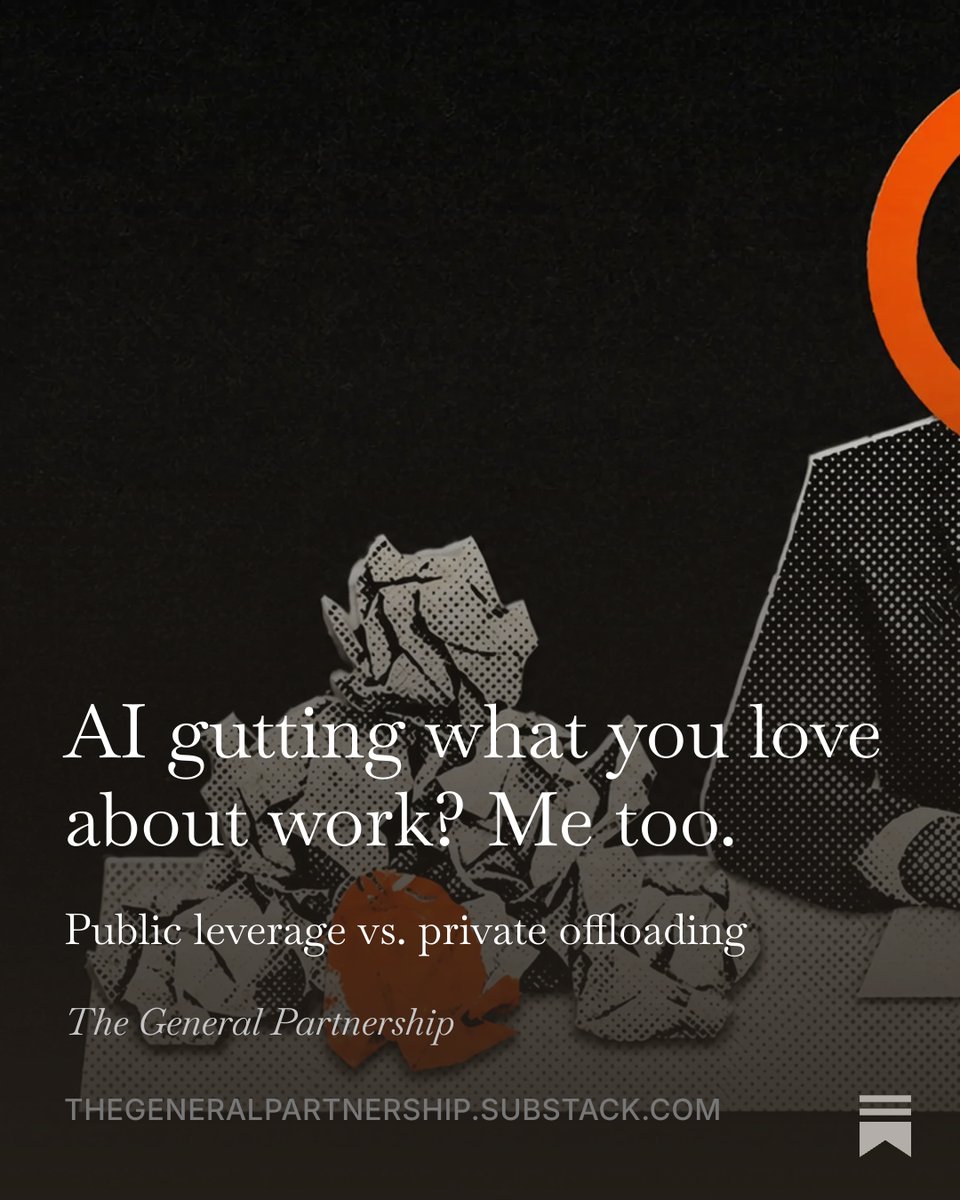
This essay articulates something I’ve been thinking about for a while now - if you enjoyed your job at all in the before times, why would you dare outsource it to AI?
"It occurred to me the other day: when I use AI too much, I enjoy my work so much less. I miss the moments I’d look up and realize hours had passed while falling down rabbit holes of markets, new tech. New AI norms in venture (promising greater speed, deeper analysis), have compressed all of this into reviewing a stack of research memos created by a soulless all-knowing machine.
All of my conversations and research get flattened into this growing to-do list of sameness. Totally devoid of the signal I used to get from following my energy - where I wanted to learn more, the random connections to other areas of interest.”
- @phineasb
"Raise less and build software."
AI’s biggest opportunity right now is at the application layer. Founders, build companies that maximize learning per dollar spent and depend on customer traction, not capital markets.
@phineasb joined @theinformation’s @akashpasricha to explain why it's time to build software at the seed again.
I think people are severely under-covering the rising class of political donors at AI labs. If you’re one of them and want to talk about your motivations for giving, reach out!
Artificial general intelligence (AGI) may be the biggest technological shift of our lifetime yet not be where most of the money is made.
@phineasb, cofounder and managing partner at @thegp, expects AI to fragment into thousands of “not really AGI” systems that are good enough at general reasoning and exceptional at one particular job.
This specialization—not general intelligence—is where most of AI’s economic value will be captured.
Read Phin’s Thesis Statement: https://t.co/cMzCJkaX1e